

Choosing a clinical genetic testing provider that combines fast turnaround with insurance billing and telehealth support is more complicated than most families anticipate. Many clinics either demand in-person visits for every test, hide pricing until after consultation, or require a physician referral just to access basic screening panels. This side-by-side review compares pricing structures, turnaround times, billing models, and access workflows so you can match a clinical genetic testing provider in Illinois to your needs without surprises.
Table of Contents
- Gene Matrix
- Reproductive Genetic Innovations (RGI)
- Tempus Genetic Test G-A
- Chicago Genetic Consultants
- Assessing Clinical Genetic Testing Providers in Illinois
Gene Matrix

At a Glance
The vendor reports a 99.9% accuracy rate validated against Sanger sequencing and advertises that GeneMatrixAI is trained on 500,000+ genetic profiles and delivers actionable genomic insights within 72 hours. That set of claims positions Gene Matrix as a rapid, lab-grade testing option with AI analysis.
Core Features
- CLIA-certified laboratory testing for hereditary cancer risk including BRCA1/BRCA2 and Lynch syndrome.
- Pharmacogenomics module to flag drug-gene interactions and guide medication selection.
- Multi-module portfolio: GeneCancer, GenePGx, GeneMind, GeneBaby, and GeneDiet for health, psychiatric, pediatric, and nutrigenomic needs.
- Family and pediatric testing options, plus data handling under HIPAA-compliant processes.
Key Differentiator
Gene Matrix’s marketing centers on AI-powered analysis that compresses variant calling and clinical annotation into a faster report cycle. The company positions GeneMatrixAI as the mechanism for both the speed claim above and the platform’s clinical validation, linking algorithmic review with CLIA workflows.
Pros
- Rapid reporting tightens clinical decision windows. That 72-hour claim shortens the time from sample to recommendation for many providers compared with multi-week panels.
- Broad test mix covers hereditary cancer and drug response. For an Illinois primary care practice, one lab partner can handle BRCA/Lynch screening and PGx without juggling vendors.
- The vendor’s training data claim supports richer variant prioritization. For clinicians, that means fewer variants of unknown significance on average, according to the marketing materials.
- Family and pediatric pathways simplify cascade testing. Ordering relatives or pediatric panels uses the same portal and reduces administrative friction.
- Data security and CLIA status mean reports arrive in a format usable by hospital systems and medical records teams.
Cons
- Pricing varies by panel and subscription tier, which the company lists in multiple packages; that variability can be confusing for patients comparing out-of-pocket costs.
Who It's For
You if you live in Illinois and want clinical-grade hereditary cancer screening or pharmacogenomics with fast turnaround and hospital-ready reports. Also for clinicians and health systems seeking a single vendor to support risk screening, medication optimization, and family testing.
Unique Value Proposition
Gene Matrix pairs CLIA-certified reports with a vendor-stated AI model trained on 500,000+ profiles, which the company says speeds interpretation and cut the review cycle. For physicians, that translates into faster, clinically formatted results you can act on during follow-up planning.
Real World Use Case
A woman in Chicago with a strong family history orders the GeneCancer panel. Within days she receives a CLIA report with variant interpretation and a pharmacogenomics addendum, enabling her clinician to schedule targeted screening and adjust preventive care without multiple lab referrals.
Pricing
Plans start at $69/month for a basic subscription, with higher tiers for expanded panels and family plans. The model mixes monthly subscriptions and one-off test pricing, so total cost depends on chosen panels and the number of family members tested.
Website: https://genematrix.io
Reproductive Genetic Innovations (RGI)
At a Glance
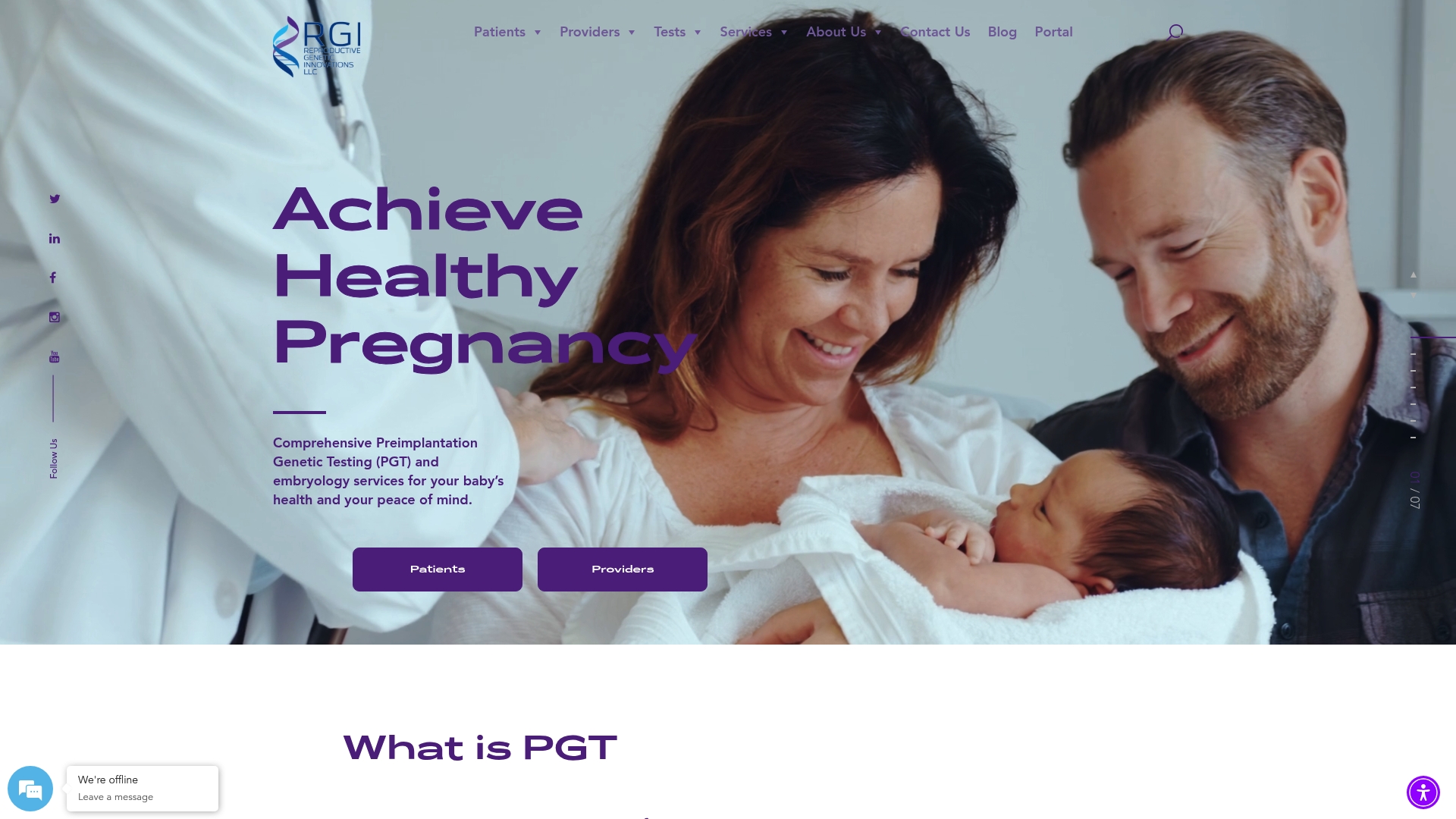
RGI reports more than 30 years of experience and says its methods have facilitated over 10,000 healthy births through integration of preimplantation testing with IVF. That claim and the lab accreditations shape its clinical credibility on paper.
The vendor also reports performing more than 25,000 PGT cycles and advertises diagnostic accuracy up to 98% for select tests. Those figures are self-reported; use them as a reference point rather than an independent audit.
Core Features
- PGT-A, PGT-M, PGT-SR, and PGT-HLA offerings for chromosome aneuploidy, single-gene disorders, structural rearrangements, and HLA matching.
- Embryology and andrology services tightly coupled to laboratory workflows used in IVF clinics.
- Genetic counseling available for patients and referring physicians to interpret results and plan next steps.
- Flexible testing bundles and personalized billing that can be aligned with clinic protocols.
Key Differentiator
RGI’s size of testable targets and its clinical track record are the distinguishing factors. The vendor’s large mutation catalog and the procedural history referenced above position it as a lab partner designed to support complex PGT cases that smaller providers may not handle.
Pros
- Deep institutional experience. The multi‑decade practice history gives clinics a predictable lab partner for recurring PGT referrals.
- Broad mutation coverage and specialized modules such as HLA matching that support family building where tissue matching is required.
- Lab accreditation and integrated embryology services reduce the need to patch together multiple vendors for biopsy, testing, and counseling.
- Personalized billing and test bundling let clinics align costs with episode‑of‑care workflows rather than one‑size pricing.
Cons
- Public evidence of patient experience and third‑party reviews is sparse, making service quality hard to benchmark externally.
- Pricing transparency is limited; the vendor does not publish standard fees and typically ties cost to clinical consultations.
- The company’s outcome and accuracy numbers are self-reported and should be validated through independent channels when possible.
When It May Not Fit
If you need direct-to-consumer testing outside an IVF episode, RGI is not appropriate. Its services are designed to run inside clinical workflows and generally require referral from a fertility provider.
If your clinic needs upfront, published fee schedules for patient price estimation, RGI’s consult-driven pricing model will slow patient counseling and financial planning.
Who It's For
Fertility clinics, reproductive endocrinologists, and genetic counselors looking for a laboratory partner capable of handling high-complexity PGT cases. Also suitable for families advised by a clinic to pursue embryo testing as part of IVF.
Real World Use Case
A regional IVF center refers biopsy samples to RGI when couples require HLA matching or rare monogenic disorder testing. RGI runs the assay, returns genotype calls, and the clinic uses the report to select an embryo for transfer and to brief the couple with a counselor.
Pricing
Fees are not published. RGI states pricing is personalized based on test scope and treatment setup and is usually discussed during clinical consultation. Expect bundled quotes rather than line‑item public rates.
Website: https://rgiscience.com
Tempus Genetic Test G-A
At a Glance
Orders require a treating clinician to complete a request form before the test proceeds, which keeps the workflow squarely in clinical hands. The service advertises EHR integration and an AI-enabled analysis layer to support treatment prediction. According to Tempus, third-party research supports its clinical utility.
Core Features
- Pharmacogenomic (PGx) testing focused on medication management for mental health conditions.
- Clinician-ordered workflow that routes results into the treating team rather than a consumer portal.
- EHR connectivity to place results directly in the medical record.
- AI-assisted interpretation to highlight likely treatment responses and to flag trial matches.
Key Differentiator
The test’s practical edge is that a clinician must initiate it and the results flow into the clinical record while the vendor layers AI analysis on top. That combination keeps test ordering, interpretation, and follow up inside the care team rather than outside it.
Pros
- Results routed to the treating clinician reduce ambiguity about who interprets and acts on findings. That workflow supports accountable prescribing.
- The EHR link lowers friction for medication reconciliation and follow up visits. Lab values and notes remain co-located in the chart.
- The vendor advertises third-party research backing the test, which helps clinicians discuss evidence with patients and peers.
- AI analysis can surface therapy options and clinical trial matches faster than manual review, saving clinician time on complex cases.
- Clinician-only ordering preserves medical oversight for cases where genetic context changes medication strategy.
Cons
- Publicly available details about which genetic markers are analyzed are sparse, making independent interpretation difficult for some specialists.
- There is limited third-party data in the public domain on test accuracy and sensitivity, which can slow adoption in conservative clinics.
- Clinics without an EHR that the vendor supports will lose the seamless result flow and must manage manual uploads.
When It May Not Fit
If you need a consumer-facing test that patients can order directly, this product is the wrong fit because a clinician must place the request. If your clinic requires fully transparent marker lists before adoption, the limited public marker detail could be a blocker. Small practices without compatible EHR systems will face extra admin work.
Who It's For
Clinicians, psychiatrists, and health systems managing patients with neuro psychiatric conditions who want pharmacogenomic support integrated into clinical workflows. Best for teams that prioritize medical oversight and want results in the chart for prescribing decisions.
Real World Use Case
A psychiatrist orders the PGx test for a patient with inconsistent antidepressant response. Results arrive in the EHR with flagged medication interactions and trial options. The clinician adjusts the regimen and documents rationale directly in the chart for the care team.
Pricing
Not listed publicly. The vendor frames the test as a clinician-ordered clinical tool rather than a direct to consumer product. Practices should contact Tempus or their account rep for billing pathways and coverage details.
Website: https://tempus.com/patients/neuro-psych/genetic-test-g-a
Chicago Genetic Consultants
At a Glance
Self-pay testing starts at $250 while many tests are billed to insurance when criteria are met. The service pairs remote counseling with at-home sample collection so you can complete the whole process without a clinic visit.
Core Features
- Genetic testing across cancer, cardiac, neurogenetic, ocular, and pharmacogenetic indications.
- Telehealth consultations for initial intake, consent discussion, and results review.
- In-home sample collection that reduces travel and scheduling friction for patients.
- Personalized counseling sessions that translate test findings into clinical and family planning steps.
- Support connecting patients with advocacy groups and follow-up resources.
Wraps test ordering, sampling, and counseling into one repeated workflow you can complete remotely.
Key Differentiator
The standout is the combination of telehealth genetic counseling with coordinated in-home sample collection. That pairing reduces no-shows and speeds diagnosis for people balancing work and family commitments. It is a workflow aimed at patients who need clinical guidance without multiple clinic visits.
Pros
-
The vendor reports more than 20 years of genetic counseling experience, which shows institutional continuity and a deep counseling practice.
-
Dedicated genetic counselors drive each case, so you get tailored risk discussion and next-step planning instead of templated result letters.
-
Remote-first care decreases the time and logistical burden for patients who live outside Chicago or who prefer not to travel for specialty visits.
-
A broad test menu covers preventive cancer screening, cardiogenetic panels, neurologic gene tests, ocular genetics, and pharmacogenetic assessments in one place.
-
The stated process of consult, sample, and review gives clear expectations for patients who feel overwhelmed by genetic testing logistics.
Cons
-
Public materials do not specify detailed test panels or which labs perform the analytic work, leaving gaps if you need granular assay or variant reporting details.
-
Pricing transparency beyond the $250 self-pay baseline is limited, so out-of-pocket cost varies and could surprise patients without insurance coverage.
-
Clinical validation details such as lab accreditations are not highlighted in the available information, which means clinicians may need to request lab documentation directly.
When It May Not Fit
If you require on-site phlebotomy, immediate in-person multidisciplinary evaluation, or specific lab accreditation documentation up front, this remote-first model could feel narrow. Also, if you need population-specific panels not listed publicly, plan to verify test availability before scheduling.
Who It's For
Individuals and families who prefer remote care and need guided genetic risk assessment or pharmacogenetic insight. Good for people with a family history of genetic disease or couples planning pregnancy who want counselor-led testing without multiple clinic visits.
Real World Use Case
A person with a family history of breast cancer books a telehealth consult, receives an in-home saliva kit, and later reviews pathogenic or benign findings with a counselor who outlines surveillance and family testing recommendations.
Pricing
Most insurance plans cover testing when clinical criteria are met. The vendor lists self-pay starting at $250. Out-of-pocket costs depend on the chosen panel and insurance adjudication so verify benefits before proceeding.
Website: https://chicagogenetics.com
Assessing Clinical Genetic Testing Providers in Illinois
Choosing the right genetic testing provider involves understanding the specific needs of patients and clinicians, and evaluating the features and operational methodologies of each option. Here's a detailed comparison of several recognized providers.
Turnaround Time and Delivery Speed
Gene Matrix stands out for offering a 72-hour result turnaround for its genetic testing panels, directly supported by its AI-driven analysis system. This efficiency greatly benefits scenarios requiring quick clinical decision-making, such as determining treatment adjustments in genetic counseling. By contrast, Reproductive Genetic Innovations (RGI) and Chicago Genetic Consultants operate effectively within respective specialties, but their workflows may extend typical result processing timeframes due to the complexity of assays and the involvement of steps like manual result interpretation or counseling.
Specialty Testing Capabilities
When it comes to meeting niche or complex testing needs, RGI proves advantageous with its extensive preimplantation genetic testing offerings, including PGT-A, PGT-M, and PGT-SR. Fertility clinics benefit from the suite of capabilities addressing chromosomal aneuploidy and structural rearrangements alongside associated counseling services. Meanwhile, Gene Matrix addresses a broad scope of genetic requirements, spanning hereditary cancer risk and pharmacogenomic interactions. This diversity makes it accessible to both clinical practitioners and individuals seeking multi-faceted genetic insights.
Best Fit for Each Scenario
- Gene Matrix: Best choice for healthcare providers and patients who prioritize rapid turnaround times coupled with genetic insights for immediate clinical application.
- RGI: Ideal for clinicians involved in IVF processes who require targeted preimplantation genetic screening embedded into clinical workflows.
- Chicago Genetic Consultants: Tailored for individuals or families preferring telehealth genetic counseling and remote sample collection, simplifying the process while ensuring professional guidance.
Our Pick
While all providers offer unique strengths, Gene Matrix distinguishes itself with its integrated AI technology and expansive module offerings, covering diverse health and genomics needs with validated laboratory operations. However, those requiring exclusive preimplantation expertise or remote-first workflows may find specialized options more aligned to their situation.
Clinical Genetic Testing Options in Illinois
Choosing the best option depends on comparing testing accuracy, coverage, and integration with clinical workflows.
| Product Name | Core Features | Key Differentiator | Best For | Pricing | Notable Limitation |
|---|---|---|---|---|---|
| GeneMatrix | CLIA-certified hereditary cancer and pharmacogenomics | AI-driven testing framework | Rapid, actionable genomic insights for clinicians | $69/month and up | Variable pricing structure may confuse consumers |
| Reproductive Genetic Innovations (RGI) | Comprehensive Preimplantation Genetic Testing (PGT) | Tailored services for complex fertility cases | Fertility clinics and high-complexity testing | Not disclosed | Limited transparency in pricing |
| Tempus Genetic Test G-A | Pharmacogenomic testing for mental health medications | AI-enhanced result integration with EHRs | Clinics managing treatment-resistant conditions | Not disclosed | Limited publicly available marker coverage details |
| Chicago Genetic Consultants | Broad genetic testing menu with remote consultations | At-home sample collection paired with telehealth | Remote, counselor-guided family risk assessments | Starting at $250 | Lack of detail on specific panels and lab validations |
Discover Reliable DNA Testing Clinic Illinois with Genematrix
Finding a trusted DNA testing clinic in Illinois that delivers rapid and accurate results can feel overwhelming. GeneMatrix stands out by offering CLIA-certified hereditary cancer screening and pharmacogenomics powered by a sophisticated AI platform trained on over 500,000 genetic profiles. This approach helps reduce uncertainty with actionable reports delivered in just 72 hours, supporting faster clinical decisions for cancer risk and medication optimization.
Why settle for delays or multiple labs when you can access comprehensive, clinically validated insights from one source?

Take control of your health with Genematrix’s tailored testing modules like GeneCancer and GenePGx. Don’t wait weeks for results; visit Genematrix to explore how our AI-driven platform can provide timely, hospital-ready genetic reports designed just for you. Start your journey to personalized precision medicine and confident next steps today.
Frequently Asked Questions
How does Genematrix ensure the quality of its DNA testing results?
Genematrix ensures high-quality testing results through its CLIA-certified laboratory that meets stringent standards for hereditary cancer risk assessments. The vendor reports a 99.9% accuracy rate validated against Sanger sequencing, providing confidence in the reliability of their genetic insights. This makes Genematrix a suitable option for individuals seeking precise and clinically validated genetic testing.
What is the difference between GeneMatrix and Reproductive Genetic Innovations (RGI) in terms of service offerings?
RGI has over 30 years of experience in preimplantation genetic testing (PGT) and boasts a large mutation catalog, which supports complex cases in IVF settings. In contrast, GeneMatrix focuses on hereditary cancer risk and pharmacogenomics, offering services that allow rapid clinical decisions with results delivered within 72 hours. Individuals seeking faster results for hereditary cancer risk might find GeneMatrix to be a clearer fit for their needs.
Which testing options does Genematrix provide for family members or pediatric cases?
Genematrix provides family and pediatric testing options under HIPAA-compliant processes, making it convenient for users who wish to test multiple family members together. This streamlined approach reduces administrative friction when ordering tests for relatives or children, allowing families to navigate genetic testing more effectively.
Can I get pricing information for Genematrix's services?
Genematrix's pricing varies based on the chosen panel and subscription tier, starting at $69/month for a basic subscription, which can be complex for patients comparing costs. It’s important for potential users to explore the specific packages that fit their genetic testing needs and consult Genematrix for clarity on out-of-pocket expenses.
Does Genematrix provide pharmacogenomic insights in its reports?
Yes, Genematrix includes a pharmacogenomics module that flags drug-gene interactions, guiding medication selection based on individual genetic profiles. This feature enhances personalized treatment plans and helps clinicians optimize medication management for their patients, making it a beneficial option for those concerned about drug interactions.