

Most insured patients pay little to nothing for a genetic counseling visit, often just a copay, while uninsured patients typically pay a moderate amount per session. Genetic testing itself ranges from under $100 for a single targeted variant to several thousand dollars for large panels or whole-exome sequencing. Before scheduling anything, ask your provider for the CPT codes and call your insurer to confirm what they'll pay.
TL;DR:
- Most insured patients pay little or nothing out-of-pocket for genetic counseling, while uninsured patients typically pay between $100 and $250 per session.
- Lab testing costs vary widely, from $250 to $600 for targeted tests and over $3,000 for whole-genome sequencing, but insurance discounts can significantly lower the final bill.
- Insurance coverage depends on meeting medical necessity criteria, with prior authorization often required and separate billing for counseling and testing.
- Calling insurers to confirm codes, network status, authorization, and expected costs before testing can help avoid unexpected charges.
- Clinical-grade testing ordered through healthcare providers offers more reliable results and interpretive support compared to direct-to-consumer options.
Table of Contents
- How Much Does Genetic Counseling Cost Compared to Testing?
- How Does Insurance Decide What It Covers?
- What Should You Ask Your Insurer Before You Test?
- Where Can You Find Lower-Cost Genetic Testing?
- What Proof Points Should You Look For in a Testing Provider?
- When Should You Expect Your Insurance Claim to Process?
- Does It Matter Where You Get Tested?
- Why Understanding the Cost Upfront Changes the Whole Experience
- Ready to Check Your Own Testing Costs?
- Sources
How Much Does Genetic Counseling Cost Compared to Testing?
The bill you get for talking to a genetic counselor and the bill you get for the lab work are two separate transactions, often from two separate companies, and that's where most sticker shock comes from. Confusing the two is the single most common billing mistake patients make.
For the counseling visit itself, a peer-reviewed study of commercially insured cancer patients found the median net payment per encounter was about $118, with a typical range between $58 and $211. Most people in that study paid $0 out-of-pocket. Roughly 31.1% still had some out-of-pocket cost, usually tied to deductible status rather than the counseling fee being expensive on its own. If you're uninsured, expect a self-pay rate somewhere between $100 and $250 per session, sometimes higher at academic medical centers.
Lab testing is where the real price spread happens. According to MedlinePlus Genetics, costs break down roughly like this:
- Targeted testing for a known family variant: $250 to $600
- Multi-gene panels (like hereditary cancer panels): often $1,200 to $3,700 or more
- Whole-exome or whole-genome sequencing: can exceed $3,000
- Newborn screening: $30 to $150, depending on the state
The gap between the list price a lab publishes and what you actually owe usually comes down to three things: whether your insurer has a negotiated rate with that lab, whether the lab has an income-based assistance program, and whether the test was billed as medically necessary versus elective. A $3,000 panel can turn into a $75 bill once insurance and lab discounts are applied, or it can stay at $3,000 if you're out-of-network and the lab has no assistance tier.
How Does Insurance Decide What It Covers?
Insurers don't cover genetic testing just because a doctor orders it. They cover it when it meets their internal definition of medically necessary, which usually means your personal or family history matches specific guideline criteria (a set number of relatives with the same cancer, a diagnosis under a certain age, or a known familial mutation).
Here's roughly how the approval chain works in practice:
- Your provider documents your family history and clinical reason for testing.
- The lab or clinic submits a prior authorization request using specific CPT and ICD-10 codes.
- Your insurer reviews the request against its medical policy and approves, denies, or asks for more documentation.
- Once approved, the counseling visit and the lab test are billed separately, sometimes weeks apart.
That last step catches people off guard constantly. You might get a $0 statement from the counseling clinic and then a lab bill three months later. It's not a mistake. It's just how the billing and insurance process works when two different entities are involved.
Medicare and Medicaid add another layer. Medicare sometimes requires genetic counseling to be billed under a supervising physician rather than directly by the counselor, which affects which codes get used and who gets reimbursed. Medicaid coverage rules vary by state, so a test covered without question in one state might require extra documentation in another. If you're on either program, ask specifically whether genetic counseling is billed as a distinct service or folded into an office visit.
What Should You Ask Your Insurer Before You Test?
Getting a real cost estimate before your appointment takes about four phone calls, and it saves you from a bill you didn't see coming.
- Get the CPT codes. Ask your provider for the counseling visit codes, commonly 96040, 96041, or S0265, and ask the lab for the specific CPT/ICD-10 codes tied to your test.
- Confirm network status. Ask whether both the counselor and the testing lab are in-network, since they can be contracted separately even at the same clinic.
- Ask about prior authorization. Find out if your insurer requires it, how long approval typically takes, and get a confirmation number for the request.
- Request a benefit estimate. Call your insurer's member services line, give them the codes, and ask for your expected coinsurance or copay in writing if possible.
- Ask about billing timing. Confirm whether counseling and testing post as separate charges and roughly when each will hit your account.
Pro Tip: Write down the name and reference number of everyone you speak with at your insurance company. If a claim gets denied later, that paper trail is what gets it overturned on appeal.
Where Can You Find Lower-Cost Genetic Testing?
If cost is a barrier, ask before you assume you can't afford it. Genetic counselors routinely help patients find these paths, and it's a normal part of the conversation, not a special favor.
- Academic medical centers and hospital genetics programs sometimes offer sliding-scale fees for eligible patients.
- Many testing labs run patient assistance programs that cap out-of-pocket costs regardless of your insurance status.
- Nonprofit advocacy groups tied to specific conditions often maintain funds or negotiated rates for members.
- Research studies occasionally offer free testing to patients who meet enrollment criteria.
Ask your counselor directly which of these apply to your situation before you schedule.
What Proof Points Should You Look For in a Testing Provider?
Cost matters, but so does knowing the lab behind your results is legitimate. A few things worth checking before you commit to any provider:
- Lab certification. Confirm the lab is CLIA-certified, the federal standard for clinical testing accuracy. Genematrix operates as a CLIA-certified lab.
- How results get generated. Genematrix uses its GeneMatrixAI platform, trained on more than 500,000 genetic profiles, to analyze hereditary cancer risk and drug-gene interactions.
- Turnaround time. Genematrix reports delivering actionable reports within 72 hours of sample processing.
- Counseling and billing support. A provider should help you verify insurance benefits and connect you with a counselor to interpret results, not just hand you a PDF.
None of this replaces calling your own insurer, but it tells you whether the provider you're considering can actually support the claims they make about speed and accuracy.
When Should You Expect Your Insurance Claim to Process?
Claims for genetic counseling and genetic testing don't move on the same clock as a routine office visit. Because two separate CPT codes and sometimes two separate billing entities are involved, expect the timeline to stretch out.
Prior authorization decisions, when required, generally come back within a few business days to two weeks, depending on your insurer's internal review process. Once your test is actually run, the lab claim gets submitted separately from the counseling claim, and that's where the wait gets longer. It's common for a lab bill to arrive months after your counseling visit, since sequencing, analysis, and insurer adjudication all take time on the back end.
That gap is exactly why so many patients get confused when they receive a "final" statement from their counseling clinic and then a second bill weeks or months later from the lab. It's not double billing. It's two claims moving through two different review cycles. If you want to avoid surprise timing, ask your provider directly: "When should I expect the lab's claim to be submitted, and how long does your insurer typically take to process it?" Get that answer in writing or via email if you can, so you have something to reference if a bill arrives later than expected.

Does It Matter Where You Get Tested?
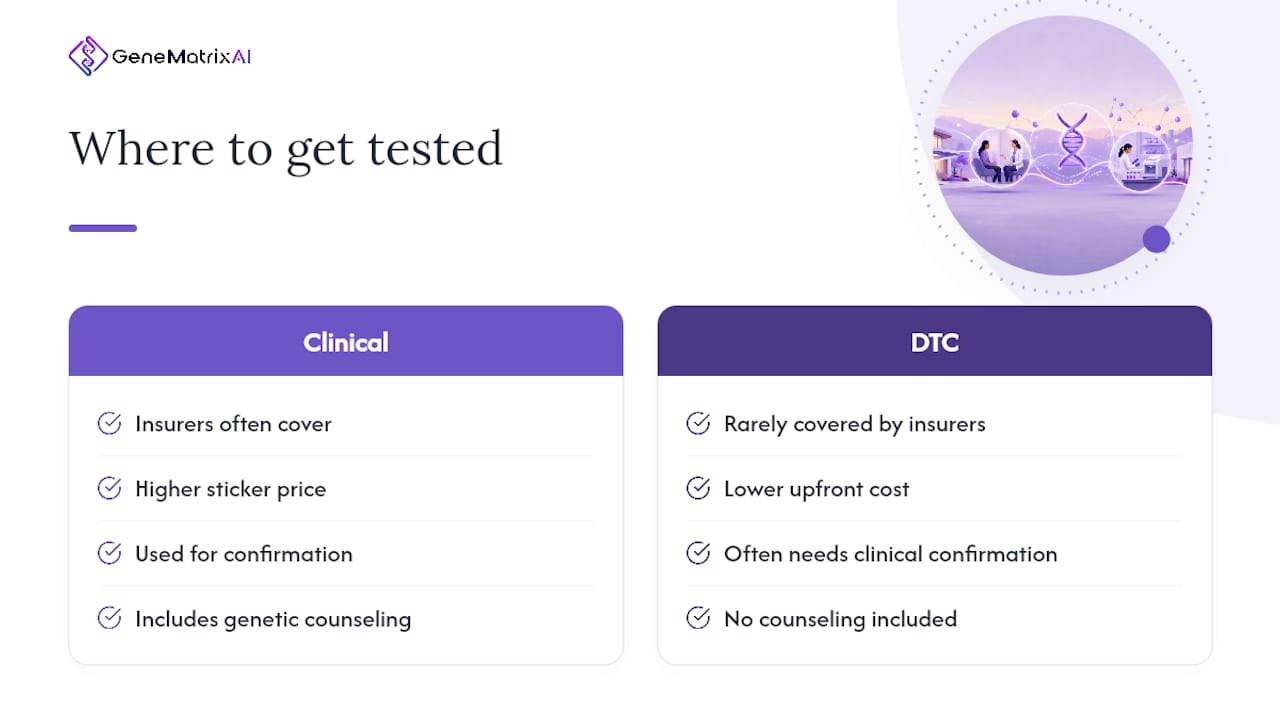
Yes, and it changes both your price and your coverage odds. Clinical testing, ordered through a genetic counselor or physician after a documented medical reason, is what insurers evaluate for coverage. Direct-to-consumer tests, ordered without a clinician's involvement, are almost never covered by insurance because they don't meet the medical necessity standard insurers use for reimbursement.
That doesn't make direct-to-consumer testing worthless. It's often cheaper upfront since there's no counseling visit or prior authorization step involved. But if a direct-to-consumer result flags something concerning, most labs will tell you to confirm it with clinical-grade testing before making any medical decisions, which means you could end up paying for both. Clinical testing ordered through a counselor also comes with someone trained to interpret ambiguous results, like a variant of uncertain significance, which a consumer report typically won't explain in useful depth.
If your goal is actionable medical information, especially around hereditary cancer risk or medication response, clinical-grade testing paired with counseling support tends to be the more reliable route, even when the sticker price looks higher at first glance.
Why Understanding the Cost Upfront Changes the Whole Experience
People avoid genetic counseling because they assume it's expensive, and that assumption is usually wrong. The data backs this up: median out-of-pocket costs for insured patients sit closer to the price of a nice dinner than a medical emergency. The bigger issue isn't the cost itself, it's the uncertainty. Get your CPT codes, get a benefit estimate in writing, and ask about assistance programs before you assume anything is out of reach.
One thing people underestimate: GINA protects you from genetic discrimination) in employment and most health insurance decisions, though it doesn't extend to life or disability insurance. That's worth knowing before you let privacy worries talk you out of testing that could genuinely change how you or your doctor manage your health.
— Tarek
Ready to Check Your Own Testing Costs?
Genematrix runs hereditary cancer screening through a CLIA-certified lab, backed by the GeneMatrixAI platform and its 72-hour turnaround on reports. That combination means you're not stuck waiting weeks to find out whether a result changes your care plan, and you get counseling support to help you interpret what a variant actually means for you and your family.

If you want a clearer picture of what a hereditary cancer panel might cost you specifically, including how insurance and billing typically work for it, visit the hereditary cancer screening page for details, or review the lab's certifications and testing technology if you want to see how the results get generated before you order.
Sources
- What is the cost of genetic testing, and how long does it take to get the results? — MedlinePlus Genetics
- Costs Associated With Genetic Counseling Among Commercially Insured US Patients With Cancer, 2013–2019 — JAMA/PMC
- Billing & insurance guidance — Genetic Support Foundation
This article is general information, not a substitute for advice from a qualified doctor. Consult a qualified healthcare professional about your own circumstances before acting on anything here.