

TL;DR:
- Proper preparation and understanding of test types are crucial for accurate genetic results.
- Gathering detailed family and medical history enhances interpretation of hereditary health risks.
- Follow precise sample collection instructions to avoid invalid tests and delays.
A single mistake during DNA sample collection can invalidate your results entirely, forcing a retest that delays the health insights you need. Whether you're exploring hereditary cancer risk, figuring out why a medication isn't working, or planning a family, the quality of your preparation directly shapes the quality of your answers. Most people assume DNA testing is as simple as spitting in a tube and mailing it off. It's not. From gathering your family history to handling your sample correctly, each step matters. This guide walks you through exactly what to do before, during, and after your DNA test so your results are accurate, actionable, and meaningful.
Table of Contents
- Understanding the types of DNA testing and what you need
- How to gather your family and medical history
- Preparing and collecting your DNA sample: dos and don'ts
- What to expect after testing: counseling, results, and next steps
- Our perspective: what most DNA test guides get wrong
- Take the next step with Gene Matrix
- Frequently asked questions
Key Takeaways
| Point | Details |
|---|---|
| Know your test type | DTC and medical DNA tests require different preparations and offer distinct insights. |
| Prepare your medical history | Gathering family health info is crucial for accurate risk analysis with clinical tests. |
| Follow collection guidelines | Proper sample collection eliminates invalid results and the need for retesting. |
| Expect counseling post-test | Professional interpretation is key for understanding and using your DNA test results. |
Understanding the types of DNA testing and what you need
Not all DNA tests are created equal, and confusing one type for another is one of the most common mistakes people make. There are two broad categories: direct-to-consumer (DTC) tests and medical-grade clinical genetic tests. Each serves a different purpose and requires a different level of preparation.
DTC tests, like those from 23andMe or AncestryDNA, are designed for general curiosity. They can tell you about your ancestry, certain physical traits, and a narrow slice of health-related variants. But here's the critical limitation: DTC tests screen only common variants, meaning a negative result does not rule out a hereditary risk. If you're relying on a DTC test to confirm you don't carry a BRCA mutation, you could be walking away with false reassurance.
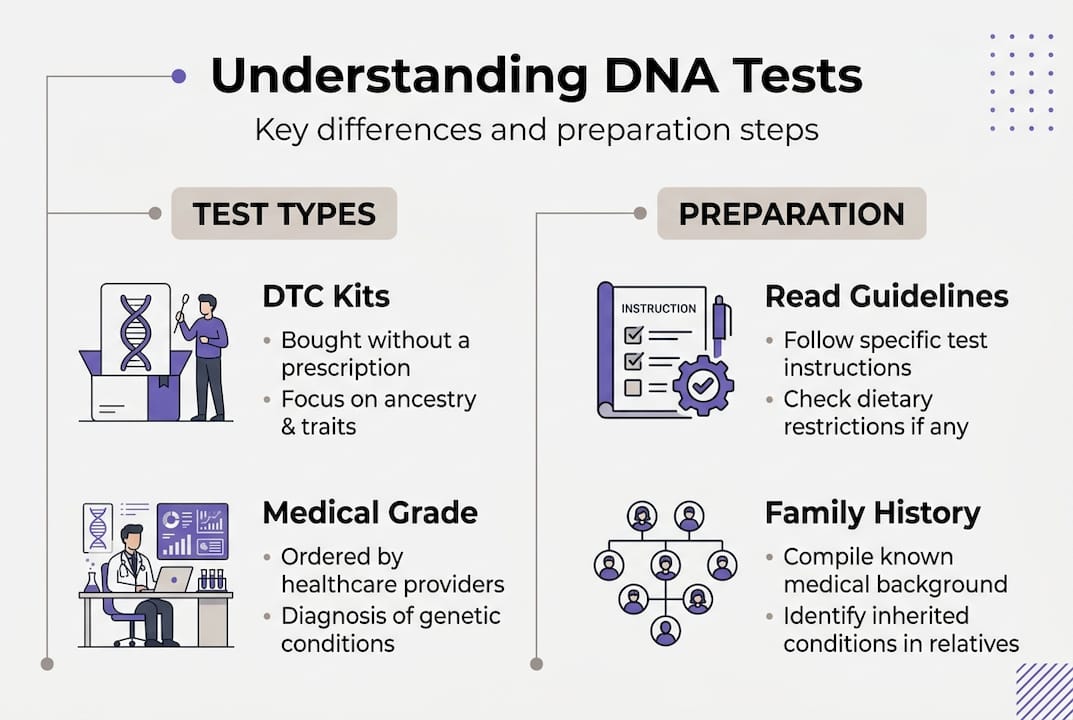
Medical-grade genetic testing is a different level entirely. These tests are ordered or guided by a clinician and are designed to detect inherited conditions, assess cancer risk, or identify how your body processes specific medications (pharmacogenomics). They analyze a far broader range of variants and are interpreted within the context of your personal and family health history.
For health-focused genetic testing, preparation starts with genetic counseling: gathering a three-generation family history, listing your personal medical background, and discussing the benefits, limitations, insurance implications, and emotional impacts before you ever collect a sample. This isn't optional paperwork. It's the foundation that makes your results interpretable.
You should also understand the test science and certifications behind any lab you use. CLIA certification, for example, is a federal standard that ensures laboratory quality. Always review the medical disclaimer for any test you take so you understand what the results can and cannot tell you.
Here's a quick comparison to keep in mind:
| Feature | DTC test | Medical-grade test |
|---|---|---|
| Purpose | Ancestry, traits, general wellness | Hereditary disease, medication response |
| Variant coverage | Common variants only | Broad, clinically validated panels |
| Requires counseling | No | Yes, strongly recommended |
| Insurance considerations | Typically not covered | May be covered with clinical indication |
| Result interpretation | Self-guided | Clinician or genetic counselor |
Key preparation differences by test type:
- DTC tests: Register your kit online, follow basic hygiene steps, mail sample
- Medical tests: Gather family history, complete pre-test counseling, confirm insurance coverage, understand privacy rights
- Pharmacogenomics tests: List all current medications, note any adverse drug reactions, share with prescribing physician
With the basics in mind, let's break down exactly what you'll need before you even start the sample.
How to gather your family and medical history
Once you know which test you're taking, the next step is to organize vital background details for the most accurate risk results. This is especially true for hereditary cancer screening and pharmacogenomics, where context transforms raw data into a real clinical picture.

Family history matters because many serious conditions, including certain cancers, heart disease, and medication sensitivities, follow patterns across generations. A genetic counselor uses your family history to determine which genes to prioritize, which variants carry the most significance, and what your results actually mean for your health. Without this context, even a technically perfect DNA result can be misinterpreted.
Preparation for health-focused genetic testing starts with gathering a three-generation family history. That means collecting information about your parents, grandparents, siblings, aunts, uncles, and first cousins. Here's a step-by-step process to do it efficiently:
- Start with what you know. Write down every first-degree relative (parents, siblings, children) and note any known diagnoses, ages at diagnosis, and causes of death.
- Expand to second-degree relatives. Include grandparents, aunts, uncles, and half-siblings. Note cancer types, chronic illnesses, and any unusual health events.
- Conduct family interviews. Call or message relatives directly. Ask about specific diagnoses, not just general health. "Did Grandma have breast cancer or ovarian cancer?" matters more than "Was she sick?"
- Gather medical documents where possible. Death certificates, pathology reports, and hospital records add precision. Even partial records help.
- Note ethnic background. Certain genetic variants are more prevalent in specific populations. Ashkenazi Jewish ancestry, for example, carries a higher frequency of BRCA1/BRCA2 mutations.
Pro Tip: Write out your questions in advance before any genetic counseling session. Ask about what specific mutations the test covers, what a positive result would mean for treatment, and how results might affect your family members.
Sometimes the history simply isn't complete. Here's how to handle common gaps:
- Unknown biological parents: Note this clearly. Counselors can still assess risk based on partial information and recommend broader testing panels.
- Relatives who won't share: Document what you know and flag the gap. Counselors are trained to work with incomplete data.
- Records lost or unavailable: Focus on what relatives remember. Anecdotal information is better than nothing.
- Adopted individuals: Genetic testing itself can partially fill the gap, but counseling is especially important in these cases.
You can organize all of this through tools like the genetic health management app or review DNA test subscription steps to understand what information is requested at enrollment.
Preparing and collecting your DNA sample: dos and don'ts
Now that your supporting info is ready, focus on sample collection, the step where most mistakes happen. A contaminated or insufficient sample means your results are delayed or voided entirely.
Most clinical and DTC tests use saliva. Here's the correct process:
- Brush your teeth or use mouthwash at least 30 minutes before collection. This removes food debris and bacteria that can degrade DNA quality.
- Avoid eating, drinking, smoking, or chewing gum for 30 to 60 minutes prior to collection. This is the single most commonly ignored instruction.
- Do not exercise vigorously right before collecting. Elevated heart rate and sweating can affect saliva composition.
- Fill the tube to the marked line. Under-filling is a leading cause of invalid samples.
- Cap and seal immediately after collection, then mix the preservative fluid thoroughly by inverting the tube several times.
Pro Tip: If you're struggling to produce enough saliva, gently rub the inside of your cheeks with your tongue for 30 seconds before spitting. This stimulates the salivary glands and makes collection much easier.
Here's a quick reference table for dos and don'ts:
| Action | Saliva sample | Blood sample |
|---|---|---|
| Eat or drink before | Avoid 30-60 min prior | Follow lab-specific fasting instructions |
| Brush teeth | Yes, 30+ min before | Not applicable |
| Chew gum | No | No |
| Exercise before | Avoid | Light activity is usually fine |
| Label the tube | Always | Always |
| Store before mailing | Room temperature | Follow cold chain instructions |
Edge case worth knowing: if you've had a recent stem cell transplant or have been treated for blood cancer, your blood and saliva may carry donor DNA rather than your own. In these situations, a skin punch biopsy is used instead to obtain a reliable sample. Always disclose your full medical history before testing.
Review the genetic testing protocols for your specific test to confirm collection requirements, since different panels may have different standards.
Critical warning: An invalid or contaminated sample cannot be analyzed. If your sample is rejected, you will need to retest, which delays your results and may require additional costs. Follow every instruction exactly the first time.
What to expect after testing: counseling, results, and next steps
After your sample is sent, here's what happens behind the scenes and what you should do once you receive your report. Understanding the post-test process is just as important as the prep work.
For medical-grade tests, your lab processes the sample and generates a clinical report, typically within a few days to a few weeks depending on the panel. At Gene Matrix, AI-powered analysis delivers actionable genomic insights within 72 hours. The report is then reviewed by a clinician or genetic counselor before it reaches you.
Medical genetic testing emphasizes counseling over mechanics. DTC health reports are considered informational only and should always be shared with a clinician for any meaningful action. This is not a technicality. A positive result for a hereditary cancer variant, for example, triggers a specific cascade of clinical decisions that require professional guidance.
Common follow-up steps after receiving results:
- Share your report with your primary care provider or specialist immediately, especially if results indicate elevated risk
- Request confirmatory testing if a DTC result shows a concerning variant, since clinical validation is required before any medical decisions
- Discuss implications for biological family members, who may benefit from targeted testing based on your results
- Review medication recommendations with your prescribing physician if you received a pharmacogenomics report
- Connect with a genetic counselor for ongoing guidance, particularly if results are ambiguous or emotionally difficult to process
For family planning, the stakes are even higher. If your results show a significant inherited risk, discuss prenatal diagnosis options such as preimplantation genetic testing (PGT-M) or IVF with your counselor. These conversations are best had before pregnancy, not during.
Pro Tip: Before your results appointment, write down your top three questions. Ask what the result means for your specific health plan, whether family members should be tested, and what the next clinical step is.
For deeper context on how results are generated and validated, explore hereditary cancer testing innovation or connect through the provider counseling portal if you're working with a clinical team.
Our perspective: what most DNA test guides get wrong
Most DNA test preparation guides stop at the mail-in envelope. They tell you not to eat beforehand, remind you to register your kit, and call it done. That advice isn't wrong. It's just dangerously incomplete.
The real preparation for meaningful genetic testing is technical and emotional. Understanding that a negative DTC result is not a clinical clearance, that family history shapes how a variant is interpreted, and that a result can carry weight for people who haven't even been tested yet, these are the things that matter most and get the least attention.
We've seen patients arrive at clinical consultations with 23andMe printouts, convinced their results are definitive. They're not. The gap between a consumer report and a clinically validated panel built on validated research protocols is significant. Closing that gap requires more than better kits. It requires better preparation, better questions, and a willingness to sit with uncertainty until a professional can help you interpret it.
The patients who get the most value from genetic testing are not the ones who act fastest. They're the ones who prepare most thoughtfully.
Take the next step with Gene Matrix
If you want expert-backed assurance for your DNA testing journey, consider what specialized support can offer. Gene Matrix combines next-generation science and technology with AI-powered analysis trained on over 500,000 genetic profiles to deliver clinically actionable reports within 72 hours.

From hereditary cancer screening with BRCA1/BRCA2 and Lynch syndrome panels to pharmacogenomics and family planning support, every test comes with professional-grade interpretation. Explore subscription plans designed for individuals, families, and clinical providers. Whether you're just starting your genetic health journey or following up on a concerning family history, Gene Matrix is built to give you answers you can actually act on, backed by a CLIA-certified lab and dedicated counseling support.
Frequently asked questions
How long should I avoid eating or drinking before a DNA saliva test?
You should avoid eating or drinking for 30 to 60 minutes before collecting your saliva sample to ensure accuracy. Smoking and chewing gum should also be avoided during this window.
What if I can't get my complete family medical history?
Gather as much as you can and share any gaps with your counselor. A three-generation family history is ideal, but counselors are trained to assess risk and advise next steps even with incomplete information.
Are home DNA kits accurate for cancer or disease risk?
Home kits screen common variants only and are not diagnostic. A negative result does not rule out hereditary risk. Clinical testing and genetic counseling provide far more complete and actionable answers.
What if I've had a stem cell transplant or blood cancer?
You may need a skin punch biopsy instead of a standard saliva or blood sample. Always disclose your full medical history to your provider before testing.
Do I need counseling for DNA testing?
Counseling is essential before medical DNA tests. Preparation starts with counseling to ensure you understand the benefits, limitations, insurance implications, and emotional impact of your results before you receive them.