

TL;DR:
- Rapid genetic testing provides actionable results within days, significantly faster than traditional methods. It enhances neonatal, critical, and prenatal care, as well as medication safety through pharmacogenomics. However, it involves complex interpretation challenges and coverage limitations that require expert guidance.
Genetic test results no longer require weeks of anxious waiting. Today, rapid whole-genome sequencing delivers actionable answers in days, sometimes hours, fundamentally changing how families, physicians, and expectant parents make critical health decisions. Whether you carry a hereditary cancer risk, take multiple prescriptions, or are preparing for a new baby, the speed of your genetic results can shape treatment paths, prevent dangerous drug reactions, and even save lives. This guide walks you through when rapid genetic testing matters most, what the science actually shows, and how to use these insights to take control of your health before problems arise.
Table of Contents
- What is rapid genetic testing and how is it different?
- Life-changing impact: Rapid testing in newborns and critical care
- Personalized medication safety: Rapid pharmacogenomic testing
- Proactive family health: Rapid testing for expectant parents and cancer risk
- The real-world tradeoffs: What most people miss about rapid genetic testing
- Explore genetic health solutions with Gene Matrix AI
- Frequently asked questions
Key Takeaways
| Point | Details |
|---|---|
| Speed saves lives | Rapid genetic testing delivers results in days instead of weeks, guiding urgent decisions for patients and families. |
| Personalized treatment | Pharmacogenomic results enable safer, more effective medication choices and dosages tailored to your DNA. |
| Proactive family planning | Early prenatal and hereditary cancer screening empowers families to act before symptoms appear. |
| Interpretation is key | Expert counseling is essential to understand results and plan next steps, especially with complex findings. |
What is rapid genetic testing and how is it different?
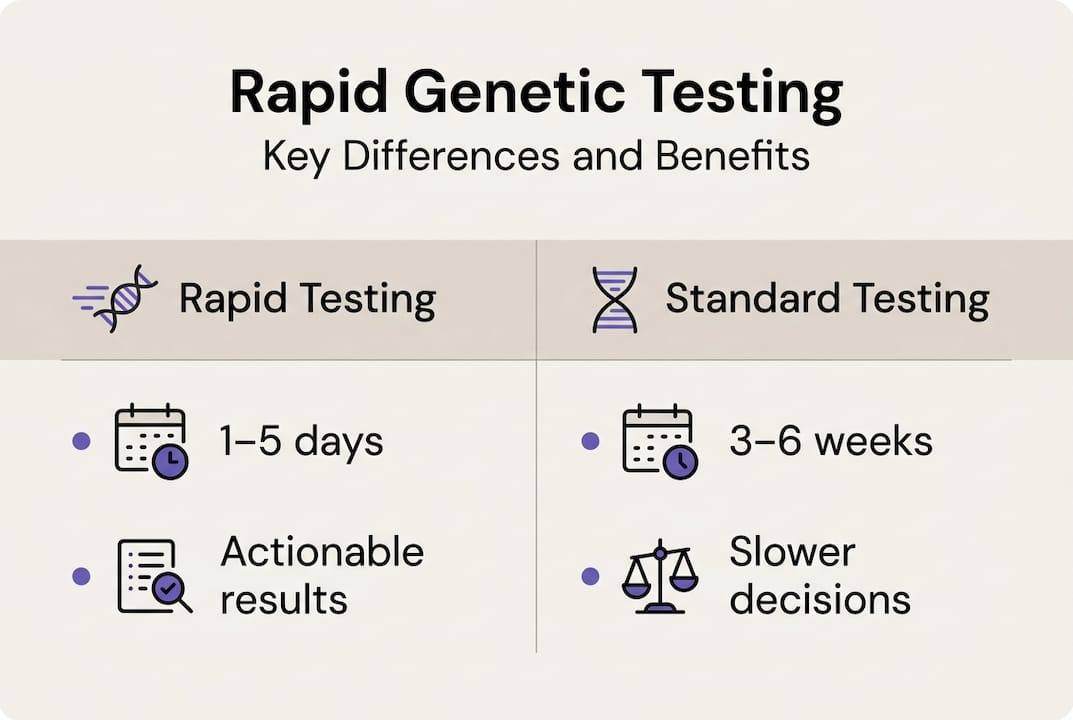
Rapid genetic testing refers to a category of genomic analysis designed to produce clinically actionable results in a fraction of the time traditional testing requires. Where standard genetic panels can take three to six weeks to return results, rapid sequencing delivers findings in under five days. In ultrarapid formats, results can arrive within 14 to 26 hours.
The most common methods include rapid whole-genome sequencing (rWGS), rapid exome sequencing (rES), and long-read genome sequencing (LR-GS). Each approach captures different layers of genetic information. rWGS scans the entire genome for single nucleotide variants (SNVs), copy number variants (CNVs), structural variants, and methylation changes. rES focuses on the protein-coding regions of DNA, which represent about 1.5% of the genome but account for roughly 85% of known disease-causing mutations. LR-GS reads longer DNA fragments, making it especially useful for detecting complex structural rearrangements that shorter reads miss.
Understanding how rapid testing works helps you ask better questions when discussing options with your provider. The core difference is not just speed. It is the depth and breadth of what each method can detect.
| Feature | Rapid testing | Standard testing |
|---|---|---|
| Turnaround time | 1 to 5 days | 3 to 6 weeks |
| Technology | rWGS, rES, LR-GS | Targeted panels, Sanger |
| Variant types detected | SNVs, CNVs, SVs, methylation | Usually SNVs and small indels |
| Clinical impact | Immediate management changes | Delayed treatment decisions |
| Best use case | Acute care, urgent screening | Routine hereditary risk |
Rapid testing also benefits proactive screening outside of hospitals. For families with known hereditary cancer risks or individuals managing complex medication regimens, faster results mean faster action. The AI-powered lab software platforms supporting these tests can process and interpret thousands of variants in minutes, something no human analyst could do alone.
Pro Tip: When your provider mentions "rapid" testing, ask specifically whether results will arrive in hours or days. Ultrarapid formats (under 26 hours) exist for acute situations, while standard rapid formats (three to five days) are more common for outpatient and proactive screening contexts.
The bottom line: rapid genetic testing is not just a faster version of the same thing. It is a fundamentally different tool with unique clinical applications.
Life-changing impact: Rapid testing in newborns and critical care
When a newborn is critically ill and physicians cannot identify the cause, every hour matters. Rapid genetic testing has become one of the most powerful diagnostic tools in neonatal and pediatric intensive care units (NICU and PICU) precisely because it delivers answers fast enough to change treatment in real time.

The numbers are striking. Diagnostic yield in NICU cohorts reaches 32 to 34%, rising to as high as 59% in PICU populations. That means in more than half of critically ill pediatric cases, rapid testing identifies a genetic cause that standard workups would have missed or found too late. Even more compelling, 65% of cases showed direct changes in clinical management as a result of rapid testing results.
| Scenario | Without rapid testing | With rapid testing |
|---|---|---|
| Time to diagnosis | Weeks to months | 1 to 5 days |
| Management changes | Delayed or empirical | Targeted and immediate |
| ICU length of stay | Often prolonged | Frequently reduced |
| Family counseling | Uncertain, delayed | Informed, timely |
Situations where rapid testing directly changes what happens next include:
- Identifying a treatable metabolic disorder before irreversible neurological damage occurs
- Ruling out genetic causes so physicians can pivot to infectious or structural explanations faster
- Guiding palliative care decisions when a diagnosis reveals a condition incompatible with long-term survival
- Informing family counseling about recurrence risk for future pregnancies
- Unlocking eligibility for clinical trials or experimental treatments tied to specific genetic variants
The ethical side of rapid testing in critical care deserves honest attention. Results sometimes return variants of uncertain significance, meaning the finding is real but its clinical meaning is not yet clear. Families need genetic counselors who can translate complex findings into plain language without causing unnecessary panic. The clinical evidence and outcomes supporting rapid testing are strong, but the human side of delivering and receiving these results requires just as much care as the science itself.
For expectant parents and families with a history of genetic conditions, understanding this landscape helps set realistic expectations about what rapid testing can and cannot answer.
Personalized medication safety: Rapid pharmacogenomic testing
Most people assume that if a medication is prescribed, it is safe for them. The reality is more complicated. Genetic variation affects how your body processes drugs, and for millions of people, a standard dose of a common medication can cause serious harm simply because of how their genes work.
Pharmacogenomics (PGx) is the science of using your genetic profile to guide prescription choices. Rapid PGx testing using adaptive sampling can identify drug-gene interactions and lower adverse drug reactions (ADRs) by 30%. That is not a minor improvement. ADRs are a leading cause of hospitalization in the United States, and many are preventable with the right genetic information.
Medications where PGx has the greatest clinical impact include:
- Antidepressants and antipsychotics (SSRIs, TCAs): metabolism varies dramatically by CYP2D6 and CYP2C19 gene variants
- Pain medications (codeine, oxycodone): ultra-rapid metabolizers face overdose risk; poor metabolizers get no relief
- Chemotherapy agents (5-fluorouracil, tamoxifen): genetic variants affect both efficacy and toxicity
- Antibiotics (fluoroquinolones): certain variants increase risk of tendon damage and cardiac events
- Blood thinners (warfarin, clopidogrel): dosing errors linked to genetic variation cause thousands of preventable bleeds annually
Here is how the rapid PGx testing process typically unfolds:
- Sample collection: A saliva swab or blood draw is taken, often at home or in a clinic
- Lab processing: The sample is analyzed using targeted long-read sequencing or array-based methods
- AI-driven interpretation: Variants are matched against drug-gene interaction databases
- Clinical report generation: Your provider receives a report flagging high-risk combinations and suggesting alternatives
- Prescriber review: Your physician adjusts your medication plan based on your unique genetic profile
"Pharmacogenomic testing gives prescribers a map of how a patient's body will respond before the first dose is given. That is the difference between guessing and knowing."
Pro Tip: Before scheduling PGx testing, compile a complete list of every medication, supplement, and over-the-counter drug you take. Include dosages and how long you have been taking each. This context helps your provider interpret results and prioritize the most clinically relevant interactions. Always review results with a licensed provider, as noted in the medical safety disclaimer before making any medication changes.
Proactive family health: Rapid testing for expectant parents and cancer risk
Rapid genetic testing empowers not only those in crisis, but also everyday families planning for the future. Two of the most impactful applications are prenatal screening and hereditary cancer risk assessment.
For expectant parents, cell-free DNA testing (also called NIPT, or noninvasive prenatal testing) analyzes fragments of fetal DNA circulating in the mother's bloodstream. NIPT detects Down syndrome with greater than 99% accuracy as early as 10 weeks of gestation. It can also identify risks for trisomy 18, trisomy 13, sex chromosome conditions, and some polygenic risks associated with hearing loss and cardiac defects.
Conditions commonly screened through rapid prenatal genetic testing:
- Down syndrome (trisomy 21)
- Edwards syndrome (trisomy 18)
- Patau syndrome (trisomy 13)
- Turner syndrome and Klinefelter syndrome
- Inherited hearing loss risk variants
- Certain microdeletion syndromes
For individuals with a personal or family history of cancer, hereditary germline screening offers a different kind of power. Knowing you carry a BRCA1 or BRCA2 mutation, or a Lynch syndrome variant, gives you and your physician the information needed to act before cancer develops. BRCA mutation carriers who engage in proactive screening can reduce breast cancer mortality by 44%. That is not a statistical footnote. That is a life.
The hereditary cancer management research supporting early germline screening is robust, and precision medicine innovation continues to expand what can be detected and acted upon. If you have two or more close relatives diagnosed with the same cancer, or a relative diagnosed under age 50, a conversation with a genetic counselor about rapid germline screening is worth having sooner rather than later.
The real-world tradeoffs: What most people miss about rapid genetic testing
Rapid genetic testing is genuinely transformative. But most coverage of this topic glosses over the complications that come with faster, broader results.
The first thing to understand is that speed does not eliminate ambiguity. Even with diagnostic yields of 42 to 59% in pediatric populations, a significant portion of results include variants of uncertain significance (VUS). A VUS is a real genetic finding with no clear clinical meaning yet. Without expert interpretation, these findings can cause unnecessary anxiety or, worse, drive unnecessary medical interventions.
For adults pursuing proactive screening, the calculus is different than for critically ill infants. The urgency is lower, which means there is more time to weigh the psychological and logistical implications of knowing. Secondary findings, genetic variants unrelated to your original reason for testing, are common in whole-genome approaches. You may learn something about a condition you were not prepared to hear about.
Insurance coverage remains inconsistent. Cost and access to expert genetic counselors vary widely. Interpreting complex multi-gene results requires specialized training that most primary care providers do not have. The provider considerations around ordering and interpreting rapid tests matter as much as the tests themselves.
Pro Tip: Always request a written summary of your results in plain language. Ask your provider specifically what each finding means for your health decisions, not just what the variant is.
Rapid testing is a tool. Its value depends entirely on how thoughtfully it is used.
Explore genetic health solutions with Gene Matrix AI
If you are ready to apply rapid genetic insights to your personal or family health journey, Gene Matrix AI offers a clear path forward. As a CLIA-certified, Chicago-based biotechnology company, Gene Matrix AI uses an AI platform trained on over 500,000 genetic profiles to deliver actionable results within 72 hours.

From our science behind hereditary cancer screening and pharmacogenomics to specialized modules like GeneBaby for pediatric testing and GenePGx for medication safety, every service is built for proactive health management. Explore DNA testing plans designed for individuals, families, and healthcare providers. To learn more about how Gene Matrix AI is advancing hereditary cancer innovation, visit genematrix.io and take the next step toward knowing your genetic health before it becomes urgent.
Frequently asked questions
How fast can I get results from rapid genetic testing?
Ultrarapid genetic testing delivers results in three to five days, while some formats return findings in under 26 hours. Standard testing typically takes three to six weeks by comparison.
Who should consider rapid pharmacogenomic (PGx) testing?
Anyone taking multiple prescriptions or with a history of adverse drug reactions should consider rapid PGx testing. Rapid PGx testing has been shown to lower adverse drug reaction rates by 30%, making it especially valuable for complex medication regimens.
What conditions can be detected with rapid prenatal genetic screening?
NIPT can detect conditions like Down syndrome, trisomy 18, trisomy 13, and certain inherited hearing loss risks. NIPT detects Down syndrome at over 99% accuracy after 10 weeks of gestation.
Are rapid genetic tests as accurate as standard genetic tests?
For most clinical applications, yes. Rapid tests reliably detect SNVs, CNVs, and structural variants using advanced sequencing methods comparable in accuracy to traditional approaches, often with broader genomic coverage.
Recommended
- Our Science — Genetic Testing Research, Technology & Lab Certifications | Gene Matrix AI
- Global Impact of Genetic Testing | GeneMatrix AI — Clinical Evidence & Market Data
- Gene Matrix | Hereditary Cancer Genetic Testing & Precision Medicine Chicago
- Gene Matrix | Hereditary Cancer Genetic Testing & Precision Medicine Chicago