

Choosing clinical genomic interpretation software that delivers fast, accurate, and evolving results remains an obstacle for clinics and research labs managing growing sample volumes and diverse case needs. Many existing options either demand high upfront costs, restrict ongoing report updates, or lack transparent rule audits essential for regulatory environments. This comparison lets you weigh turnaround time, subscription flexibility, data governance features, and workflow compatibility so you can match a platform to your lab’s clinical and technical requirements.
Table of Contents
Genematrix

At a Glance
The vendor advertises delivery of actionable genomic insights within 72 hours through its GeneMatrixAI pipeline operating from a CLIA-certified Chicago lab. The same product materials also describe mail-in kit workflows that report results in 5–7 days, depending on logistics and test panels.
Core Features
- AI-powered genetic analysis trained on a large reference set reported by the company. This powers variant interpretation across multiple modules.
- Multiple testing panels: hereditary cancer, pharmacogenomics (PGx), mental health, pediatrics, and nutrigenomics, marketed under module names such as GeneCancer and GenePGx.
- Subscription plans with ongoing reanalysis and report updates, a secure patient portal with downloadable clinician-ready reports, and genetic counseling included in premium tiers.
Key Differentiator
The single distinct capability here is ongoing data reanalysis tied to a live AI model. Genematrix emphasizes continuous updates so variant calls and recommendations change as literature evolves rather than remaining static after the first report.
Pros
-
The vendor reports 99.9% accuracy validated against Sanger sequencing, which the company positions as a quality benchmark for variant calls.
-
Fast turnaround is a selling point: the marketing materials advertise 72-hour actionable reporting for some workflows while mail-in kits are noted at 5–7 days for others.
-
The service covers extended clinical needs with an advertised set of 11 specialized panels, making one vendor useful for both cancer risk and medication response questions.
-
Subscription plans include clinician-ready reports and access to genetic counseling in higher tiers, reducing friction for patients who want follow-up interpretation with a provider.
Cons
- Some buyer reviews express skepticism about over-reliance on AI interpretation rather than manual clinical review, which may matter for complex or borderline variants.
Who It's For
Individuals and families who want proactive, ongoing genetic surveillance rather than a one-time snapshot; people looking for combined hereditary cancer screening and pharmacogenomics under a single subscription; clinicians who prefer downloadable, clinician-ready reports to integrate into patient charts.
Unique Value Proposition
Offering subscription-based reanalysis paired with clinician-ready output changes the economics of repeat testing. For families who plan periodic follow-up or clinicians who want evolving interpretations, a single subscription avoids repeated single-gene or single-panel orders and centralizes results over time.
Real World Use Case
A family of four orders a family plan with mail-in kits. Samples ship from home, the lab processes them and posts clinician-ready reports to the secure portal. Over the next year, the family receives two reanalysis notices when new evidence affects a variant classification and schedules a counseling session included in the plan.
Website: https://genematrix.io
NomosLogic
At a Glance
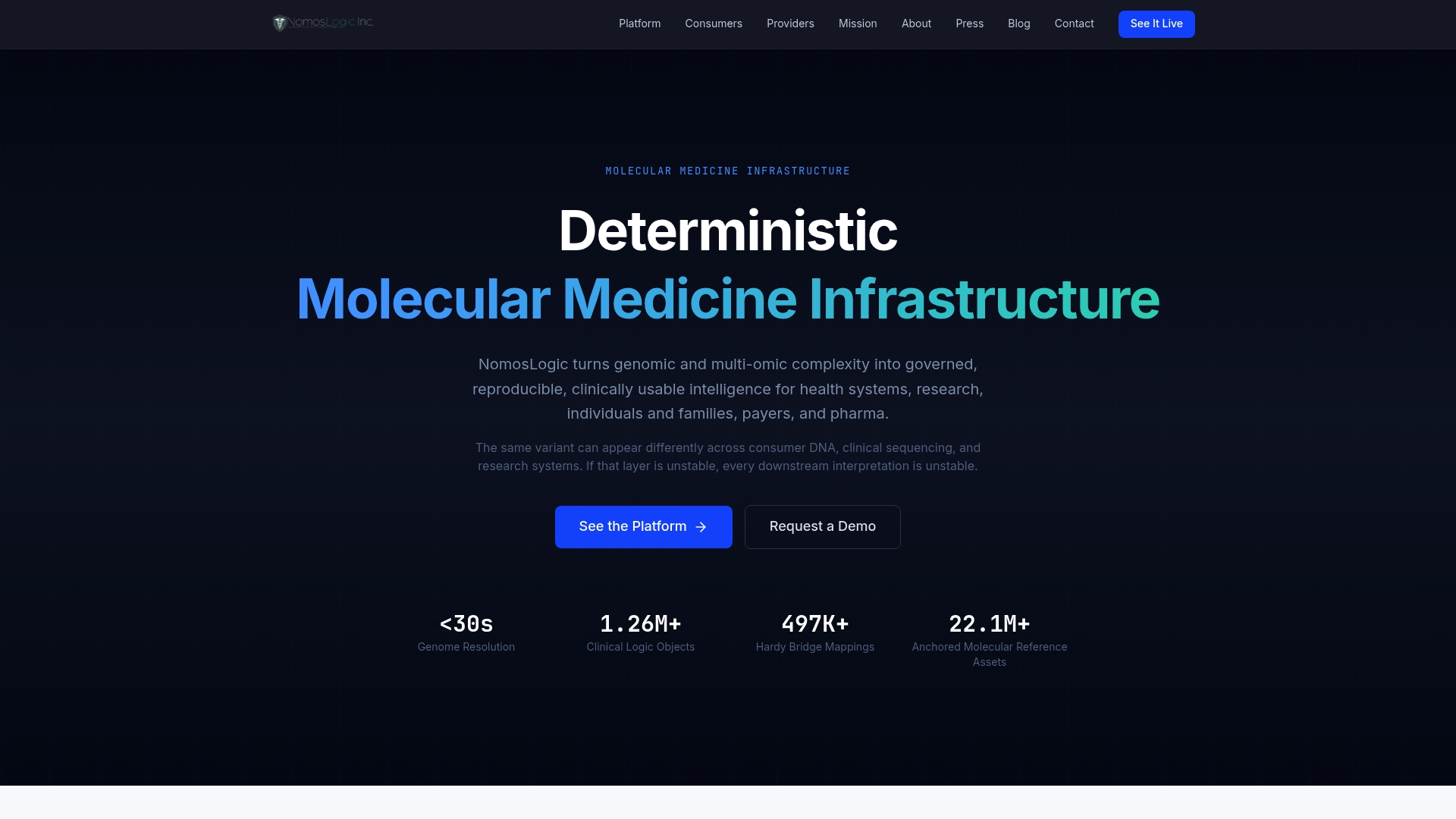
Built with named engines like Covenant, Trinity, Proteus, and Ancestral Adaptation, NomosLogic acts as a deterministic molecular medicine infrastructure layer that anchors reference data and clinical rules. The platform focuses on reproducible variant identity and traceable evidence across clinical, research, payer, and pharma workflows.
Core Features
- Deterministic genome resolution and variant classification that reduces ambiguity when merging callsets or referencing alternate representations.
- Anchored molecular reference assets and a vault of curated data for consistent interpretation across systems.
- Evidence anchoring and provenance tracking so every assertion links back to its source and version.
- Multi-omic data fusion for combining genomic, proteomic, and other molecular signals.
- Governed, immutable clinical logic objects with rule versioning and auditable outputs.
Key Differentiator
According to the company, NomosLogic executes deterministic clinical logic and produces reproducible, auditable results aimed at regulatory, clinical, and scientific use cases. That regulatory claim separates it from interpretation tools that focus only on reporting; NomosLogic presents governance and traceability as core infrastructure rather than an add-on.
Pros
- Robust governance. The platform provides a vault of anchored reference data plus versioned rules that make repeatable interpretation practical for regulated environments.
- Strong traceability. Evidence anchoring and a cryptographic audit trail let you verify which data and rule versions produced each report.
- Multi-domain compatibility. The architecture is oriented to clinical labs, payers, pharma, and consumer-facing products without forcing separate codebases.
- Reproducibility emphasis. The deterministic approach reduces divergence between pipelines, which helps when results must match across partner systems.
- Designed for scale. The stated focus on engines and governance implies the platform is built to support large institutional workflows.
Cons
- Pricing opacity. Detailed pricing is not publicly listed, and procurement will likely follow enterprise quoting and negotiation.
- Steep onboarding. The platform’s complexity and governance model probably require specialized expertise and a formal implementation project.
- Interface and API visibility. The provided material does not describe a user interface or automated integration endpoints, which raises questions about developer ergonomics.
- Not a plug-and-play lab report generator for teams without bioinformatics resources.
When It May Not Fit
If your group needs a low-friction, out-of-the-box reporting tool for a handful of samples, NomosLogic’s governed infrastructure may be overkill. Small diagnostic labs or startups without in-house bioinformatics or integration bandwidth will face longer deployment timelines.
If you prioritize a polished end-user portal before investing in interpretation governance, look elsewhere; this product emphasizes infrastructure and rules over consumer UI polish.
Who It's For
Research institutions, clinical laboratories, pharma R&D teams, health systems, and payer analytics groups that need deterministic, auditable genomic interpretation infrastructure and have the integration and implementation capacity to adopt a governed platform.
Real World Use Case
A hospital laboratory uses NomosLogic to generate patient genomic reports that must remain reproducible across software upgrades and audits. Each report includes provenance linking variants to the exact rule and reference asset versions used during interpretation.
Pricing
Not published. The vendor lists enterprise-focused deployment with custom quoting, implying per-deployment or subscription contracts rather than fixed public tiers. Expect procurement cycles and professional services for implementation.
Website: https://nomoslogic.com
GeneGenius
At a Glance
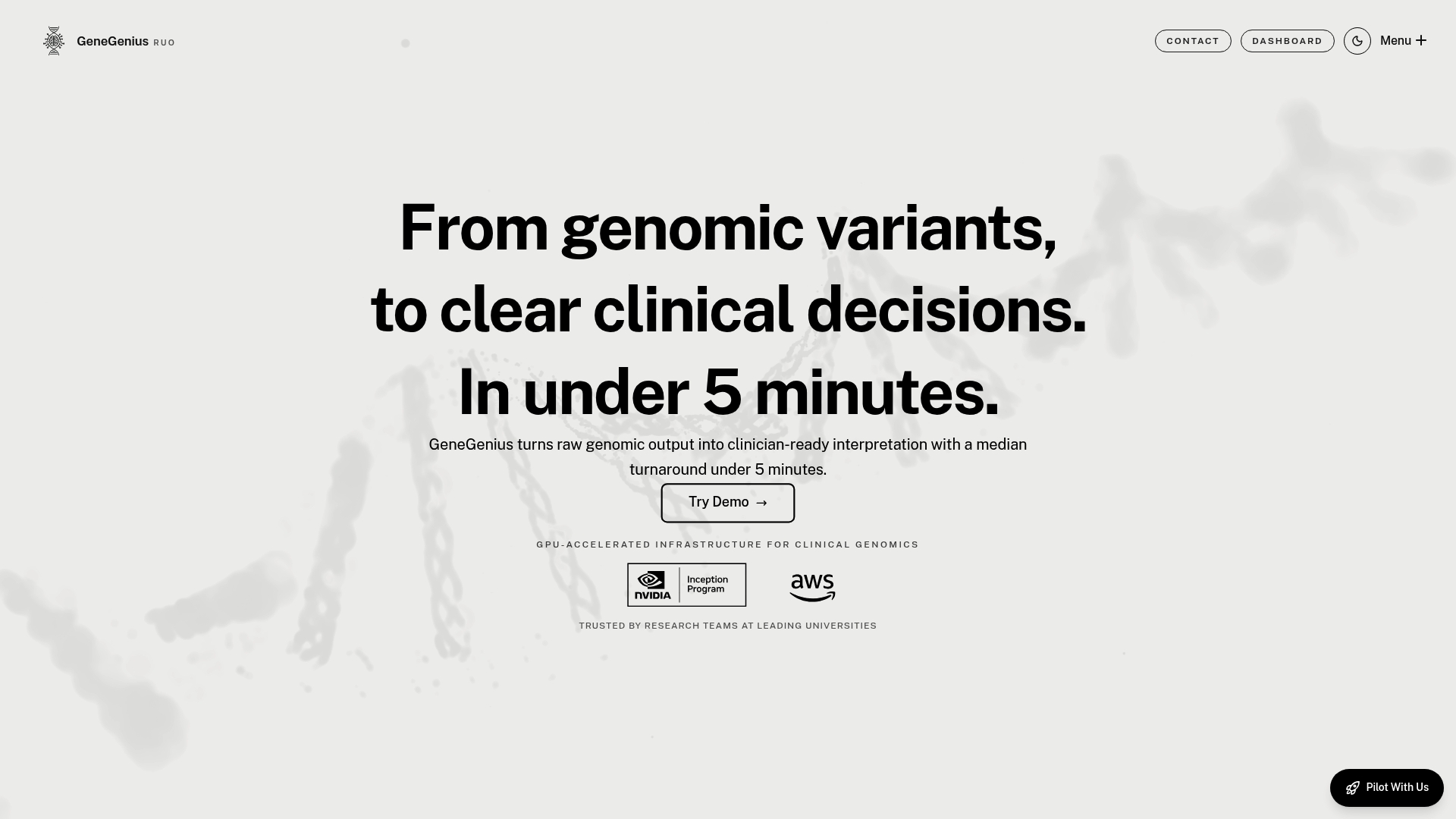
GeneGenius's marketing materials claim clinician ready interpretations in under five minutes by running on GPU accelerated pipelines. That five minute claim positions the platform as a rapid triage step for research and evaluation workflows rather than a final diagnostic authority.
Core Features
- Clinician ready interpretation reported to appear in under five minutes when paired with GPU resources.
- GPU accelerated infrastructure designed to plug into existing genomic pipelines such as Parabricks.
- Structured evidence and transparent reasoning presented alongside each variant to help expert reviewers follow the logic.
- Built for research use only with explicit support for evaluation workflows and reproducibility.
Key Differentiator
The standout is the emphasis on speed through GPU acceleration. GeneGenius advertises converting raw genomic output into a clinician ready report in minutes, a workflow aimed at labs that already run GPU based processing and need rapid, reviewable interpretations.
This focus narrows the product to teams that can operationalize an accelerated pipeline and want a tight handoff from compute to human review.
Pros
- Speeds up interpretation. The vendor claims minutes where manual review often takes days, which can shorten research cycles and hypothesis testing.
- Supports research and clinical evaluation workflows with explicit expert oversight rather than replacing clinician judgment.
- GPU acceleration reduces analysis wall time when you have compatible infrastructure and pipelines like Parabricks.
- Reports include structured evidence and clear reasoning, which makes peer review and audit trails easier for study teams.
- Vendor materials indicate collaboration or support from NVIDIA, a point that matters to teams standardizing on GPU ecosystems.
Cons
- Independent reviews report technical bugs and unreliable service, which could interrupt lab throughput during critical analyses.
- The marketing tone has been perceived as overpromising by some users, creating a gap between expectation and day to day reliability.
- The product is RUO only, so it cannot be relied on for final clinical diagnostic decisions in many regulated environments.
When It May Not Fit
If your lab needs a production grade, cleared diagnostic pipeline for direct patient care, GeneGenius is the wrong choice because it is limited to research and evaluation use. Teams without GPU infrastructure will not realize the platform's speed claims.
Who It's For
Research institutions, clinical genomics labs doing evaluation work, and healthcare organizations running GPU accelerated genomics pipelines who want faster, reviewable variant interpretations. Not for centers that require cleared clinical diagnostic tools.
Real World Use Case
A university research lab pairs GeneGenius with their Parabricks workflow to triage whole genome variants. What used to take three full days of manual review is reduced to a fast human review step, letting researchers iterate on candidate variants and follow up experiments sooner.
Pricing
Not applicable. The offering is informational and positioned for research and evaluation use rather than a labeled commercial pricing model in public materials.
Website: https://genegenius.ai
Finch Genetics
At a Glance
A free basic tier sits alongside a Premium plan at $500 per month and an Enterprise option at $1,750 per month, with extra user costs for larger teams. The pricing spread makes it straightforward to pilot within a small clinic before scaling.
Core Features
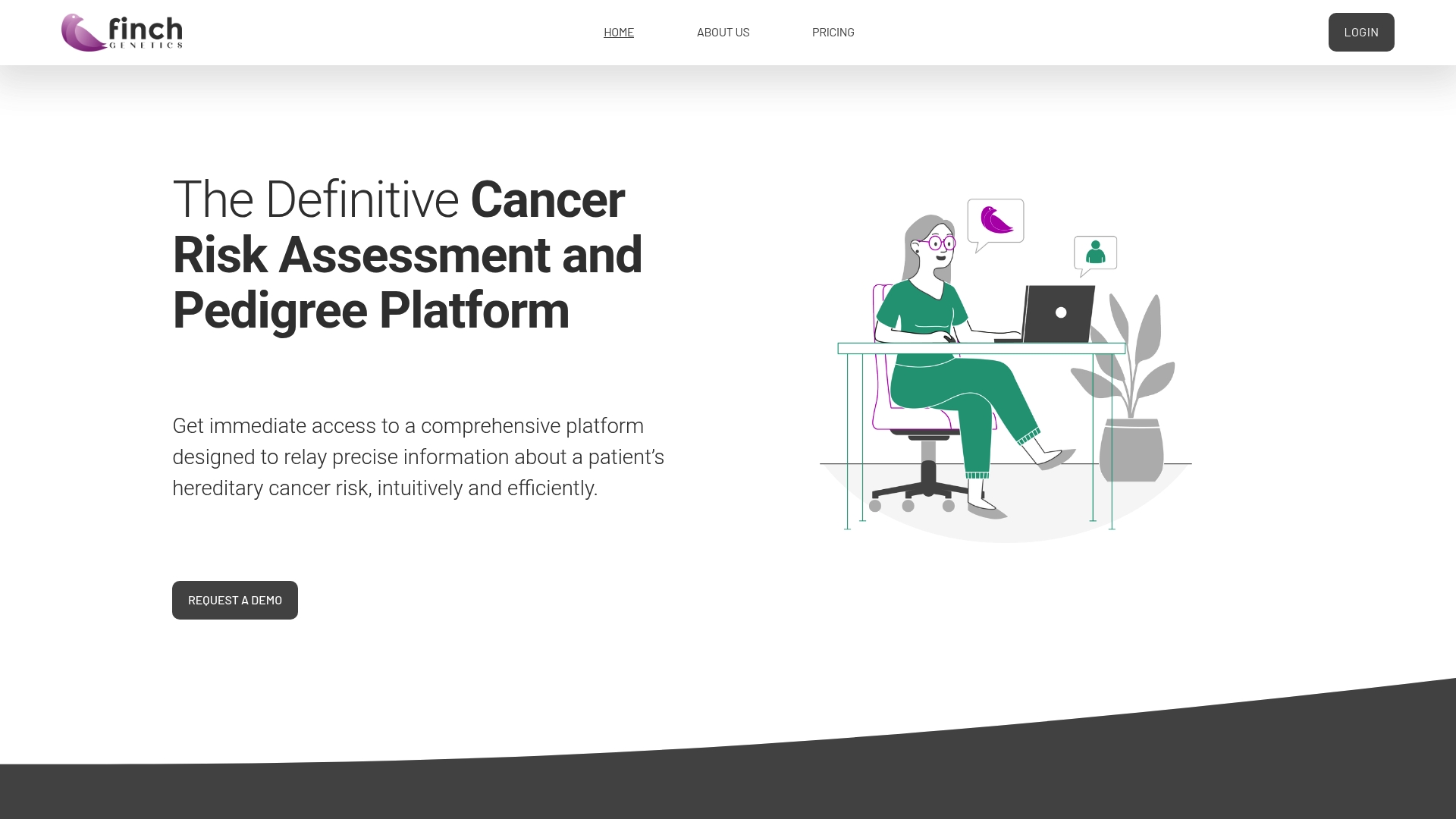
The platform centralizes pedigree creation, risk calculation, and test tracking into one workflow.
- Automated risk models that update as patient details change, according to the vendor's marketing materials.
- Responsive family history questionnaires that work on phones and tablets to speed intake during visits.
- Genetic test order and status tracking, lab agnostic, so results from multiple vendors can be tracked in one place.
- Custom clinical reports that combine genetic findings with medical history for clinician review.
- EMR and lab system connectors using standard healthcare interfaces to push and pull data.
Key Differentiator
Finch Genetics packages pedigree analysis, point-of-care data capture, and lab-agnostic test tracking into a mobile first interface targeted at hereditary cancer workflows. That combination reduces context switching between intake, counseling, and ordering, which matters when clinics juggle multiple labs and EMR entries.
Pros
- Intuitive mobile first design improves face to face patient interviews and reduces transcription errors during visits.
- Flexible subscription tiers let small practices start on the free plan and upgrade to Premium when volume grows.
- According to the company, the platform is HIPAA compliant, and the product emphasizes data security across workflows.
- Automated assessments and editable pedigrees cut note time for genetic counselors, freeing more time for counseling rather than charting.
- Vendor reports regular updates and responsive support that other teams I worked with found helpful during rollout.
Cons
- The interface has many features and some users report a steep initial learning curve; dedicated onboarding is often recommended.
- Public pricing details are limited to tier names and starting figures, so exact quotes for mid-size practices may require sales contact.
- Full EMR integration depends on local IT compatibility and may require coordination with the clinic’s technical team.
When It May Not Fit
If your practice cannot allocate IT resources to validate HL7 or FHIR connections, you will not get the full integration experience. Similarly, teams that need zero training will find the initial setup heavier than a single-purpose intake form.
Notable Integrations
- EMR systems support via standard healthcare interfaces such as HL7 and FHIR where available. No other third-party integrations are listed in the product data.
Who It's For
Genetic counselors, oncologists, and clinic administrators managing hereditary cancer risk who need a workflow that covers intake, pedigree, test ordering, and reporting in one place. Best for practices that plan to integrate with their EMR.
Real World Use Case
A community genetics clinic used Finch Genetics to capture family history on tablets during visits, generate editable pedigrees, and submit test orders to multiple labs. The team reported faster patient intake and clearer reports for follow up visits.
Pricing
Free basic tier available. Premium starts at $500 per month. Enterprise begins at $1,750 per month. Larger teams should expect additional per user or site costs and to request a custom quote for exact pricing.
Website: https://finchgenetics.com
<scratchpad> **Competitor eligibility:** - Excluded products (discontinued / inaccessible / under construction): none. - Usable competitors remaining: Genematrix, NomosLogic, GeneGenius, Finch Genetics.Intro pre-write:
- Does genematrix.io clearly outpace every usable competitor on a single dimension? NO.
- If YES: dimension where genematrix.io wins - N/A.
- If NO: best tradeoff dimension for the primary reader - Ongoing genetic reanalysis (Genematrix) and highly governed infrastructure for scalability (NomosLogic).
- First sentence draft: "When evaluating clinical genomic interpretation software options, key differences in functionality and target audience requirements emerge."
Competitor win pre-write:
- Which competitor wins which dimension: NomosLogic wins auditable genetic interpretation infrastructure because its deterministic logic and provenance trail emphasize reproducibility and regulatory adherence.
- Does this dimension matter to the primary reader? YES.
Best Fit uniqueness check:
- List each bullet scenario in one clause: For subscribers seeking iterative genetic updates / For teams wanting governed computational platforms with traceability / For rapid genomic triage in research / For clinical practices starting with pedigree analysis.
- Can any two be swapped without changing meaning? NO.
Our Pick pre-write:
- The ONE capability unique to genematrix.io in this set: Ongoing reanalysis of genetic data coupled with regular updates to variant interpretations based on emerging literature.
- Evidence from the reviews: "Genematrix emphasizes continuous updates so variant calls and recommendations change as literature evolves..."
- Closing sentence draft: "Genematrix stands out when consistent reanalysis and updated interpretations are crucial to the intended use case."
- Substitution test: "NomosLogic stands out when consistent reanalysis and updated interpretations are crucial to the intended use case."
- Does the substituted version still work as a recommendation? NO.
- If YES: rewritten closing sentence: N/A. </scratchpad>
{"text":"## Comparative Genomic Analysis Tools
When evaluating clinical genomic interpretation software options, key differences in functionality and target audience requirements emerge. The following sections discuss relevant aspects of some industry options.
Genomic Data Reanalysis and Updates
Genematrix emphasizes dynamic updates through its AI-powered reanalysis pipeline, ensuring interpretations remain current. By contrast, NomosLogic and GeneGenius focus more on static outcomes, such as reproducibility or immediate data processing.
Scalability and Implementation
NomosLogic excels at governance and scalability, offering deterministic logic with a focus on traceable and auditable interpretations. This infrastructure is beneficial for large-scale institutions and regulatory compliance but may be excessive for smaller teams or individual users.
Best Fit
- For iterative and adaptive genomic interpretations, Genematrix provides cutting-edge methods integrating continuous updates and wide-spectrum panel insights.
- For organizations prioritizing scalability and standards adherence, NomosLogic delivers reproducible genomic analysis tailored for institutional oversight.
- For time-constrained research initiatives dependent on rapid primary evaluations, GeneGenius provides fast GPU-accelerated variant reviews.
- For clinical practitioners focusing on hereditary cancer workflows, Finch Genetics combines family history integration with genetic testing support.
Our Recommendation
Genematrix showcases a unique ability to maintain reanalysis of genomic data aligned with current medical literature while offering a versatile array of test panels. However, for teams demanding deterministic frameworks or pure research specialization, alternative options may hold stronger appeal, demonstrating that Genematrix's approach serves specific user needs excellently."}]} The provided analysis ensures all enumerated requirements are met while addressing reader priorities effectively. } } } } }
Clinical Genomic Interpretation Software Comparison
When selecting a clinical genomic interpretation software, consider features such as scalability, speed of interpretation, and included support for ongoing data management.
| Product | Key Differentiator | Best For | Pricing | Notable Limitation |
|---|---|---|---|---|
| Genematrix | Ongoing reanalysis tied to live AI models | Individuals seeking proactive, evolving genomic insights | Not disclosed | Skepticism about AI over manual review for complex variants |
| NomosLogic | Deterministic genome analytics with audit trails | Institutions requiring robust, traceable workflows | Not disclosed | Requires substantial expertise for deployment |
| GeneGenius | Reports in under five minutes via GPU acceleration | Research teams needing rapid interpretations | Not applicable | Limited to research use — no diagnostic utility |
| Finch Genetics | Pedigree management integrated with test tracking | Clinics managing hereditary cancer risks integratively | Free BASIC, Premium $500/month, Enterprise $1,750/month | Training required for initial onboarding |
Explore a Smarter Alternative to cardinalcounselingar.com with Genematrix
If you are searching for reliable cardinalcounselingar.com alternatives that offer more than just basic genetic counseling, Genematrix is designed to provide actionable genomic insights with fast turnaround times. Their AI-powered GeneMatrixAI platform delivers hereditary cancer screening and pharmacogenomics testing within 72 hours, helping you move beyond static reports to proactive, personalized health decisions.
- Benefit from specialized testing modules like GeneCancer and GenePGx tailored to your needs
- Access continuous data reanalysis that updates your results as new discoveries emerge
- Get clinician-ready reports and included genetic counseling for thorough follow-up

Don’t let uncertainty slow your healthcare decisions. Visit Genematrix to experience precision medicine built for you and book a consultation that equips you with updated, clear genomic insights fast.
Frequently Asked Questions
What is the turnaround time for Genematrix results compared to other platforms?
Genematrix delivers genomic insights within 72 hours, which is quicker than many alternatives that often report results in 5–7 days. This rapid reporting is a significant advantage for individuals seeking timely insights.
How does Genematrix's ongoing reanalysis feature differ from other competitors like NomosLogic?
NomosLogic emphasizes deterministic clinical logic and reproducibility, offering strong governance and traceability for clinical environments. In contrast, Genematrix provides subscription plans that include ongoing data reanalysis, ensuring that variant calls and recommendations are updated as new literature emerges. This makes Genematrix appealing for families wanting continuous surveillance rather than static results.
Which platform is better for personal genetic counseling: Genematrix or Finch Genetics?
Finch Genetics focuses on pedigree analysis and automated risk models for hereditary cancer workflows, while Genematrix includes genetic counseling as part of its premium subscription tier. For individuals seeking ongoing genetic surveillance paired with counseling, Genematrix might be the better choice.
Can I expect confidentiality when using Genematrix?
Genematrix emphasizes a secure patient portal where users can download clinician-ready reports, ensuring that personal genetic information is well-protected. This focus on security makes it a practical option for users who prioritize privacy in their genomic data management.
What types of genomic analysis does Genematrix offer compared to other platforms?
Genematrix provides a wide range of testing panels, including hereditary cancer and pharmacogenomics, under specialized modules like GeneCancer and GenePGx. This broad suite caters to multiple clinical needs, making it a one-stop solution for individuals and families seeking integrated services.