

Most diet DNA tests in the United States cost between $120 and $399, with clinical-grade options running above $400. Entry-level kits at $120 to $199 give you basic trait reports and a handful of nutrient markers. Mid-range tests at $200 to $399 add more markers and personalized guidance. Anything past $400 typically means CLIA/CAP lab processing, clinician-validated reports, and genetic counseling.
- Entry/mass-market ($120–$199): Basic PDF report, limited markers, no clinical review
- Mid-range ($200–$399): Broader marker panel, diet and supplement suggestions, partial expert input
- Premium/clinical ($400+): Accredited lab work, clinician-reviewed reports, counseling access, faster turnaround
If you're making a medical or clinically informed decision, pay for premium. If you just want general lifestyle pointers, entry or mid-range covers it.
Key Takeaways
Diet DNA test prices in the United States track directly with lab accreditation, panel size, and clinician involvement, not marketing claims.
| Point | Details |
|---|---|
| Know your price band | Expect $120–$199 for entry kits, $200–$399 for mid-range, and $400+ for clinician-reviewed clinical tests. |
| Check lab credentials | Confirm CLIA/CAP certification and, where possible, AABB-linked lab standards before paying a premium price. |
| Watch for hidden costs | Coaching calls, extended reports, and supplement bundles often bill separately from the base test. |
| Read refund terms first | Most providers only refund unopened, unprocessed kits, so ask before your sample ships. |
| Choose premium for clinical needs | Genematrix's GeneDiet offers CLIA-certified processing and clinician-reviewed reports for buyers who need actionable, clinical-grade results. |
Table of Contents
- What Does a Diet DNA Test Cost at Each Price Level?
- Why Do Diet DNA Tests Vary So Much in Price?
- What Do You Actually Get for Your Money?
- How Do You Compare Price and Value Quickly?
- Will Insurance or an HSA Cover a Diet DNA Test?
- Can You Actually Trust a Diet DNA Test's Results?
- How Gene Matrix's GeneDiet Fits the Premium Price Band
- What Do Coaching and Extended Report Add-Ons Cost?
- What Happens If You Want a Refund?
- Author Note From Tarek: Practical Buying Advice
- Getting Started With Gene Matrix's GeneDiet Testing
- Sources
What Does a Diet DNA Test Cost at Each Price Level?
Lower-priced tests generally include a saliva kit and a brief report focusing on a small number of markers, with turnaround times that can extend several weeks due to batching samples. You won't get a clinician's eyes on your results, and the "personalization" is mostly template text swapped in based on your genotype at a handful of spots.
Step up to $200 to $399 and the picture changes. Here's what typically improves:
- Marker count jumps from a dozen or so to 50 to 200 genetic variants tied to metabolism, weight tendencies, and nutrient processing.
- Recommendations get more specific — supplement dosing ranges, macronutrient ratios, exercise-response notes.
- Some providers add partial expert review, though full clinician sign-off is rare at this tier.
Pricing in this middle band clusters heavily around $200 to $400 for health and nutrition tests, based on current market listings.
Above $400, you're paying for CLIA/CAP-accredited lab processing, actual clinician review of your report, and often a consultation call. Turnaround shrinks to one to three weeks because these labs prioritize clinical workflows over consumer batch processing. Promotional bundles and seasonal discounts can shave $20 to $50 off any tier, but don't assume a sale price reflects the test's real value tier: a $150 "premium" test on sale is still an entry-level test.
Why Do Diet DNA Tests Vary So Much in Price?
Panel size drives a lot of the cost gap. A test analyzing 15 markers is fundamentally cheaper to run than one analyzing 200, and the lab work scales accordingly.
Laboratory accreditation matters just as much. CLIA and CAP certification require ongoing audits, validated protocols, and staff credentialing, all of which show up in the price tag. Whole-genome or targeted sequencing also costs more to run than simple genotyping arrays, which only check specific known variant sites.
- Report writing and clinician review add labor cost per sample
- Included nutritionist consults (versus paid add-ons) shift the whole pricing model up
- Subscription fees for "ongoing analysis" create costs beyond the kit price
- Shipping, cold-chain handling, and rush processing can each add $10 to $40
Pro Tip: Before buying, check whether the price you're comparing includes one clinician consult or unlimited access to a dietitian for a year. Providers rarely make this distinction obvious on the pricing page.
Lab method and marker breadth are the same cost drivers behind pharmacogenetic testing pricing, which follows a nearly identical accreditation-and-panel-size logic.
What Do You Actually Get for Your Money?
Report content varies more than most buyers expect. At minimum, you get trait summaries: whether you're a fast or slow caffeine metabolizer, your likely response to saturated fat, that kind of thing. Better reports flag specific nutrient processing issues (vitamin D, folate, omega-3 conversion) and translate those into supplement guidance and even recipe suggestions.
Format matters too:
- Simple PDF — static, one-time download, cheapest to produce
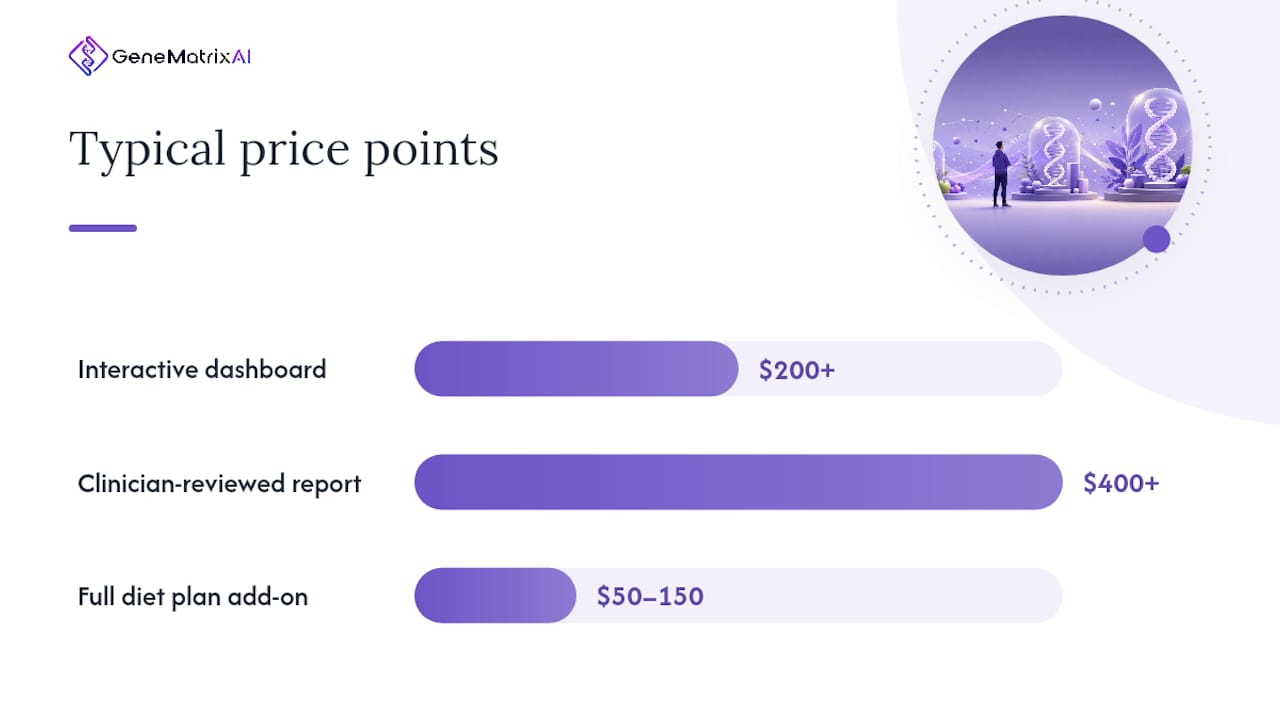
- Interactive dashboard — updated as the science evolves, common in the $200+ range
- Clinician-reviewed report — a real person checks findings before you see them, standard above $400
Add-ons push costs higher fast. A full diet plan can add $50 to $150. Supplement bundles tied to your results add ongoing subscription costs. Bloodwork integration, pairing your DNA data with actual biomarker panels, adds real clinical value and correspondingly higher pricing. One-on-one counseling calls are often billed separately even from otherwise "complete" packages, so read the fine print on what's bundled versus billed.
Delivery also differs: some companies dump everything into a downloadable file, others use a secure portal with ongoing updates and a scheduling link for your clinician consult.
How Do You Compare Price and Value Quickly?
A higher price tag doesn't automatically mean a better test for your situation. Run through this before you buy:
- Match the test to your actual goal. General curiosity about your metabolism doesn't need a $500 clinical panel.
- Verify lab credentials. Look for CLIA and CAP certification, and check whether the lab is AABB-affiliated, since accreditation is the clearest signal of testing rigor in this industry.
- Confirm what expert time costs. Some providers include one nutritionist call; others charge $75 to $150 per session on top of the kit price.
- Check for hidden subscription costs. Ongoing app access or "updated analysis" fees can turn a $250 kit into a $300+ annual expense.
- Ask about bloodwork integration. Combining DNA data with actual lab values gives you far more actionable results than DNA alone.
Pro Tip: Call customer service before you buy and ask directly: "Is clinician review included, or is that a separate add-on?" The answer often isn't on the pricing page at all.
Will Insurance or an HSA Cover a Diet DNA Test?
Most consumer nutrition DNA tests are paid entirely out-of-pocket. Insurance rarely covers wellness-oriented genetic testing unless a physician orders it for a specific medical indication, like a diagnosed metabolic condition.
HSA and FSA funds can sometimes reimburse these tests, but usually only with a clinician's order and a letter of medical necessity on file. Keep your receipt and any clinician documentation, then call your HSA administrator or insurer directly and ask whether your specific test qualifies before you assume it does.
Can You Actually Trust a Diet DNA Test's Results?
Nutrigenomics identifies predispositions in how your body processes nutrients. It doesn't hand you a definitive, guaranteed diet plan.
Genetic testing for personalized nutrition points to tendencies in nutrient metabolism rather than fixed prescriptions, and results carry more weight when interpreted alongside clinical history and lifestyle factors rather than in isolation.
That framing comes from a peer-reviewed review of nutrigenomics research, and it's worth remembering every time a report tells you something in confident, absolute language. Different labs test different marker sets, so two tests can give you genuinely different answers about the same gene. The strongest use case pairs your DNA report with real bloodwork and a conversation with a professional who can weigh both.
How Gene Matrix's GeneDiet Fits the Premium Price Band
Genematrix is a Chicago-based, CLIA-certified biotechnology company built around clinician-validated genomic testing. Its AI platform, trained on more than 500,000 genetic profiles, forms the backbone of its GeneDiet nutrigenomics module, one of several specialized testing lines alongside its hereditary cancer and pharmacogenomics offerings.
A premium-tier offering like GeneDiet typically includes:
- CLIA-certified lab processing rather than a consumer-grade genotyping array alone
- AI-assisted analysis designed to speed up report turnaround
- Clinician review before you receive your results
- Optional genetic counseling for questions about your findings
- Delivery through a secure online portal
| Price band | What Gene Matrix offers at this level |
|---|---|
| Premium ($400+) | CLIA-certified processing, AI-assisted analysis, clinician-reviewed report, counseling option |
If clinical-grade nutrigenomics is what you're after, the Gene Matrix science page breaks down the lab credentials and methodology behind the premium tier in more detail.
What Do Coaching and Extended Report Add-Ons Cost?
Beyond the base test price, most providers offer optional services that push your total spend higher, sometimes substantially.

One-on-one nutrition coaching calls typically run $50 to $150 per session when billed separately from the test itself. Some companies bundle a single intro call into the base price, then charge for anything beyond that. If ongoing accountability matters to you, ask upfront how many sessions are included and what a follow-up call costs.
Extended or updated reports are another common add-on. As nutrigenomic science evolves, some providers offer a re-analysis of your existing raw data using newer marker interpretations, usually for $30 to $80 rather than requiring a whole new sample. This can be worth it if you tested years ago and the panel has since expanded significantly.
Supplement bundles tied to your specific results add recurring cost, often structured as a monthly subscription rather than a one-time fee. These can run anywhere from $30 to $100+ per month depending on what's included, and it's easy to lose track of this as an ongoing line item separate from your original test purchase.
Integrated bloodwork panels, when offered as an add-on rather than a separate purchase, typically add $75 to $200 depending on how many biomarkers get tested. This is often the single highest-value add-on because it gives your DNA results actual clinical context rather than leaving them as an isolated data point.
Before adding any of these, ask whether they're one-time charges or recurring commitments. That distinction matters more to your total cost than the sticker price of the test itself.
What Happens If You Want a Refund?
Refund policies vary widely across DNA testing providers, and the moment your sample gets processed usually marks the point of no return. Most companies allow a refund or exchange only if the kit is unopened and unused, typically within 30 days of purchase.
Once your saliva sample has been analyzed, refunds become far less likely because the lab work itself has already been done. Some providers will offer a partial refund or store credit if a test fails due to insufficient sample quality, since that's considered a processing issue rather than a change of mind on your part.
Subscription-based add-ons (ongoing app access, coaching packages) usually follow standard cancellation rules: you can cancel future billing, but past charges for services already rendered typically aren't refundable. Read the cancellation terms before you subscribe, not after you want out.
A practical rule: if a company won't clearly state its refund policy on its pricing page, ask customer service directly and get the answer in writing before you buy. That single email can save you a frustrating dispute later.
Author Note From Tarek: Practical Buying Advice
I tell people to skip premium tests unless they have a real clinical reason: a family history, a medication interaction concern, or a doctor asking for genetic context. Ask yourself three things: what's my goal, do I need clinical support, and what's my real budget including add-ons. Watch for subscription traps buried in the checkout flow.
— Tarek
Getting Started With Gene Matrix's GeneDiet Testing
If you've decided clinical-grade nutrigenomics is worth the spend, Genematrix's GeneDiet order includes CLIA-certified lab processing, AI-assisted analysis built on a platform trained across 500,000+ genetic profiles, and a clinician-reviewed report rather than a template-generated PDF. Genetic counseling is available if you want to talk through your results with a professional instead of reading them cold.
This fits best for people managing a specific health goal, working with a physician on medication or metabolic questions, or anyone who's tried an entry-level test before and found the report too thin to act on. If hereditary risk factors run in your family, Genematrix's 108-gene hereditary cancer screening is worth reviewing alongside GeneDiet, since many buyers request both at once.
Ready to move forward? Visit the health intake page to start your order or request a clinician consultation before testing.
Sources
This article is general information, not a substitute for advice from a qualified doctor. Consult a qualified healthcare professional about your own circumstances before acting on anything here.