

Pharmacogenomic testing costs vary widely, starting from no charge when reinterpreting raw DNA data you already have, up to moderate amounts for a clinical-grade multi-gene panel, with comprehensive reference-lab pricing sometimes reaching higher levels. The single biggest lever on your final bill is insurance: coverage depends on your diagnosis, your plan, and whether the ordering physician submits the right billing code. Before you agree to any test, ask the lab or clinic for its CPT code and its self-pay price. That one question tells you more than any price list can.
TL;DR:
- Cost of pharmacogenomic testing ranges from no charge for raw data reinterpretation to over $1,000 for comprehensive clinical panels, depending on the depth and accreditation.
- Insurance coverage is highly variable and depends on diagnosis, the CPT code submitted, and whether prior authorization is obtained; always ask labs for the CPT code and self-pay price.
- Accreditation such as CLIA and CAP is essential for testing to be considered actionable by physicians, and higher prices often reflect more comprehensive reports including counseling and updates.
- The actual out-of-pocket expense can be lower when paying cash or using HSA/FSA funds, especially if insurance denies or does not cover the testing.
- Fast turnaround times are typical with reinterpretation services in days, while clinical panels generally take one to two weeks, with some providers like Genematrix delivering results within 72 hours.
Table of Contents
- Pharmacogenomic Testing Cost Ranges and What You Get for the Price
- What Actually Drives the Price Differences
- How Insurance Coverage Actually Works for PGx Testing
- Payment Options When Insurance Falls Short
- A Checklist Before You Order: What to Ask Labs and Insurers
- How Genematrix Approaches PGx Testing, Turnaround, and Billing Support
- When Paying More for PGx Testing Is Actually Worth It
- Ready for Clinical-Grade Pharmacogenomic Testing? Here's How to Start
- Where to Verify These Numbers Yourself
- Sources
Pharmacogenomic Testing Cost Ranges and What You Get for the Price
The price tag on a PGx test tracks almost exactly with how much clinical weight the result carries. A free reinterpretation of your existing 23andMe or AncestryDNA raw file is not the same product as a CLIA-certified panel your oncologist can act on, and the price gap reflects that.
Here's how the tiers typically break down for someone paying out of pocket in the US:
- Raw data reinterpretation: $0 to $100. Services that take DNA data you already own and run it through a pharmacogenomic algorithm. Fast, cheap, and generally not accepted by prescribers for actual dosing decisions because the underlying genotyping wasn't done to clinical standards.
- Single-gene tests: $100 to $500. Useful when a prescriber wants to check one specific gene, say CYP2C19 before starting clopidogrel, rather than a broad panel.
- Clinical multi-gene panels: $250 to $1,000. This is the most common clinical offering and the one most people mean when they ask about pharmacogenomic testing cost. It typically covers 10 to 25+ genes tied to drug metabolism across psychiatry, cardiology, and pain management.
- Reference-lab or hospital-based comprehensive testing: $1,000 to $2,000+. Reserved for complex cases requiring structural variant analysis on genes like CYP2D6, which has known copy-number variations that simpler genotyping methods miss.
A 2018 cost-effectiveness analysis published in a peer-reviewed depression treatment study used a per-test cost around $2,000 in its modeling, a figure that sits at the very top of what most patients will actually pay but illustrates how expensive comprehensive clinical testing can get in research and hospital settings. Advocacy groups tracking real-world patient costs, including NAMI, put the typical range closer to $50 to $2,000, which lines up with what most patients report paying once insurance and self-pay discounts are factored in.
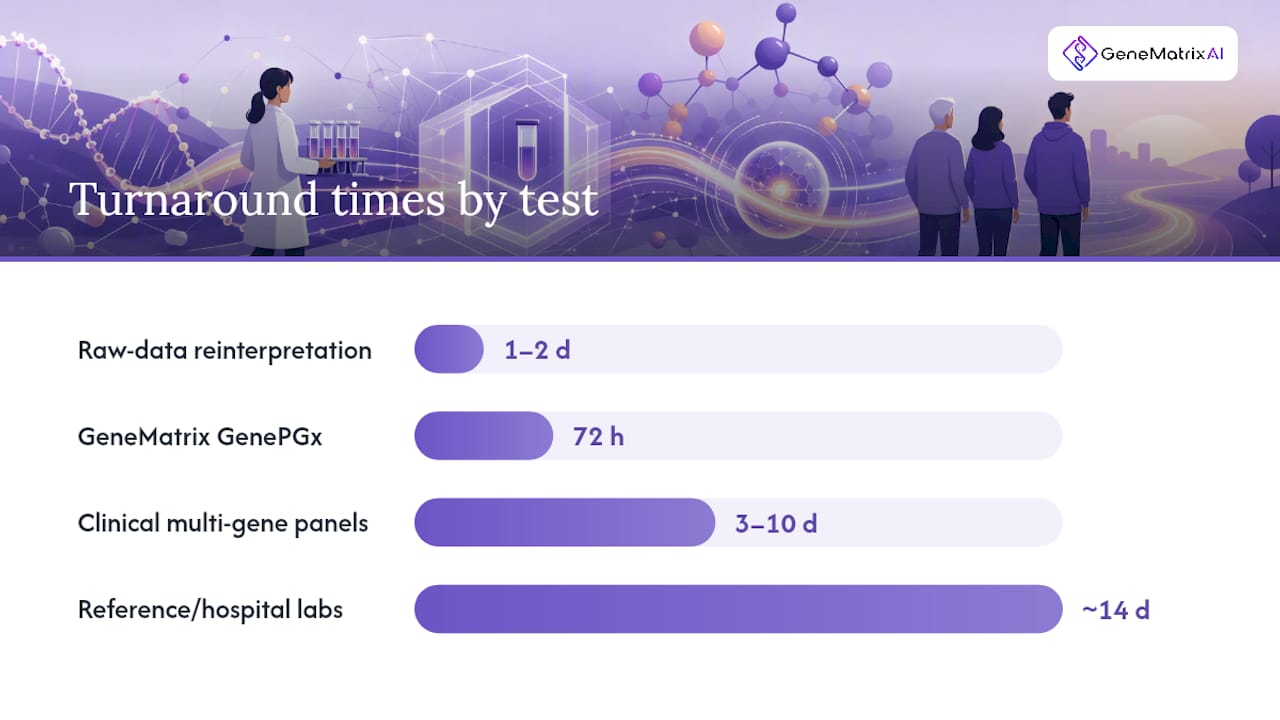
Turnaround time tracks with tier, too. Raw-data reinterpretation services often return results in a day or two since no new lab work happens. Clinical panels usually take 3 to 10 business days. Genematrix's GenePGx testing, for comparison, delivers clinician-validated results within 72 hours through its AI-driven analysis pipeline, which is fast by clinical-lab standards, where two-week turnarounds aren't unusual.
Pro Tip: If a company quotes you a price for pharmacogenomic testing without mentioning CLIA or CAP accreditation, ask directly whether the lab holds either certification. If they can't answer clearly, that result likely won't be usable for a prescribing decision, no matter how cheap it was.
What Actually Drives the Price Differences
Two labs can offer what looks like the same panel at wildly different prices, and the gap almost never comes down to one factor.
Accreditation is the floor, not the ceiling. CLIA certification and CAP accreditation mean a lab has met federal and professional quality standards for clinical testing, and meeting those standards costs money: validated instruments, documented quality control, licensed lab directors. A test that skips accreditation can be cheaper, but no physician should treat its results as actionable for prescribing.
Panel breadth and gene difficulty add real lab complexity. A test covering CYP2D6 costs more to run accurately than most other pharmacogenes because the gene has structural variants and copy-number differences that basic genotyping arrays frequently misread. Labs that sequence rather than simply genotype charge more, but they also tend to catch more of these edge cases.
What's bundled into the report matters just as much as the sequencing itself. A bare list of genotypes costs less to produce than a report that includes:
- Pharmacist or clinical geneticist consultation to walk through results
- Genetic counseling before or after testing
- Ongoing reinterpretation as new drug-gene guidelines are published
- Physician-facing clinical decision support tied to specific medications
Premium panels that include consultation and update services tend to sit at the higher end of the $250 to $1,000 clinical range for a reason: someone qualified is reviewing and re-reviewing the data over time, not just running it once and emailing a PDF.
Administrative overhead shows up in the price, too. Labs and clinics that handle prior authorization paperwork and insurance liaison work on your behalf are absorbing labor costs that a bare-bones, self-pay-only service doesn't carry. That's part of why a hospital-affiliated program can quote a higher list price than an independent lab, even when the underlying test is comparable.
How Insurance Coverage Actually Works for PGx Testing
Insurance coverage for pharmacogenomic testing is inconsistent by design, because coverage decisions are made indication by indication, not test by test.
- Medicare covers certain PGx tests, but only for specific clinical indications spelled out in local coverage determinations. The CMS Medicare Coverage Database is the authoritative source, and your specific LCD depends on your Medicare Administrative Contractor's region.
- Private insurers typically require a physician order (self-referred, direct-to-consumer tests almost never qualify) plus prior authorization tied to a documented medical need, such as starting a medication known to have variable metabolism across genotypes.
- Medicaid coverage varies by state, sometimes dramatically. There's no single national answer here. Calling your state Medicaid office directly, with the CPT code in hand, is the only reliable way to find out.
The billing code is the whole conversation. Ask the ordering clinic or lab which CPT code they'll submit, CPT 81418 is a common one for multi-gene pharmacogenomic panels, and give that exact code to your insurer when you call. Insurance representatives can't give you a meaningful coverage answer without it; "genetic testing" is too broad a category for them to quote anything useful.
Here's a script that works: call the number on your insurance card, and say, "I'm having pharmacogenomic testing billed under CPT code [code]. Can you tell me if this is a covered benefit under my plan, whether prior authorization is required, and what my estimated out-of-pocket cost would be after my deductible?" Write down the representative's name, the call date, and any reference number they give you.
One nuance worth knowing: even when a test itself is nominally covered, your deductible status changes what you'll actually owe. Someone who's already met their deductible in October pays far less out of pocket than someone testing in January.
Payment Options When Insurance Falls Short
When insurance denies coverage or leaves a large balance, you have more options than most patients realize.
- Cash-pay pricing can beat the insurance-billed price. This sounds backwards, but it happens: many labs offer a lower self-pay rate specifically because it skips the administrative cost of insurance billing. Always ask for the cash price even if you have coverage, and compare the two before deciding.
- HSA and FSA funds cover PGx testing and related consultations. Because pharmacogenomic testing is medically related to prescription decisions, it typically qualifies as an eligible expense under most HSA and FSA plans. Check with your plan administrator, but this is usually a straightforward yes.
- Health-system bundled pricing can be more transparent than a hospital bill. Programs like UF Health's MyRx list a flat consultation-only fee around $199 and a combined testing-plus-consultation package around $599, letting patients see the full cost upfront instead of waiting for a facility bill.
- Veterans should ask about VA program access. The VA has run no-cost pharmacogenomic testing initiatives for eligible veterans through 2025, a model worth checking on directly with your VA provider since program windows and eligibility can shift.
- Ask about sliding-scale or payment-plan options directly. Many labs and hospital genetics programs have financial assistance policies that aren't advertised on their pricing pages. It costs nothing to ask a billing coordinator whether one exists before you pay full price.
A Checklist Before You Order: What to Ask Labs and Insurers
Getting a real number, not a guess, before you commit to testing takes about four phone calls.
- Ask the lab or clinic for the exact CPT code(s) they bill, their CLIA/CAP accreditation status, and their self-pay price if you paid nothing to insurance at all.
- Call your insurer with that CPT code in hand. Ask specifically about prior authorization requirements, coverage criteria for your diagnosis, how much of your deductible you've already met, and their estimate of your patient responsibility.
- Request an itemized cost estimate from the clinic that you can submit to insurance yourself if you want a second opinion on coverage, or if the clinic doesn't bill insurance directly.
- Compare the insurer's estimated patient responsibility against the lab's cash-pay price. Sometimes the math favors skipping insurance billing entirely, especially if you haven't met your deductible.
- Write down every name, date, and reference number from every call. Ask for written or emailed confirmation of coverage determinations when the representative can provide it.
Pro Tip: Insurance verbal quotes are not guarantees. Ask explicitly, "Is this a guarantee of payment or an estimate?" Representatives are required to tell you the difference, and it can save you from an unpleasant surprise bill weeks later.
How Genematrix Approaches PGx Testing, Turnaround, and Billing Support
Genematrix is a Chicago-based, CLIA-certified biotechnology company built specifically around the problem this article is walking through: getting patients real, clinically usable genomic answers without the guesswork that usually surrounds pricing and turnaround.
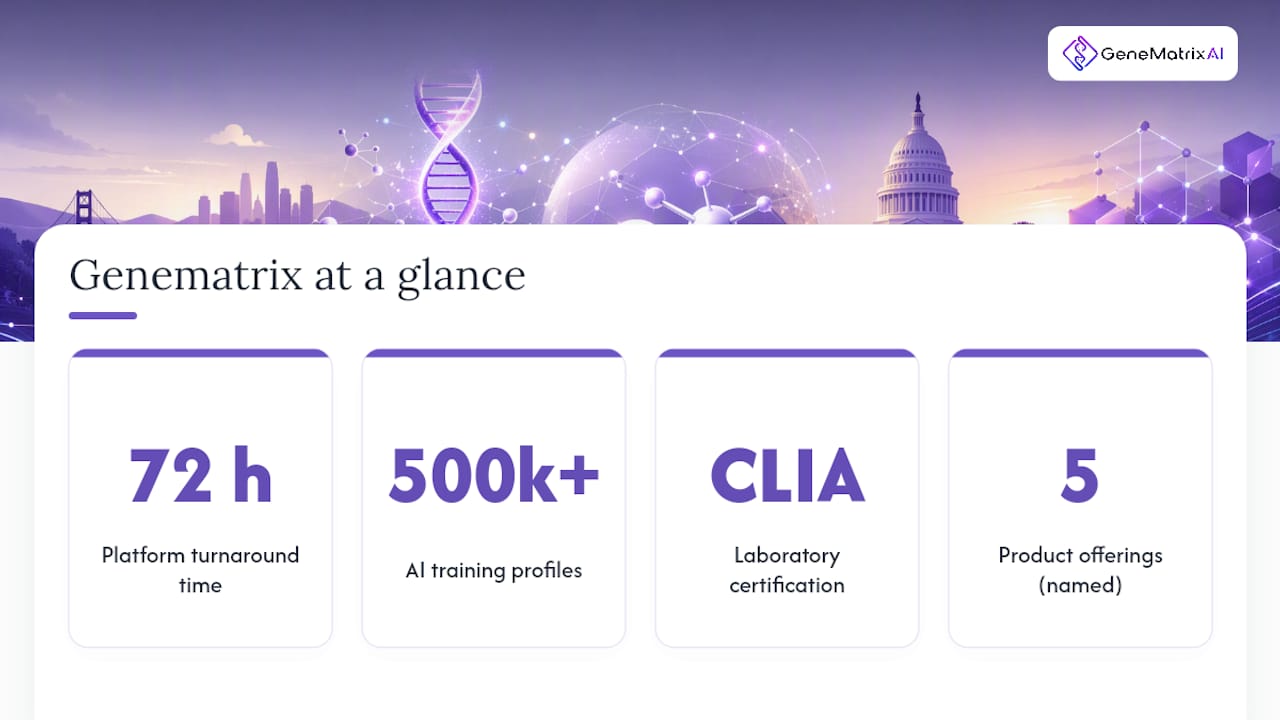
The company's GeneMatrixAI platform delivers results within 72 hours, a timeline built on AI-driven analysis trained on more than 500,000 genetic profiles, applied to specific use cases including hereditary cancer risk, drug-gene interactions, and personalized wellness reporting. That specialization shows up in Genematrix's product lineup: GeneCancer for hereditary cancer screening, GenePGx for pharmacogenomics and medication optimization, GeneMind for psychiatric medication response, GeneBaby for pediatric applications, and GeneDiet for nutrigenomics.
For billing questions specifically, patients working with Genematrix can get guidance on insurance and self-pay pricing directly through the company's support channels before ordering, which matters more than it sounds: the biggest source of PGx billing frustration is finding out the CPT code and estimated liability after the test has already been run, not before.
When Paying More for PGx Testing Is Actually Worth It
Not every situation calls for a $1,000 clinical panel, and I'd be lying if I told you it did. Someone who's curious about caffeine metabolism or wants a general wellness snapshot can reasonably start with a low-cost reinterpretation of raw DNA data they already have. That's informational, and treating it as anything more than that is the mistake, not the tool itself.
But a few clinical situations change the math entirely. Multiple failed antidepressant trials, complex polypharmacy in an older patient managing five or more medications, or a documented history of severe adverse drug reactions are exactly the scenarios where a clinical-grade panel that maps drug-gene interactions earns its higher price. The stakes of a wrong guess are much higher than the stakes of an extra few hundred dollars. In those cases, the right move is always a conversation with your prescribing clinician about whether a clinical-grade test changes their next decision, not a solo decision made from a price comparison chart.
— Tarek
Ready for Clinical-Grade Pharmacogenomic Testing? Here's How to Start
Genematrix's GenePGx testing gives you what a raw-data reinterpretation service can't: a CLIA-certified, clinician-validated report your prescriber can actually act on, delivered in 72 hours instead of the one-to-two-week wait common at larger reference labs.

Ordering starts with a straightforward intake through Genematrix's platform, and the team can walk you through what your plan is likely to cover before you commit to anything. Before you order, confirm your CPT code and compare it against your insurer's estimated patient responsibility, and ask about the self-pay price even if you're planning to bill insurance. If hereditary cancer risk is part of your family history alongside medication concerns, the 108-gene hereditary cancer screening panel is worth asking about in the same conversation, since many patients end up ordering both. Reach out to get a firm cost estimate for your specific situation before your next prescription decision.
Where to Verify These Numbers Yourself
Every figure and coverage rule in this guide comes from a source you can check directly rather than take on faith.
- The CMS Medicare Coverage Database lets you search local coverage determinations for pharmacogenomics by your specific region and contractor.
- CDC's Genomics and Precision Health blog summarizes the systematic-review evidence on when PGx testing is cost-effective and when the evidence is more mixed.
- Genome is the clearest plain-language primer on what these tests measure and how results are typically structured, published by the National Institutes of Health.
- For a broader look at genetic testing pricing outside pharmacogenomics specifically, Genematrix's genetic testing cost guide covers hereditary cancer and other panel types side by side.
This article is general information, not a substitute for advice from a qualified doctor. Consult a qualified healthcare professional about your own circumstances before acting on anything here.
Sources
- Cost-Effectiveness of a Pharmacogenetic Test to Guide Treatment for Major Depressive Disorder
- Cost-effectiveness of Pharmacogenomic Testing
- Costs and Insurance - MyRx
- VA Offers No Cost Pharmacogenomic Testing To Enhance Veterans’ Health Care Through 2025
- Medicare Coverage Database (CMS) — pharmacogenomics