

TL;DR:
- AI enhances hereditary cancer screening by identifying complex genetic patterns faster and more accurately. It should always be paired with CLIA-certified labs and genetic counseling for responsible, personalized results. Genematrix offers a validated, rapid, and clinician-reviewed at-home testing solution that combines all these features.
Yes, AI-powered hereditary cancer screening is worth it, and here is why, in plain terms. AI finds subtle genetic patterns across massive datasets that standard rule-based analysis routinely misses, results typically come back within approximately 72 hours instead of weeks. The best platforms pair that speed with CLIA-certified lab processing and genetic counseling so you actually know what to do with your results.
Three reasons to consider an at-home AI-powered hereditary test:
-
Precision: AI trained on 500,000+ genetic profiles detects complex variant combinations that simpler screening methods overlook.
-
Speed: Rapid analysis shortens the gap between sample collection and a decision you can act on.
-
Responsible integration: The strongest platforms combine AI analysis with CLIA-certified labs and licensed genetic counselors, so the report is clinically grounded, not just algorithmically generated.
Before you order, confirm two things: that the lab holds CLIA certification and that genetic counseling is available after results are delivered.
Table of Contents
- Why use AI for cancer screening? The concrete benefits
- What AI can't do, and why human oversight still matters
- What an at-home AI-powered hereditary cancer test actually looks like
- How to choose an AI-powered hereditary testing provider
- How Genematrix applies AI for hereditary cancer screening
- Key Takeaways
- The case for pairing AI with counseling, not choosing between them
- Genematrix: AI-powered hereditary cancer screening, ready to order
Why use AI for cancer screening? The concrete benefits
AI's single biggest contribution to hereditary cancer screening is pattern recognition at a scale no human analyst can match. AI-powered tools identify hidden patterns in large, complex genomic datasets, enabling more precise hereditary cancer risk assessments than broad, rule-based approaches can deliver.
What that means practically:
Precision and sensitivity. Hereditary cancer variants, especially in genes like BRCA1, BRCA2, and the Lynch syndrome mismatch-repair genes, often appear in combinations that only become meaningful when compared against population-scale data. AI surfaces those combinations. Clinical reviews confirm AI improves diagnostic sensitivity in several cancer screening contexts, though real-world performance still varies by platform and validation quality.
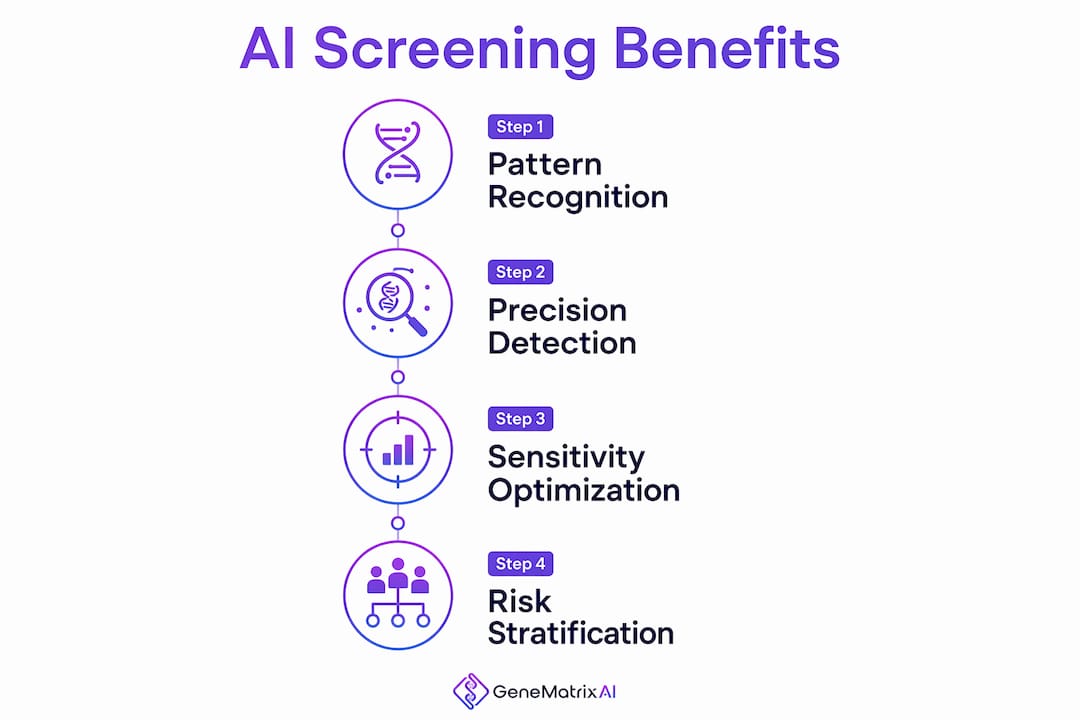
Personalized risk stratification. Rather than a binary positive/negative result, AI-driven reports generate a risk score calibrated to your specific variant profile. Experts frame this as a shift toward proactive precision prevention, where individualized risk changes what surveillance or prevention steps make sense for you specifically.
Speed as a clinical benefit. Rapid AI analysis delivers faster, actionable results, allowing lifestyle or clinical decisions to occur sooner, compared with slower, fragmented testing pathways. Platforms like Genematrix target rapid analysis speed, which Harvard Medical School cites as clinically meaningful for reducing patient waiting anxiety and speeding follow-up.
Stat to know: AI-assisted genomic analysis can increase detection rates and reduce clinician workloads when integrated into validated clinical workflows, with randomized triage studies showing meaningful workload and detection improvements.
What AI can't do, and why human oversight still matters
AI augments clinical judgment. It does not replace it. That distinction is not semantic; it has direct consequences for how you should evaluate any at-home test.
Real limitations to know:
- Models trained on non-representative populations can perpetuate disparities in detection accuracy, meaning a model built mostly on European ancestry data may perform less reliably for people of other backgrounds.
- False positives and false negatives both occur. AI flags variants for expert review; it does not render a final verdict on its own.
- Interpretability gaps exist. Many AI models cannot fully explain why they flagged a variant, which is exactly why clinician review is essential before results reach you.
- Privacy risk scales with data volume. As more platforms collect genomic data, the exposure surface for sensitive information grows.
Researchers consistently call for integrating AI outputs with genetic counseling because AI acts as decision support, not as a counselor who can contextualize what a BRCA2 variant actually means for your family planning or surveillance schedule.
Pro Tip: Ask any provider whether their AI model was validated on diverse cohorts and whether raw variant calls are reviewed by a molecular geneticist or board-certified genetic counselor before the report is finalized. A vague answer to either question is a red flag.
The U.S. GAO has flagged bias, lack of transparency, and privacy risk as the three primary challenges for clinical AI tools. Those challenges apply directly to hereditary genetic testing.
What an at-home AI-powered hereditary cancer test actually looks like
The consumer experience is straightforward. You order, collect a saliva sample at home, mail it to the lab, and receive a clinician-validated report. Here is how the steps break down:

| Step | Who performs it | Typical timeline | What you receive |
|---|---|---|---|
| Order and kit delivery | Provider | 2–5 business days | Collection kit with instructions |
| Sample collection | You (saliva swab) | — | Sealed sample for mailing |
| Lab processing | CLIA-certified lab | 3–5 business days | Extracted and sequenced DNA |
| AI analysis | GeneMatrixAI platform | Approximately 72 hours | Variant calls and risk scores |
| Report review | Licensed clinician | Concurrent with analysis | Clinician-validated actionable report |
| Genetic counseling | Certified counselor | Scheduled post-results | Personalized guidance on next steps |
Your report will typically include variant classification (pathogenic, likely pathogenic, variant of uncertain significance), a personalized risk score, recommended surveillance or referral steps, and, where applicable, pharmacogenomics cross-links through modules like GenePGx.
Privacy and data handling: what to confirm before you buy
- Where your genomic data is stored and for how long
- Whether data is used to retrain AI models, and how to opt out
- Whether data is shared with third parties or insurers
- What happens to your sample after analysis
On cost: most providers offer either a one-time test purchase or a subscription that bundles multiple screening modules. Fast lab turnaround is a meaningful part of the value proposition at any price point. Insurance coverage for hereditary genetic testing varies; check with your insurer before ordering.
How to choose an AI-powered hereditary testing provider
The core principle: prefer providers that pair validated AI with CLIA-certified labs and licensed genetic counseling. Everything else is secondary.
Questions to ask before you buy:
- Is the lab CLIA-certified? (Verify directly at the CMS CLIA database, not just on the provider's marketing page.)
- Has the AI model been validated on diverse, prospective cohorts? Ask for published validation studies.
- Is genetic counseling included or available after results?
- What is the data-use policy? Can you opt out of research aggregation?
- What is the actual turnaround time from sample receipt to report delivery?
- How are variants classified? Does the platform follow ACMG/AMP variant classification standards?
Red flags:
- Vague validation claims with no published studies or regulatory clearances
- No clinician review before results are delivered to you
- Unclear or buried data-use policies
- Opaque variant classification with no reference to recognized standards
The NCI emphasizes that FDA authorization is an important validation signal for AI-based software in pathology and genomics. A Frontiers review reinforces that model performance varies by population and that poorly validated AI can worsen disparities. Ask specifically whether the model was tested on a population similar to yours.
How Genematrix applies AI for hereditary cancer screening
Genematrix uses its GeneMatrixAI platform to augment clinical review and deliver actionable reports within approximately 72 hours. The company is a Chicago-based, CLIA-certified biotechnology firm offering both subscription and one-time test models, serving people with a family history of cancer, individuals managing medications, and families planning for children.
Trust signals Genematrix provides:
- CLIA-certified lab processing for every sample
- Clinician-reviewed reports before delivery
- Genetic counseling availability post-results
- GeneMatrixAI trained on 500,000+ genomic profiles
- Specialized modules: GeneCancer (hereditary cancer), GenePGx (pharmacogenomics), GeneMind (psychiatric), GeneBaby (pediatric), GeneDiet (nutrigenomics)
Reports include variant calls, personalized risk stratification for conditions like BRCA1/BRCA2 mutations and Lynch syndrome, and recommended next steps with counseling. For deeper technical and certification details, Genematrix publishes its science and lab certifications publicly.
Key Takeaways
AI-powered hereditary cancer screening is most valuable when it combines validated genomic pattern recognition, CLIA-certified lab processing, and genetic counseling in a single, fast workflow.
| Point | Details |
|---|---|
| AI finds what rules miss | Pattern recognition across large genomic datasets surfaces hereditary variants that standard analysis overlooks. |
| Speed matters clinically | Analysis is typically completed within approximately 72 hours, shortening the time between sample collection and a decision you can act on. |
| Human oversight is non-optional | Clinician review and genetic counseling are required to interpret results safely and avoid misinterpretation. |
| Verify before you buy | Confirm CLIA certification, diverse-cohort validation, and counseling availability before ordering any test. |
| Genematrix delivers all three | Genematrix pairs GeneMatrixAI, CLIA-certified labs, and genetic counseling in one at-home hereditary testing workflow. |
The case for pairing AI with counseling, not choosing between them
The debate in consumer genomics often gets framed as AI versus human expertise. That framing is wrong, and it leads people to either distrust useful technology or over-rely on it without the context that makes results meaningful.
AI in hereditary cancer screening earns its place by doing what humans genuinely cannot do at scale: compare your variant profile against hundreds of thousands of genomic patterns simultaneously, in minutes. That is a real capability. But a risk score without a counselor explaining what it means for your specific family history, your surveillance options, and your emotional response to the information is incomplete medicine. The SAGE literature is clear that AI integration without counseling is not the gold standard; it is a shortcut that can cause harm.
What consumers should actually demand is both: fast, validated AI analysis and a licensed counselor available to walk through the results. Platforms that offer one without the other are cutting a corner that matters.
Genematrix: AI-powered hereditary cancer screening, ready to order
Genematrix is a validated, CLIA-backed option for consumers who want rapid hereditary cancer screening with clinician oversight built in, not bolted on as an afterthought.

The GeneCancer module screens for hereditary cancer risk including BRCA1/BRCA2 and Lynch syndrome. GenePGx adds pharmacogenomics analysis for medication optimization. Every test runs through a CLIA-certified lab, every report is reviewed by a licensed clinician, and genetic counseling is available after results are delivered, typically within approximately 72 hours of sample receipt.
You can order as a one-time test or through a subscription that bundles multiple modules. View hereditary cancer testing options to see what is available for your situation, or review the science and certifications page to confirm the validation details before you commit.
Useful sources and further reading
These sources support the clinical claims and validation standards discussed above.
- AI and Cancer, National Cancer Institute
- Uses and limitations of AI for oncology, PMC review
- AI in healthcare: clinical applications, Springer
- AI speed and real-world value, Springer Nature
- AI implementation and human oversight, SAGE
- Benefits of AI technologies for patients and clinicians, Harvard Medical School
- AI in healthcare challenges, U.S. GAO
When evaluating any provider, ask directly for their published validation studies and a sample report. A provider confident in their AI should have both ready to share.
This article is general health information, not medical or genetic advice. Confirm your specific situation with a licensed genetic counselor or qualified healthcare provider before making clinical decisions.