

TL;DR:
- Many AI genetic testing platforms lack scientific rigor, risking over-confidence and missed early interventions. The most trustworthy systems combine validated laboratory assays, evidence-based variant interpretation, and guideline-aligned, clinically useful recommendations. Families should prioritize certified labs, peer-reviewed evidence, domain-specific AI, and demonstrated clinical utility when choosing testing platforms.
Not every AI genetic testing platform delivers what it promises. Many families assume that because a test uses "AI," the results are automatically more accurate, more actionable, and safer to act on. That assumption can lead to dangerous over-confidence or missed opportunities for early intervention. The real dividing line is not whether a platform uses AI, but whether it applies that AI with scientific rigor, domain specialization, and evidence-backed interpretation. This guide breaks down how these platforms work, what separates the best from the rest, and how you can use that knowledge to make smarter, proactive health decisions for yourself and your family.
Table of Contents
- What is an AI genetic testing platform and why does it matter?
- How do AI platforms personalize hereditary cancer and medication insights?
- What sets top AI genetic testing platforms apart?
- How to choose and use an AI genetic testing platform
- The uncomfortable truth: Clinical utility is still the missing piece in most AI genetic testing platforms
- Ready to put AI-powered genetics to work for your health?
- Frequently asked questions
Key Takeaways
| Point | Details |
|---|---|
| Not all AI tools are equal | Some AI genetic testing platforms only deliver results—not actionable, clinically useful guidance. |
| Clinical utility is crucial | Look for platforms that show not just accuracy, but proof their results improve real health outcomes. |
| Domain specialization matters | Platforms tuned for genetics and pharmacogenomics provide safer, guideline-consistent recommendations. |
| Evidence should back every claim | The best AI genetic platforms use structured literature and FDA sources to offer trustworthy guidance. |
| Empower yourself | Asking the right questions and understanding platform features helps you use genetic results proactively. |
What is an AI genetic testing platform and why does it matter?
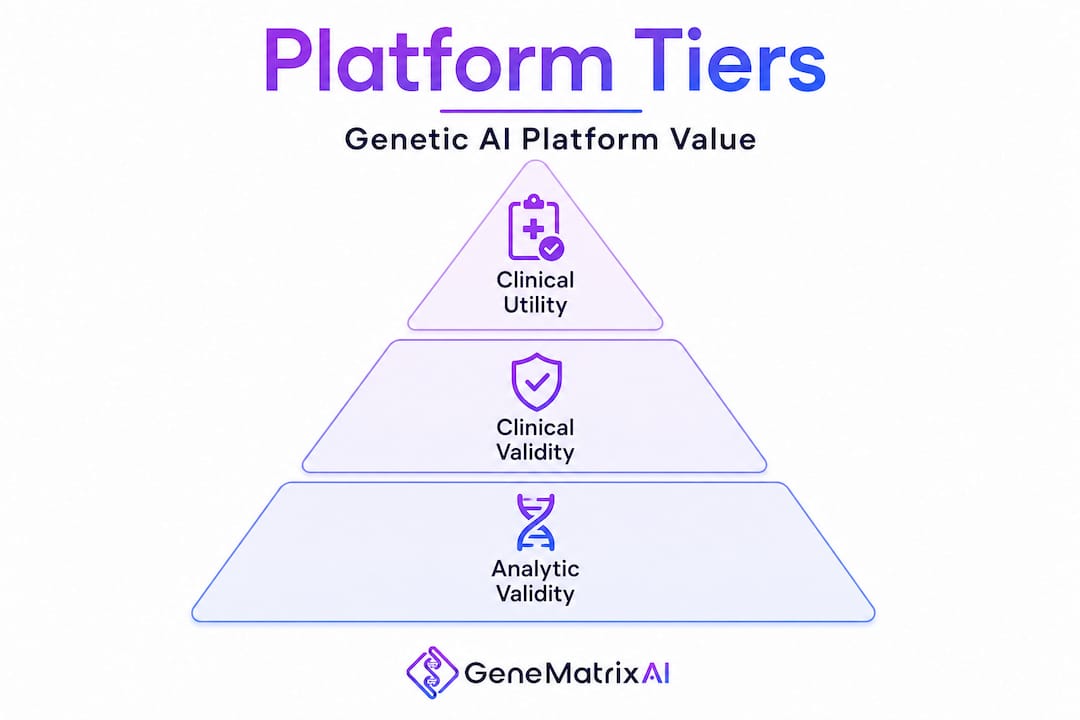
An AI genetic testing platform is not just a lab that reads your DNA. It is a system that combines three core components: the actual laboratory test (the assay), the interpretation of genetic variants against clinical evidence, and the generation of recommendations that can meaningfully change care. Each layer requires a different kind of rigor, and failing at any one of them undermines the entire value of the result.
To evaluate any platform honestly, it helps to separate the three pillars of performance: analytic validity (does the test accurately detect variants?), clinical validity (are those variants linked to real health outcomes?), and clinical utility (do the results actually lead to better patient outcomes?). Many platforms excel at the first, some at the second, and very few can demonstrate the third.
Here is why this matters for families focused on hereditary cancer risk or medication safety:
- Hereditary cancers such as those tied to BRCA1/BRCA2 mutations or Lynch syndrome require not just detection but interpretation that aligns with current clinical guidelines.
- Pharmacogenomics (PGx) testing, which identifies how your genes affect drug metabolism, demands domain-specialized AI that understands the nuances between, say, a CYP2D6 poor metabolizer and an intermediate metabolizer when prescribing antidepressants or pain medications.
- Wellness recommendations that emerge from raw genetic data without evidence synthesis can be misleading or even counterproductive.
"A platform that reports a variant but cannot tell you what to do about it in plain, clinically supported language is not a useful tool. It is a data dump."
The benefits of AI-powered genomics are real, but only when the AI has been trained on clinically validated data and structured to produce outputs that clinicians and patients can actually use. Think of it like weather forecasting: a system that can detect atmospheric pressure changes is technically impressive, but what you need is a clear, accurate prediction of whether to carry an umbrella.
Pro Tip: When reviewing a platform, ask directly: "What clinical guidelines do your recommendations follow?" If they cannot name specific guidelines (like CPIC for pharmacogenomics or NCCN for hereditary cancer), treat that as a red flag.
How do AI platforms personalize hereditary cancer and medication insights?
Once you understand the components, the next logical question is: how does a well-built AI system actually improve accuracy and guidance for high-stakes decisions?

For pharmacogenomics, the answer lies in what researchers call agentic AI. These are systems that do not just retrieve information but actively reason through evidence, check for conflicts across studies, and generate structured clinical recommendations. A published study in npj Digital Medicine found that an agentic AI system achieved 91.9% accuracy in generating CPIC-style recommendations, outperforming leading general-purpose large language models in both clinical clarity and guideline consistency. That is not a marginal improvement. That is the difference between a recommendation a physician trusts and one they have to re-verify from scratch.
Domain adaptation is the other major factor. Peer-reviewed benchmarking of domain-adapted language models found an LLM Score of 0.92 across 599 gene-drug-phenotype scenarios, significantly outperforming general-purpose models that were not trained on pharmacogenomics-specific data. A general AI might "know" that CYP2C19 affects clopidogrel metabolism. A domain-adapted AI knows the clinical weight of that interaction, understands current CPIC Tier 1 recommendations, and generates a clear, actionable output.
Here is a direct comparison to illustrate the difference:
| Feature | General-purpose AI | Domain-adapted AI |
|---|---|---|
| Guideline consistency | Variable, often outdated | High, aligned with CPIC/NCCN |
| Clinical clarity | Moderate | High (91.9%+ accuracy reported) |
| Pharmacogenomic nuance | Limited | Strong across gene-drug pairs |
| Hereditary cancer interpretation | Surface-level | Variant-specific, risk-stratified |
| Actionable recommendations | Sometimes | Consistently structured |
This matters enormously when a family member is about to start a medication that 20% of the population metabolizes poorly. Rapid genetic testing and proactive health decisions go hand in hand, and the speed only has value if the accuracy is there to back it up.
"Domain specialization is not a luxury feature. In pharmacogenomics and hereditary cancer interpretation, it is the baseline requirement for clinical trustworthiness."
AI's role in transforming healthcare is well-documented, but the most meaningful progress happens where AI systems are built for a specific clinical context, not retrofitted from general knowledge.
Pro Tip: Ask your testing provider whether their AI was trained specifically on pharmacogenomics and cancer genetics data, or whether it relies on a general-purpose model with clinical prompts layered on top. The difference in output quality is substantial.
What sets top AI genetic testing platforms apart?
Knowing that domain-adapted AI outperforms general models is useful, but how do you actually identify the best platforms before you commit? The answer comes back to those three pillars: analytic validity, clinical validity, and clinical utility.
Here is a numbered breakdown of what to demand from any serious AI genetic testing platform:
- Analytic validity verified by a CLIA-certified lab. The test must accurately detect the variants it claims to detect. CLIA certification is the minimum acceptable standard in the United States.
- Clinical validity supported by peer-reviewed evidence. The variants flagged must have published, replicated associations with real health outcomes, not just statistical correlations from small studies.
- Clinical utility demonstrated through outcome data. This is the hardest bar, and most platforms do not clear it. Can the provider show that patients who used their results made better health decisions and experienced better outcomes?
- Guideline adherence. For hereditary cancer, look for NCCN alignment. For pharmacogenomics, look for CPIC and PharmGKB integration.
- Transparent reporting. Results should clearly distinguish between confirmed pathogenic variants, variants of uncertain significance (VUS), and benign variants.
The table below summarizes how different platform tiers typically perform:
| Platform tier | Analytic validity | Clinical validity | Clinical utility |
|---|---|---|---|
| Consumer/direct-to-consumer | High | Moderate | Low or unproven |
| Clinical lab (standard) | High | High | Moderate |
| AI-specialized (domain-adapted) | High | High | Emerging to strong |
Precision medicine AI trends are moving toward clinical utility as the central benchmark, but the industry is not there yet across the board. This is precisely why genomic profiling for personalized health requires platforms that go beyond impressive marketing claims and publish their outcome data.
The most important thing to remember: clinical utility requires evidence that a test leads to better patient outcomes, and FDA clearance of an AI tool does not guarantee that bar has been met. FDA clearance means a device works as intended, not that it works better than doing nothing or than existing alternatives.
Pro Tip: Search for published peer-reviewed studies linked to the specific platform you are considering. A trustworthy provider will either have published outcome data or be actively enrolled in clinical studies. Vague references to "studies" without citations are a warning sign.
How to choose and use an AI genetic testing platform
With the evaluation criteria in place, the practical question becomes: how do you actually go about choosing a platform and then using your results effectively?
Start with a structured checklist before you even request a test:
- Is the lab CLIA-certified? This is non-negotiable for any clinical-grade test in the United States.
- What genes does the panel cover? For hereditary cancer, does it include BRCA1, BRCA2, MLH1, MSH2, and other high-risk genes? For PGx, does it cover CYP2D6, CYP2C19, CYP2C9, and DPYD?
- How does the platform handle variants of uncertain significance? A responsible platform explains VUS clearly and does not alarm you unnecessarily.
- Are recommendations guideline-based? Look for explicit references to CPIC, NCCN, or other recognized clinical bodies.
- Does the platform support physician follow-up? Results without clinical context and physician involvement can cause more confusion than clarity.
Red flags to watch for in any platform include: no peer-reviewed publications linked to their technology, vague claims about "proprietary AI," no clear process for updating results as new evidence emerges, and no mention of genetic counseling resources.
Once you have your results, DNA testing and medication outcomes are most impactful when you share your full pharmacogenomics report with every prescribing physician. Many adverse drug reactions are preventable when doctors know your metabolizer status in advance.
Real-world precision medicine examples show that patients who use PGx data proactively, before a medication is prescribed rather than after an adverse event, experience significantly fewer hospitalizations related to drug reactions.
Incomplete or non-specialized AI outputs create clinically dangerous gaps, particularly in edge cases where gene-drug interactions are subtle or where multiple variants interact. This is why your choice of platform directly affects your safety, not just your curiosity.
Pro Tip: After receiving your results, bring them to a genetic counselor or physician who specializes in precision medicine. A skilled clinician can translate even complex variant reports into clear, personalized next steps that account for your full health history.
The uncomfortable truth: Clinical utility is still the missing piece in most AI genetic testing platforms
Here is what most enthusiastic coverage of AI genetics glosses over: the gap between impressive technology and proven health improvement is still significant, and families deserve to know that before they invest emotionally and financially in a test.
FDA approval counts for AI devices do not imply that genomic or pathology tools have demonstrated clinical utility. This is not a minor caveat. It means a platform can be FDA-cleared, technically accurate, and clinically validated, and still fail to demonstrate that using it leads to better health outcomes than not using it.
Why does this happen? Because proving clinical utility requires long-term outcome studies, controlled comparisons, and real-world data collection at scale. Those studies are expensive, slow, and often not prioritized by companies racing to market. The result is that many platforms can tell you what variants you carry, but cannot yet prove that knowing changes anything for the better in a statistically meaningful way.
This is not an argument against genetic testing. It is an argument for demanding more from the industry. When you ask a provider "what is the evidence that using your platform improved patient outcomes?", you are doing the industry a favor. Platforms that cannot answer that question have more work to do. Platforms that can should be rewarded with your trust and your business.
We believe the families who engage with genetic testing today, who ask hard questions and hold platforms accountable, are the ones who will benefit most as the evidence base matures. The technology is advancing rapidly, and the global impact of genetic testing is expanding. But the standard of clinical utility should be the North Star guiding every purchasing decision you make in this space.
Ready to put AI-powered genetics to work for your health?
The science is clear: AI-driven genetic testing works best when it is domain-specialized, guideline-grounded, and built for clinical action, not just data output. If you have been waiting for a platform that takes all three pillars seriously, that moment is here.

Gene Matrix offers evidence-based hereditary cancer genetic testing and pharmacogenomics analysis through its CLIA-certified, AI-powered GeneMatrixAI platform, trained on more than 500,000 genetic profiles. With actionable reports delivered within 72 hours and specialized modules covering cancer risk, drug-gene interactions, pediatric genetics, and nutrigenomics, Gene Matrix is built for families and individuals who take proactive health seriously. Explore the science behind the platform and see how rigorous, clinically grounded AI analysis translates into real guidance you can act on today.
Frequently asked questions
What does an AI genetic testing platform actually analyze?
It analyzes your DNA for clinically relevant variants tied to disease risk and drug response, then interprets those variants using AI-powered evidence synthesis. As one framework for evaluation notes, the key is separating the assay quality, variant interpretation accuracy, and whether recommendations actually change care.
How accurate are AI-driven pharmacogenomic recommendations?
State-of-the-art platforms report over 91% accuracy in generating guideline-consistent medication recommendations. Published research in npj Digital Medicine confirmed 91.9% accuracy for an agentic AI system outperforming leading general-purpose models.
Does FDA approval guarantee a platform will improve my health outcomes?
No. FDA clearance means a tool performs as intended, not that it improves outcomes. Research confirms that FDA approval for AI devices does not imply demonstrated clinical utility for genomic tools.
What should I look for in a trustworthy AI genetic testing platform?
Look for CLIA certification, published peer-reviewed outcome data, domain-specific AI training, and explicit alignment with clinical guidelines. Benchmarking studies consistently show that domain-adapted models outperform general-purpose AI in guideline-based genetic recommendations.