

TL;DR:
- Genetic cancer testing can identify inherited mutations that significantly reduce or alter cancer risk. It is recommended for high-risk individuals, especially with family history or early-onset cancers. Results guide preventative strategies, targeted therapies, and family testing, but proper counseling is essential to interpret and act on findings.
Most people assume genetic cancer testing is something you do after a diagnosis, not before one. That assumption leaves enormous power on the table. A positive result from a hereditary cancer panel can drive proactive surgeries, medication choices, and surveillance schedules that dramatically reduce your risk, sometimes by more than half. A negative result offers real, evidence-based reassurance. Whether you carry a known family history or simply want clarity about your biological risk, understanding what genetic cancer testing can and cannot do for you is one of the most valuable things you can invest time in right now.
Table of Contents
- Understanding genetic cancer testing: What is it and how does it work?
- Who should consider genetic cancer testing?
- What can you expect from your genetic test results?
- How genetic test results guide your health decisions
- Our take: The real value and limits of genetic cancer testing
- Next steps: Find the right genetic cancer testing partner
- Frequently asked questions
Key Takeaways
| Point | Details |
|---|---|
| Proactive health insight | Genetic cancer testing empowers you to identify risks before symptoms appear and make informed health decisions. |
| Best for high-risk backgrounds | Testing is most useful if you have a family history or personal risk factors for hereditary cancer. |
| Interpretation matters most | Expert counseling is crucial to make sense of results, especially variants of uncertain significance. |
| Actionable results | Results may guide preventive surgeries, new treatment options, or help family members manage their health. |
| Choose accredited labs | Work with certified providers to ensure reliability and receive guidance grounded in research and guidelines. |
Understanding genetic cancer testing: What is it and how does it work?
Genetic cancer testing looks for inherited changes, called variants or mutations, in specific genes that increase the risk of developing certain cancers. It is not the same as a general health screening. These tests target genes with well-documented links to cancer predisposition, such as BRCA1, BRCA2, MLH1, and PALB2.
Two main approaches shape how testing is done:
- Single-gene testing: Looks at one gene at a time. Useful when a known family variant has already been identified.
- Multi-gene panel testing: Analyzes dozens or even hundreds of cancer predisposition genes at once. Better for individuals without a known family variant but with strong risk indicators.
Multi-gene panel testing via next-generation sequencing (NGS) analyzes multiple cancer predisposition genes simultaneously using blood, saliva, or tumor tissue samples. NGS has largely replaced older sequencing methods because it is faster, more thorough, and increasingly affordable. This matters for you because broader panels catch variants that a single-gene test would miss entirely.
Here is a simplified look at how the process flows:
| Step | What happens |
|---|---|
| Sample collection | Blood draw, saliva kit, or biopsy sent to a CLIA-certified lab |
| DNA extraction | Lab isolates your DNA from the sample |
| Sequencing | NGS technology reads your genetic code across target genes |
| Bioinformatics analysis | AI and algorithms identify known and novel variants |
| Clinical interpretation | Geneticists classify each variant by pathogenicity |
| Report delivery | You and your provider receive an actionable results report |
When you are weighing single-gene versus panel testing, think about your risk picture. If you have a family member who tested positive for a specific BRCA variant, single-gene testing for that exact variant makes sense as a starting point. But if you have multiple relatives with different cancers or no prior testing in the family, the gene panel insights from a broader panel give far more useful information.
Pro Tip: Always verify that the laboratory performing your test is CLIA-certified and uses validated NGS methods. A certification check takes two minutes and confirms the results meet federal quality standards.
Who should consider genetic cancer testing?
Understanding the types of tests available is key, but knowing who should actually get tested is just as important. The short answer: far more people than currently pursue testing.
Only 5 to 10% of cancers are hereditary. That sounds small, but it translates to hundreds of thousands of people whose cancer risk is substantially shaped by genetics and who could benefit from knowing. Identifying which group you belong to is the critical first step.
High-risk indicators that suggest testing:
- A first-degree relative (parent, sibling, child) diagnosed with breast, ovarian, colorectal, or pancreatic cancer
- Multiple relatives on the same side of the family with the same or related cancers
- A family member diagnosed at an unusually early age, typically before 50
- A personal history of two separate cancer diagnoses
- Ashkenazi Jewish ancestry, which carries elevated BRCA1/BRCA2 variant frequency
- A male relative with breast cancer
Beyond family history, other groups have compelling reasons to test. Adopted individuals often lack family history data entirely and may benefit from baseline panel testing. People whose tumors tested negative for a specific marker but whose clinical picture still suggests hereditary risk deserve germline testing. And if you are currently taking or considering targeted therapies, your genetics could determine whether certain drugs will actually work for you.
Testing guides targeted therapies like PARP inhibitors for patients with BRCA variants in cancers such as prostate and ovarian cancer. PARP inhibitors are a class of drugs that exploit specific DNA repair defects in BRCA-mutated cells. If you carry a qualifying variant, these drugs may be among your most effective treatment options. Without genetic testing, your doctor cannot know whether to prescribe them.
| Profile | Recommended action |
|---|---|
| Strong family history, multiple affected relatives | Immediate multi-gene panel testing |
| Single relative with cancer, early onset | Discuss genetic risk assessment with a specialist |
| Currently on targeted therapy | Confirm germline testing is completed |
| Adopted, unknown family history | Baseline panel for hereditary cancer risk |
| Low-risk, no family history | Testing may not be clinically indicated yet |
You can explore genetic risk assessment in more depth if you want to understand how risk scores translate into clinical recommendations. And if family members are hesitant about testing, the family genetic testing tips available from Gene Matrix can help you frame those conversations productively.
What can you expect from your genetic test results?
After determining whether you should get tested, it is crucial to understand what kind of answers genetic tests really deliver. Results are not simply "you have cancer" or "you don't." They are probability statements about risk, and they fall into a few categories.
The four main result types:
- Positive (pathogenic or likely pathogenic variant): A known disease-causing variant was found. This does not mean you will develop cancer, but your risk is significantly elevated. Action is required.
- Negative: No pathogenic variant was found in the genes tested. This is reassuring, though it does not eliminate all cancer risk since environmental and lifestyle factors still apply.
- Variant of uncertain significance (VUS): A change in your DNA was identified, but current science cannot confirm whether it raises your cancer risk. This is the most common source of confusion.
- Uninformative negative: A negative result in a family where no pathogenic variant has been confirmed, which limits how much reassurance the result can actually provide.
The diagnostic yield of germline testing panels is around 17 to 24%, rising to 30 to 41% with whole-exome sequencing. Secondary findings occur in 0.57% of suspected predisposition cases. This means that most people who test will not find a clearly pathogenic variant, which is why understanding "negative" results requires context and expert counseling.
The VUS category deserves special attention. Variants of uncertain significance comprise roughly 40% of findings, challenging interpretation. Reclassification is possible using functional assays, co-segregation data, tumor evidence, and updated ClinGen criteria. In plain terms, a VUS today may be reclassified as pathogenic or benign within a few years as databases grow. This is why staying connected with your testing provider and re-checking results over time matters.
"A VUS finding is not a diagnosis and should not be treated as one. It is an open scientific question, not a verdict."
Here is a quick reference for what to do with each result type:
| Result type | Immediate action | Ongoing action |
|---|---|---|
| Positive | Meet with genetic counselor, begin surveillance | Risk-reducing interventions, test family members |
| Negative (informative) | Confirm coverage of tested genes | Routine cancer screenings per age guidelines |
| VUS | No immediate clinical change | Annual re-check with lab or counselor |
| Uninformative negative | Discuss family history interpretation | Continue heightened surveillance if history warrants |
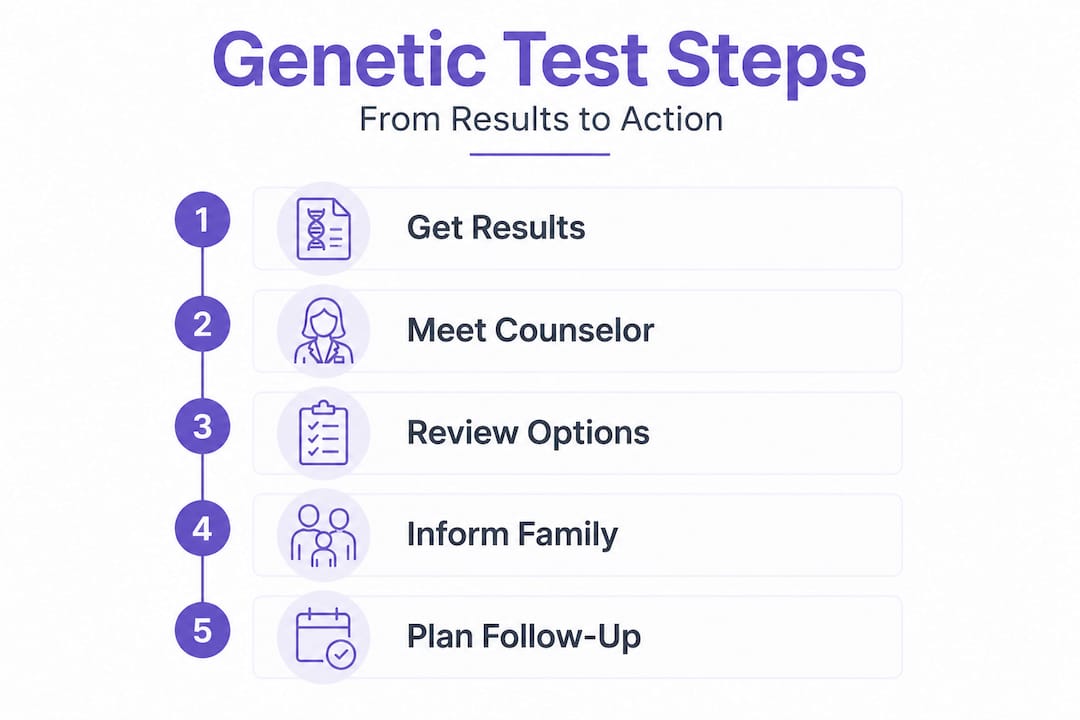
For a broader view of how results connect to your long-term wellness, the genetic testing wellness resource walks through prevention planning in detail. If timeline matters to you, rapid genetic testing explains how modern platforms like GeneMatrixAI deliver results within 72 hours without sacrificing accuracy.
How genetic test results guide your health decisions
With test results in hand, here is how you and your healthcare team can take practical steps based on what you learn. Results are not just data points. They are decision tools.
Positive results for high-penetrance variants like BRCA1 or BRCA2 can unlock:
- Enhanced screening protocols such as annual MRI alongside mammography
- Chemoprevention options, including medications like tamoxifen or raloxifene for breast cancer risk reduction
- Targeted drug eligibility, especially PARP inhibitors for qualifying cancer types
- Risk-reducing surgical discussions with your care team
- Cascade testing for biological relatives who share your genetic line
The surgical data here is compelling. Risk-reducing surgeries like contralateral mastectomy improve distant recurrence-free survival with a hazard ratio of 0.63 and overall survival with a hazard ratio of 0.64. Salpingo-oophorectomy, the removal of the fallopian tubes and ovaries, shows meaningful benefit for BRCA carriers aged 50 and older. These are not minor statistics. A hazard ratio below 1.0 means the intervention reduces the risk of that outcome, and ratios in the 0.63 to 0.64 range represent substantial, clinically meaningful reductions.
Your results also extend their value to your family. If you test positive for a pathogenic BRCA2 variant, each of your first-degree relatives has approximately a 50% chance of carrying the same variant. Sharing your results with siblings, children, and parents gives them the opportunity to test and take action years before cancer could develop.

Pro Tip: Do not file your genetic report away and forget it. Genetic databases update regularly, and a variant classified as uncertain today may be reclassified in two years. Schedule a results review with a genetic counselor every 12 to 24 months to check for reclassifications.
The practical pathway from result to action is covered step by step in the genetic screening guide. And if you want to understand how AI-driven tools are accelerating the translation of genomic data into clinical action, the deep-dive on AI-powered genomics is worth your time.
Our take: The real value and limits of genetic cancer testing
Here is what most articles about genetic cancer testing get wrong: they treat the test itself as the goal. It is not. The test is a question. What you do with the answer is everything.
At Gene Matrix, we see a pattern. People pursue testing with genuine motivation and then receive a VUS result. Without counseling, many respond to a VUS the way they would to a positive result, initiating anxiety, lifestyle disruption, and sometimes unnecessary procedures. Others receive a negative result and assume they face zero cancer risk, abandoning routine screenings entirely. Both responses are wrong, and both stem from treating genetic test results as standalone answers rather than inputs into a larger clinical conversation.
Benefits outweigh risks for high-risk individuals, but overtesting in low-risk populations may yield VUS anxiety without actionable guidance. The strongest recommendation from NCCN and ASCO guidelines is this: testing should happen when results can realistically guide decisions, not simply out of curiosity. Testing without the infrastructure to act on results, meaning access to genetic counselors, informed physicians, and established surveillance protocols, creates more confusion than clarity.
Our view is direct: if you meet high-risk criteria, pursue testing without delay. The evidence for its value is strong. If you are low-risk and driven by general curiosity, a conversation with a genetic counselor before testing is the more responsible first move. And regardless of your result, always close the loop with expert guidance. The science behind these tests is sophisticated, but it is only useful when it connects to a real clinical plan.
Visit our Genetic testing science page to understand exactly how we approach variant interpretation and clinical reporting.
Next steps: Find the right genetic cancer testing partner
For those ready to take the next step, choosing the right testing partner is essential for getting clear, useful answers.
Gene Matrix offers CLIA-certified hereditary cancer panels with genetic testing nationwide access, meaning geography does not limit your ability to get high-quality results. Our GeneMatrixAI platform analyzes your results against a dataset of over 500,000 genetic profiles and delivers an actionable report within 72 hours.

Whether you are a patient exploring your personal risk or a physician looking to integrate precision medicine into your practice, our Precision medicine providers portal connects you directly with our clinical team. Our GeneCancer module covers hereditary breast, ovarian, colorectal, pancreatic, and prostate cancer risk. And for those interested in how we continue to push accuracy forward, our Genetic testing innovation work in research and development reflects our commitment to keeping our tools at the leading edge of the field.
Frequently asked questions
How accurate are genetic cancer tests?
Genetic cancer tests using next-generation sequencing panels are highly accurate for detecting known pathogenic variants, especially in high-penetrance genes like BRCA1 and BRCA2. Accuracy depends on the quality of the laboratory, the scope of the panel, and whether the gene in question has been well-characterized in clinical databases.
Can a genetic cancer test predict all cancer risks?
No. Genetic tests reveal known hereditary cancer risks but cannot account for environmental exposures, lifestyle factors, or cancers driven by non-inherited mutations. Testing is one layer of your overall health picture, not a complete forecast.
What does a "variant of uncertain significance" mean?
A VUS means a genetic change was found, but its role in cancer risk is not yet understood. VUS findings comprise roughly 40% of results and may be reclassified as science advances, which is why regular follow-up with your genetic counselor or testing provider is important.
Is genetic counseling necessary before and after testing?
Yes. Expert counseling is strongly advised both before and after testing. Counseling and guidelines from NCCN and ASCO consistently recommend pre-test counseling to set realistic expectations and post-test counseling to translate results into an actionable health plan.