

TL;DR:
- Gene panel testing analyzes multiple genes simultaneously for comprehensive hereditary risk assessment.
- It offers higher accuracy and broader detection compared to older single-gene or chromosomal tests.
- Results guide personalized prevention strategies, but interpretation of variants, especially VUS, requires ongoing counseling.
Many people assume that a strong family history of cancer is the clearest signal of genetic risk. But family history alone misses a significant portion of hereditary risk, because mutations can skip generations, appear de novo, or exist in genes no one in your family has been tested for. Gene panel testing simultaneously analyzes a set of genes relevant to specific conditions using next-generation sequencing, giving you a far more complete picture than any questionnaire or pedigree chart ever could. This article breaks down what gene panel testing is, how it works, what it can detect, and what your results actually mean for your health.
Table of Contents
- What is gene panel testing?
- How does gene panel testing work? From sample to results
- Applications: Gene panel testing for cancer risk, wellness, and precision medicine
- Benefits, limitations, and what results really mean
- Our perspective: Why gene panel testing matters more than ever
- Take the next step with Gene Matrix
- Frequently asked questions
Key Takeaways
| Point | Details |
|---|---|
| Comprehensive risk detection | Gene panel testing identifies inherited risks that family history alone may miss. |
| High accuracy process | Panels use next-generation sequencing for over 99% sensitivity and actionable results. |
| Expert guidance needed | Genetic counseling is crucial to interpret nuanced or uncertain findings from panel tests. |
| Personalized prevention | Test results guide tailored screening, lifestyle choices, and even early preventive options. |
What is gene panel testing?
Gene panel testing examines multiple genes for disease-associated variants using advanced sequencing technology. Instead of looking at one gene at a time, a panel groups together all the genes known to be relevant to a specific condition or category of conditions. Think of it like running a full diagnostic scan on your car rather than checking one component at a time.
Panels are designed around clinical questions. A hereditary breast and ovarian cancer panel, for example, will include BRCA1, BRCA2, PALB2, ATM, and several other genes that collectively account for the majority of inherited risk. A broader cancer panel might cover 50 to 500 or more genes. The Invitae Cancer panel, as one reference point, covers 64 genes linked to hereditary cancer syndromes.
Here is what makes gene panel testing stand out from older approaches:
- Single-gene testing only checks one gene at a time, which is slow and often misses co-occurring mutations
- Chromosomal microarray looks at large structural changes, not the small variants that drive most hereditary cancer risk
- Whole-exome sequencing reads all protein-coding genes but is more expensive and generates far more uncertain results
- Gene panels strike the right balance: targeted, cost-effective, clinically validated, and fast
The foundation of genetic risk assessment has shifted because of panels. Clinicians can now identify individuals at elevated risk before any symptoms appear, enabling preventive action rather than reactive treatment. This is the core promise of wellness optimization through genomics: knowing your risk early enough to do something meaningful about it.
Statistic callout: Panels covering 50 to 500 genes are now standard in clinical genetics, replacing the slower, less informative single-gene approach that dominated testing just a decade ago.
The accuracy of modern panels is also worth noting. Next-generation sequencing has matured to the point where clinical-grade panels deliver highly reliable results for the variant types most relevant to hereditary disease.
How does gene panel testing work? From sample to results
The process is more straightforward than most people expect. Here is what happens from the moment you provide a sample to the moment you receive your results.
- Sample collection: You provide a blood draw or saliva sample. Both are suitable for DNA extraction, and saliva kits can often be completed at home.
- DNA extraction: The lab isolates your genomic DNA from the sample. Quality and quantity checks ensure the extracted DNA is suitable for sequencing.
- Targeted enrichment: Specific regions of the genome, the genes included in your panel, are captured and amplified. This focuses sequencing resources on the areas that matter clinically.
- Next-generation sequencing: The enriched DNA is sequenced at high depth, meaning each region is read many times over to maximize accuracy.
- Variant analysis: Bioinformatics pipelines compare your sequence to a reference genome, flagging differences called variants. Each variant is then classified based on clinical evidence.
- Confirmation and reporting: Key findings, especially pathogenic variants, are confirmed using orthogonal methods such as Sanger sequencing. A clinical report is generated with interpretation and recommendations.
This panel testing methodology includes sample collection, DNA extraction, targeted sequencing, and variant interpretation with confirmation steps, and it supports greater than 99% sensitivity and specificity for single nucleotide variants and small insertions or deletions. Turnaround time in most clinical settings is two to four weeks, though platforms like GeneMatrixAI deliver actionable results within 72 hours.
Pro Tip: When choosing a testing provider, ask specifically whether they confirm pathogenic findings with a secondary method and whether their variant classification follows ACMG/AMP guidelines. This is the difference between a clinical-grade result and a consumer-grade one.
For a deeper look at the science behind gene panels and how to prepare for DNA testing, both are worth reviewing before you schedule your test. The testing innovations driving faster and more accurate results continue to evolve rapidly.
Applications: Gene panel testing for cancer risk, wellness, and precision medicine
Understanding the process is one thing. Knowing where it delivers real clinical value is what drives the decision to test.

Panels assess hereditary risk for a range of cancers, including breast, ovarian, and colon cancer, and major guidelines from organizations like NCCN and ACMG recommend multi-gene panels when several clinically relevant genes are implicated. The days of testing only BRCA1 and BRCA2 are behind us.
Key genes commonly included in hereditary cancer panels:
- BRCA1 and BRCA2: Breast, ovarian, pancreatic, and prostate cancer risk
- TP53: Li-Fraumeni syndrome, associated with multiple early-onset cancers
- PALB2: Breast and pancreatic cancer risk, often missed in older single-gene protocols
- ATM: Moderate breast cancer risk and ataxia-telangiectasia
- MLH1, MSH2, MSH6, PMS2: Lynch syndrome, driving colorectal and endometrial cancer risk
Beyond cancer, panels are increasingly used for inherited cardiovascular conditions, pharmacogenomics (how your genes affect drug metabolism), and nutrigenomics. Empirical data show that panels find actionable germline risks missed by traditional criteria, which means people who would have been cleared under older guidelines are now receiving findings that change their care.
| Panel type | Genes covered | Target conditions |
|---|---|---|
| Hereditary breast and ovarian | BRCA1, BRCA2, PALB2, ATM, CHEK2 | Breast, ovarian, pancreatic cancer |
| Comprehensive cancer | 50 to 500+ genes | Multiple hereditary cancer syndromes |
| Lynch syndrome | MLH1, MSH2, MSH6, PMS2, EPCAM | Colorectal, endometrial, gastric cancer |
| Pharmacogenomics (PGx) | CYP2D6, CYP2C19, SLCO1B1 and others | Drug metabolism and dosing optimization |
| Cardiovascular | MYBPC3, MYH7, KCNQ1 and others | Cardiomyopathy, arrhythmia syndromes |
Actionable findings from panels directly inform clinical decisions. A pathogenic BRCA2 variant, for example, may lead to enhanced screening, risk-reducing medications, or preventive surgery. For genetic cancer risk and precision medicine, the panel is the starting point for a personalized prevention strategy.
Benefits, limitations, and what results really mean
Gene panel testing is powerful, but it is not a simple yes or no answer. Understanding the full picture helps you use results effectively.
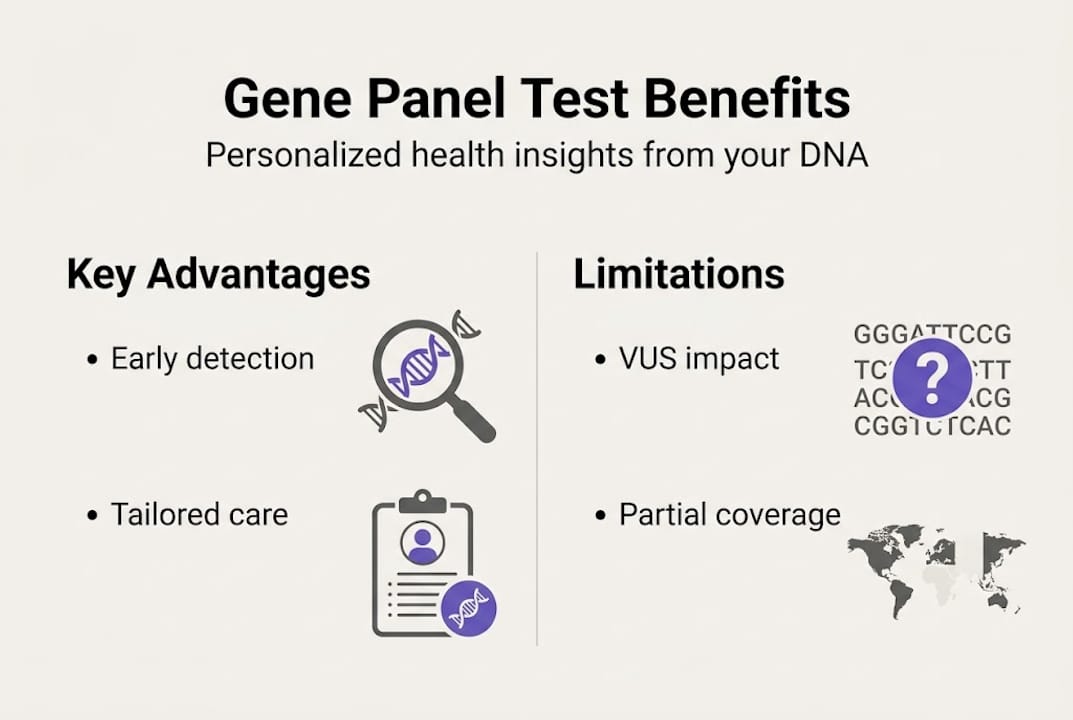
On the benefit side, panels identify actionable germline risks that traditional criteria miss, with a diagnostic yield of roughly 25% in targeted high-risk cohorts. In general population screening, positive findings occur in approximately 1 to 2% of individuals tested. That may sound low, but at population scale, it represents a significant number of people who would otherwise have no idea they carry an elevated risk.
| Feature | Gene panel | Whole-exome sequencing |
|---|---|---|
| Cost | Lower | Higher |
| Turnaround | 2 to 4 weeks | 4 to 8 weeks |
| Genes analyzed | Targeted set (50 to 500+) | All protein-coding genes (~20,000) |
| VUS rate | Moderate | High |
| Clinical utility | High for known syndromes | Broader but less actionable |
The most important limitation is the variant of uncertain significance, or VUS. Up to 40% of tested cases may yield a VUS, a result that cannot currently be classified as harmful or benign. This does not mean your test failed. It means science has not yet accumulated enough evidence to interpret that specific variant.
"A VUS is not a dead end. It is a data point in an evolving conversation between your genome and the scientific literature."
Panels are also efficient but miss certain variant types, including large structural rearrangements and variants in non-coding regions. Counseling is critical to interpret VUS findings and to place any result in the context of your personal and family history.
Pro Tip: Request that your provider offer periodic reanalysis of VUS findings. As databases grow and evidence accumulates, a VUS today may be reclassified as pathogenic or benign within a few years.
For practical guidance on navigating these results with your family, family genetic testing tips and insights on AI-powered genomics benefits are both useful resources.
Our perspective: Why gene panel testing matters more than ever
Most conversations about genetic testing focus on the technology. We think the bigger issue is the gap between what testing can reveal and what people actually do with that information.
Relying on family history alone is a structural flaw in how risk is assessed. Many people with significant hereditary risk have no documented family history, either because relatives were never tested, died young from other causes, or simply never discussed health openly. Panels identify actionable germline risks missed by traditional criteria, and that finding alone should shift how clinicians approach screening eligibility.
The anxiety around a VUS result is real, but it is often mismanaged. A VUS is not a diagnosis. It is an invitation to stay engaged with your genomic data over time. Providers who offer reanalysis and ongoing counseling turn uncertainty into a manageable, evolving picture rather than a source of fear.
Accessibility matters as much as accuracy. The best panel in the world is useless if the person who needs it cannot access it, afford it, or understand the results. Rapid genetic testing combined with expert interpretation closes that gap meaningfully. Gene panel testing should be treated as an ongoing health tool, not a one-time event.
Take the next step with Gene Matrix
If this article has made one thing clear, it is that gene panel testing is not just for people with a dramatic family history. It is for anyone who wants to move from reactive healthcare to proactive, personalized prevention.

Gene Matrix offers CLIA-certified hereditary cancer screening, pharmacogenomics, and wellness panels powered by GeneMatrixAI, trained on over 500,000 genetic profiles. Results are delivered within 72 hours with expert interpretation built in. Explore our science to understand the methodology behind every report, or review subscription plans to find the right fit for your health goals. Your genome has answers. We help you read them.
Frequently asked questions
What types of conditions can gene panel testing detect?
Panels assess hereditary risk for various conditions including cancer syndromes, cardiovascular disorders, rare diseases, and inherited metabolic conditions by analyzing multiple clinically relevant genes simultaneously.
How accurate are gene panel tests?
Modern gene panel tests achieve greater than 99% sensitivity and specificity for single nucleotide variants and small insertions or deletions using deep next-generation sequencing.
What happens if my panel test reports a variant of unknown significance (VUS)?
A VUS means current evidence is insufficient to classify the variant as harmful or benign. VUS are common, up to 40% of results, and genetic counseling combined with periodic reanalysis is the recommended path forward.
Is gene panel testing recommended for healthy individuals?
Panels are recommended when multiple clinically relevant genes are implicated by family history or risk factors, and some programs now offer community-based screening for unselected populations who want proactive insight.