

TL;DR:
- Precision medicine personalizes prevention and treatment based on individual genetics and family history.
- Preparing documents and consulting genetic counselors ensure effective risk assessment and testing.
- Ongoing engagement, family communication, and AI tools enhance the success of precision health strategies.
Traditional medicine often treats everyone the same way, using average dosages and standard screening schedules that may not reflect your actual genetic makeup. That approach can miss real risks hiding in your DNA. Precision medicine offers a stepwise path to personalized health, matching prevention, screening, and treatment to your unique biology. For families with a history of cancer, complex medication needs, or simply a desire to get ahead of health risks, this guide breaks down every step so you can move from uncertainty to action with confidence.
Table of Contents
- What you need before starting precision medicine
- Step-by-step process of precision medicine
- How precision medicine works for hereditary cancer risk
- Using pharmacogenomics for safer medication choices
- Common pitfalls, privacy, and making it work for your family
- Our perspective: Beyond steps—what makes precision medicine actually work
- Take the next step with Gene Matrix
- Frequently asked questions
Key Takeaways
| Point | Details |
|---|---|
| Start with expert support | Genetic counseling and accurate family history are key to safe, effective precision medicine. |
| Follow the stepwise process | Risk assessment, testing, interpretation, and personalized care work together for best results. |
| Pharmacogenomics lowers risk | Medication tailored to your DNA can cut serious side effects by about 30 percent. |
| Think beyond the individual | Cascade testing can protect at-risk relatives and improve outcomes for whole families. |
| Plan for privacy | Be proactive about insurance, consent, and choosing trusted providers for data protection. |
What you need before starting precision medicine
Now that you understand why precision medicine matters, let's gather what you'll need to get started. The single most important thing you can do before your first appointment is build a detailed picture of your family's health history. Think three generations back: grandparents, parents, aunts, uncles, siblings, and children. Note any cancers, heart disease, psychiatric conditions, or medication reactions. This information directly shapes which tests your provider will recommend.
Risk assessment and genetic counseling is the first step in any well-structured precision medicine plan. A certified genetic counselor reviews your history, identifies red flags, and helps you decide whether testing makes sense. You can find board-certified counselors through the National Society of Genetic Counselors or ask your primary care physician for a referral.
Before your first consultation, gather the following:
- Personal health history: Diagnoses, surgeries, chronic conditions, and current medications
- Family health history: Cancer types, age at diagnosis, and any known genetic mutations
- Previous test results: Prior genetic panels, pathology reports, or imaging findings
- Insurance information: Your plan details and any prior authorization requirements
- Questions for your counselor: Written out in advance so nothing gets forgotten
Review genetics guidelines from trusted sources before your visit so you arrive informed. Understanding genetic risk assessment basics will help you ask sharper questions and understand the answers your counselor gives you.
| Preparation task | Why it matters | When to do it |
|---|---|---|
| Build family health history | Guides risk assessment | Before first appointment |
| Find a genetic counselor | Ensures expert interpretation | Before testing |
| Gather insurance details | Avoids surprise costs | Before testing |
| List current medications | Needed for PGx evaluation | Before testing |
| Review trusted guidelines | Helps you ask better questions | Before appointment |
Pro Tip: Use a free family health history tool like the Surgeon General's "My Family Health Portrait" to organize your records digitally before your first visit.
Step-by-step process of precision medicine
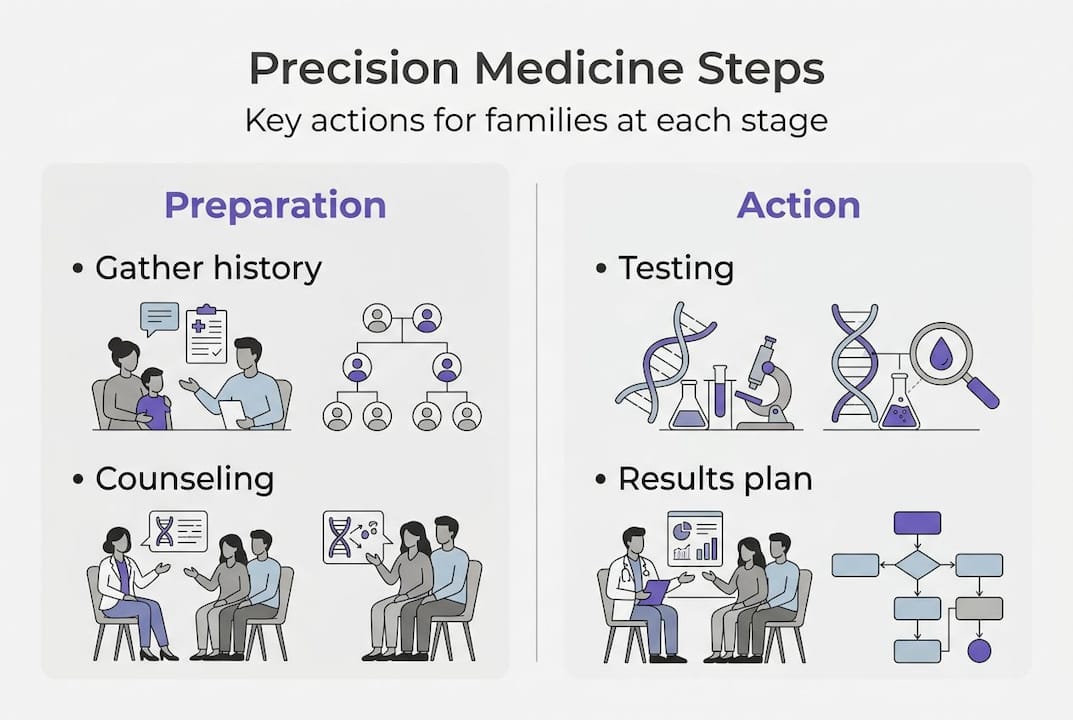
With your preparation complete, let's break down how each step actually unfolds. The core steps are assessment, testing, interpretation, management, and monitoring, and each one builds on the last. Skipping a step is like building a house without a foundation.
- Risk assessment and counseling: Your genetic counselor reviews your personal and family history, identifies which genes to evaluate, and sets expectations for what testing can and cannot tell you.
- Genetic testing: Depending on your risk profile, this may include hereditary cancer panels, tumor profiling, or pharmacogenomic (PGx) testing. Saliva or blood samples are typically used.
- Interpreting results: A clinical geneticist or counselor explains what your variants mean, distinguishing between pathogenic variants, variants of uncertain significance, and benign findings.
- Personalized management: Based on results, your care team builds a plan. This could mean enhanced screening schedules, preventive surgery, targeted therapy, or medication adjustments.
- Ongoing monitoring and cascade testing: Your risk picture changes over time. Regular follow-ups and sharing results with family members (cascade testing) keep everyone protected.
NCCN guidelines inform risk management and help clinicians decide which genes to include in panels and what surveillance protocols to follow. Staying aligned with these guidelines ensures your care reflects current evidence. You can also explore precision medicine trends to see how AI is accelerating each of these steps.
For a deeper look at stepwise process details, clinical literature confirms that structured, sequential approaches produce better outcomes than ad hoc testing.
| Step | Purpose | Key actions |
|---|---|---|
| Risk assessment | Identify who needs testing | History review, counseling |
| Genetic testing | Detect variants | Sample collection, lab analysis |
| Result interpretation | Understand findings | Counselor review, variant classification |
| Personalized management | Act on results | Screening plans, treatment changes |
| Monitoring and cascade testing | Sustain protection | Follow-ups, family notification |
Pro Tip: Keep a dedicated folder (physical or digital) for all test reports, counseling notes, and provider communications. You will reference these documents repeatedly over the years.
How precision medicine works for hereditary cancer risk
Precision medicine's impact is especially powerful for hereditary cancers. Here's how the steps work in action. When a family has multiple members diagnosed with breast, ovarian, colorectal, or other cancers, especially at younger ages, that pattern signals a possible hereditary cause worth investigating.
Pre-test counseling comes first. Your counselor explains what multigene panel testing involves, what results might look like, and how findings could affect you and your relatives emotionally and medically. This conversation is not optional. It is essential.

BRCA and multigene testing identifies risk and guides early screening decisions. Panels today can evaluate dozens of genes simultaneously, giving a far more complete picture than single-gene tests ever could. Detection rates in high-risk patients have improved significantly with modern panel testing.
Key genes and their typical screening protocols include:
- BRCA1/BRCA2: Annual MRI and mammogram starting at age 25 to 30; risk-reducing surgery discussions
- Lynch syndrome genes (MLH1, MSH2, MSH6, PMS2): Colonoscopy every 1 to 2 years starting at 20 to 25
- PALB2: Enhanced breast surveillance similar to BRCA protocols
- ATM and CHEK2: Individualized screening based on family history and variant type
Cascade testing means sharing your results with first-degree relatives so they can be tested too. Learn more about family cascade testing tips and review cascade testing protocols to understand how this process is structured.
Early identification of a hereditary cancer variant can shift a family's trajectory from late-stage diagnosis to prevention. That is not an overstatement. It is what the data consistently shows.
Post-test counseling closes the loop, helping you process results and build a surveillance plan with your medical team.
Using pharmacogenomics for safer medication choices
Precision medicine isn't just about preventing disease. It's also key to safer and more effective medication choices. Pharmacogenomics, or PGx, studies how your genes affect the way your body processes drugs. Two people taking the same antidepressant or blood thinner can have completely different responses based on their genetic variants.
PGx reduces adverse drug reactions by 30%, which is a meaningful reduction for patients managing chronic conditions. Patients on warfarin, clopidogrel, SSRIs, or opioids benefit most, but PGx insights apply across dozens of drug classes.
Genes like CYP2C19 and CYP2C9 are among the most studied. A variant in CYP2C19, for example, can make a patient a poor metabolizer of clopidogrel, a common heart medication, meaning the drug may not work as intended and a different therapy would be safer.
Questions to ask your provider about PGx:
- Which of my current medications have known gene-drug interactions?
- Which genes should be included in my panel based on my prescriptions?
- How will my results be stored and updated as new drugs are added?
- Will my results be shared with my pharmacist and specialists?
- How often should I revisit my PGx profile as my medications change?
Explore pharmacogenomics introduction from the NIH for a solid foundation. You can also read about genetic testing for wellness to see how PGx fits into a broader prevention strategy.
Pro Tip: Share your PGx report with every provider who prescribes medications for you, including dentists and urgent care physicians. Drug-gene interactions do not pause because you are seeing a new doctor.
Common pitfalls, privacy, and making it work for your family
Even with great benefits, there are challenges, but practical steps can help your family succeed. Privacy, cost, and equity are major concerns in precision medicine adoption, and ignoring them can derail even the best intentions.
Insurance coverage is inconsistent. Some plans cover hereditary cancer panels when NCCN criteria are met, but PGx testing is often out of pocket. Costs range from a few hundred to several thousand dollars depending on the panel and lab.
Practical solutions for common obstacles:
- Insurance gaps: Work with a genetic counselor to document medical necessity; appeal denials with clinical evidence
- Cost concerns: Ask about financial assistance programs through testing labs or nonprofits like FORCE (Facing Our Risk of Cancer Empowered)
- Data privacy: Understand that the Genetic Information Nondiscrimination Act (GINA) protects you from discrimination by employers and health insurers based on genetic data
- Family communication: Use written summaries from your counselor to share results with relatives in a clear, non-alarming way
- Health equity: Seek out community health centers or academic medical centers with sliding-scale genetic services
Review privacy in precision medicine guidance before signing any consent forms. Understanding rapid genetic testing options can also help you move forward without unnecessary delays. When making family decisions about testing, open conversations early reduce stress later. Building a culture of wellness through genetic testing in your family starts with one honest conversation.
Pro Tip: Before signing a consent form with any lab or provider, ask specifically how your genetic data will be stored, who can access it, and whether it will ever be sold or shared with third parties.
Our perspective: Beyond steps—what makes precision medicine actually work
Now that we've dissected the process and addressed obstacles, here's what really unlocks the power of precision medicine. Checklists and step-by-step guides are valuable starting points, but they are not enough on their own. The families who get the most out of precision medicine are the ones who advocate for themselves, ask hard questions, and stay engaged long after the initial test.
AI-driven analysis, multiomics data integration, and validated frameworks like NCCN and CPIC guidelines are raising the quality of genetic interpretation every year. At Gene Matrix, our platform is trained on 500,000+ genetic profiles, which means the insights we deliver reflect patterns that individual clinicians simply cannot see alone. Explore AI power in precision medicine to understand why that matters for your family.
Genetics is not a one-time event. It is a living conversation between your biology and your choices. The families who treat it that way will be the ones who benefit most across generations.
Take the next step with Gene Matrix
If you're ready to start, Gene Matrix offers resources to guide every step of your precision medicine journey.

From hereditary cancer risk assessment to pharmacogenomic medication optimization, our CLIA-certified platform delivers actionable results within 72 hours. Our AI-powered GeneMatrixAI platform covers everything from BRCA1/BRCA2 screening to drug-gene interaction analysis, all designed for individuals and families who want real answers, not generic advice. Explore DNA testing subscription plans built for ongoing precision health, or learn more about our hereditary cancer genetic testing capabilities. Your family's health story is already written in your DNA. We help you read it.
Frequently asked questions
What documents or information should I gather before starting precision medicine?
Collect your family health history, current medications, and any past genetic test results before your first consultation. Personal and family history are foundational to accurate risk assessment.
How long does the precision medicine testing process take?
The core steps often span 2 to 4 weeks from consultation to results. NGS testing turnaround is typically about 2 weeks for most panels.
Will insurance cover genetic testing for hereditary cancer risk?
Coverage varies, but many insurers follow NCCN criteria for genetic testing approval, particularly when family history meets established thresholds.
How can families address privacy concerns with genetic data?
Ask providers about data storage policies, document your consents, and understand that laws like GINA offer protections. Privacy and equity challenges are real but manageable with the right questions.
Do I need ongoing follow-up after initial testing?
Absolutely. Ongoing monitoring and cascade testing are built into best-practice precision medicine to update risk profiles and protect family members over time.
Recommended
- Precision medicine trends and AI solutions for 2026
- Our Science — Genetic Testing Research, Technology & Lab Certifications | Gene Matrix AI
- Family genetic testing tips for informed health choices
- Prepare for DNA testing: step-by-step guide to accurate results
- La Revolución de la Medicina Regenerativa: Un Futuro Cercano ✔