

TL;DR:
- Genetic testing offers insights into wellness traits like vitamin absorption, exercise response, and medication metabolism.
- It helps identify genetic risks for preventable diseases, enabling early screening and proactive measures.
- Professional counseling and ongoing re-evaluation are essential for accurate interpretation and long-term benefit.
Most people assume genetic testing is strictly for diagnosing rare inherited diseases or confirming a family history of illness. That assumption leaves enormous value on the table. Today, genetic testing reveals far more: how your body processes vitamins, which exercises suit your recovery style, whether a prescribed medication might cause you harm, and where your cancer risk actually stands. This article walks you through the real-world benefits of genetic testing for wellness, disease prevention, and medication optimization, while being honest about its limits and how to use results wisely.
Table of Contents
- How genetic testing powers personalized wellness
- Understanding your genetic risk for disease prevention
- Medication optimization: Pharmacogenetics and your treatments
- Limitations, privacy concerns, and the importance of guidance
- What most people miss about genetic testing and wellness
- Next steps: Safe, certified wellness genetic testing
- Frequently asked questions
Key Takeaways
| Point | Details |
|---|---|
| Insightful wellness planning | Genetic testing offers personalized guidance for nutrition, exercise, and lifestyle. |
| Actionable disease prevention | Early risk detection enables proactive screening and prevention strategies. |
| Safer medication choices | Pharmacogenetic tests reduce medication side effects and boost effectiveness. |
| Knowledge boundaries | Genetic testing is powerful but not all-knowing—pair with expert advice. |
How genetic testing powers personalized wellness
Genetic testing has moved well beyond the clinic. It now sits at the center of personalized wellness planning for individuals and families who want to stop guessing and start acting on real biological data. Genetic testing reveals information beyond disease risk, including nutrition sensitivity, exercise response, and medication metabolism. That shift changes everything about how you approach daily health decisions.
Not all genetic panels are created equal. Some focus narrowly on disease risk, while others are built specifically for wellness optimization. Here is a quick comparison:
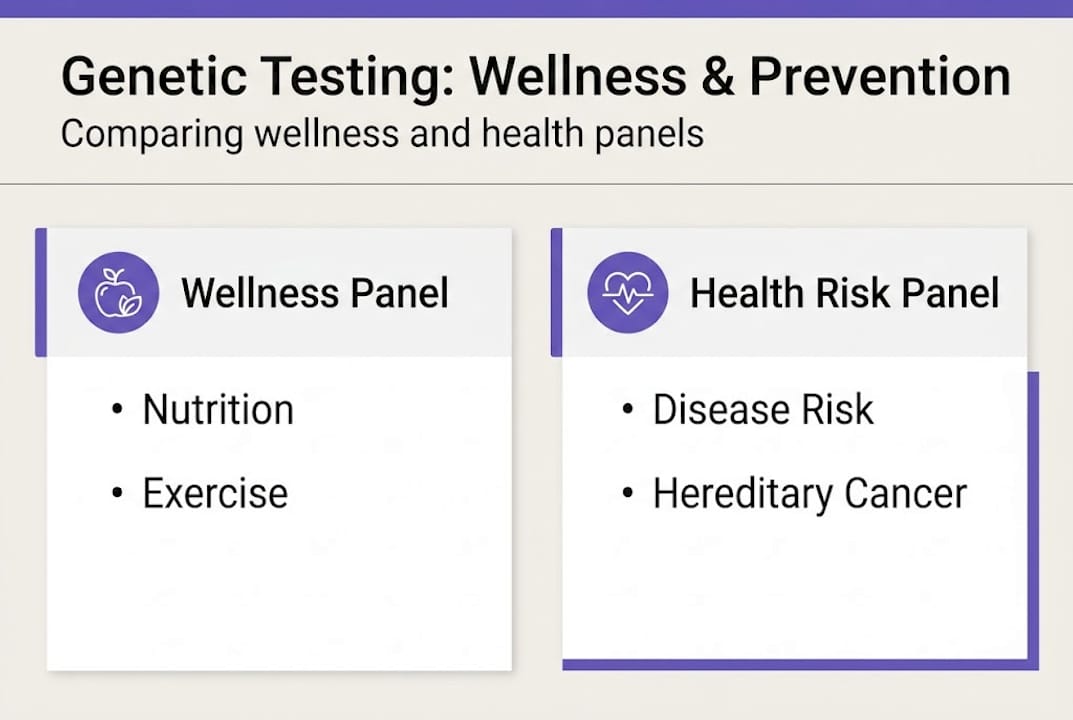
| Feature | Wellness panel | Health risk panel |
|---|---|---|
| Nutrition sensitivity | Yes | Limited |
| Exercise and recovery | Yes | No |
| Vitamin metabolism | Yes | Sometimes |
| Cancer risk markers | Sometimes | Yes |
| Medication metabolism | Sometimes | Yes |
| Family planning insights | Limited | Yes |
Choosing the right panel depends on your goals. If you want to fine-tune your lifestyle, a wellness-focused panel gives you the most actionable data. If you have a family history of cancer or other serious conditions, a health risk panel is the smarter starting point. Many people benefit from both.
Here is what a quality wellness genetic test can actually tell you:
- How efficiently your body absorbs vitamin D, B12, and folate
- Whether you carry variants linked to lactose or gluten sensitivity
- Your genetic predisposition for endurance versus power-based exercise
- How quickly you recover from intense physical activity
- Your tendency toward inflammation after exertion
- Caffeine metabolism speed and its effect on sleep quality
These are not abstract facts. They translate directly into smarter food choices, better workout programming, and more targeted supplement use. For families, understanding genetic testing for your family creates a shared wellness roadmap that benefits everyone across generations.
Pro Tip: Raw genetic data alone does not change your health. Pair your results with a registered dietitian, a sports medicine professional, or a genetic counselor to turn insights into a real action plan. The science behind genetic analysis matters, but so does the human expertise that helps you apply it.
Understanding your genetic risk for disease prevention
While personalized wellness is important, understanding genetic risk for diseases, especially preventable ones, is equally vital. Genetic testing for disease risk is not about receiving a verdict. It is about gaining the kind of early warning that lets you act before symptoms ever appear.
Consider what the data shows about hereditary cancers. Roughly 5 to 10 percent of all cancers are directly linked to inherited gene mutations, and identifying those mutations early can be lifesaving. Genetic risk assessment allows for earlier screening and preventive actions for individuals at increased cancer risk, making it one of the most powerful tools in proactive medicine.
Here is how cancer risk compares with and without genetic data:
| Scenario | Average population risk | With genetic risk data |
|---|---|---|
| Breast cancer (BRCA1/2) | ~12% lifetime risk | Up to 72% identified early |
| Colorectal cancer (Lynch) | ~4% lifetime risk | 3x higher risk flagged early |
| Ovarian cancer | ~1.2% lifetime risk | Up to 44% in BRCA carriers |
| Prostate cancer | ~13% lifetime risk | Elevated risk confirmed sooner |
If your results show elevated risk, that is not a diagnosis. It is a signal to act. Here are the steps to take:
- Schedule earlier or more frequent screenings based on the specific risk identified
- Consult a genetic counselor to fully understand what your results mean in context
- Discuss preventive options with your doctor, including lifestyle changes or prophylactic treatments
- Inform close family members so they can consider testing for the same variants
- Build a long-term monitoring plan that evolves as new research emerges
The global impact of genetic testing on cancer outcomes is measurable. Patients who know their risk earlier get screened sooner, catch disease at more treatable stages, and in many cases avoid it altogether. Genetics is not destiny. It is opportunity.
Medication optimization: Pharmacogenetics and your treatments
Genetic insight also affects not just what you eat or your cancer risk, but how your body processes medications. This field is called pharmacogenomics, or PGx, and it is one of the fastest-growing areas of precision medicine.

Your genes influence how quickly you break down drugs, whether a standard dose will be effective, and whether you are likely to experience serious side effects. Two people can take the same antidepressant at the same dose and have completely different outcomes, not because one is responding poorly, but because their liver enzymes process the drug differently.
Medications commonly affected by genetic variation include:
- Antidepressants (SSRIs like citalopram and sertraline)
- Blood thinners (warfarin dosing is highly gene-dependent)
- Painkillers (codeine can be dangerous in ultra-rapid metabolizers)
- Statins (muscle-related side effects tied to SLCO1B1 variants)
- Antiplatelet drugs (clopidogrel effectiveness varies with CYP2C19)
- Antipsychotics (metabolism speed affects both efficacy and side effects)
"Up to 50% of medications fail the first time due to genetic factors, making pharmacogenetic testing one of the most practical tools for reducing trial-and-error prescribing."
Pharmacogenetic testing can reduce trial-and-error prescriptions, leading to better health outcomes and fewer adverse reactions. That matters especially for people managing chronic conditions who cannot afford months of adjustment periods.
Pro Tip: Before starting any new prescription, ask your doctor whether a pharmacogenomic test is appropriate. It is a simple, one-time test that can inform medication choices for life. Rapid genetic testing makes this easier than ever, with results available within days rather than weeks.
Limitations, privacy concerns, and the importance of guidance
No wellness tool is perfect, so it is critical to understand what genetic testing cannot tell you and how to get the most accurate, ethical results. Being informed about limitations protects you from false confidence or unnecessary anxiety.
Here is what genetic testing genuinely cannot do:
- Detect every risk: Most panels cover known variants. Unknown or rare mutations may not appear.
- Guarantee outcomes: A negative result does not mean zero risk. Lifestyle and environment still matter enormously.
- Provide certainty on variants of uncertain significance: Some findings are flagged but not yet fully understood by science.
- Replace clinical diagnosis: A genetic test is not a medical diagnosis. It informs decisions, it does not make them.
- Predict timing: Even elevated risk variants cannot tell you when or whether disease will develop.
Privacy is a real concern worth taking seriously. Before choosing a provider, ask these questions: Is the lab CLIA-certified? Who owns your data after testing? Can your results be shared with insurers or third parties without your consent? Reputable providers answer these questions clearly and in writing. The Gene Matrix app is built with security and user data control as foundational features, not afterthoughts.
"Interpreting wellness-related genetic test results should always include counseling from a genetics expert to avoid confusion or false reassurance."
Professional genetic counseling is not optional for complex results. A counselor helps you understand what a variant actually means for your specific situation, your family history, and your health goals. They also help you avoid the trap of over-interpreting a result that may have limited clinical significance right now.
What most people miss about genetic testing and wellness
Here is the part most articles skip: a single genetic test is not a wellness strategy. It is a starting point. The people who get the most lasting value from genetic testing are the ones who treat their results as living information, not a one-time report to file away.
New research constantly updates what specific variants mean. A finding that was classified as uncertain in 2022 may have clear clinical guidance by 2026. That means revisiting your results with a professional every few years is genuinely worthwhile, not just cautious advice.
The families who benefit most are those who approach testing together, sharing relevant findings and building a collective health picture. Family-oriented genetic testing creates a sustained wellness strategy rather than an isolated individual insight. It shifts the conversation from "what might happen to me" to "what can we do together to stay well."
The real power is in integration: combining your genetic data with regular checkups, updated lifestyle choices, and ongoing expert guidance. That is where precision medicine actually delivers on its promise.
Next steps: Safe, certified wellness genetic testing
If you are ready to move from curiosity to action, the quality of your testing provider matters as much as the test itself. At Gene Matrix, we are a CLIA-certified, AI-powered genomics company built specifically for individuals and families who want real, actionable health intelligence.

Our platform delivers results within 72 hours, trained on over 500,000 genetic profiles, covering everything from hereditary cancer screening to pharmacogenomics and nutrigenomics. You can learn about our science to understand exactly how we analyze your data, and explore flexible subscription plans designed to make precision medicine accessible without compromise. Privacy, certified accuracy, and expert-backed insights are built into everything we do.
Frequently asked questions
What types of wellness insights can genetic testing reveal?
Genetic testing can uncover how your body processes nutrients, your sensitivity to exercise types, and how you metabolize medications. Genetic testing provides nutrition, fitness, and metabolism insights that directly inform daily health decisions.
Can genetic tests really predict if I'll get cancer?
No test can guarantee you will get or avoid cancer, but genetic testing shows if you carry variants that increase your risk so you can take preventive action. Genetic risk assessment identifies increased likelihood, not certainties.
Will my DNA data be kept private and secure?
Reputable providers use advanced encryption and strict access controls, and you always retain control over who sees your results. Always verify that your provider is CLIA-certified and has a clear, written data privacy policy.
Do I need a doctor to interpret my genetic test results?
Professional guidance is strongly recommended to ensure you understand your results and avoid misinterpretation. Counseling ensures accurate and informed use of results, especially for complex or elevated-risk findings.