

TL;DR:
- Genomic profiling analyzes DNA variations to assess disease risks, treatment responses, and personalized health strategies.
- It includes germline, somatic tumor, and pharmacogenomic tests, guiding early detection and tailored therapies.
- Clinical-grade testing with professional counseling offers accurate, actionable insights, unlike consumer direct-to-consumer kits.
Most people assume a DNA test is a DNA test. You spit in a tube, get ancestry percentages back, and feel mildly curious about your distant relatives. But genomic profiling does something fundamentally different: it analyzes your genetic material to identify variations tied to disease risk, cancer drivers, treatment response, and personalized health strategies. This is not about where your great-grandparents came from. It is about whether your body is wired to develop hereditary cancer, how your liver processes a common blood thinner, or why an antidepressant works for your sibling but not for you. This article breaks down exactly what genomic profiling is, what it can tell you, and how to use it wisely.
Table of Contents
- What is genomic profiling and how does it work?
- Applications and impact: From cancer risk to medication guidance
- Comparing clinical and direct-to-consumer (DTC) genomic profiling
- Navigating the debate: Benefits, challenges, and what to consider
- Our perspective: How to truly benefit from genomic profiling
- Explore advanced genomic solutions with Gene Matrix
- Frequently asked questions
Key Takeaways
| Point | Details |
|---|---|
| Genomic profiling basics | It analyzes your genes to assess disease risks, guide treatments, and support personalized prevention. |
| Types and uses | Different methods help uncover hereditary risks, match cancer therapies, and optimize medication. |
| DTC vs. clinical | Clinical-grade tests are more reliable than at-home DNA kits for medical decisions. |
| Expert guidance matters | Genetic counseling and consultation improve the quality and value of profiling results. |
What is genomic profiling and how does it work?
Genomic profiling is the process of reading your DNA at a clinically meaningful level to generate actionable health insights. It is not a single test. It is a category of analyses, each targeting a different biological question. Traditional genetic testing might look at one or two genes. Genomic profiling typically examines hundreds to thousands of genes at once, using next-generation sequencing to identify variants that matter for your health.
There are three main types worth knowing:
- Germline profiling looks at inherited DNA variants present in every cell of your body. This is how hereditary cancer risk is assessed, including BRCA1 and BRCA2 mutations linked to breast and ovarian cancer, and Lynch syndrome variants tied to colorectal cancer.
- Somatic tumor profiling analyzes mutations that develop within a tumor itself, not inherited, but acquired. Oncologists use this to match a cancer patient to targeted therapies or immunotherapy options.
- Pharmacogenomics (PGx) examines how your genes influence drug metabolism. Think of it as your body's instruction manual for medications. It explains why some patients need a different dose of warfarin or why codeine can be unsafe for certain individuals.
The process itself is straightforward. You provide a biological sample, usually a saliva swab or blood draw. The lab extracts DNA, sequences relevant regions, and an AI-powered system cross-references variants against clinical databases. The result is a structured report mapping your genetic landscape to real health risks and decisions.
"Genomic profiling analyzes an individual's or tumor's genetic material to identify variations associated with disease risk, cancer drivers, treatment response, and personalized health strategies."
Think of germline profiling like checking the blueprint your house was built from. Somatic profiling is more like inspecting what changed after years of weather damage. And pharmacogenomics is your user manual for which tools work best on that specific structure.
Explore personalized medicine overview to understand how these results connect to treatment decisions. If you are weighing which test to start with, gene panel testing details can help clarify which panel fits your situation.
Pro Tip: Before ordering any test, document your family health history for at least two generations. Knowing which cancers, cardiovascular conditions, or psychiatric diagnoses appear in your family tree dramatically sharpens the clinical value of your genomic results.
Applications and impact: From cancer risk to medication guidance
Knowing what genomic profiling is becomes far more meaningful when you see what it changes in practice. These are not abstract findings. They translate into earlier screenings, different drug choices, and sometimes life-saving interventions.
Here is a summary of the major application areas:
| Application | What it reveals | Real-world impact |
|---|---|---|
| Hereditary cancer risk | BRCA1/2, Lynch, ATM variants | Earlier screening, prophylactic options |
| Tumor genomic profiling | Acquired mutations, TMB, MSI | Matched targeted therapy or immunotherapy |
| Pharmacogenomics | CYP enzyme variants, drug metabolism | Safer prescribing, fewer adverse reactions |
| Polygenic risk scores | Combined SNP-based disease risk | Prevention-focused lifestyle and monitoring |
For hereditary cancer, multigene panels guided by NCCN clinical standards are the clinical gold standard. They assess not just BRCA1 and BRCA2, but a broader set of genes including PALB2, CHEK2, and MLH1 that contribute to breast, ovarian, colorectal, and pancreatic cancer risk.
In advanced cancer care, comprehensive genomic profiling (CGP) changes treatment decisions in measurable ways. Clinical data shows that CGP detects actionable alterations in 16.6% of cases at the highest evidence level, with approximately 8.1% qualifying for approved targeted therapies. A tumor mutational burden (TMB) score at or above 20 predicts a stronger response to immunotherapy, which makes CGP a critical tool before selecting treatment.

For medications, pharmacogenomics is one of the most underused tools in mainstream healthcare. A PGx report can flag that a patient is a poor metabolizer of certain psychiatric medications, preventing months of ineffective treatment and unnecessary side effects.
Here is a practical sequence for using genomic profiling strategically:
- Start with germline profiling if you have a family history of cancer or early-onset disease.
- Add a PGx panel if you are managing multiple medications or experiencing unexpected drug reactions.
- Use polygenic risk scores as a supplement, not a standalone, for common conditions like heart disease or type 2 diabetes.
- Request tumor profiling if you or a loved one receives an advanced cancer diagnosis.
- Review all results with a certified genetic counselor or clinician before making any medical changes.
The benefits of AI-powered genomics are particularly relevant here: AI-driven platforms can cross-reference your variants against constantly updated clinical databases, improving the speed and accuracy of actionable findings. See also this precision medicine practical guide for a structured approach for families navigating these decisions together.
Comparing clinical and direct-to-consumer (DTC) genomic profiling
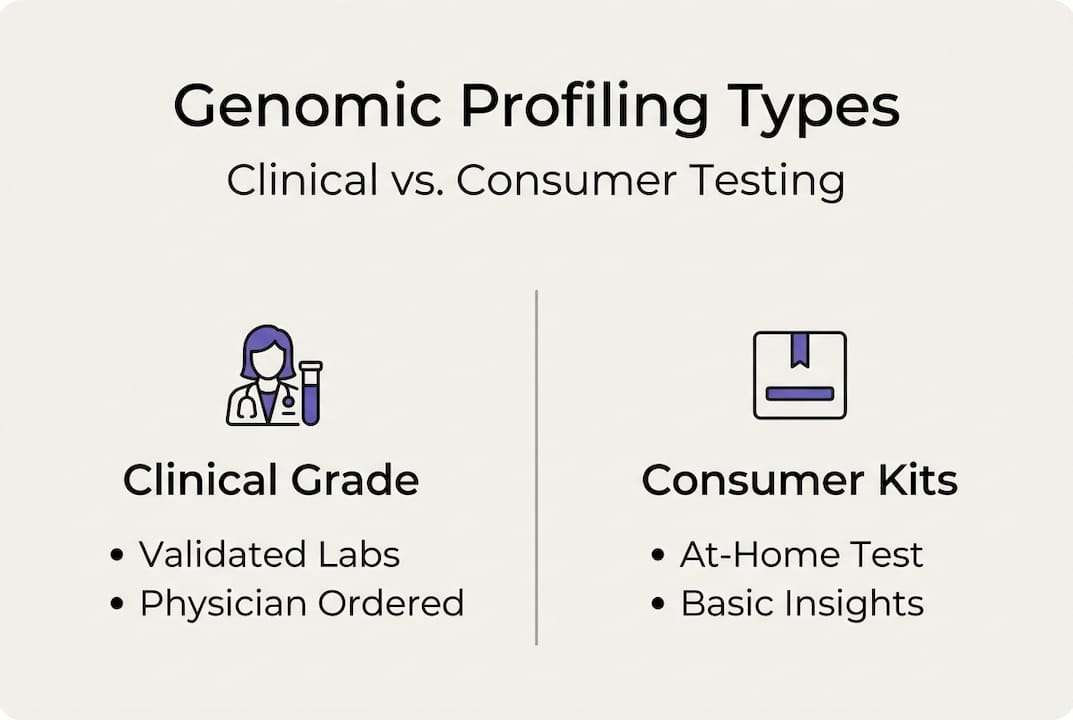
Not all genomic tests are created equal. Understanding the difference between clinical-grade profiling and direct-to-consumer (DTC) kits is essential before spending money or making health decisions based on results.
| Feature | Clinical genomic profiling | DTC kits (e.g., 23andMe) |
|---|---|---|
| Accuracy | High, validated, CLIA-certified labs | Variable, limited SNP arrays |
| Gene coverage | Hundreds to thousands of genes | Narrow, consumer-focused panels |
| Medical supervision | Required, integrated with care team | None, self-interpretation |
| Ancestry population coverage | Broad, clinically validated | Often skewed toward European ancestry |
| Privacy protections | HIPAA-regulated | Varies by company policy |
| Clinical utility | High for cancer, PGx, rare disease | Low for actionable medical decisions |
DTC genomic profiling from companies like 23andMe has real value for curiosity and broad wellness awareness. However, DTC profiling carries notable limitations: inconsistent risk predictions, limited clinical utility for common diseases, poor performance in non-European ancestries, and significant ethical and data privacy concerns.
This matters more than many users realize. A negative result on a DTC BRCA screen is not the same as a negative result on a clinical BRCA panel. DTC tests check a small number of known variants. Clinical tests sequence the entire gene, catching mutations that a consumer kit would miss entirely.
Key considerations when evaluating any genomic test:
- Who performs the lab analysis and what is their certification status?
- Does the test cover the specific genes relevant to your personal or family history?
- Will a clinician or genetic counselor review the results with you?
- How is your raw genetic data stored and who can access it?
For anyone with a meaningful personal or family health history, rapid genetic testing through a clinical provider is the more reliable path. Understanding how genetic testing supports prevention is also a useful starting point, as is reviewing genetic risk assessment insights to frame what risk scores actually mean for your daily decisions.
Pro Tip: Always have your genomic results reviewed by a board-certified genetic counselor or physician before acting on them. Raw data without clinical context can be confusing and, in some cases, genuinely misleading.
Navigating the debate: Benefits, challenges, and what to consider
Genomic profiling has strong clinical advocates and equally vocal critics. Understanding both sides helps you make smarter decisions without falling for either hype or excessive skepticism.
Experts broadly agree on a few things. For hereditary cancer syndromes and pharmacogenomics, the clinical evidence is solid. Identifying a BRCA1 variant in a high-risk individual enables surveillance and risk-reduction strategies that demonstrably save lives. PGx-guided prescribing reduces adverse drug events and improves treatment outcomes in documented studies.
"Proponents emphasize personalized insights and behavioral change; critics highlight lack of consensus on markers, cost-effectiveness, and overinterpretation without counseling; CGP is superior to single-gene tests but access and cost barriers persist."
The controversy centers on a few recurring issues. First, which genomic markers actually warrant clinical action is still debated for many variants of uncertain significance (VUS). Getting a VUS result can create anxiety without providing a clear path forward. Second, cost and access remain barriers. CGP is not universally covered by insurance, and many patients in under-resourced settings cannot access these services at all. Third, behavioral change after profiling is less consistent than researchers initially hoped. Knowing your risk does not automatically translate into following through with screening or lifestyle changes.
Here is a checklist to decide if genomic profiling makes sense for you right now:
- You have a personal or family history of cancer, heart disease, or a rare genetic condition.
- You are currently on multiple medications and experiencing unexpected side effects or poor response.
- You are planning a family and want to screen for heritable conditions.
- Your physician has recommended genetic testing as part of a diagnostic workup.
- You are committed to following up results with a genetic counselor or specialist.
Explore the science behind our approach and the broader global impact of genetic testing to understand how these tools are applied at scale in clinical practice.
Our perspective: How to truly benefit from genomic profiling
Here is what most guides skip: buying a genomic test is not the same as benefiting from one. The test is just data. What turns that data into value is the clinical context wrapped around it.
We see this pattern repeatedly. Someone orders a consumer kit, gets a confusing variant report, and either panics unnecessarily or dismisses a real risk because no one explains what the finding actually means. Both outcomes are avoidable.
Clinical supervision is not a bureaucratic obstacle. It is the mechanism that separates noise from signal. A genetic counselor who understands your family history can distinguish a benign variant from one that warrants immediate follow-up. That judgment cannot come from a PDF report alone.
Family context also multiplies the value of your results. A variant that seems inconclusive in isolation becomes clinically significant when three relatives share the same finding. Genomic profiling done as a family-level exercise, rather than an individual purchase, produces far more useful insights.
Personalized medicine is a process, not a product. Explore family genetic testing tips to understand how to build a longitudinal approach that actually changes health outcomes over time.
Explore advanced genomic solutions with Gene Matrix
If this guide has clarified what genomic profiling can do, the next step is finding a provider that delivers clinical-grade results you can act on with confidence.

Gene Matrix is a CLIA-certified, Chicago-based biotechnology company that combines AI-driven analysis trained on over 500,000 genetic profiles with personalized reporting across hereditary cancer risk, pharmacogenomics, and wellness. Results are delivered within 72 hours through the GeneMatrixAI platform. Whether you are a patient, physician, or health system, explore our science and R&D innovation to see how we validate every finding. Healthcare professionals can access testing and support directly through the providers portal.
Frequently asked questions
What does genomic profiling test for?
Genomic profiling identifies DNA variations that can affect cancer risk, treatment response, and disease prevention strategies, covering both inherited and acquired genetic changes.
How is genomic profiling different from ancestry DNA testing?
Unlike ancestry tests, genomic profiling focuses on health-related genes to guide medical and wellness decisions, including distinctions between germline, somatic, and pharmacogenomic testing types.
Are direct-to-consumer genomic tests reliable for health decisions?
DTC tests can provide basic insights, but clinical-grade profiling is recommended for accuracy and decision-making, especially given known limitations in non-European populations and data privacy concerns.
Should I talk to a genetic counselor about my genomic profile?
Yes, a counselor helps interpret results and guides medical decisions for hereditary risks, because overinterpretation without counseling remains one of the most common and preventable pitfalls in genomic medicine.