

TL;DR:
- Personalized medicine tailors healthcare based on genetics, environment, and lifestyle for individual treatment.
- It relies on data like genomic sequencing, biomarkers, and AI to customize cancer and medication therapies.
- Challenges include population diversity bias, data privacy issues, and integrating patient biography into clinical decisions.
Your doctor prescribes the same blood pressure medication to you and three other patients with identical diagnoses. Two respond well. One sees no change. You develop a side effect that lands you back in the office. This isn't a failure of medicine. It's the predictable result of treating every patient as if they're built the same way. Personalized medicine flips that model entirely. By factoring in your unique genetic makeup, lifestyle, and environment, it moves care from reactive guesswork to proactive precision. This article breaks down what personalized medicine actually is, the science behind it, where it's making the biggest difference, and the real challenges that still need solving.
Table of Contents
- What is personalized medicine?
- Core methodologies: Genomics, biomarkers, and AI
- Impact in cancer screening and medication optimization
- Nuances, challenges, and ethics: From data to diversity
- A fresh perspective: What most guides miss about personalized medicine
- Your next step: Unlocking personalized health solutions
- Frequently asked questions
Key Takeaways
| Point | Details |
|---|---|
| Tailored healthcare | Personalized medicine adapts your treatment plan based on unique genetic and lifestyle factors. |
| Genomic insights | Advanced DNA testing and biomarkers guide targeted therapies and medication choices. |
| Real-world impact | Patients benefit from improved outcomes and fewer side effects in cancer and medication management. |
| Nuance matters | Diversity, ethical concerns, and lived experience are essential for effective, equitable personalized medicine. |
| Accessible solutions | Affordable subscriptions and specialized services make personalized medicine within reach for more people. |
What is personalized medicine?
Personalized medicine is a healthcare approach that tailors medical decisions and treatments to the individual, not the average patient. The American Medical Association defines it as treatment that adapts to a person's genetic, environmental, and lifestyle characteristics. That's a broader canvas than most people expect. It's not just about your DNA. It accounts for where you live, what you eat, how you sleep, and what stressors you carry.
A lot of people use "precision medicine" and "personalized medicine" interchangeably, but there's a meaningful difference. Precision medicine tends to group patients by shared molecular profiles, targeting therapies at clusters of people who share a mutation or biomarker. Personalized medicine goes further, incorporating a patient's biography, lived experience, and holistic health picture. Think of precision medicine as a sharper scalpel. Personalized medicine is the whole surgical plan.
Why does this distinction matter? Because two patients can carry the same BRCA1 mutation and still have very different risk trajectories based on their lifestyle, reproductive history, and psychological resilience. A purely molecular approach might miss those layers entirely.
Here's what personalized medicine actually covers:
- Genetic profiling: Identifying inherited mutations, variants, and gene expressions that influence disease risk
- Pharmacogenomics: Matching drug choices and dosages to how your body metabolizes medications
- Biomarker analysis: Using measurable biological signals to guide diagnosis and treatment
- Environmental and lifestyle integration: Factoring in diet, stress, toxin exposure, and behavior patterns
- Longitudinal monitoring: Tracking how your health profile evolves over time, not just at one snapshot
"The goal isn't to find the best treatment for the average patient. It's to find the right treatment for this patient, right now."
For those curious about where this field is heading, the personalized medicine trends shaping 2026 offer a compelling look at what's already in clinical practice and what's on the horizon.
Core methodologies: Genomics, biomarkers, and AI
Personalized medicine doesn't run on intuition. It runs on data, and a lot of it. The NIH identifies the core methodologies as genomic sequencing, pharmacogenomics, biomarker identification, multi-omics integration, and AI-driven pattern recognition. Each layer adds resolution to the picture of who you are biologically.
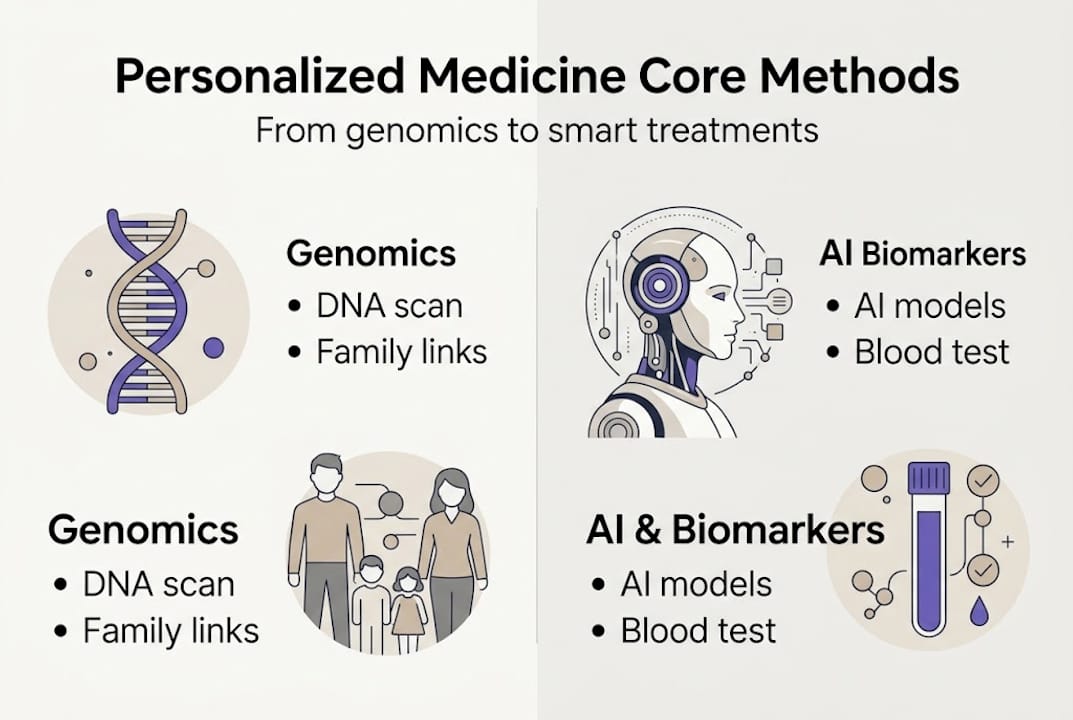
Genomic sequencing reads your DNA to identify variants that affect disease risk or drug response. A full whole-genome sequence captures over 3 billion base pairs. Gene panel testing focuses on specific, clinically relevant regions, making it faster and more actionable for most patients. Gene panel testing is often the practical entry point for people exploring hereditary cancer risk or medication sensitivity.
Biomarkers are measurable indicators in blood, tissue, or other biological material that signal disease activity or treatment response. HER2 expression in breast cancer, for example, tells oncologists whether a patient will respond to targeted therapies like trastuzumab. Without that biomarker, the treatment choice is a coin flip.
Pharmacogenomics (PGx) is where personalized medicine gets immediately practical for most people. Your CYP450 enzyme variants determine how quickly you metabolize dozens of common drugs, from antidepressants to blood thinners. A slow metabolizer taking a standard codeine dose can accumulate toxic levels. A rapid metabolizer taking the same dose might get no therapeutic effect at all.
Here's a quick comparison of traditional versus personalized approaches:
| Factor | Traditional medicine | Personalized medicine |
|---|---|---|
| Drug selection | Population averages | Individual genomic profile |
| Dosing | Standard weight-based | Metabolizer phenotype |
| Cancer screening | Age and family history | DNA mutation analysis |
| Treatment monitoring | Symptom-based | Biomarker-driven |
| Side effect prediction | Trial and error | Gene-drug interaction data |
AI and machine learning are the force multipliers here. Trained on hundreds of thousands of genetic profiles, AI systems can surface patterns that no human clinician could detect manually. They correlate variants with outcomes, flag drug interactions, and generate risk scores in hours rather than weeks. Platforms built on AI-powered genomics are already changing the speed and accuracy of clinical decision-making.
Pro Tip: If you're starting your personalized medicine journey, ask your provider specifically about PGx testing before starting any new psychiatric or cardiovascular medication. The data can prevent months of ineffective treatment.
For a practical walkthrough of how this all fits together clinically, the step-by-step guide for families is a useful starting point. The science behind these tools is validated through rigorous research and lab certifications that ensure clinical-grade accuracy.
Impact in cancer screening and medication optimization
Cancer is where personalized medicine has made its most dramatic mark. The shift from treating cancer by organ of origin to treating it by molecular profile has fundamentally changed survival odds for many patients.

Genomic profiling now identifies actionable mutations that guide targeted therapy selection and pharmacogenomics-informed dosing for chemotherapies. A patient with non-small cell lung cancer carrying an EGFR mutation responds very differently to treatment than a patient without it. Treating both the same way is clinically indefensible in 2026.
Here's how personalized medicine is reshaping key areas:
- Hereditary cancer risk: BRCA1/BRCA2 testing identifies patients with significantly elevated breast and ovarian cancer risk, enabling preventive strategies before disease develops
- Lynch syndrome detection: Identifies inherited mutations that increase colorectal and endometrial cancer risk, guiding surveillance frequency
- Tumor DNA profiling: Liquid biopsies and tumor sequencing reveal which mutations are driving growth, pointing directly to the most effective targeted agents
- Chemotherapy dosing: PGx data prevents under-dosing (reducing efficacy) and over-dosing (causing organ toxicity) in cancer patients
- Immunotherapy selection: Biomarkers like PD-L1 expression and tumor mutational burden predict who will respond to checkpoint inhibitors
The clinical outcomes are compelling. Personalized multi-drug regimens built around tumor DNA mutation profiles have demonstrated significantly improved response rates and survival compared to standard protocols.
"Matching treatment to tumor biology isn't experimental anymore. It's the standard of care for patients whose providers have access to genomic data."
Beyond cancer, medication optimization through PGx is improving outcomes across psychiatry, cardiology, and pain management. Antidepressant selection, for instance, has historically involved months of trial and error. PGx testing can identify which drug classes are likely to work based on your metabolizer status, cutting that timeline dramatically.
For those considering proactive testing, genetic testing for wellness offers a broader look at how DNA insights support prevention, not just diagnosis. The global impact of genetic testing continues to grow as costs fall and access improves. And for patients who need answers fast, rapid genetic testing is now a clinical reality.
Nuances, challenges, and ethics: From data to diversity
Personalized medicine is not a solved problem. The science is powerful, but the gaps are real and worth understanding before you assume a genetic report tells the whole story.
One of the most pressing issues is population diversity. The majority of large-scale genomic studies have been conducted on individuals of European ancestry. Challenges include rare variants, polygenic risks, and underrepresentation of non-European populations, which means the algorithms drawing on this data are less accurate for patients from other backgrounds. A risk score calibrated on one population can be dangerously misleading for another.
Here are the key challenges the field is actively working through:
- Algorithmic bias: AI models trained on non-diverse datasets produce skewed risk predictions for underrepresented groups
- Data privacy: Genomic data is uniquely identifying and permanent. Breaches carry risks that go far beyond financial data
- Informed consent: Patients need to understand what they're agreeing to when their genetic data enters research databases
- Incidental findings: Sequencing sometimes reveals variants unrelated to the original clinical question, creating difficult disclosure decisions
- Access inequality: High costs, limited accessibility, and ethical issues mean personalized medicine is not yet equitably distributed
The multi-omics frontier, which integrates genomics with proteomics, metabolomics, and epigenomics, holds real promise for addressing some of these gaps. But it also adds complexity. More data doesn't automatically mean better decisions. It requires better interpretation frameworks.
Pro Tip: When reviewing any genetic risk report, ask your provider whether the reference population used in the analysis matches your ancestry. It matters more than most people realize.
Patient biography, emotional history, and social determinants of health are still largely absent from most genomic models. Expert perspectives on patient biography argue that this omission limits clinical utility significantly. Gene panel diversity and inclusive dataset development are areas where ongoing R&D innovation is critical.
A fresh perspective: What most guides miss about personalized medicine
Most articles about personalized medicine focus on the technology and stop there. Genomic sequencing, AI models, biomarker panels. It reads like a product catalog. What gets left out is the human layer, and that omission is a clinical problem.
Current molecular profiling approaches neglect patient biography, and future progress will require hybrid quantum-AI systems alongside diverse cohorts to address the biases baked into current models. That's not a minor footnote. It means the most sophisticated genomic report available today is still incomplete without a clinician who asks about your stress history, your relationships, your sense of purpose.
We believe the next frontier in personalized medicine isn't a faster sequencer. It's a better integration of what the genome tells us with what the patient's life tells us. The data informs. The person decides. Clinicians who treat genomic reports as the final word are missing the point.
Patients should demand both. Ask for the genomic data. Then ask what it means in the context of your actual life. AI's evolving role is to support that conversation, not replace it.
Your next step: Unlocking personalized health solutions
Understanding personalized medicine is one thing. Acting on it is where outcomes actually change. Gene Matrix's CLIA-certified platform delivers actionable genomic insights within 72 hours, trained on over 500,000 genetic profiles.

Whether you're exploring hereditary cancer genetic testing for BRCA or Lynch syndrome, or looking to optimize medications through pharmacogenomics, the tools are accessible now. Our genetic testing research validates every panel we run. For ongoing health management, DNA testing subscriptions make precision medicine a continuous part of your care, not a one-time event. Your genome doesn't change. Your understanding of it should keep growing.
Frequently asked questions
How does personalized medicine differ from traditional care?
Personalized medicine tailors treatment to your genetics, environment, and lifestyle, while traditional care applies standard protocols designed for the average patient. The result is more targeted decisions with fewer trial-and-error cycles.
What genomic tests are involved in personalized medicine?
The core methodologies include genomic sequencing, gene panel testing, and pharmacogenomic analysis that maps how your body processes specific drug classes. Each test adds a different layer of clinical insight.
Can personalized medicine improve cancer treatment outcomes?
Yes. Personalized multi-drug regimens matched to tumor DNA mutations have shown improved response rates and survival compared to standard treatment protocols, particularly in solid tumors with actionable mutations.
What are the ethical concerns in personalized medicine?
Limitations include ethical issues, algorithmic bias, and gaps in diverse population data, alongside concerns about genomic data privacy, consent, and the potential for incidental findings that require careful clinical handling.
How can I access personalized medicine options?
You can start through a CLIA-certified genetic testing service, request gene panel testing from your physician, or use a platform like Gene Matrix that combines hereditary cancer screening, PGx testing, and AI-driven analysis in a single workflow.