

TL;DR:
- AI diagnostics are already operational in clinical settings, achieving expert-level accuracy and improving workflow efficiency. Adoption is hindered primarily by regulatory, infrastructural, and trust barriers, rather than technical performance. Clinician involvement in customization and validation enhances integration and accelerates trust and use.
Most clinicians still think of AI diagnostics as a horizon technology. Something coming. Something being piloted in well-funded academic centers while the rest of healthcare waits. That assumption is now wrong. An AI healthcare diagnostics platform is operating in radiology suites, pathology labs, and oncology workflows today, delivering results that outperform or match specialist-level accuracy at a fraction of the time. The real question is no longer whether these platforms work. It's whether your clinical environment is set up to use them well.
Table of Contents
- Key takeaways
- What powers an AI healthcare diagnostics platform
- Clinical performance: what the benchmarks actually show
- Barriers to adopting AI diagnostics platforms
- Workflow integration in clinical practice
- Future directions in AI diagnostic technology
- My take on what actually matters here
- How Genematrix applies this in practice
- FAQ
Key takeaways
| Point | Details |
|---|---|
| AI diagnostics are clinically active now | Platforms achieve up to 98.88% accuracy in disease classification, making them viable in live clinical settings. |
| Speed gains are measurable | AI reduces exam interpretation time by 20% and diagnostic delays by up to 50% in integrated workflows. |
| Adoption barriers are structural, not technical | Regulatory inconsistency and infrastructure gaps, not algorithm failure, are the primary adoption obstacles. |
| Explainability drives clinician trust | Platforms that cite clinical evidence behind each decision see significantly higher adoption and lower resistance. |
| Precision medicine is the next frontier | AI diagnostics are converging with genomics to enable proactive, personalized care rather than reactive treatment. |
What powers an AI healthcare diagnostics platform
The phrase "AI diagnostics" covers a wide range of technologies, and conflating them leads to poor purchasing decisions and unrealistic expectations. Here's what actually runs under the hood of a modern platform.
Machine learning models form the base layer. These are trained on large labeled datasets, such as imaging archives, pathology slides, or lab result histories, to recognize patterns associated with specific conditions. The more diverse and validated the training data, the more generalizable the model. Genematrix, for example, trains its GeneMatrixAI platform on 500,000+ genetic profiles to generate actionable genomic reports, which is a scale that matters for reliability across diverse patient populations.
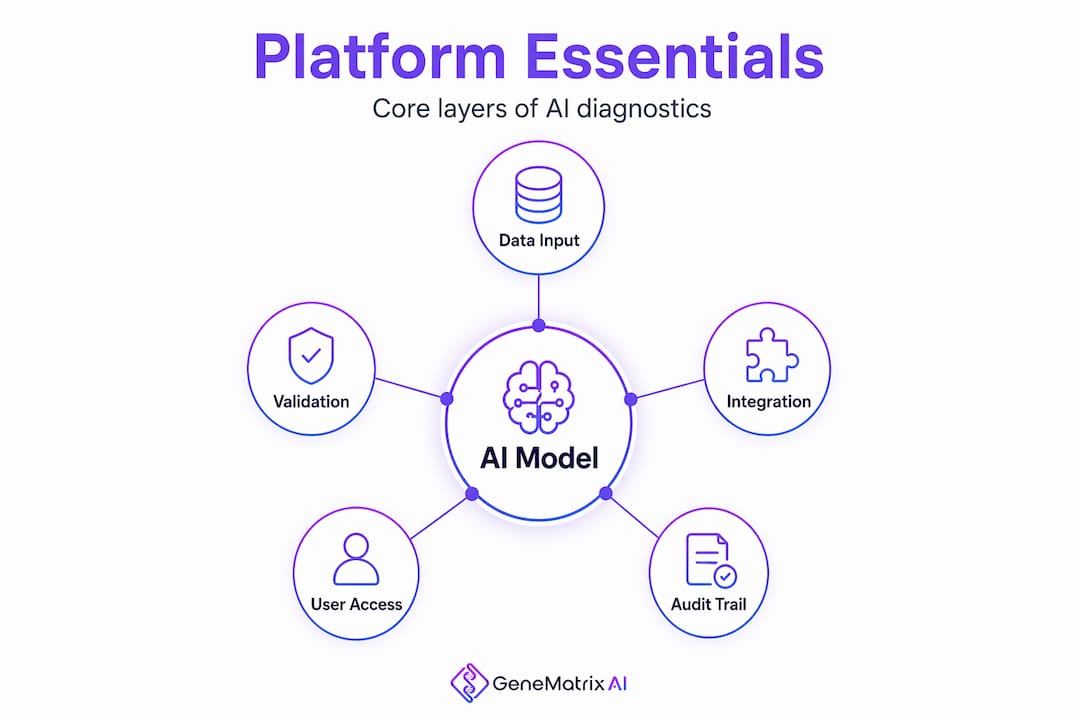
Generative vision-language models represent the current frontier. These systems process both medical images and clinical text simultaneously, then produce structured outputs like preliminary diagnostic reports. Cognita CXR, which recently received FDA breakthrough device designation, is a direct example. It drafts radiology reports to reduce radiologist burnout and support faster turnaround, without replacing the radiologist's final judgment.
Evidence-based AI is a newer design philosophy that directly addresses the trust problem. Rather than producing a result with no traceable logic, platforms like Polaris 5.0 from Hippocratic AI benchmark against GPT-5 and Claude Opus while citing the specific clinical literature behind each recommendation. That transparency is not cosmetic. It's the mechanism by which clinicians learn to trust outputs enough to act on them.
- Convolutional neural networks (CNNs): Specialized for image-based tasks including X-ray, CT, and MRI analysis
- Natural language processing (NLP): Extracts structured data from unstructured clinical notes and reports
- Multimodal integration: Combines imaging, lab values, genomic data, and patient history into a single diagnostic signal
- Explainability layers: Highlight which features drove a specific output, critical for regulatory review and clinician adoption
Pro Tip: When evaluating an intelligent diagnostics platform, ask vendors specifically how their model handles out-of-distribution inputs, meaning cases that fall outside the training data. This single question separates mature platforms from prototype-stage tools.
Clinical performance: what the benchmarks actually show
Numbers matter here, so let's be specific. Vague claims about "improved accuracy" are not enough to change clinical protocols. Concrete benchmarks are.
| Metric | Performance | Application |
|---|---|---|
| Multiclass X-ray classification | 98.88% accuracy | Pulmonary disease detection |
| Colposcopy lesion detection (HSIL+) | 95.96% sensitivity | Cervical cancer screening |
| Diagnostic time per exam | ~0.30 minutes | Real-time colposcopy workflow |
| Exam interpretation time reduction | 20% | Radiology workflow integration |
| Diagnostic delay reduction | Up to 50% | Multi-specialty clinical settings |
Those numbers come from peer-reviewed studies and platform-level benchmarks, not marketing decks. The 50% reduction in diagnostic delays is particularly significant for specialties where time to diagnosis directly affects survival, including stroke neurology, sepsis management, and early-stage oncology.
Radiology sees the most immediate workflow impact. Generative vision-language models draft preliminary reports, which means radiologists spend their cognitive energy on edge cases and final sign-off rather than routine documentation. That shift addresses one of the most cited drivers of physician burnout in high-volume imaging centers.
The multi-specialty reach of modern clinical AI applications also deserves attention. Today's platforms are not single-use tools. They operate across radiology, pathology, oncology, and even pharmacogenomics, where AI matches drug metabolism profiles to patient genetics to reduce adverse events. The AI-powered genomics benefits in this space are measurable and growing. When a platform can simultaneously flag a suspicious lung nodule, flag a drug interaction risk, and surface a hereditary cancer marker, the clinical value compounds quickly.
Barriers to adopting AI diagnostics platforms
Understanding the performance data is one thing. Getting a platform deployed in a real clinical environment is another. The obstacles are real, and they are worth naming precisely.
-
Regulatory inconsistency. There is no unified global standard for validating AI diagnostic tools. The FDA has frameworks in development, but lack of standardized validation protocols across regions creates compliance uncertainty for health systems operating across state lines or internationally. Procurement teams often stall because they cannot confirm what postmarket surveillance will be required.
-
Infrastructure gaps. In resource-limited settings, the hardware, connectivity, and IT staffing required to run a modern AI healthcare diagnostics platform may simply not exist. Hospital penetration below 10% in some regions reflects this reality. The algorithm is not the bottleneck. The infrastructure is.
-
Clinician training and trust. Even high-performing platforms fail at the bedside if clinicians do not understand how to interpret outputs or integrate them into existing decision workflows. Explainability is not optional. Cited clinical logic behind AI decisions is the single most effective mechanism for reducing clinician skepticism.
-
Algorithmic bias and data privacy. Models trained on non-representative datasets produce skewed outputs for underrepresented populations. This is not a hypothetical risk. It is a documented problem in dermatology AI, cardiac risk scoring, and sepsis prediction. Ethical governance frameworks and diverse training data are prerequisites, not afterthoughts.
-
Liability ambiguity. When an AI-assisted diagnosis is wrong, the question of who bears responsibility, the platform vendor, the ordering physician, or the health system, remains legally unresolved in most jurisdictions. That ambiguity slows institutional adoption even when clinical performance is strong.
Pro Tip: Before committing to any diagnostic AI tool, request a bias audit report specific to your patient population demographics. A platform that performs at 97% accuracy on a homogeneous training set may perform significantly worse on your actual patient mix.
Workflow integration in clinical practice
Knowing a platform performs well in a study is different from knowing how it fits into a Tuesday morning in your department. Here is where the AI genetic testing platforms and broader diagnostic tools are actually being used today.

Diagnostic imaging remains the highest-volume use case. AI flags anomalies in chest X-rays, mammograms, and CT scans before the radiologist opens the file, creating a prioritized worklist that puts the highest-acuity cases at the top. This is not replacing radiologist judgment. It is making sure the right cases get that judgment first.
Lab data automation connects AI analysis to incoming laboratory results, surfacing patterns across complete blood counts, metabolic panels, and genomic assays that would take a human analyst hours to identify. Automated healthcare analysis in administrative workflows, including medical records summarization and claim denial resolution, further reduces the non-clinical burden on clinical staff.
- EHR integration: AI outputs feed directly into electronic health records, creating a continuous clinical decision support layer without requiring clinicians to switch systems
- Risk stratification: Platforms score incoming patients by acuity and flag those at elevated risk for deterioration, sepsis, or specific hereditary conditions
- Report generation: Preliminary structured reports are drafted automatically, with the clinician reviewing and modifying rather than authoring from scratch
- Pathology support: Digital pathology platforms analyze tissue slides at cellular resolution, identifying malignant features with accuracy that supports or challenges initial pathologist reads
The GeneMatrix LIMS platform is a concrete example of this integration in action, connecting AI-powered lab analysis to clinical workflows in a way that reduces turnaround time without sacrificing accuracy or compliance.
Future directions in AI diagnostic technology
The next three years will look materially different from today. Several trends are converging that will change what an AI healthcare diagnostics platform can do and who can access it.
- Multimodal data integration will become standard. Platforms will routinely combine imaging, genomics, wearable sensor data, and longitudinal EHR history into a single diagnostic model, giving clinicians a more complete picture than any single data stream provides
- Real-time LLM integration will allow clinicians to query diagnostic systems in natural language, asking follow-up questions about a flagged finding and receiving evidence-cited responses within seconds
- Regulatory maturation is accelerating. The FDA is developing adaptive approval frameworks for AI devices, and CPT reimbursement codes for AI-assisted diagnostics are expanding, which will reduce the financial uncertainty that currently slows institutional adoption
- Specialist shortage mitigation is becoming a primary use case. AI diagnostic platforms are increasingly positioned as a way to extend specialist-level analysis to underserved geographies where recruiting a radiologist or pathologist is not feasible
- Precision medicine convergence will tie diagnostic AI directly to treatment personalization, with platforms like Genematrix's GeneMatrixAI already delivering precision medicine insights that connect genetic risk profiles to individualized care plans
My take on what actually matters here
I've spent years watching pilot projects for AI diagnostic tools succeed in controlled trials and then stall at the implementation stage. The pattern is consistent enough that I've stopped being surprised by it.
The technology is rarely the problem. What fails is the assumption that a high-performing model will integrate itself. It won't. Every clinical environment has its own data formats, its own EHR quirks, its own physician culture around new tools. A platform that requires fine-tuning within specific clinical environments is not a flawed product. It's an honest one.
What I've found actually moves the needle is clinician co-design. When the physicians who will use a platform are involved in configuring its outputs, its alert thresholds, and its report formats, adoption rates are dramatically higher. The AI becomes their tool, not something imposed on them.
The hype around AI diagnostics is real, and it occasionally sets expectations that no platform can meet on day one. My honest advice: evaluate platforms on their explainability, their integration flexibility, and the quality of their validation data. Performance metrics matter, but they matter most when they reflect your patient population, not a benchmark dataset assembled three years ago.
— Tarek
How Genematrix applies this in practice
If you're evaluating where AI-powered diagnostics can have the most immediate impact on your clinical outcomes, hereditary cancer screening and pharmacogenomics are two areas where the evidence base is strongest and the clinical ROI is clearest.

Genematrix is a CLIA-certified, Chicago-based biotechnology company that has built its GeneMatrixAI platform specifically for this intersection of AI and precision medicine. Their platform is trained on over 500,000 genetic profiles and delivers hereditary cancer testing and precision medicine results within 72 hours, covering BRCA1/BRCA2, Lynch syndrome, pharmacogenomics, and specialty modules including GeneMind and GeneDiet. For hospitals, physicians, and health systems looking to move from reactive treatment to proactive, data-driven care, Genematrix offers a validated, clinically integrated path forward. Their AI-powered lab software connects genomic analysis directly to clinical workflows, reducing turnaround time while maintaining full compliance.
FAQ
What is an AI healthcare diagnostics platform?
An AI healthcare diagnostics platform uses machine learning models and clinical algorithms to analyze medical data, including imaging, lab results, and genomic profiles, and generate diagnostic outputs that support or accelerate clinical decision-making.
How accurate are AI diagnostic tools in clinical settings?
Recent studies show AI-based tools achieving up to 98.88% accuracy in multiclass disease classification from X-rays and 95.96% sensitivity in real-time colposcopy lesion detection, making them clinically competitive with specialist-level performance.
What are the biggest barriers to AI diagnostics adoption?
Regulatory inconsistency and lack of standardized validation are the primary structural barriers, followed by infrastructure gaps in under-resourced settings and clinician trust issues tied to limited explainability in many platforms.
How does AI reduce diagnostic delays?
AI-driven workflows reduce exam interpretation time by 20% and can cut overall diagnostic delays by up to 50% by automating worklist prioritization, preliminary report drafting, and pattern recognition across high-volume data streams.
Can AI diagnostics platforms integrate with existing EHR systems?
Yes. Most modern platforms are designed to feed outputs directly into electronic health records via HL7 or FHIR standards, creating a continuous clinical decision support layer without requiring clinicians to operate outside their existing systems.