

TL;DR:
- Choosing an accredited CLIA and CAP-certified DNA lab is essential for valid clinical results and insurance reimbursement. Consumers' direct-to-home tests lack FDA approval and require confirmation through certified laboratories for clinical decisions. Effective integration relies on standardized workflows, timely results, comprehensive service panels, and ongoing clinical support to improve patient outcomes.
Selecting a DNA lab for healthcare providers is not a straightforward task, and the stakes are high. A wrong choice means test results your patients act on could be clinically invalid, insurance claims could be denied, and treatment decisions could rest on unvalidated data. The gap between a consumer-grade genetic test and a clinical-grade genomic analysis is enormous, yet many providers underestimate it. This guide breaks down what certifications actually matter, which testing services belong in your practice, how to integrate lab partnerships without disrupting workflow, and what to look for before signing any agreement.
Table of Contents
- Key takeaways
- What to look for in a DNA lab for healthcare providers
- Core DNA testing services your practice actually needs
- Integrating DNA lab partnerships into your clinical workflow
- Evaluating DNA lab partnerships
- Clinical impact: what good lab partnerships actually deliver
- My honest take on where providers go wrong
- How Genematrix supports your practice
- FAQ
Key takeaways
| Point | Details |
|---|---|
| Accreditation is non-negotiable | Only CLIA-certified, CAP-accredited labs produce results valid for medical decision-making and insurance coverage. |
| Consumer tests cannot substitute clinical labs | At-home DNA tests lack FDA diagnostic approval and are unsuitable for clinical use. |
| Turnaround time affects outcomes | Rapid whole genome sequencing in critical settings like the NICU can return results in under six days, directly improving care. |
| Workflow integration is the bottleneck | The right B2B ordering platform cuts friction and accelerates patient management from sample to report. |
| Range of services signals lab maturity | A strong lab partner covers hereditary cancer, pharmacogenomics, prenatal screening, and specialty panels under one roof. |
What to look for in a DNA lab for healthcare providers
Clinical-grade genetic testing begins with one question: is this lab accredited? Three credentialing bodies set the standard you should measure against.
CLIA (Clinical Laboratory Improvement Amendments) is the federal baseline. Any lab performing testing on human specimens for diagnostic purposes must hold a CLIA certificate. Without it, results are not reportable in clinical practice. CAP (College of American Pathologists) accreditation goes further, requiring peer inspections, proficiency testing, and strict quality management systems. The AABB credential matters specifically for identity and relationship testing, though it is less commonly required for genomic applications.
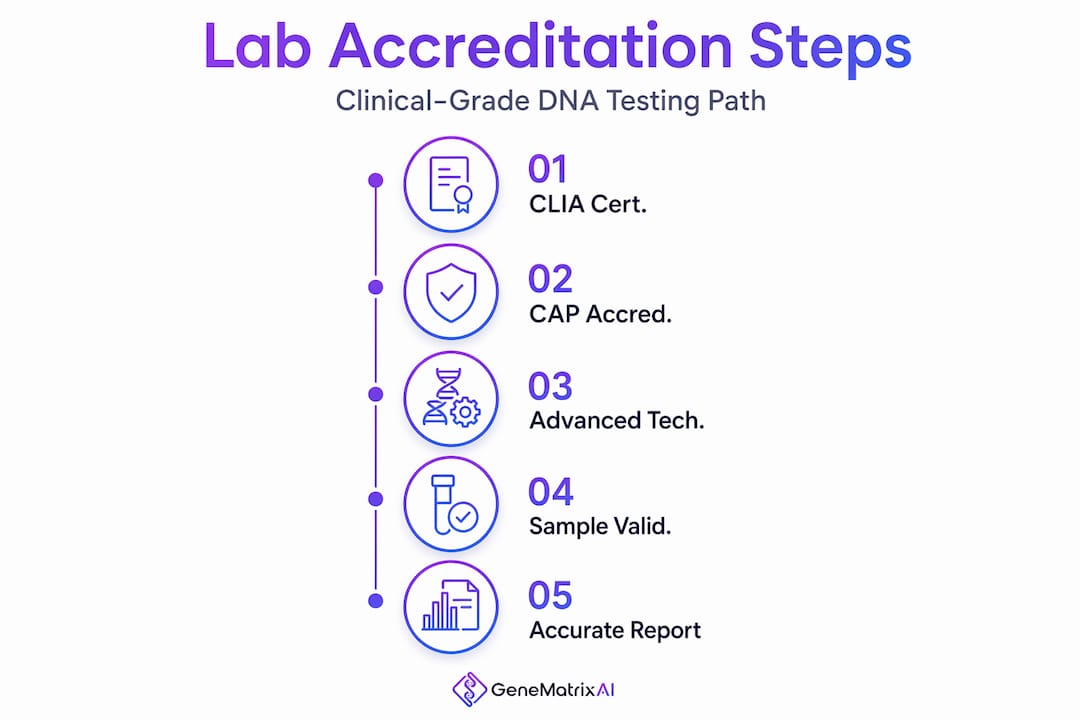
Why does this matter beyond paperwork? Clinical-grade DNA testing demands CLIA and CAP accreditation, and results from direct-to-consumer tests lack acceptance due to limited validation and expert interpretation. The American College of Medical Genetics is explicit: certified labs are required for diagnosis and treatment decisions. This is not a technicality. It is the difference between a result you can act on and one that gets your patient nowhere.
The misconception worth addressing directly: many patients arrive having already ordered a consumer DNA test, expecting those results to carry clinical weight. They do not. Consumer DNA tests estimate risk and require confirmation with clinical genetic tests before informing any medical decision. Your patients need to understand this, and so do you before choosing a lab partner.
Pro Tip: Ask any prospective DNA lab partner for their current CLIA certificate number and CAP accreditation number, then verify both independently through the relevant federal and professional databases before proceeding.
Clinical genetics labs also deploy advanced sequencing technology, high sensitivity and specificity for detecting rare and complex genetic disorders, which most consumer labs simply cannot replicate. The technology gap is not cosmetic. It determines whether a clinically significant variant gets flagged or missed entirely.
Core DNA testing services your practice actually needs
Not all genomic tests serve the same clinical purpose. Understanding what your patient population requires helps you evaluate whether a prospective lab can genuinely serve your practice.
Hereditary cancer genomic testing
For practices seeing oncology patients or managing families with known BRCA1, BRCA2, or Lynch syndrome histories, hereditary cancer panels are the foundation. Genomic tests like Prolaris influence treatment decisions in up to 65% of prostate cancer cases by combining clinical and pathological data with tumor aggressiveness scores. That is not a marginal improvement in clinical certainty. It is a structural shift in how you approach surveillance versus intervention conversations. Providers managing cancer hereditary risk should confirm their lab partner specifically covers multi-gene panel testing across BRCA1/2, Lynch syndrome genes, and emerging high-risk variants.

Rapid whole genome sequencing
In critical care settings, time is the variable that changes outcomes. Rapid whole genome sequencing in the NICU achieves an average turnaround of 5.5 days with a 50% diagnostic yield in critically ill neonates. For a family waiting on a diagnosis for a newborn with a suspected genetic condition, five days versus five weeks is not a scheduling inconvenience. It is the difference between initiating targeted treatment and managing symptoms blindly while waiting. Labs offering rapid WGS as a clinical service demonstrate both technological readiness and genuine commitment to acute care use cases.
Non-invasive prenatal screening
The Prequel non-invasive prenatal screen delivers results in 7 to 10 days with the lowest sample failure rate in the industry, detecting conditions including Down syndrome from as early as 8 weeks gestation. For OB-GYN practices and maternal-fetal medicine specialists, the failure rate metric matters as much as sensitivity. A failed sample means a repeat draw, a delayed result, and an anxious patient. When evaluating labs, ask for documented failure rates, not just detection rates.
Pharmacogenomics
PGx testing tells you how a patient's genetic profile affects drug metabolism, which makes it relevant across nearly every specialty. A patient with a CYP2D6 variant metabolizing codeine abnormally is a patient at serious risk if that information is unknown. Labs that offer pharmacogenomics panels alongside cancer and prenatal services give you one partner for a wide range of clinical scenarios.
Here is a quick comparison of the core services to prioritize when vetting any lab:
| Test type | Clinical application | Key metric to request |
|---|---|---|
| Hereditary cancer panels | BRCA, Lynch syndrome, multi-gene | Sensitivity and variant classification rate |
| Rapid whole genome sequencing | NICU, undiagnosed rare disease | Turnaround time and diagnostic yield |
| Non-invasive prenatal screening | Down syndrome, chromosomal aneuploidies | Sample failure rate and gestational age range |
| Pharmacogenomics | Medication optimization across specialties | Number of genes covered and drug-gene pairs |
Pro Tip: Request a sample report from any lab before committing. The format and clinical utility of the report you hand to a patient or specialist matters as much as the underlying accuracy of the test.
Integrating DNA lab partnerships into your clinical workflow
The science is only as useful as your ability to operationalize it. Many providers invest in a lab partnership and then find the workflow integration is where things stall. Here is a practical sequence that actually works.
-
Define your ordering pathway. Determine whether your EHR integrates with the lab's ordering system or whether you will use a standalone B2B platform. Managing genetic tests through dedicated B2B platforms accelerates patient management and reduces administrative friction significantly. Confirm this compatibility before signing an agreement.
-
Standardize sample collection protocols. Different tests require different specimen types: saliva, blood, buccal swab, or tissue. Your front-office and nursing staff need clear, written protocols for each test type. A single mislabeled tube causes delays and may require a patient to return for a repeat collection.
-
Establish a results review process. Decide who receives and reviews incoming reports. For complex genomic results, a designated physician or advanced practice provider should hold accountability for interpreting findings before they reach the patient. For practices without in-house genetics expertise, genetic counseling benefits can be coordinated through the lab partner itself, which is a service feature worth prioritizing.
-
Build a patient counseling framework. Integrating genetic analysis into medical practice allows providers to contextualize genetic data within patient history for evidence-backed preventive medicine. That contextualization does not happen automatically. You need a standard conversation template for pre-test counseling and a clear protocol for delivering significant findings, particularly for hereditary cancer results.
-
Address privacy and compliance requirements. HIPAA applies to genetic information. Confirm your lab partner has a signed Business Associate Agreement in place and that their data handling practices align with your own compliance obligations.
Evaluating DNA lab partnerships
Once you know what services you need, the evaluation process comes down to four factors that separate a capable partner from a vendor you will eventually regret.
Turnaround time, specifically. Vague promises about "fast results" are not useful. Ask for the median and 90th-percentile turnaround time for each specific test you plan to order. A lab that delivers routine hereditary cancer panels in five business days but takes three weeks for PGx panels may not meet your patients' expectations across the board.
Breadth of testing panels. As precision medicine expands, your testing needs will evolve. A lab that only offers a narrow hereditary cancer panel today will require you to find a second or third vendor as your practice grows. Look for labs that cover hereditary cancer, pharmacogenomics, prenatal screening, pediatric genetics, and nutrigenomics under one platform. The fewer vendor relationships you manage, the more consistent your workflow remains.
Clinical support beyond the report. The strongest lab partners provide access to medical geneticists or genetic counselors for complex case consultations. This is especially relevant for practices in specialties that do not routinely manage genetic findings, such as primary care or psychiatry. A report flagging a pathogenic BRCA2 variant in a patient seeing a psychiatrist for medication management requires a clinical handoff process that a good lab partner helps you build.
Pricing and insurance coverage. Understand the billing model before you order. Some labs bill patients directly, others bill through the ordering provider, and reimbursement rates vary substantially by payer and test type. Labs with established payer relationships and pre-authorization support reduce administrative burden on your billing team.
Clinical impact: what good lab partnerships actually deliver
The evidence base for genomic testing in patient care is no longer theoretical. Two examples demonstrate exactly what a quality DNA lab partnership produces in practice.
In oncology, genomic testing is actively reshaping treatment planning. When a urologist uses a prostate cancer genomic test to stratify a patient's tumor aggressiveness, the decision about whether to pursue active surveillance or aggressive intervention becomes grounded in molecular data rather than clinical intuition alone. That is a meaningful shift in the quality of the conversation between physician and patient.
In neonatal medicine, speed is everything. As the research demonstrates:
"Rapid whole genome sequencing in critically ill neonates produces diagnoses at a median of 5.5 days, enabling treatment modifications that would otherwise be delayed by weeks of inconclusive workup."
The downstream effect of that speed is measurable. Earlier targeted therapy, fewer redundant diagnostic tests, and, in some cases, avoidance of procedures that would have been unnecessary once a genetic diagnosis was established. Rapid genetic testing in acute care settings is one of the clearest cases where a lab partnership directly affects whether a patient leaves the hospital better or not.
My honest take on where providers go wrong
I have worked alongside healthcare providers making lab partnership decisions for years, and I keep seeing the same pattern. A practice selects a lab based on name recognition or the lowest per-test price, and neither of those factors predicts what actually matters: report quality, turnaround reliability, and the clinical support you get when a result is ambiguous.
The second mistake I see is conflating patient familiarity with clinical validity. A patient who walks in with 23andMe results and says "it says I'm fine" creates a genuinely difficult conversation, especially when their family history suggests otherwise. What I have found is that providers who have already partnered with a certified lab and have a standing clinical testing protocol handle these conversations better. They can point to a concrete next step rather than apologizing for limitations they have no control over.
The third issue is underestimating the workflow side. The best genomic test in the world becomes a liability if your staff does not know how to collect the specimen correctly, or if the report lands in a portal no one checks. The labs worth partnering with take implementation seriously. They assign a clinical liaison, they walk your team through the ordering system, and they do not disappear after the contract is signed.
My honest view: genetics is moving into routine medicine faster than most practices are prepared for. The providers who get ahead of it now, by building the right lab relationships and internal workflows today, will spend far less time scrambling to catch up in three years.
— Tarek
How Genematrix supports your practice

Genematrix is a Chicago-based, CLIA-certified biotechnology company purpose-built for healthcare providers who need clinical-grade genomic testing without the operational headaches. Their GeneMatrixAI platform, trained on more than 500,000 genetic profiles, delivers AI-powered reports within 72 hours across hereditary cancer screening, pharmacogenomics, prenatal insights, and specialty panels including GeneMind for psychiatric applications and GeneDiet for nutrigenomics.
For providers ready to build or expand their genetic testing practice, Genematrix offers a B2B ordering platform with dedicated clinical liaison support, pre-authorization assistance, and sample collection guidance. Their lab certifications and science meet the accreditation standards that insurance carriers and clinical guidelines require. If you are evaluating a DNA lab partnership, Genematrix is designed to make that integration practical from day one.
FAQ
What certifications should a DNA lab have for clinical use?
A DNA lab for healthcare providers must hold a CLIA certificate and ideally CAP accreditation. These credentials confirm that test results meet the validation standards required for medical decision-making and insurance reimbursement.
Can providers use consumer DNA tests for clinical decisions?
No. At-home DNA tests lack FDA approval for diagnostic use and do not meet the standards required for clinical acceptance. Consumer results should be confirmed with a certified clinical lab before informing any treatment or screening decision.
How fast should a DNA lab deliver results?
Turnaround time varies by test type. Hereditary cancer panels typically return in five to seven business days, while rapid whole genome sequencing for critical care can deliver results in approximately 5.5 days. Non-invasive prenatal screens like Prequel return results in 7 to 10 days.
How does genomic testing improve patient outcomes in oncology?
Genomic tests in oncology, such as prostate cancer aggressiveness panels, influence treatment decisions in up to 65% of cases by stratifying tumor risk with molecular data, enabling more precise choices between active surveillance and intervention.
What should providers ask a DNA lab before partnering?
Ask for their CLIA and CAP credentials, median turnaround times per test type, sample report examples, billing and pre-authorization support, and what clinical liaison or genetic counseling services they provide after results are delivered.