

TL;DR:
- DNA health tests vary widely in purpose, accuracy, and clinical support.
- Proper interpretation and follow-up with professionals are crucial for meaningful health decisions.
- Gene Matrix offers rapid, clinically validated genetic testing to translate DNA insights into action.
Not all DNA health tests are the same, and assuming otherwise can lead to real consequences. Someone who gets a consumer wellness kit and receives a "low risk" cancer result might skip a clinical referral they genuinely needed. A patient who orders a pharmacogenomics panel without understanding how results translate into prescribing decisions may never get the medication adjustment they require. Whether you're assessing hereditary cancer risk, trying to optimize medications, or preparing for pregnancy, the test you choose and the support around it determine whether you get answers or just data.
Table of Contents
- What is a DNA health test? Types, uses, and limitations
- Hereditary cancer risk: What DNA health testing can reveal (and where it falls short)
- Pharmacogenomics: Using DNA tests to optimize medications
- Preconception DNA health testing: Making informed family planning choices
- A perspective your doctor might not tell you: Why context and follow-up matter more than your DNA report
- Turn your DNA insights into action with Gene Matrix
- Frequently asked questions
Key Takeaways
| Point | Details |
|---|---|
| Know your test type | Different DNA health tests answer different questions about risk, medication, and family planning. |
| Counseling is key | Expert interpretation before and after your DNA test is critical for meaningful results. |
| Home tests have limits | At-home DNA health kits often miss important clinical risks and should not replace professional screening. |
| Medication guidance | Pharmacogenomic tests need clinical standards to make medication decisions truly safe and actionable. |
| Plan family health | Preconception carrier screening can empower family planning but requires thorough counseling and follow-up. |
What is a DNA health test? Types, uses, and limitations
With the confusion around what a DNA health test really means, it's crucial to start with the basics. The phrase "DNA health test" is an umbrella term that covers very different products with very different purposes. Some tests look at inherited variants linked to disease risk. Others examine how your body metabolizes medications. Still others screen for traits related to nutrition, fitness, or mental health. Knowing which type you need is the first decision, and it matters enormously.
The major categories include:
- Disease predisposition testing: Looks for inherited gene variants linked to conditions like breast cancer, Lynch syndrome, or heart disease.
- Pharmacogenomics (PGx) testing: Examines how your genes affect your response to specific medications.
- Carrier screening: Identifies whether you carry recessive gene variants that could be passed to a child.
- Wellness and trait testing: Covers nutrigenomics, fitness traits, and lifestyle factors; generally the least clinically actionable.
The marketplace also divides sharply between clinical tests ordered through a physician and direct-to-consumer (DTC) tests purchased online. Here's how they compare:
| Feature | Clinical DNA health test | Direct-to-consumer (DTC) test |
|---|---|---|
| Ordered by | Physician or genetic counselor | Consumer (self-ordered) |
| Regulatory oversight | CLIA-certified laboratory required | Varies widely |
| Variants analyzed | Broad, clinically validated panels | Often limited variant sets |
| Result interpretation | Genetic counselor included | Usually self-service |
| Clinical action supported | Yes, with follow-up care | Limited |
| Best use case | Cancer risk, PGx, carrier screening | Ancestry, general wellness traits |
The American Cancer Society cautions about home tests noting that consumer kits may blend concepts like ancestry, wellness, disease predisposition, and pharmacogenetics without making those distinctions clear to buyers. For hereditary cancer specifically, home tests may not capture all relevant variants and should never replace professional screening or counseling.
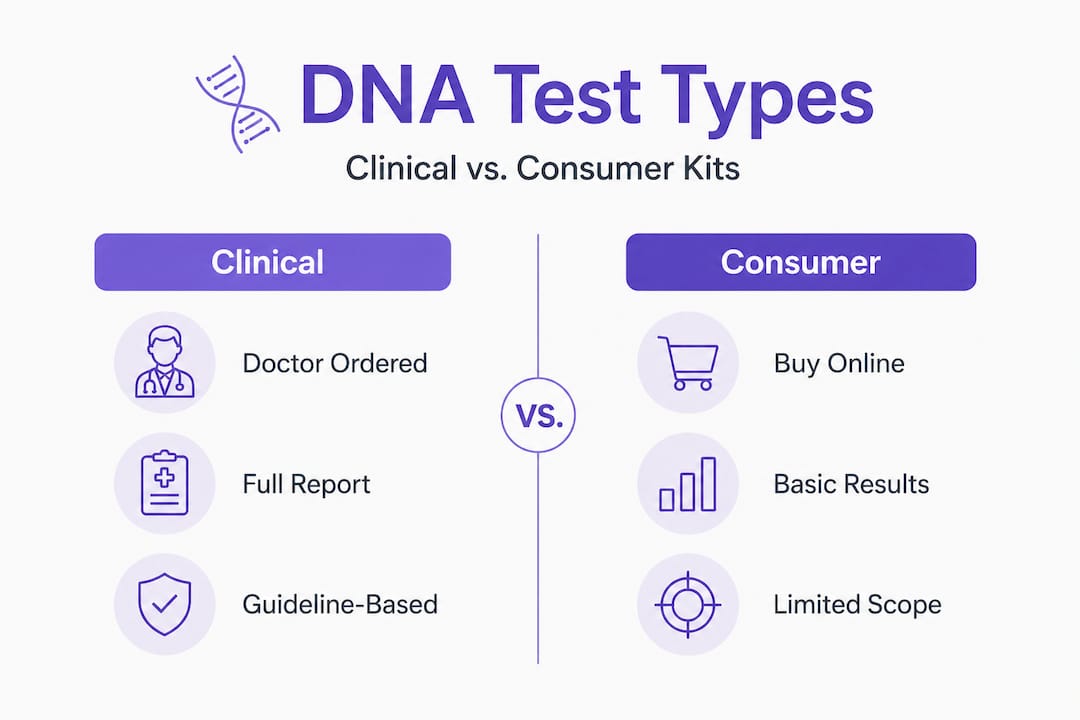
When you begin genetic risk assessment, understanding which type of test fits your question is the foundation. Choosing the wrong category is like getting an eye exam when you need a cardiac workup. The technology may be sophisticated, but it won't answer the question you're actually asking. You can also explore types of DNA testing services to better understand which options serve different health goals.
Pro Tip: Always verify whether a test is backed by clinical guidelines specific to your concern before purchasing. CLIA certification and integration with professional counseling are minimum requirements for any test addressing serious health decisions.
Hereditary cancer risk: What DNA health testing can reveal (and where it falls short)
Now that you understand the marketplace, let's focus on one of the most common motivations for seeking a DNA health test: cancer risk. Many families carry inherited gene variants, including BRCA1, BRCA2, and Lynch syndrome genes, that significantly raise their lifetime cancer risk. Identifying those variants early creates real opportunities to act.
There are two distinct types of genetic testing in the cancer context. Germline testing examines inherited DNA, the variants you were born with and could pass to children. Somatic testing looks at mutations within a tumor itself and is used to guide treatment, not predict inherited risk. For hereditary cancer screening, germline testing is what matters. Germline genetic testing looks for inherited variants that may raise the likelihood of certain cancers and can guide both screening and risk-reducing decisions.
The clinical workflow for hereditary cancer testing follows a clear structure:
- Pre-test counseling: A genetic counselor reviews your personal and family history, explains the types of tests available, and sets realistic expectations about what results can and cannot tell you.
- Test selection: Based on counseling, a targeted gene panel (such as BRCA1/2) or a broader multigene panel is ordered from a CLIA-certified laboratory.
- Sample collection: Usually a blood draw or saliva sample, processed and analyzed by the lab.
- Result generation: The lab produces a report classifying variants found in analyzed genes.
- Post-test counseling: A counselor interprets results in the context of your specific history and helps you understand next steps.
Results from hereditary cancer testing fall into three categories, and each demands a different response:
| Result type | What it means | Typical next step |
|---|---|---|
| Positive | A known pathogenic variant was found | Enhanced screening, risk-reducing surgery, cascade testing for family |
| Negative | No known pathogenic variant found in tested genes | May still have risk; continue routine screening |
| Variant of uncertain significance (VUS) | A DNA change was found, but its health impact is unclear | Monitor for reclassification; discuss with genetic counselor |
The NCCN patient guidelines identify these three result categories as central to the clinical workflow and stress that pre-test counseling is essential for proper interpretation. A VUS result in particular confuses many patients because it sounds alarming but is not a confirmed risk indicator.
"A negative result does not mean you have no risk. It means no known variants were detected in the genes that were tested. Clinical screening recommendations still apply." This principle is why professional follow-up cannot be skipped.
The limits of DTC testing for cancer risk are significant. At-home cancer tests may only analyze a handful of variants out of hundreds that have been linked to elevated cancer risk. A negative result on a consumer kit can create false confidence, particularly in individuals with strong family histories. These results do not replace recommended cancer screening or genetic counseling.
For families navigating this, reviewing family genetic testing tips can clarify when to bring other relatives into the testing process. And for those curious about what gene panel testing involves at a clinical level, broader multi-gene panels offer substantially more insight than targeted single-gene or limited variant tests.
Pharmacogenomics: Using DNA tests to optimize medications
While cancer risk gets most headlines, many people seek DNA health tests for a very practical reason: to get their medications right. Pharmacogenomics, commonly abbreviated as PGx, is the study of how your genes affect your response to drugs. It addresses a question that matters enormously in everyday clinical care: why does the same medication at the same dose work well for one patient but cause side effects or no effect at all in another?

The answer is often genetic. Variants in genes like CYP2D6 and CYP2C19 determine how quickly your body breaks down certain medications, including antidepressants, blood thinners, and pain relievers. A "poor metabolizer" might accumulate dangerous drug levels at standard doses. An "ultra-rapid metabolizer" might clear a drug too fast for it to ever work. PGx testing translates gene-drug evidence into specific prescribing actions using established frameworks like the Clinical Pharmacogenomics Implementation Consortium (CPIC) guidelines.
CPIC guidelines are the clinical backbone of PGx interpretation. They assign tiered recommendations, meaning for any given gene-drug pair, they tell prescribers exactly what to do with a specific genotype result: use the drug as labeled, adjust the dose, choose an alternative, or avoid the drug entirely. This removes guesswork from what could otherwise be a confusing data set.
The scale of actionable PGx variants in real patients is striking. Clinical implementation data from one hospital program showed that when preemptive PGx testing was deployed across a patient population, 95% of patients had at least one actionable drug-gene variant. That means the vast majority of people walking into a pharmacy carry genetic information that should influence at least one of their prescriptions.
Despite this, practical challenges still slow adoption:
- EHR integration: Test results need to appear directly in the prescribing workflow so clinicians see alerts at the point of care.
- Clinician education: Many prescribers aren't trained in how to interpret PGx reports or apply CPIC tiers.
- Results communication: Patients often receive lengthy reports without plain-language guidance.
- Timing: PGx testing ideally happens before a new prescription is written, not after an adverse event occurs.
The promise of rapid genetic testing is that it closes the gap between testing and treatment. When a report is available within 72 hours and integrated into a clinical workflow, medication optimization becomes genuinely proactive rather than reactive. You can also explore how genetic testing for wellness connects pharmacogenomics to broader preventive health strategies.
There's even emerging evidence connecting genetic variation to complex behaviors. Research into the genetics of addiction illustrates how deeply gene expression can shape health outcomes beyond traditional disease categories.
Pro Tip: When reviewing a PGx report, ask specifically whether it follows CPIC tiered guidance. Reports that don't reference CPIC recommendations or that fail to link results to specific drug-gene pairs provide far less clinical value.
Preconception DNA health testing: Making informed family planning choices
Beyond the individual, DNA health tests shape some of the most important decisions a family can make. Preconception genetic testing gives couples the information they need before conception, not after, to understand their risk of passing inherited conditions to a child.
Carrier screening is the cornerstone of preconception genetic testing. One person carrying a single copy of a recessive gene variant, such as cystic fibrosis or spinal muscular atrophy, typically has no symptoms. But when both partners carry variants in the same gene, each pregnancy carries a 25% chance of the child inheriting two copies and developing the condition. Pre-test counseling and carrier screening identify this risk before pregnancy begins, giving couples time to understand their options.
The steps involved in preconception DNA health testing generally follow this path:
- Initial consultation: Meet with a genetic counselor or OB/GYN to review family history and determine which screening panels are appropriate.
- Carrier screening for both partners: Saliva or blood samples are collected and analyzed for recessive condition variants.
- Result interpretation: If only one partner is a carrier, risk to offspring is very low. If both are carriers, further counseling is essential.
- Reproductive options counseling: Couples receive guidance on their full range of options based on results.
- Decision-making with support: Decisions are made with full knowledge of risk, not guesswork.
If both partners are identified as carriers, their reproductive options include:
- In vitro fertilization (IVF) with preimplantation genetic testing (PGT): Embryos are tested before implantation to select unaffected ones.
- Use of a donor egg or sperm: Removes the genetic variant from the equation on one side.
- Prenatal diagnosis: Proceed with natural conception and test the pregnancy through amniocentesis or chorionic villus sampling (CVS).
- Informed pregnancy without intervention: Some couples choose to proceed with full knowledge and prepare for potential outcomes.
- Adoption or choosing not to have children: A deeply personal choice that some couples make after understanding their risk.
"Understanding options and limitations before pregnancy empowers couples to make decisions that reflect their values, not just their fears." This is the central purpose of preconception counseling.
Premarital genetic screening is also emerging as a public health strategy. Citywide premarital genomic screening programs, such as one implemented in Dubai using panels covering 782 genes, have demonstrated feasibility in identifying carrier couples for autosomal recessive disorders at a population level. These programs aim to enable preventive reproductive choices at scale.
For families exploring these services, genetic testing for family planning options are available through specialized clinical providers. And if you're new to the process, a detailed guide on preparing for DNA testing can help you arrive at your first appointment with the right questions ready.
You can also learn more about preconception DNA testing services to compare what different providers offer for this specific purpose.
A perspective your doctor might not tell you: Why context and follow-up matter more than your DNA report
Here's where things get real. After working with genetic data across thousands of cases, one pattern stands out consistently: people focus intensely on getting the test result, then lose momentum when it comes to acting on it. The test itself is not the destination. It's the starting point of a process.
DNA reports almost never give a clean yes or no. A BRCA2 positive result doesn't tell you when cancer will develop or if it will. A VUS result doesn't tell you whether to worry. A PGx report showing poor metabolism of a specific enzyme doesn't automatically change your prescription. What bridges the gap between the report and the decision is context: your family history, your current health status, your existing medications, and above all, an ongoing relationship with a clinician who understands genomics.
Direct access to test results without any interpretive support is one of the riskier trends in consumer genomics. People download reports, search symptoms online, and either catastrophize or dismiss findings that genuinely required clinical attention. Ironically, the easier tests become to access, the more important expert guidance becomes, not less.
What most people miss is that even a "normal" or "negative" result has meaning that needs to be connected to follow-up care. A negative hereditary cancer result in someone with a strong family history might simply mean the current panel didn't test the right genes, not that there's no inherited risk. Understanding your DNA test workflow from sample to action plan changes how you engage with results at every stage.
Think of DNA health tests as launching a process. The report is your first briefing. Everything that matters happens in the follow-up.
Turn your DNA insights into action with Gene Matrix
If you've reached this point, you understand that the value of a DNA health test depends entirely on what you do with it. Gene Matrix is built exactly for that transition: from data to decision.

Gene Matrix is a Chicago-based, CLIA-certified biotechnology company offering AI-powered testing for hereditary cancer risk (including BRCA1/2 and Lynch syndrome), pharmacogenomics through GenePGx, and family planning through GeneBaby. The GeneMatrixAI app delivers actionable reports within 72 hours, backed by AI trained on more than 500,000 genetic profiles. Explore Gene Matrix science to see how clinical rigor and technology combine, or review the latest genetic R&D innovation driving precision medicine forward. If you're ready to move from information to action, Gene Matrix makes that next step straightforward.
Frequently asked questions
Can at-home DNA health tests diagnose hereditary cancer?
No. At-home DNA health tests cannot fully assess hereditary cancer risk because they may miss broader risk and should not replace clinical screening or genetic counseling.
What does a 'variant of uncertain significance' mean on a genetic test?
It means a DNA change was detected, but its health impact is not yet established. Per NCCN testing guidelines, a genetic counselor is essential for interpreting this result in your specific clinical context.
How is pharmacogenomic testing used in prescribing medications?
PGx testing identifies how your genes affect drug metabolism, and CPIC guidelines translate those results into specific prescribing recommendations your doctor can act on.
Should couples get carrier screening before pregnancy?
Yes. Carrier screening before pregnancy identifies whether both partners carry recessive variants, giving couples time to understand their options and make informed reproductive decisions.
Is pharmacogenomic testing covered by insurance?
Coverage varies by insurance plan and clinical indication. Contact your insurer and ordering provider to confirm benefits before testing.