

TL;DR:
- Hereditary cancers result from germline mutations, affecting a small percentage but impacting many families.
- Genetic testing involves counseling, sample collection, and result interpretation, guiding personalized prevention.
- Advances in technology enable comprehensive panels and improved mutation detection, enhancing risk assessment.
Only 5-10% of all cancers are caused by inherited gene mutations, yet that small percentage represents hundreds of thousands of families facing elevated, preventable risk. Many people assume cancer gene testing is only relevant after a diagnosis. That assumption is wrong, and it can cost lives. If you carry a hereditary mutation, knowing early gives you real options: enhanced screening, preventive surgery, lifestyle changes, and informed family planning. This guide walks you through who should consider testing, how the process works, what your results actually mean, and how evolving technology is making answers clearer than ever.
Table of Contents
- Understanding hereditary cancer risk
- The cancer gene testing process: From counseling to results
- Interpreting results: Positive, negative, and variants of uncertain significance (VUS))
- Advances in cancer genetic testing: Panels, exome, and paired tumor-germline sequencing
- Testing guidelines and ethical considerations: Criteria-based vs. universal testing
- A fresh perspective: Why your genetics are only part of the story
- Take the next step: Expert-guided cancer gene testing
- Frequently asked questions
Key Takeaways
| Point | Details |
|---|---|
| Hereditary cancers are rare | Only about 5-10% of cancers are due to inherited gene mutations. |
| Testing process is guided | Genetic counseling ensures you understand each step and result in the testing journey. |
| VUS outcomes are common | A variant of uncertain significance means more research is needed and doesn't require urgent action. |
| Advances improve accuracy | New technologies resolve uncertainties and help personalize cancer risk assessment. |
| Guidelines shape testing | Professional recommendations determine who should be tested and how results impact families. |
Understanding hereditary cancer risk
Hereditary cancer happens when a mutation is present in your germline, meaning every cell in your body carries it from birth. These mutations are passed from parent to child, which is why certain cancers cluster in families across generations. Unlike sporadic cancers that develop from environmental or lifestyle factors, hereditary cancers often appear at younger ages and in patterns that repeat across relatives.
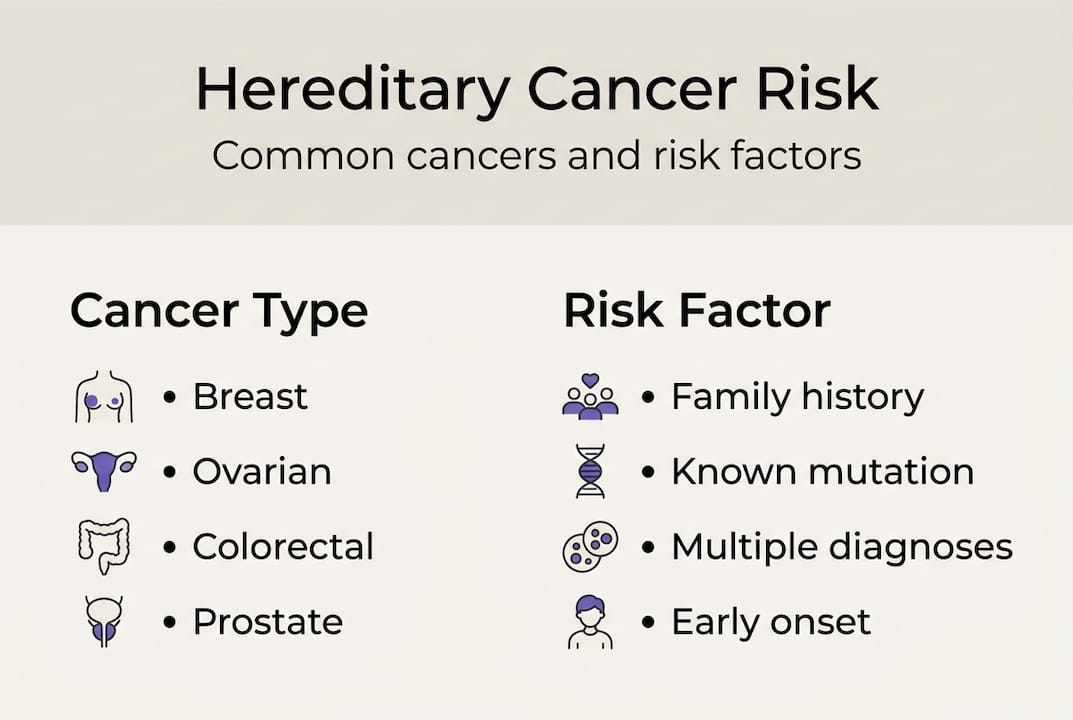
The cancers most commonly linked to inherited mutations include breast, ovarian, pancreatic, prostate, and colorectal cancers. The genes you've likely heard of, BRCA1 and BRCA2, are among the most studied. Carrying a BRCA1 mutation raises your lifetime breast cancer risk above 60%, compared to about 12% in the general population. That's not a small difference. That's a fundamentally different risk profile that changes how you and your doctor should approach prevention.
Research published in Nature Communications confirms that BRCA1/2 penetrance exceeds 60%, with testing sensitivity reaching 99.1% in controlled studies, meaning modern tests are highly accurate when identifying these mutations.
Here's a quick look at the most commonly tested hereditary cancer genes and their associated cancers:
| Gene | Associated cancers | Estimated lifetime risk increase |
|---|---|---|
| BRCA1 | Breast, ovarian | 60-72% (breast) |
| BRCA2 | Breast, ovarian, pancreatic | 45-69% (breast) |
| MLH1/MSH2 | Colorectal, endometrial | 40-80% (colorectal) |
| PALB2 | Breast, pancreatic | 35-60% (breast) |
| TP53 | Multiple cancers | Highly variable |
Who should consider genetic risk assessment? Look for these signals in your family history:
- Multiple relatives on the same side with the same or related cancers
- Cancer diagnosed before age 50 in a close relative
- A relative with two or more primary cancers
- Male breast cancer in any relative
- Known hereditary mutation in your family
Pro Tip: You don't need a cancer diagnosis to pursue gene testing. If your family history raises any of these flags, a genetic counselor can help you decide whether testing makes sense for you right now.
The cancer gene testing process: From counseling to results
Knowing you might be at risk is one thing. Taking action is another. The good news is that the testing process is more straightforward than most people expect, and you're not navigating it alone.
Here's how the process typically unfolds, step by step:
- Pre-test genetic counseling. Before any sample is collected, you meet with a certified genetic counselor. They review your personal and family medical history, assess your risk level, and help you decide which test is appropriate.
- Sample collection. Testing uses a blood draw or saliva sample. No surgery, no biopsy. The sample goes to a certified lab for analysis.
- Lab analysis. The lab sequences the relevant genes and compares your variants against known databases of pathogenic and benign mutations.
- Results delivery. Standard results take 2-3 weeks from sample receipt. Some expedited panels return faster.
- Post-test counseling. This is where your results are explained in plain language, and a plan is built around what they mean for your health and your family.
"Genetic counseling is not optional, it's the foundation of responsible testing. Without it, even a clear result can be misunderstood or misapplied."
One thing many people overlook is the importance of family testing tips when a mutation is found. If you test positive, your first-degree relatives (parents, siblings, children) each have a 50% chance of carrying the same mutation. Counselors can help you navigate those conversations and coordinate cascade testing for your family.

Pro Tip: Bring a written family history to your first counseling appointment. Include cancer diagnoses, ages at diagnosis, and which side of the family each relative is on. The more detail you bring, the more useful your counselor's assessment will be.
Interpreting results: Positive, negative, and variants of uncertain significance (VUS)
When your results arrive, they fall into one of three categories. Understanding what each one means prevents unnecessary panic or false reassurance.
| Result type | What it means | Recommended next step |
|---|---|---|
| Pathogenic (positive) | A known harmful mutation was found | Enhanced surveillance, risk-reduction options |
| Benign (negative) | No harmful mutation detected | Continue standard screening |
| VUS (uncertain) | A variant exists but its impact is unknown | Monitor; retest as evidence grows |
The most confusing result is a variant of uncertain significance, or VUS. A VUS means the lab found a genetic change, but science hasn't yet determined whether it causes harm. This is not a diagnosis. It does not mean you have cancer or will get cancer.
VUS results are more common than most people realize. Research from the European Journal of Human Genetics shows that VUS comprise about 40% of hereditary cancer variants, and 31.4% of those are eventually reclassified as likely pathogenic as more data becomes available. That reclassification rate matters because it means your result today may have a clearer answer in two or three years.
Here's what to do if you receive a VUS:
- Do not make major medical decisions based on a VUS alone
- Ask your lab to notify you if your variant is reclassified
- Revisit your result with a counselor every 12-18 months
- Consider gene panel testing insights to see whether a broader panel adds clarity
Pro Tip: Keep a copy of your full lab report, including the specific variant notation (e.g., c.5266dupC). If you change providers or want a second opinion, this detail is essential for accurate interpretation.
Advances in cancer genetic testing: Panels, exome, and paired tumor-germline sequencing
The technology behind cancer gene testing has changed dramatically in the past decade. Understanding your options helps you ask better questions and get more useful answers.
Single-gene testing, where labs analyzed one gene at a time, is largely outdated. Today, next-generation sequencing (NGS) allows labs to analyze dozens or even hundreds of genes simultaneously. This matters because many hereditary cancer syndromes involve multiple genes, and testing only one can miss the full picture.
Here's a comparison of current testing approaches:
| Technology | Genes analyzed | Best for |
|---|---|---|
| Single-gene test | 1 | Known family mutation |
| Multi-gene panel | 10-100+ | Unknown hereditary risk |
| Exome sequencing | ~20,000 | Complex or unresolved cases |
| Whole genome sequencing | All genes | Research or rare syndromes |
| Paired tumor-germline | Tumor + blood | Clarifying VUS, guiding treatment |
Paired tumor-germline sequencing is one of the most significant recent advances. By comparing DNA from a tumor sample with DNA from a blood or saliva sample, labs can distinguish mutations that developed in the tumor from those inherited at birth. This approach directly improves VUS resolution and helps oncologists choose targeted therapies.
The ongoing evolution of NGS and long-read sequencing is making it possible to detect structural variants and complex rearrangements that older technologies missed entirely. These advances mean that a negative result from five years ago may be worth revisiting with today's tools.
At Gene Matrix, our laboratory science integrates AI-driven analysis trained on over 500,000 genetic profiles, which improves accuracy and helps contextualize results that would otherwise remain ambiguous.
Pro Tip: If you had single-gene testing more than three years ago, ask your provider whether updated multi-gene panel testing would add value given your family history.
Testing guidelines and ethical considerations: Criteria-based vs. universal testing
Not everyone with cancer gets offered genetic testing, and that gap is increasingly controversial in the medical community.
Currently, organizations like NCCN and ASCO use clinical criteria to determine who qualifies for testing. These criteria consider cancer type, age at diagnosis, and family history. A 2026 study found that ASCO criteria capture 94.8% of eligible patients compared to NCCN's 67.3%, suggesting that broader criteria identify more people who would benefit from testing.
The push for universal testing, offering genetic testing to all newly diagnosed cancer patients regardless of family history, is gaining ground. Proponents argue it catches more hereditary cases early. Critics point to resource strain, the potential for increased VUS results, and the ethical complexity of finding mutations in patients who didn't specifically seek that information.
Families navigating this space face real ethical questions:
- Who has the right to know about a family mutation?
- What happens to insurance coverage if a mutation is found?
- How do you tell a child they may carry a hereditary risk?
- What are your obligations to inform relatives who may not want to know?
"A positive result doesn't just affect you. It ripples through your entire family, and that's both the power and the weight of hereditary cancer testing."
For those facing these decisions, cancer support resources can help families process the emotional and practical dimensions of what testing reveals. Genetic counselors are trained to navigate these conversations, and their role extends well beyond interpreting lab reports.
A fresh perspective: Why your genetics are only part of the story
Here's something most testing guides won't tell you directly: a gene mutation is not a sentence. It's information. And information only has power when you act on it thoughtfully.
We've seen people receive a BRCA1 positive result and spiral into fear-driven decisions, and we've seen others use the same result to build a proactive, confident health plan. The difference is almost never the result itself. It's the support structure around it.
Direct-to-consumer genetic tests, the kind you order online and spit into a tube at home, are not the same as clinical-grade hereditary cancer panels. They test a fraction of the variants that matter and often miss pathogenic mutations entirely. Relying on them for cancer risk decisions is like checking the weather with a broken thermometer.
Genetics and prevention through informed action are most powerful together. Your genes set a baseline, but your choices, your screening schedule, your lifestyle, and your medical team shape the outcome. Science also keeps moving. A VUS today may be reclassified tomorrow. A gene panel from 2021 may miss variants that 2026 technology catches. Revisiting your results every few years isn't paranoia. It's precision medicine working the way it should.
Take the next step: Expert-guided cancer gene testing
Understanding your hereditary cancer risk is one of the most proactive decisions you can make for your long-term health. But knowledge is only useful when it's backed by expert guidance and clinical-grade technology.

Gene Matrix provides end-to-end hereditary cancer testing, from pre-test counseling through AI-powered result interpretation, all delivered within 72 hours through our GeneMatrixAI platform. Our cancer research innovation ensures your results reflect the latest science, not yesterday's databases. Whether you're just starting to explore your family history or ready to act on a known risk, we're here to make your results actionable, not just informative. Explore what's possible with laboratory science at Gene Matrix and take the first step toward clarity.
Frequently asked questions
Who should consider cancer gene testing?
Anyone with a personal or family history of specific cancers, or those with a known hereditary mutation in the family, should speak with a genetic counselor about testing. You don't need a diagnosis to qualify.
What does a positive gene test result mean?
A positive result means a harmful mutation was identified, but BRCA1/2 mutations increase risk, not certainty. Many people with pathogenic mutations never develop cancer, which is why the result guides surveillance and prevention, not panic.
Can a variant of uncertain significance (VUS) affect my care?
A VUS should not change your medical management until science reclassifies it. VUS reclassification happens regularly as genetic databases grow, so staying in contact with your provider is important.
How long do results from cancer gene testing take?
Most cancer gene panels return results in 2-3 weeks from sample collection, though some expedited tests are faster.
Is cancer gene testing covered by insurance?
Many insurance plans cover hereditary cancer testing when you meet clinical criteria such as family history or specific cancer diagnoses. Always verify coverage with your insurance provider before testing.