

TL;DR:
- Outsourcing genomic testing often offers faster turnaround, higher quality, and better compliance than keeping testing in-house. Certified partners provide scalable, reliable services that are essential for the expanding precision medicine landscape, particularly for complex or low-volume assays. Selecting a trusted, compliant provider with clear operational processes ensures improved patient outcomes and operational efficiency.
Most healthcare labs assume that keeping genomic testing in-house guarantees better control, faster results, and stronger compliance. In practice, the opposite is often true. Genomics lab outsourcing services have matured significantly, with certified partners now delivering clinical-grade sequencing, bioinformatics, and genomic data analysis at speeds and quality levels that most hospital labs cannot replicate internally. The global genomics services market was valued at USD 6.7 billion in 2025 and is projected to reach USD 16.2 billion by 2035. This guide gives you the framework to evaluate, select, and operationalize a genomics outsourcing partnership that actually improves patient outcomes.
Table of Contents
- Key takeaways
- Why genomics lab outsourcing services are growing fast
- Quality standards and compliance in clinical genomics outsourcing
- Operational best practices for outsourcing genomics workflows
- In-house testing vs. outsourcing: what actually matters
- Choosing the right genomics outsourcing partner
- My perspective on genomics outsourcing in precision medicine
- How Genematrix supports your genomics program
- FAQ
Key takeaways
| Point | Details |
|---|---|
| Market growth is real | The genomics services market is expanding rapidly, creating more certified, specialized outsourcing options for clinical labs. |
| Compliance is non-negotiable | Verify ISO 15189, CAP, and CLIA certifications with actual QC artifacts, not marketing claims. |
| Logistics determine data quality | Sample shipping protocols directly affect sequencing integrity and final result accuracy. |
| Cheapest rarely wins | Prioritize expertise and quality management over price to avoid costly delays and errors downstream. |
| Domestic partners reduce risk | US-based providers simplify regulatory compliance and data residency requirements for sensitive genetic data. |
Why genomics lab outsourcing services are growing fast
The precision medicine movement has fundamentally changed what clinical labs are expected to deliver. Physicians now order hereditary cancer panels, pharmacogenomic profiles, and whole-exome sequences as part of routine care. Few hospital labs have the capital, staff, or infrastructure to run all of these in-house at scale.
The genomics services market is growing at a compound annual rate between 9.2% and 11.2%, driven by next-generation sequencing (NGS) adoption and the expansion of precision medicine programs across health systems. Outsourcing workflows now cover everything from sample preparation and library construction to bioinformatics pipelines and clinical interpretation reports.
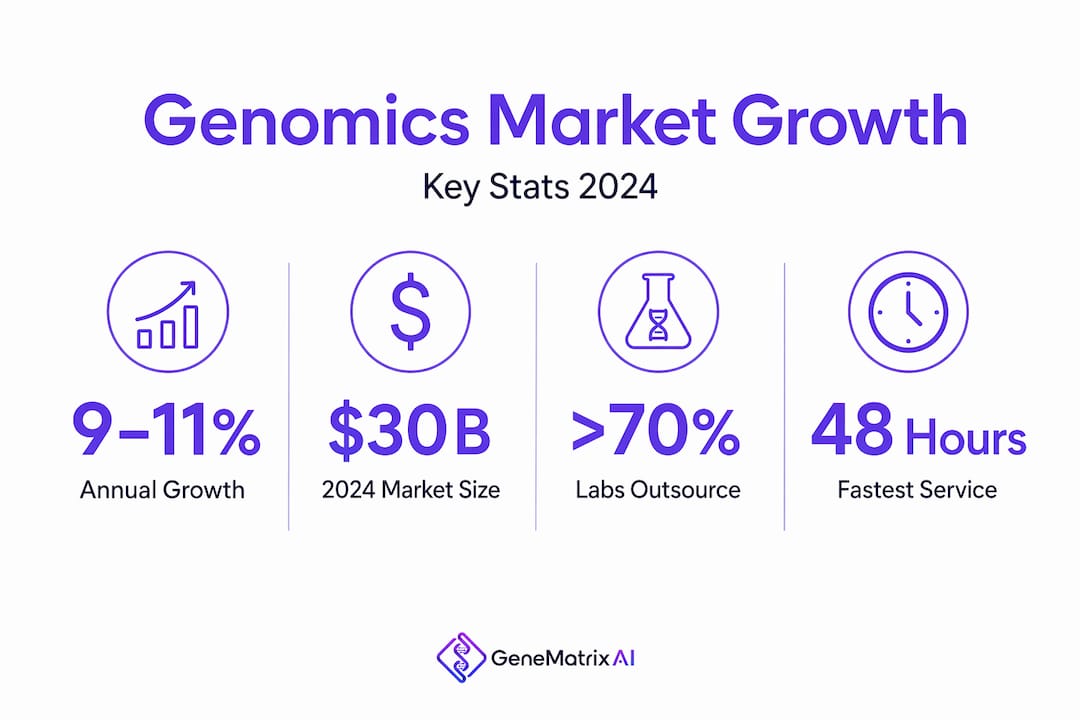
Turnaround time is one of the most compelling arguments for outsourcing. RNA-Seq services can be completed in as few as five business days, while complex clinical diagnostic panels typically run around ten business days. Most hospital labs running the same assays internally take two to four weeks due to batch scheduling and instrument availability constraints.
| Service type | Typical outsourced turnaround | Typical in-house turnaround |
|---|---|---|
| RNA-Seq | 5 business days | 15 to 20 business days |
| Whole-exome sequencing | 10 to 14 business days | 3 to 5 weeks |
| Clinical diagnostic NGS panel | 10 business days | 2 to 4 weeks |
| Bioinformatics analysis only | 3 to 7 business days | 1 to 3 weeks |
Pro Tip: When evaluating genomic data analysis partners, ask for documented average turnaround times across the last 90 days of production runs, not just advertised estimates. Real operational data tells a very different story.
Quality standards and compliance in clinical genomics outsourcing
Compliance in genomics is not a checkbox. It is an engineering capability built into every step of the workflow, from sample receipt to report delivery. When you evaluate clinical genomics outsourcing partners, the certifications they hold should be your first filter, but they should never be your last.
ISO 15189:2022 accreditation is the international benchmark for medical laboratory competence and patient safety risk management. Full compliance was required by December 2025, and it demands a risk-based approach to quality that goes well beyond documentation. Labs accredited under this standard show measurably lower error rates, faster turnaround, and stronger staff competency frameworks according to published laboratory performance data.
Beyond ISO 15189, look for these credentials and practices when evaluating any lab services for genomics:
- CLIA certification: Required for any lab reporting clinical results in the United States. Verify the CLIA number independently through the CMS database.
- CAP accreditation: The College of American Pathologists sets standards that function as a compliance ceiling for NGS pipelines. CAP-compliant NGS pipelines require documented sensitivity, specificity, limit of detection, and precision validations.
- Documented SOPs: Request copies of standard operating procedures for sample handling, sequencing runs, and variant calling. If a provider hesitates to share these, that hesitation is your answer.
- Real QC artifacts: Ask for actual QC reports from recent runs, not summary slides. Metrics like Q30 scores, coverage uniformity, and duplicate read rates tell you whether their process is reproducible.
- Audit readiness: A compliant partner should be able to walk you through a mock audit without preparation. If they need weeks to gather documentation, their quality management system is not mature.
Pro Tip: Request a sample data package from a de-identified run before signing any contract. Reviewing the actual report format, variant annotations, and interpretation notes will tell you more about a provider's clinical rigor than any sales conversation.
Operational best practices for outsourcing genomics workflows
Getting the partnership structure right before the first sample ships is what separates successful genomics research outsourcing from expensive frustration. Most operational failures are not technical. They are logistical and contractual.
Here is a structured approach to establishing an effective outsourcing workflow:
- Define data ownership upfront. Before any sequencing begins, your contract must specify who owns the raw data, processed files, and variant calls. Data ownership and security policies should include role-based access control and documented audit trails. Ambiguity here creates serious compliance exposure.
- Establish sample shipping protocols. Ship biological samples early in the week, with excess dry ice, to avoid weekend transit delays. Use strip caps or sealing foil for multi-well plates rather than plastic film seals, which are prone to leaking during temperature fluctuations.
- Assign a dedicated project manager on both sides. Effective communication with clear progress reporting reduces delays and eliminates the most common source of outsourcing friction: nobody knowing the current status of a run.
- Set up a data transfer and retention schedule. Agree on file formats, delivery timelines, and how long raw data will be stored on the provider's servers. HIPAA-compliant cloud environments with encryption at rest and in transit are the minimum standard for clinical samples.
- Build in a quality review cycle. The first three to five runs with any new partner should include a formal review of QC metrics, turnaround adherence, and report accuracy before you scale volume.
- Avoid optimizing purely on price. Choosing the cheapest provider is rarely the right strategy. Errors, re-runs, and compliance failures cost far more than the premium you pay for a reliable partner.
Pro Tip: Include a turnaround time penalty clause in your service agreement. Partners who are confident in their operations will accept it. Those who push back are telling you something about their reliability.
In-house testing vs. outsourcing: what actually matters
The in-house versus outsourcing decision is rarely black and white. Most health systems benefit from a hybrid model where high-volume, standardized assays stay internal while complex or low-volume testing goes to specialized partners.

Here is how the two models compare across the factors that matter most to clinical labs:
| Factor | In-house testing | Outsourced genomics |
|---|---|---|
| Upfront cost | High (instruments, staff, validation) | Low to moderate (per-sample pricing) |
| Expertise depth | Limited to existing staff skills | Access to specialized bioinformaticians |
| Scalability | Constrained by instrument capacity | Scales on demand |
| Technology access | Dependent on capital budget cycles | Access to latest platforms immediately |
| Regulatory burden | Fully internal | Shared with certified partner |
| Turnaround time | Variable, often slower | Consistently faster for complex assays |
Outsourcing makes the most sense when your lab needs to offer precision medicine tests that require specialized bioinformatics interpretation, when test volumes are too low to justify dedicated instrument time, or when you need to expand your test menu faster than internal validation timelines allow.
Internal testing still has advantages when you need real-time results for urgent clinical decisions, when your volume justifies full instrument utilization, or when your patient population requires highly customized assay development that an external partner cannot replicate.
The intangible benefits of outsourcing are often underweighted in these decisions. Regulatory peace of mind, access to a partner's existing validation data, and the ability to scale during high-demand periods without capital expenditure are real operational advantages that do not show up in a simple cost-per-sample comparison.
Choosing the right genomics outsourcing partner
Selecting a genomics outsourcing partner is a long-term clinical decision, not a procurement transaction. The wrong partner affects patient care. The right one extends your lab's capabilities without adding operational complexity.
When evaluating providers, focus on these criteria:
- Specialization match: Does the provider have published data and validated workflows in the specific assay types you need? A partner strong in oncology panels may not be the right fit for pharmacogenomics.
- Technology platform transparency: Ask which sequencing platforms they run, what their bioinformatics pipeline looks like, and whether their analysis tools are validated for clinical reporting.
- Data residency and compliance alignment: Selecting a genomics partner requires aligning platform features with your data residency requirements, not just evaluating technology specs.
- Domestic provider advantages: US-based providers minimize export control risks and simplify compliance for sensitive genetic data, which matters significantly for clinical labs operating under HIPAA.
- Pricing model clarity: Understand exactly what is included in per-sample pricing. Bioinformatics, clinical interpretation, and data storage are frequently billed separately and can double the apparent cost.
The cost of genomics lab services varies widely depending on assay complexity, data analysis depth, and turnaround requirements. Expect to pay a premium for clinical-grade reporting with interpretation notes versus raw sequencing data alone. That premium is almost always worth it when results inform patient treatment decisions.
For long-term partnerships, evaluate the provider's investment in AI-powered genomics and their roadmap for expanding capabilities. A partner who is standing still technologically will become a liability as your clinical programs grow.
My perspective on genomics outsourcing in precision medicine
I've reviewed a lot of genomics outsourcing arrangements over the years, and the pattern that causes the most damage is always the same. Labs choose a partner based on price and a polished sales deck, then discover six months later that the QMS is shallow, the turnaround commitments are aspirational, and the data security posture doesn't hold up to scrutiny.
What I've learned is that the quality of the partnership matters more than any individual specification. A provider who proactively flags a sample quality issue before running a sequencing batch, who delivers QC metrics without being asked, and who treats your compliance requirements as their own is worth significantly more than one offering a lower per-sample rate.
The clinical stakes in genomics are not abstract. A missed BRCA1 variant or a misinterpreted pharmacogenomic result affects a real patient's treatment. I've seen what happens when labs treat outsourcing as a cost-cutting exercise rather than a clinical capability decision. The consequences are expensive, and sometimes they're irreversible.
The future of this space is genuinely exciting. AI-driven interpretation platforms trained on large genetic datasets are compressing the time between sequencing and clinical insight. But the technology only delivers value when it sits on top of a compliant, well-managed operational foundation. That foundation is what you need to evaluate first, before any conversation about platforms or pricing.
— Tarek
How Genematrix supports your genomics program
If you're evaluating genomics lab outsourcing services and need a partner who combines certified lab operations with AI-powered clinical interpretation, Genematrix is built for exactly that. As a CLIA-certified, Chicago-based biotechnology company, Genematrix delivers hereditary cancer screening, pharmacogenomics, and precision medicine reports within 72 hours, backed by AI analysis trained on over 500,000 genetic profiles.

Genematrix's R&D innovation platform supports hospitals, physician groups, and health systems looking to expand their genomic testing capabilities without the overhead of in-house infrastructure. From GeneCancer and GenePGx to specialized modules in psychiatric, pediatric, and nutrigenomic testing, the service menu is designed to match real clinical workflows. Explore the full Gene Matrix platform or contact the team directly to discuss a partnership structure that fits your lab's patient care goals.
FAQ
What are genomics lab outsourcing services?
Genomics lab outsourcing services involve contracting certified external laboratories to perform genetic sequencing, bioinformatics analysis, and clinical reporting on behalf of healthcare organizations. These services allow labs to expand their genomic testing capabilities without investing in dedicated infrastructure.
How do I verify a genomics outsourcing partner's compliance?
Request the provider's CLIA number and verify it through the CMS database, confirm CAP or ISO 15189 accreditation, and ask for actual QC reports and SOPs rather than relying on marketing materials. Documented validation artifacts are the clearest indicator of a mature quality management system.
What is the typical cost of genomics lab services?
The cost of genomics lab services varies by assay type, data analysis depth, and turnaround requirements. Per-sample pricing for clinical NGS panels typically ranges from a few hundred to several thousand dollars, with bioinformatics interpretation and clinical reporting often priced separately.
When does outsourcing genomics testing make more sense than in-house testing?
Outsourcing is most advantageous when test volumes are too low to justify dedicated instrument time, when specialized bioinformatics expertise is required, or when your lab needs to expand its test menu faster than internal validation timelines allow. The top clinical genomics labs in the US cover a wide range of specialized assays that most hospital labs cannot replicate internally.
How do I protect patient data when outsourcing genomic testing?
Before outsourcing begins, define data ownership, establish role-based access controls, and require HIPAA-compliant data transfer and storage protocols in your service agreement. Contractual clarity on data security and audit trails is the most effective way to prevent breaches and compliance exposure.