

TL;DR:
- Not all clinical genomics labs are equal, especially when treatment outcomes depend on accurate variant interpretation. True clinical-grade providers maintain rigorous processes, validation, and sample identity checks, which research-only labs often lack. Differences in validation, VUS management, and workflow flexibility significantly impact patient care quality and reliability.
Not all clinical genomics labs are created equal, and that gap becomes painfully clear when a patient's treatment decision hinges on a variant interpretation that turns out to be wrong. Healthcare providers and institutions shopping for a clinical genomics solutions partner often focus on surface-level features: panel size, turnaround time, or slick reporting dashboards. But the real differentiators live deeper, in bioinformatics validation, variant reclassification workflows, pharmacogenomics (PGx) integration, and the clinical support structure that transforms raw data into actionable guidance. This guide cuts through the noise so you can evaluate providers on what actually drives patient outcomes.
Table of Contents
- What makes a clinical genomics solutions provider 'clinical-grade'?
- How clinical genomics providers support precise medication decisions
- Complexities in hereditary cancer screening: the VUS challenge
- Matching analysis workflows to the clinical intent: why one size doesn't fit all
- Why clinical genomics provider differences matter more than most realize
- Explore advanced clinical genomics solutions with Gene Matrix
- Frequently asked questions
Key Takeaways
| Point | Details |
|---|---|
| Operational rigor | Choose providers with validated, accredited, and fully documented workflows for reliable clinical results. |
| Variant interpretation | Look for sophisticated frameworks to manage variants of uncertain significance, minimizing patient uncertainty. |
| Actionable PGx support | Top providers offer integrated pharmacogenomics testing and reporting to inform safe, effective medication choices. |
| Workflow alignment | Ensure analysis approaches match clinical questions, sample type, and required sensitivity for each patient. |
| Transparency and support | Demand transparent quality processes and ongoing support beyond the lab report for best outcomes. |
What makes a clinical genomics solutions provider 'clinical-grade'?
With the stakes set, let's clarify what separates a true clinical-grade genomics provider from the rest.
The term "clinical-grade" gets used loosely in genomics marketing, but it carries specific operational meaning. A provider that meets clinical standards doesn't just sequence DNA accurately. It maintains rigorous processes around every step from sample receipt to final report delivery. Consensus recommendations for clinical bioinformatics make clear that clinical genomics operations require rigorous bioinformatics mechanics: validation, standardization/accreditation, reproducibility, integrity checks, and sample identity confirmation. Each of those pillars represents a potential failure point that a research-only lab may never encounter because research tolerates uncertainty in ways clinical care cannot.
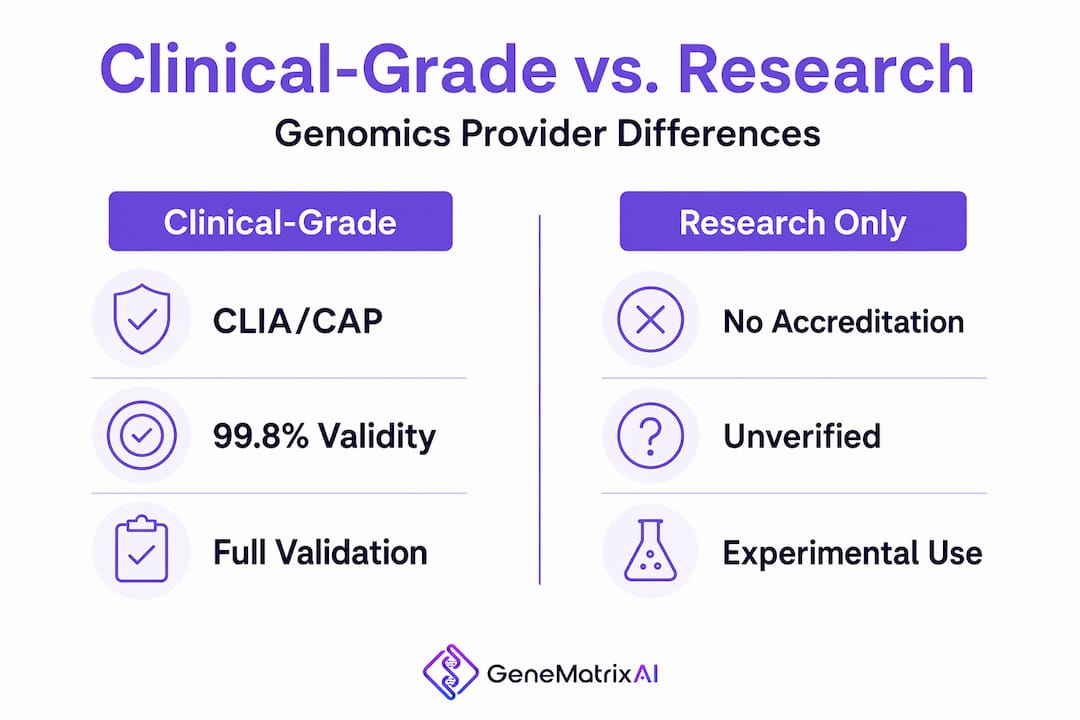
Analytical validity is the foundation. Industry benchmarks target 99.8% analytical validity as the minimum acceptable threshold for clinical variant detection. Missing that mark even slightly at scale means thousands of patients receive incorrect or incomplete information. Reproducibility matters just as much: can the lab produce the same result from the same sample on different days, different instruments, and different analysts? A research lab might run a single experiment; a clinical lab must demonstrate consistent performance across hundreds of runs.
Sample identity confirmation is one of the most overlooked differentiators. Mix-ups happen. A provider without molecular barcoding and chain-of-custody documentation creates real risk of reporting one patient's variants under another patient's name. The downstream clinical consequences of that error are severe.
Here is what a true clinical-grade provider does that a research-only lab typically does not:
- Maintains College of American Pathologists (CAP) accreditation or equivalent, plus CLIA certification
- Validates every bioinformatics pipeline against established reference standards before clinical deployment
- Uses containerized software environments to ensure reproducibility across system updates
- Implements sample-level identity checks using fingerprinting panels at multiple workflow stages
- Documents every pipeline version change and its effect on variant calling performance
- Provides a signed laboratory director review on every clinical report
Pro Tip: Ask any prospective provider for their pipeline validation documentation and version control logs. If they cannot produce those on request, their "clinical-grade" claim is marketing, not operations.
The global impact of genetic testing continues to grow, which means the bar for clinical standards must rise with it. Providers who treat healthcare compliance essentials as optional extras rather than operational baselines will struggle to maintain consistent quality as volume scales.
| Requirement | Clinical-grade provider | Research-only lab |
|---|---|---|
| CLIA/CAP accreditation | Required | Rare |
| Pipeline validation against reference standards | Documented, versioned | Informal or absent |
| Sample identity confirmation | Molecular barcoding | Manual tracking |
| Reproducibility testing | Regular, documented | Ad hoc |
| Signed clinical report | Laboratory director sign-off | Not standard |
| Variant reclassification process | Structured, ongoing | Not applicable |
How clinical genomics providers support precise medication decisions
Once the basics of clinical-grade service are established, let's see how these standards directly influence critical decisions, like choosing the right medication.

Pharmacogenomics is one of the highest-value applications in precision medicine, yet its clinical utility depends almost entirely on how the provider structures the testing and reporting workflow. PGx solution providers include test and interpretation elements explicitly intended to inform medication choice and dosing based on genotype. That phrase "explicitly intended" is doing a lot of work. A provider that sequences relevant genes but leaves interpretation to the ordering physician without structured guidance is delivering raw data, not clinical support.
The practical difference is significant. A provider with integrated clinical decision support can flag a patient as a CYP2D6 poor metabolizer and immediately connect that finding to specific drug classes, dosing adjustments, and alternative agents, all within the report. A provider without that layer hands the physician a genotype and expects them to translate it independently, which is both time-consuming and error-prone.
Collection method also matters more than it might seem. Noninvasive cheek swab collection reduces barriers to testing, particularly in outpatient and primary care settings where venipuncture creates friction. Providers that support saliva or buccal swab collection with validated pre-analytic protocols make PGx testing accessible without compromising data quality. Reports built on FDA pharmacogenomics biomarker data and CPIC guidelines give ordering providers confidence that the clinical recommendations are evidence-based, not proprietary algorithms with no external validation.
Here is how a well-structured PGx workflow runs from order to clinical action:
- Ordering provider submits a test request through the provider portal with relevant medication history
- Patient collects a buccal swab sample using a kit shipped directly to them
- Sample arrives at the CLIA-certified lab with chain-of-custody documentation intact
- Sequencing and genotyping are performed against validated gene panels covering 50 or more clinically actionable genes
- AI-assisted interpretation maps genotype results to CPIC and FDA drug interaction data
- A structured clinical report is generated and reviewed by a licensed pharmacogenomics specialist
- The ordering provider receives the report with tiered recommendations: avoid, use with caution, or preferred agent
- Post-test clinical support is available for complex cases or treatment change questions
Pro Tip: Confirm that your PGx provider offers post-test clinical consultation. Medication changes based on genomic data can be complex, and having a specialist available to discuss edge cases protects both your patients and your practice.
| Feature | High-quality PGx provider | Basic PGx provider |
|---|---|---|
| Genes covered | 50+ clinically actionable | 10 to 20 genes |
| Collection method | Buccal swab or blood | Blood only |
| Report framework | CPIC/FDA-based tiers | Proprietary scoring |
| Clinical support | Post-test specialist access | Report only |
| Turnaround time | 48 to 72 hours | 7 to 14 days |
| Drug-gene interaction detail | Drug-specific dosing guidance | General gene-level flags |
Complexities in hereditary cancer screening: the VUS challenge
Individualized treatment starts with precise variant interpretation, especially where the clinical stakes are less black and white.
Hereditary cancer screening panels for genes like BRCA1, BRCA2, and Lynch syndrome-associated mismatch repair genes have become standard of care in oncology and high-risk family medicine. But the clinical value of those panels depends heavily on how a provider handles variants of uncertain significance, commonly called VUS. A VUS is a genetic change whose relationship to disease risk has not yet been definitively established. It is neither clearly pathogenic nor clearly benign, and that ambiguity creates real clinical tension.
Research on VUS prioritization highlights that edge-case nuance in hereditary cancer genomics includes VUS prevalence and the need for specialized strategies to prioritize and resolve uncertain variants rather than treating all results as equivalent. That framing is important. A provider that simply reports VUS findings without a structured reclassification pathway is offloading clinical uncertainty onto the ordering provider and ultimately onto the patient.
The consequences of poor VUS management are real and serious:
- Patients receive ambiguous results without clear follow-up guidance, leading to anxiety without actionable next steps
- Families may undergo unnecessary surveillance or, conversely, skip appropriate screening based on misinterpreted findings
- Providers face liability exposure when VUS findings are not communicated with appropriate context
- Reclassification events (when a VUS is later upgraded to pathogenic) go unnoticed if the lab has no mechanism to notify ordering providers
In contrast, providers with advanced VUS management do the following:
- Apply computational pathogenicity scoring and population frequency data to stratify VUS by likelihood of clinical significance
- Integrate functional evidence and published literature into variant classification reviews
- Maintain a reclassification pipeline that automatically updates reports when new evidence emerges
- Notify ordering providers and offer updated genetic counseling when a VUS is reclassified
"Specialized strategies to prioritize and resolve uncertain variants are essential in hereditary cancer genomics. Treating all results as equivalent, regardless of their evidence base, undermines the clinical value of testing and can lead to both over- and under-management of patient risk." European Journal of Human Genetics, 2026
Pro Tip: When evaluating a hereditary cancer testing portal, ask specifically how the provider handles VUS reclassification. Request a sample report showing how VUS findings are communicated and what the follow-up process looks like for reclassification events.
Matching analysis workflows to the clinical intent: why one size doesn't fit all
These subtleties come into sharp focus when you consider the diversity of real-world clinical scenarios.
A genomics provider that applies the same analysis pipeline to every sample regardless of clinical context is not delivering precision medicine. It is delivering standardized processing, which is a fundamentally different thing. The analysis workflow must match the clinical question being asked.
Empirical benchmarking shows that somatic variant calling performance differs by analysis goal and sequencing depth, meaning clinical genomics providers must align caller choice and workflows with clinical intent, whether that is high sensitivity or unbiased discovery, and with sample characteristics such as circulating tumor DNA (ctDNA). This has direct implications for how you evaluate a provider's technical capabilities.
Consider two scenarios. In the first, a clinician wants to detect a known somatic mutation at very low allele frequency in a liquid biopsy sample from a patient on active cancer therapy. That requires ultra-deep sequencing (often 1,000x or more) and a variant caller optimized for high sensitivity at low allele frequencies. In the second scenario, a clinician wants to characterize the full mutational landscape of a newly diagnosed solid tumor to guide treatment selection. That requires a different sequencing depth, a different caller optimized for unbiased discovery, and a different interpretation framework.
A provider that uses one pipeline for both cases will either miss low-frequency variants in the liquid biopsy or generate noise in the solid tumor analysis. Neither outcome serves the patient.
Here is how to align workflow parameters with clinical need:
- Define the clinical question before ordering: Is this diagnostic, prognostic, treatment selection, or monitoring?
- Specify the sample type: solid tissue, blood-derived ctDNA, or germline DNA from saliva or blood
- Confirm the provider's sequencing depth protocol for that sample type and clinical intent
- Verify that the variant caller used is validated for that specific combination of sample type and analysis goal
- Review the reporting framework to confirm it surfaces the variants most relevant to your clinical question
| Clinical goal | Optimal sequencing depth | Preferred caller approach |
|---|---|---|
| High-sensitivity ctDNA detection | 500x to 2,000x | Error-corrected, sensitivity-optimized |
| Solid tumor mutation profiling | 100x to 300x | Balanced sensitivity/specificity |
| Germline hereditary risk | 30x to 100x | High-accuracy germline caller |
| Treatment resistance monitoring | 1,000x or higher | Ultra-sensitive somatic caller |
Providers who build using genomics for proactive health into their workflow design understand that the analysis layer is not a commodity. It is a clinical decision in itself. Telemedicine-enabled delivery of results also requires that reports are structured for clarity across diverse clinical settings, a consideration that telemedicine considerations in healthcare delivery make increasingly relevant.
Why clinical genomics provider differences matter more than most realize
Stepping back, it is clear that successful genomics integration is not plug-and-play, and the providers who market it that way are doing their customers a disservice.
The technology is real and impressive. Next-generation sequencing, AI-assisted variant interpretation, and cloud-based reporting platforms have genuinely transformed what is possible in clinical genomics. But technology is the floor, not the ceiling. What distinguishes a provider that consistently delivers clinical value is everything that happens around the technology: the validation rigor, the VUS management framework, the pharmacogenomics clinical support structure, and the workflow flexibility to match analysis to intent.
Here is the uncomfortable truth that marketing materials rarely surface. Two providers can both claim AI-powered genomics, CLIA certification, and rapid turnaround, and still differ enormously in clinical reliability. The differences live in their pipeline validation documentation, their VUS reclassification rates, their post-test support model, and the depth of their clinical interpretation layer. None of those things appear in a feature comparison table.
We have seen institutions make provider decisions based on panel size and price, only to discover months later that their VUS communication process was inadequate, their PGx reports lacked clinical tiering, or their bioinformatics pipeline had not been revalidated after a software update. Those are not theoretical risks. They are operational realities that affect patient care.
The contrarian take is this: the most important questions to ask a genomics provider are not about their technology. They are about their processes. Ask to see their validation documentation. Ask how they handle VUS reclassification. Ask what happens when a PGx result conflicts with a patient's current medication regimen. Ask who reviews the reports before they reach you. The answers to those questions reveal far more than any product brochure.
Our lab science standards reflect this philosophy. Clinical genomics done right is a continuous operational commitment, not a one-time technical achievement.
Pro Tip: Demand transparency on workflows, validation records, and reporting logic before signing any provider agreement. A provider confident in their clinical rigor will welcome those questions. One that deflects them is telling you something important.
Explore advanced clinical genomics solutions with Gene Matrix
Providers ready to transform their clinical offering can take the next step with leaders in the field.
Gene Matrix delivers the operational depth this article describes, not as an aspiration but as a daily standard. Our scientific foundation is built on AI-driven analysis trained on more than 500,000 genetic profiles, with validated pipelines for hereditary cancer screening, pharmacogenomics, and specialized modules including GeneCancer, GenePGx, GeneMind, and GeneDiet. Every report is reviewed by credentialed specialists and delivered within 72 hours, with post-test clinical support built into the workflow.

Healthcare institutions and physician groups can access our full suite of actionable genomic insights through an intuitive provider portal, with mobile genetic health management available for patient-facing engagement. If you are evaluating clinical genomics partners and want a provider that can answer every hard question about validation, VUS management, and workflow alignment, we are ready for that conversation. Explore what Gene Matrix brings to your practice at genematrix.io.
Frequently asked questions
What key accreditations should a clinical genomics solutions provider have?
Look for CLIA certification combined with CAP accreditation or ISO 15189 equivalent, as clinical genomics operations require validated bioinformatics, reproducibility standards, and documented integrity checks that only accredited labs consistently maintain.
How should a provider address variants of uncertain significance (VUS) in hereditary cancer testing?
The best providers use structured frameworks to prioritize and reclassify VUS over time, because specialized strategies to resolve uncertain variants are essential to avoid over- or under-managing patient risk.
What's the value of pharmacogenomics (PGx) testing for patient care?
PGx testing guides precise medication and dosing choices by mapping a patient's genotype to drug response, and providers that include interpretation elements explicitly tied to medication choice deliver the most direct clinical value.
Do all clinical genomics providers use the same variant calling tools?
No. Somatic variant calling performance differs significantly by analysis goal and sequencing depth, so top providers align their pipeline and caller choice to each clinical use case and sample type rather than applying a single universal workflow.
Why does data integrity and sample identity confirmation matter?
Sample mix-ups and data errors can lead directly to incorrect clinical action, which is why rigorous integrity checks and identity confirmation are non-negotiable requirements in any truly clinical-grade genomics operation.
Recommended
- Our Science — Genetic Testing Research, Technology & Lab Certifications | Gene Matrix AI
- Gene Matrix | Hereditary Cancer Genetic Testing & Precision Medicine Chicago
- Genomic profiling explained: unlock personalized health insights
- Top precision medicine tests: real-world examples for informed health