

TL;DR:
- Nearly all patients carry genetic variants that affect medication responses, leading to unpredictable effects and adverse reactions.
- Drug-gene interactions influence drug absorption, metabolism, and excretion, guiding personalized treatment and reducing hospitalizations.
- Implementing pharmacogenomic testing improves safety, treatment success, and long-term health by integrating genetic insights into routine care.
Nearly everyone carries at least one genetic variant that changes how their body processes common medications, yet most prescriptions are still written without this knowledge. 95% of patients carry at least one actionable pharmacogenomic variant, meaning the gap between how a drug is expected to work and how it actually works is enormous. This guide explains the science behind drug-gene interactions, reviews the clinical evidence, walks through how testing is performed, and addresses the complex scenarios that patients and providers encounter when moving from standard prescribing toward genuinely personalized therapy.
Table of Contents
- What are drug-gene interactions and why do they matter?
- Clinical evidence: The impact of drug-gene testing
- How testing works: Methods, types of results, and examples
- Beyond the basics: Complex scenarios and challenges
- A new way forward: Rethinking what drug-gene testing means for patients and providers
- Ready to unlock the benefits of drug-gene interaction testing?
- Frequently asked questions
Key Takeaways
| Point | Details |
|---|---|
| Personalized medicine works | Drug-gene interaction testing helps tailor medications for safer, more effective results. |
| Widespread relevance | Nearly everyone has at least one actionable gene variant affecting common medications. |
| Evidence supports action | Clinical trials show fewer adverse drug reactions and smarter prescribing through genetic insight. |
| Interpret results carefully | Complexities like ancestry and multiple genes mean medical guidance is essential. |
| Barriers remain | Implementation challenges like cost and education must be overcome for equitable access. |
What are drug-gene interactions and why do they matter?
Pharmacogenomics (PGx) is the study of how a person's genes influence their response to drugs. A drug-gene interaction occurs when a genetic variant changes the way the body absorbs, distributes, metabolizes, or eliminates a medication. These four processes, known collectively as ADME, determine how much active drug reaches its target and for how long it stays there. When a variant disrupts any part of this chain, the result can range from a drug that does nothing at all to one that causes a dangerous buildup.
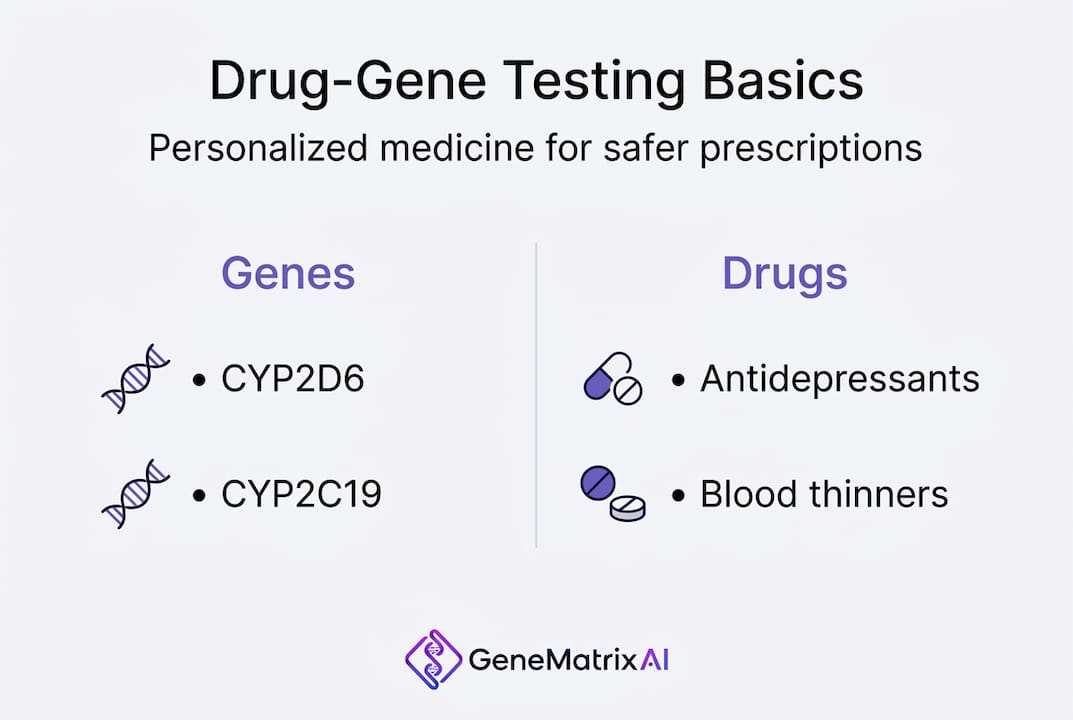
PGx testing identifies genetic variants affecting drug absorption, distribution, metabolism, and excretion, enabling personalized dosing to optimize efficacy and minimize adverse drug reactions (ADRs). This is not a fringe area of medicine. Adverse drug reactions account for roughly 7% of all hospital admissions in the United States, and a significant portion of those reactions are linked to variants in genes like CYP2D6, CYP2C19, CYP2C9, and TPMT, all of which can be detected with a single cheek swab.
To understand why this matters in daily practice, think about what happens when a patient is classified as a CYP2D6 poor metabolizer. CYP2D6 is an enzyme in the liver responsible for breaking down more than 25% of all prescribed medications, including codeine, tamoxifen, many antidepressants, and several antipsychotics. A poor metabolizer produces little or no functional enzyme. When that patient takes codeine, the drug is never converted to its active form, morphine, so they feel no pain relief at all. Meanwhile, a CYP2D6 ultra-rapid metabolizer converts codeine so quickly that morphine floods the bloodstream and can cause respiratory depression at standard doses. Same prescription, radically different outcomes, and the only difference is a genetic variant.
Beyond metabolism, genetic variants also influence wellness outcomes in broader ways, including how nutrients are processed and how inflammatory pathways respond to medications. Understanding these interactions creates a fuller picture of patient health.
Key reasons why drug-gene interactions matter in routine care include:
- Unpredictable ADRs: Variants can cause toxicity even at doses considered safe for the general population.
- Treatment failure: Slow metabolism of prodrugs (drugs that need conversion to become active) leads to no therapeutic benefit.
- Polypharmacy risk: Patients taking multiple medications face compounded gene-drug interactions.
- Wasted time and cost: Trial-and-error prescribing adds months to finding an effective regimen, especially in psychiatry and oncology.
"Genetic variation is not a rare exception. It is the norm, and ignoring it in routine prescribing is the equivalent of dosing every patient the same regardless of age or weight."
The real shift happens when clinicians stop thinking of pharmacogenomics as a specialty tool and start treating it as foundational data, as routine as a complete blood count. AI-driven genomics platforms are making this transition faster and more scalable than ever before, reducing the time between sample collection and actionable clinical guidance to under 72 hours in many settings.
Clinical evidence: The impact of drug-gene testing
Understanding the basics is one thing. Seeing what happens in large-scale clinical trials is another. The evidence supporting drug-gene testing has grown considerably over the past decade, and the numbers are difficult to ignore.

The landmark PREPARE trial, a prospective, block-randomized study conducted across seven European countries, showed that PGx-guided prescribing reduced ADRs by 30% compared to standard care. The trial also found that 95% of patients carry at least one actionable PGx variant, and that actionable recommendations arose in 21.5% of cases. Of those, physicians changed treatment in 75.5% of instances when provided with a PGx-informed recommendation. These are not marginal findings. A 30% reduction in ADRs translates to thousands of preventable hospitalizations per year at a population level.
| Metric | Standard care | PGx-guided care |
|---|---|---|
| Patients with actionable variants | 95% | 95% (identified) |
| Treatment changes made | Minimal | 75.5% of flagged cases |
| ADR reduction | Baseline | 30% lower |
| Actionable recommendations triggered | Rare | 21.5% of prescriptions |
Beyond the PREPARE trial, broader genomic surveillance studies reinforce these findings. When large cohorts are screened, actionable variants turn up consistently across all demographic groups. This is not a condition limited to a specific ancestry or age range. It is a biological reality that applies to virtually every patient population studied.
Here is a step-by-step picture of how testing changes a real treatment plan:
- A patient presents with depression and is prescribed sertraline, a common SSRI.
- Gene panel testing reveals the patient is a CYP2C19 poor metabolizer.
- Poor metabolizers of CYP2C19 accumulate sertraline at higher concentrations, increasing the risk of side effects like QT prolongation and sedation.
- The prescribing physician, guided by the PGx report, switches to an antidepressant not primarily metabolized by CYP2C19, such as desvenlafaxine.
- The patient achieves symptom control at a standard dose with no significant side effects.
This scenario plays out daily across psychiatric, oncology, cardiology, and pain management clinics. The genetic risk assessment that makes this possible does not require repeated testing. A patient's pharmacogenomic profile is essentially stable across their lifetime, meaning the results inform prescribing decisions for decades.
Statistic callout: In the PREPARE trial, physicians acted on PGx guidance in more than three out of four flagged cases, demonstrating strong clinical buy-in when actionable data is clearly presented.
How testing works: Methods, types of results, and examples
Having seen the clinical impact, let's look at the mechanics. Drug-gene interaction testing is performed using one of two primary methods: targeted genotyping panels or next-generation sequencing (NGS).
Testing methodologies include genotyping panels covering 60 or more known variants, as well as NGS for complex gene loci. Results are reported using a star allele nomenclature system, where variants are combined into diplotypes (e.g., CYP2D6 *1/*4) and then translated into phenotype categories. The four main phenotype categories are:
- Poor metabolizer (PM): Little or no enzyme activity; drug accumulates or prodrug fails to activate.
- Intermediate metabolizer (IM): Reduced enzyme activity; response is blunted or unpredictable.
- Normal metabolizer (NM): Standard activity; expected response at standard doses.
- Ultra-rapid metabolizer (UM): Excessive enzyme activity; drug clears too fast or prodrug over-converts.
Pro Tip: When reviewing a PGx report with patients, lead with the phenotype category rather than the raw diplotype. "You are a poor metabolizer of this enzyme" is far more actionable in a clinical conversation than "You carry a *4/*4 diplotype."
The guidelines that translate these phenotypes into prescribing decisions come primarily from two authoritative bodies. CPIC and DPWG guidelines provide dosing recommendations based on phenotype. For example, a patient identified as a TPMT or NUDT15 poor metabolizer should receive only 10% of the standard thiopurine dose to avoid life-threatening bone marrow toxicity. A CYP2D6 poor metabolizer prescribed a tricyclic antidepressant (TCA) should receive 30% to 60% of the standard dose to prevent cardiac toxicity.
| Gene | Phenotype | Drug class affected | Clinical action |
|---|---|---|---|
| CYP2D6 | Poor metabolizer | TCAs, codeine, tamoxifen | Reduce dose or switch drug |
| CYP2C19 | Ultra-rapid metabolizer | SSRIs, clopidogrel | Increase dose or switch drug |
| TPMT/NUDT15 | Poor metabolizer | Thiopurines (azathioprine) | Reduce to 10% of standard dose |
| CYP2C9 | Intermediate metabolizer | Warfarin, NSAIDs | Start at lower dose, monitor INR |
What does the actual report look like? A well-structured PGx report lists each gene tested, the diplotype identified, the derived phenotype, and a list of affected medications with specific recommendations. Providers receive not just a flag but a clear clinical directive. For more on how personalized medicine uses these reports to shape treatment, the science behind the workflow is both accessible and clinically rigorous.
Beyond the basics: Complex scenarios and challenges
With the fundamentals and clinical workflow in place, it is worth addressing the more complicated realities of pharmacogenomics. Testing is powerful, but it is not simple, and several factors can complicate the picture significantly.
One of the more counterintuitive findings in recent research involves CYP2C19 rapid metabolizers (RM). You might expect that metabolizing a drug faster always reduces side effects, but CYP2C19 and CYP2D6 non-normal phenotypes can increase ADR risk in antidepressants, with odds ratios between 2.3 and 9.04. A CYP2C19 rapid metabolizer taking certain antidepressants may shunt the drug through alternative metabolic pathways that generate toxic byproducts, resulting in unexpected side effects despite seemingly favorable metabolism of the parent compound.
Edge cases add further complexity: combined phenotypes where one gene's behavior counteracts another, ancestry-specific variants like HLA-B*15:02 in Southeast Asian populations that dramatically increase the risk of severe skin reactions to carbamazepine, and ambiguous diplotypes in genes like NUDT15 where phase determination requires additional analysis. These are not theoretical concerns. They represent real patients who would be misguided by a report that oversimplifies the genetic picture.
Here is how complex scenarios unfold in practice and what clinicians should watch for:
- Phenoconversion: A patient who is genetically a normal CYP2D6 metabolizer may effectively behave as a poor metabolizer if they are also taking a strong CYP2D6 inhibitor like fluoxetine. The drug changes the phenotype without changing the genotype. This drug-drug-gene interaction is commonly missed.
- Ancestry-specific variants: Standard genotyping panels are built around variants most common in European populations. A patient of African or Asian ancestry may carry clinically significant variants not included on the panel.
- Multi-gene interactions: A patient metabolizing warfarin is affected by CYP2C9 (metabolism), VKORC1 (drug target sensitivity), and CYP4F2 (vitamin K metabolism). All three genes interact to determine the correct dose.
"Pharmacogenomics is not a lookup table. It is a probabilistic framework that informs clinical judgment. Providers who treat it as a binary pass/fail test will miss its most important insights."
Despite this complexity, proactive genetic testing remains far more informative than waiting for an ADR to occur. The impact across drug classes is substantial enough that even imperfect testing yields real clinical benefit.
Implementation barriers are the other major challenge. 62.7% of patients in the 100,000 Genomes project carried actionable variants in genes like DPYD, yet real-world uptake remains remarkably low. In Switzerland, for example, only 0.09% of patients had PGx testing integrated into their electronic health record (EHR). The barriers are not primarily scientific. They are logistical and systemic: insufficient clinician education, inconsistent insurance reimbursement, and poor EHR integration that makes it difficult to connect a test result to a prescribing decision at the point of care.
Pro Tip: When advocating for PGx integration at your institution, focus first on high-risk drug classes with strong guideline support, such as thiopurines, TCAs, and clopidogrel. Early wins in defined clinical areas build institutional confidence more effectively than broad rollout.
A new way forward: Rethinking what drug-gene testing means for patients and providers
The field spends a lot of energy discussing testing accuracy and clinical utility. That is important, but we think the more significant challenge is cultural. Drug-gene testing is still framed primarily as a risk-reduction tool, something you do to avoid bad outcomes. That framing, while accurate, undersells what is actually on offer.
When a patient understands their own metabolizer status, they become a more informed participant in every prescribing decision they face for the rest of their life. That is not a one-time risk reduction. It is a permanent shift in the therapeutic relationship. Genetic insights support long-term wellness in ways that go far beyond single medication decisions.
There is also a health equity dimension that cannot be ignored. Ancestry-specific variants are underrepresented in current panels and guidelines because research cohorts have historically been predominantly European. Building equitable pharmacogenomics means actively investing in diverse population data and making testing financially accessible across income levels. The technology to do this exists. The will to prioritize it is what needs to catch up.
Ready to unlock the benefits of drug-gene interaction testing?
When you're ready to move from understanding to action, seamless access to trusted testing and expert support matters most. Gene Matrix offers the GenePGx platform, built on AI trained on more than 500,000 genetic profiles and delivering actionable pharmacogenomic reports within 72 hours. Whether you are a clinician looking to integrate PGx into your practice or a health system evaluating precision medicine programs, Gene Matrix provides the infrastructure, the science, and the support to make it work.

Explore Gene Matrix's research and development innovation to see how their technology is advancing PGx accuracy. Review the science behind the platform for clinical validation details. When you're ready to take the next step, browse available testing and subscription plans to find the right fit for your practice or health system.
Frequently asked questions
What drugs are most affected by drug-gene interactions?
Commonly impacted drugs include antidepressants, blood thinners, pain relievers, and chemotherapy agents. CYP2C19 and CYP2D6 non-normal phenotypes significantly increase ADR risk specifically in antidepressants, making psychiatric medications among the highest-priority areas for PGx-guided prescribing.
How reliable is drug-gene interaction testing?
Reliability is high when validated methodologies and established clinical guidelines are applied, though accuracy depends on which genes and variants are included in the panel. Complex loci benefit from NGS and long-read sequencing, which improve accuracy over short-read methods for difficult-to-genotype regions.
Does insurance usually cover pharmacogenomic testing?
Coverage varies widely depending on region, insurer, and the specific clinical indication. Low uptake in countries like Switzerland highlights that reimbursement gaps, not scientific uncertainty, remain the primary barrier to broad adoption.
Should children get tested for drug-gene interactions?
Testing may be appropriate for children receiving medications with well-established pharmacogenomic risks, such as thiopurines or certain antidepressants. Any decision should be made collaboratively between the family and a healthcare provider familiar with pediatric PGx implications.