

TL;DR:
- Building effective genetic testing partnerships no longer requires extensive resources or long timelines, making access easier across diverse organizations. AI-powered pipelines accelerate complex genomic interpretation, improving timely cancer risk assessment and personalized treatment decisions. Selecting the appropriate model—academic, commercial, or consortium—depends on clinical goals, capacity, and desired patient outcomes.
Most healthcare professionals assume that building a meaningful lab partnership genetic testing program requires massive institutional resources, months of legal wrangling, and a dedicated genomics department. That assumption is costing patients access to life-changing cancer risk data. The reality is that genetic testing collaboration has matured significantly, with academic centers, commercial labs, and AI-driven platforms creating models that fit organizations of every size. This guide breaks down how those models work, what they deliver clinically, and exactly how you can engage with them to strengthen your cancer risk assessment programs and personalized medicine capabilities.
Table of Contents
- Key takeaways
- Lab partnership genetic testing: the current landscape
- How partnerships improve cancer risk assessment
- Comparing partnership models: academic, commercial, and consortium
- How to establish a genetic testing lab partnership
- Future trends reshaping lab partnerships in genetic testing
- My take on why most partnerships fail before they start
- Genematrix: built for clinical partnerships in genetic testing
- FAQ
Key takeaways
| Point | Details |
|---|---|
| Partnerships are accessible | Genetic testing collaboration is no longer limited to large academic medical centers or major health systems. |
| AI accelerates clinical value | AI-powered bioinformatics pipelines translate complex genomic data into treatment-ready insights within days, not weeks. |
| Multiple models exist | Academic, commercial, and consortium partnership structures each serve different organizational goals and patient populations. |
| Practical steps matter | Evaluating technology compatibility and regulatory alignment before signing agreements prevents costly mismatches. |
| Future trends favor prevention | Insurance-backed preventive genomics programs and multi-omics integration are reshaping how partnerships are structured and funded. |
Lab partnership genetic testing: the current landscape
The structure of laboratory genetic partnerships has changed dramatically over the past five years. What was once a bilateral agreement between a hospital lab and a reference lab has evolved into a multi-layered ecosystem of co-development agreements, service integrations, and data-sharing consortiums.
Three structural models dominate the space today:
- Co-development partnerships involve two organizations jointly building new tests or bioinformatics pipelines. The MD Anderson and SOPHiA GENETICS collaboration is a clear example, uniting AI analytics with deep clinical oncology expertise to develop advanced sequencing tests and accelerate precision oncology decision-making.
- Service integration agreements allow a clinical organization to plug into an existing lab's infrastructure and test menu without building anything from scratch. This is the fastest path to expanding DNA testing services for most mid-sized health systems.
- Consortiums bring together multiple stakeholders, including sequencing technology companies, insurers, and genetic counseling networks, to create end-to-end programs. The Illumina and Veritas Genetics consortium demonstrates this well, combining clinical-grade sequencing, member-ready reporting, and genetic counseling to support earlier identification of hereditary cancer and cardiometabolic risk.
The role of AI in these structures cannot be overstated. AI-driven bioinformatics pipelines enable fast, accurate interpretation of highly complex multimodal genomic data, which is what makes clinical decisions possible at scale. Without that layer, even the best sequencing infrastructure produces reports that take weeks to interpret.
Pro Tip: When evaluating any genetic testing collaboration, ask specifically about turnaround time from sample receipt to clinical report. That single metric tells you more about a partner's operational maturity than any brochure.
How partnerships improve cancer risk assessment
The clinical benefits of a well-structured lab partnership go well beyond simply having access to more tests. The real value shows up in how quickly and accurately you can act on genomic data to change a patient's trajectory.
Here is how the most effective clinical lab partnerships deliver measurable impact:
- Faster time to targeted therapy. The Synnovis and SOPHiA GENETICS partnership supports approximately 400 patients monthly with blood-based liquid biopsy testing for lung and breast cancer, accelerating targeted therapy initiation by up to two weeks. That time difference is clinically significant for patients with aggressive disease.
- Broader test access without capital investment. Service integration agreements give your organization access to whole-genome sequencing and liquid biopsy panels that would cost millions to develop independently. You get the clinical capability; the partner absorbs the infrastructure cost.
- Better patient stratification. AI-powered analytics allow partners to segment patients by genomic risk profile with a level of precision that manual review cannot match. This directly improves enrollment in targeted therapies and clinical trials, where the right patient-to-treatment match is everything.
- Rare disease and pediatric coverage. The Open Hyperinsulinism Genes Project provided life-saving genetic testing to over 1,100 families worldwide by combining university research, healthcare trusts, and charities. That kind of reach is only possible through coordinated partnership.
Genetic testing programs that integrate AI analytics with genetic counseling shift care from reactive treatment to proactive prevention, which is where the greatest patient benefit lies.
The shift from reactive to proactive care is not a slogan. It is a measurable outcome when the right partnership structure is in place. Organizations that have integrated AI-powered genomics into their cancer risk programs consistently report earlier-stage diagnoses and reduced downstream treatment costs.
Comparing partnership models: academic, commercial, and consortium
Choosing the right partnership structure depends on your organization's goals, patient population, and internal capacity. Each model has distinct strengths, and the wrong fit creates friction that erodes clinical value.
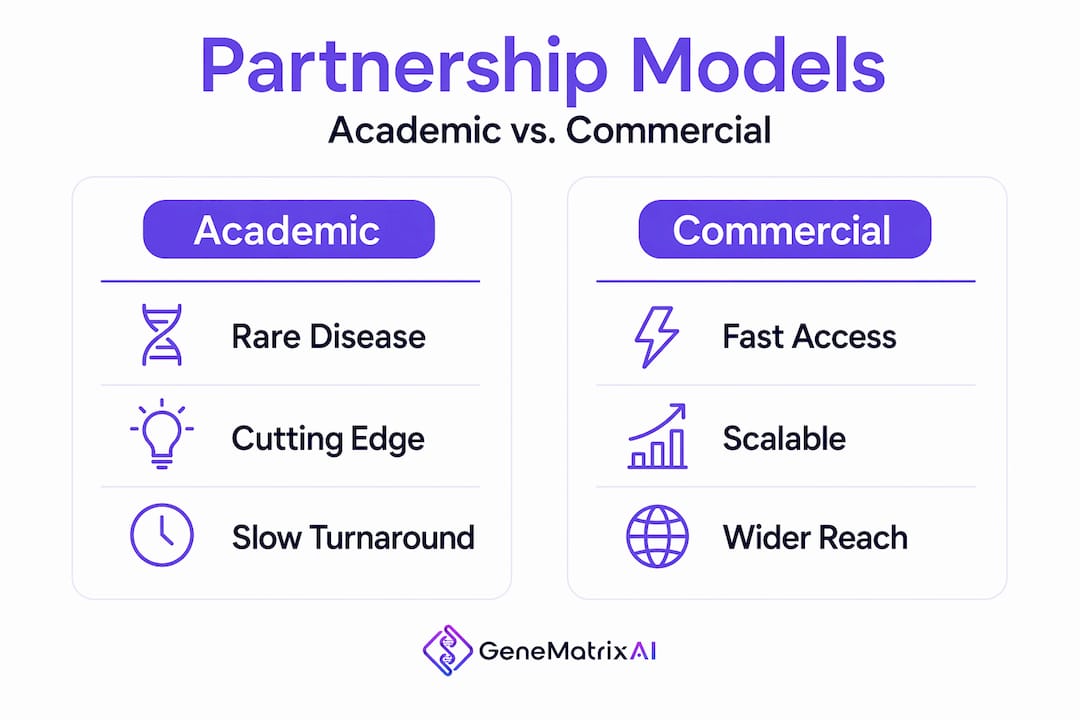
| Model | Best for | Key strength | Typical limitation |
|---|---|---|---|
| Academic partnership | Rare diseases, research-driven programs | Deep scientific expertise, novel test development | Slower commercialization timelines |
| Commercial lab partnership | Scaling existing programs, broad test access | Infrastructure, speed, nationwide reach | Less flexibility for custom test development |
| Consortium | Preventive genomics, insurance integration | End-to-end program design, counseling built in | Complex governance and stakeholder alignment |
Academic partnerships work best when your goal involves rare disease diagnostics or cutting-edge test development that does not yet exist commercially. The Labcorp and Children's Hospital of Philadelphia partnership illustrates how academic-commercial collaboration bridges the discovery-to-market gap, targeting pediatric oncology, metabolic, autoimmune, and rare diseases that have historically faced diagnostic delays.
Commercial lab partnerships are the right choice when your priority is speed and scale. These partners already have CLIA-certified infrastructure, established reporting pipelines, and national logistics. You can go from agreement to first patient report in weeks rather than years.
Consortium models are more complex to establish but deliver the most complete patient experience. When sequencing technology, insurance reimbursement pathways, and genetic counseling are integrated from the start, you eliminate the gaps where patients fall through.
- Look for consortium partners that include genetic counseling as a core service, not an add-on.
- Verify that insurance pathway integration is operational, not aspirational.
- Confirm that reporting formats meet your EHR's import specifications before committing.
Pro Tip: Before engaging any partner, review their CLIA certification scope and CAP accreditation status. These are non-negotiable for clinical use, and gaps in either create liability exposure for your organization.
For a structured framework on evaluating providers, the guide on choosing a clinical genomics provider covers the technical and operational criteria that matter most.
How to establish a genetic testing lab partnership
The process of building a functional genetic testing lab alliance is more structured than most clinicians expect. The organizations that do it well follow a disciplined sequence rather than jumping straight to vendor selection.
-
Define your clinical objectives first. Are you expanding hereditary cancer screening, adding pharmacogenomics, or building a liquid biopsy program? Your answer determines which partner type fits. A commercial lab is the right choice for scaling BRCA1/BRCA2 testing volume. An academic center is the right choice if you need a novel Lynch syndrome panel that does not exist yet.
-
Audit your internal capabilities. Identify what you already have: genetic counselors on staff, EHR integration capacity, patient consent workflows, and billing infrastructure for genetic tests. Gaps in any of these areas need to be addressed in the partnership agreement, not discovered after launch.
-
Evaluate technology compatibility. Ask potential partners for sample reports and confirm that their output format integrates with your clinical systems. Genomics lab outsourcing agreements frequently stall at this step because EHR integration was assumed rather than confirmed.
-
Address legal and regulatory requirements early. HIPAA business associate agreements, data use agreements for genomic data, and state-specific genetic privacy laws all need to be resolved before any samples are transferred. Engage legal counsel with healthcare genomics experience specifically.
-
Build a pilot before scaling. Start with a defined patient cohort, a specific test panel, and a clear success metric. A 90-day pilot with 50 patients tells you more about operational fit than any due diligence document.
Pro Tip: Negotiate reporting turnaround time as a contractual service level, not a best-effort commitment. Forty-eight to seventy-two hours from sample receipt to clinical report is achievable with the right partner and should be your baseline expectation.
The BEACONS initiative, funded with $14.4 million from the NIH, demonstrates how even complex multi-site partnerships can be structured around clear operational frameworks covering data flow, workforce readiness, and feasibility metrics.

Future trends reshaping lab partnerships in genetic testing
The next three years will bring structural changes to how genetic testing lab alliances are formed and funded. Several trends are already in motion that will directly affect how you build and manage these relationships.
- Multi-omics integration is becoming the standard. Partnerships that combine genomics with transcriptomics, proteomics, and metabolomics data are producing richer clinical insights than single-modality testing alone. AI platforms trained on large multimodal datasets are what make this interpretation feasible in clinical time frames.
- Insurance-backed preventive genomics is expanding. The Illumina and Veritas Genetics consortium model of combining sequencing with insurance pathways is a preview of where the market is heading. Reimbursement for hereditary cancer screening is improving, and partnerships that build insurance integration from the start will have a significant structural advantage.
- Pediatric and rare disease testing is growing rapidly. The Labcorp and CHOP model of combining research expertise with commercial scale is being replicated across pediatric oncology and rare metabolic disease programs. This is an area where precision medicine trends in 2026 are moving faster than most clinicians realize.
- Data sharing frameworks are maturing. Federated learning models allow partners to train AI on shared genomic datasets without transferring raw patient data, which resolves many of the privacy concerns that previously slowed partnership formation.
- Policy changes are creating new incentives. Proposed CMS reimbursement expansions for liquid biopsy and whole-genome sequencing in oncology will shift the economics of partnership agreements, making programs that were previously cost-prohibitive viable for community health systems.
"The organizations that establish genetic testing partnerships now, before reimbursement expansion fully materializes, will be positioned to scale rapidly when the policy environment catches up to the clinical evidence."
My take on why most partnerships fail before they start
I've spent years watching healthcare organizations approach genetic testing collaboration with the wrong frame entirely. They treat it as a procurement decision rather than a clinical strategy decision. The result is partnerships that look good on paper and underdeliver at the bedside.
What I've learned is that the partnerships that actually move patient outcomes are built around a shared clinical question, not a shared vendor contract. When MD Anderson and SOPHiA GENETICS aligned around the specific problem of translating complex RNA sequencing data into oncology decisions, they built something that neither could have built alone. That is the model worth emulating.
The most common mistake I see is underinvesting in genetic counseling integration. Organizations will spend months negotiating sequencing contracts and then assume counseling will sort itself out. It never does. Patients who receive a high-risk BRCA2 result without immediate counseling support often disengage from the care pathway entirely, which defeats the purpose of the test.
My practical advice: identify one clinical champion in your organization who owns the partnership operationally, not just administratively. That person needs enough genomics literacy to ask the right questions of the lab partner and enough clinical credibility to drive adoption among physicians. Without that role filled, even the best-structured agreement produces reports that sit unread in the EHR.
The organizations getting this right are the ones treating genetic testing lab alliances as a long-term clinical infrastructure investment, not a short-term vendor relationship.
— Tarek
Genematrix: built for clinical partnerships in genetic testing

Genematrix is a CLIA-certified, Chicago-based precision medicine company purpose-built for the kind of clinical partnerships described throughout this article. Their hereditary cancer testing and precision medicine services cover BRCA1/BRCA2, Lynch syndrome, and a full pharmacogenomics panel, with AI-driven reports delivered within 72 hours. The GeneMatrixAI platform, trained on over 500,000 genetic profiles, translates complex genomic data into reports your clinical team can act on immediately. For organizations exploring scalable genetic testing programs, Genematrix also offers DNA testing subscription plans starting at $69 per month, making ongoing genomic monitoring accessible across diverse patient populations. If you are evaluating partnership options for cancer risk assessment or personalized medicine, Genematrix is designed to integrate with your existing clinical workflows from day one.
FAQ
What is a lab partnership in genetic testing?
A lab partnership in genetic testing is a formal collaboration between a healthcare organization and one or more laboratory entities to deliver genetic testing services, share infrastructure, or co-develop new diagnostic tools. These arrangements range from simple service agreements to complex multi-institutional consortiums.
How do genetic testing partnerships improve cancer risk assessment?
Partnerships give clinical organizations access to advanced sequencing technologies, AI-powered analytics, and genetic counseling networks that accelerate diagnosis and improve patient stratification for targeted therapies. The Synnovis and SOPHiA GENETICS partnership, for example, reduced time to targeted therapy by up to two weeks for lung and breast cancer patients.
What should I look for when evaluating a lab partner for genetic testing?
Prioritize CLIA certification, report turnaround time, EHR integration capability, and the availability of genetic counseling support. Technology compatibility and regulatory alignment should be confirmed before any agreement is signed.
Are genetic testing lab partnerships accessible for smaller health systems?
Yes. Commercial service integration agreements allow smaller organizations to access whole-genome sequencing and hereditary cancer panels without building internal infrastructure. The key is matching the partnership model to your organization's specific clinical goals and existing capacity.
How is AI changing genetic testing partnerships?
AI-driven bioinformatics pipelines now enable partners to interpret complex multimodal genomic data rapidly enough for clinical decision-making. This capability is what makes precision oncology programs scalable beyond large academic medical centers.