

TL;DR:
- Many healthcare providers mistakenly believe outsourcing genetic testing compromises quality or compliance, which is incorrect. White label services with CLIA-certified labs and AI-driven analysis enable providers to offer advanced hereditary cancer and pharmacogenomic testing confidently and efficiently. Partnering with compliant, integrated labs ensures regulatory adherence, billing accuracy, faster results, and improved patient outcomes through precision medicine.
Many healthcare providers assume that outsourcing genetic testing means sacrificing control over quality or exposing their practice to compliance risk. That assumption is wrong, and it's costing providers a real opportunity. White label genetic testing services let hospitals and physicians offer fully branded hereditary cancer screening and pharmacogenomics without operating their own clinical laboratory. When the partner lab holds CLIA certification and runs AI-driven analysis, providers gain both regulatory confidence and clinical depth that would take years and millions of dollars to build independently.
Table of Contents
- Understanding CLIA certification and its importance in white label genetic testing
- Leveraging AI for hereditary cancer screening and pharmacogenomics in white label offerings
- Key considerations when partnering for white label genetic testing services
- Implementing white label genetic testing in clinical practice: workflow and benefits
- Rethinking white label genetic testing: a healthcare provider's edge in personalized care
- Partner with Gene Matrix for white label hereditary cancer and pharmacogenomic testing
- Frequently asked questions
Key Takeaways
| Point | Details |
|---|---|
| CLIA certification crucial | All genetic testing labs must have CLIA certification to ensure compliance and test accuracy. |
| AI enhances screening | AI tools automate family history and apply risk models for efficient hereditary cancer screening. |
| Partner verification key | Healthcare providers should verify a partner lab's accreditation and AI capabilities before partnering. |
| Hybrid interpretation needed | Combining AI analysis with physician review assures precise, clinically useful genetic reports. |
| Integration improves care | Implementing white label services with clinical workflows streamlines genetic testing and counseling. |
Understanding CLIA certification and its importance in white label genetic testing
CLIA stands for Clinical Laboratory Improvement Amendments. It is the federal regulatory framework that governs every laboratory in the United States that tests human specimens for the purpose of diagnosis, prevention, or treatment. CLIA certification is required for all US labs performing human specimen testing, ensuring accuracy, reliability, and quality control across the board. For healthcare providers evaluating a white label partner, this is the first box to check, not an afterthought.
There are several certificate types under CLIA, and the distinctions matter for genetic testing specifically. A Certificate of Waiver covers only simple tests. A Certificate of Compliance or Certificate of Accreditation (the latter issued through bodies like CAP, the College of American Pathologists) is what you need from any lab running complex molecular assays, including hereditary cancer panels and pharmacogenomic profiling. If your partner lab holds only a waiver certificate, it cannot legally perform the tests you want to offer.
CLIA compliance directly affects your billing. Labs that are not CLIA-certified cannot bill Medicare or Medicaid for genetic testing services, and neither can the providers who refer to them. That means a single non-compliant partner can trigger claim denials across your entire genetic testing program. The financial exposure is not theoretical; it is a documented pattern that CMS audits surface regularly.
Key quality elements CLIA mandates include:
- Personnel qualifications: Lab directors, technical supervisors, and testing personnel must meet defined education and experience standards.
- Proficiency testing: Labs must participate in approved external proficiency testing programs for each test category they perform.
- Quality control: Ongoing internal controls must verify test accuracy with every run.
- Inspections: Certified labs face biennial inspections, either by CMS or an approved accrediting body.
"A lab's CLIA certificate number is public record. Before signing any white label agreement, verify that number against the CMS database and confirm the certificate type covers high-complexity molecular testing."
Pro Tip: Ask prospective partners for their most recent inspection report. A lab confident in its compliance will share it without hesitation. One that hedges is telling you something important.
With a clear grasp of CLIA regulations, we can explore how AI supports hereditary cancer screening within these standards.
Leveraging AI for hereditary cancer screening and pharmacogenomics in white label offerings
AI does not replace the clinical judgment of a physician or genetic counselor. What it does is eliminate the bottleneck that makes genetic testing programs fail at scale: the manual, time-consuming process of collecting family history, applying risk models, and identifying which patients actually qualify for testing under current guidelines.
Automating family history collection with tools that integrate NCCN guidelines and validated risk models identifies 100% of eligible patients for testing while reducing the staff burden that has historically made genetic programs unsustainable in busy clinical environments. The practical implication for a hospital system is significant. A program that previously required a dedicated genetic counselor to screen every referral can now triage at scale, reserving human expertise for interpretation and counseling rather than intake.
The validated risk models embedded in AI-driven platforms include tools like Tyrer-Cuzick for breast cancer and the GAIL model, both of which are recognized in NCCN guidelines. When a white label partner's AI engine is trained on these models and aligned with current guideline versions, the hereditary cancer risk assessment your patients receive reflects the same standards a major academic medical center would apply.

Pharmacogenomics (PGx) is where AI adds a different kind of value. PGx testing examines how a patient's genetic variants affect drug metabolism, particularly through cytochrome P450 enzymes. AI-driven analysis can cross-reference a patient's full variant profile against a drug interaction database in seconds, generating actionable guidance on dosing or drug selection that a physician can act on immediately. For providers managing patients on multiple medications, this is not a nice-to-have. It is a patient safety tool.
Key AI capabilities to look for in a white label genetic testing partner:
- EHR integration: Results and risk flags should flow directly into your existing electronic health record without manual data entry.
- Guideline alignment: The AI engine must update as NCCN and other guidelines change, not remain static after deployment.
- Genetic risk assessment automation: Automated pedigree analysis and risk scoring should be part of the standard workflow, not an add-on.
- Hybrid interpretation: AI generates the initial analysis; a board-certified physician or geneticist reviews and signs the final report.
Pro Tip: When evaluating a partner's AI platform, ask specifically which version of NCCN guidelines the system currently reflects and how frequently updates are pushed. A six-month lag in guideline alignment is a clinical liability.
Understanding AI's role in screening sets the stage for assessing how white label services operationalize these capabilities.
Key considerations when partnering for white label genetic testing services
Choosing a white label genetics partner is a clinical and operational decision, not just a procurement exercise. The wrong choice creates billing exposure, patient safety gaps, and reputational risk. The right choice expands your service line with minimal internal investment.
Providers should verify CLIA and CAP accreditation first to avoid claim denials that directly impact Medicare reimbursement. Beyond that foundational check, here are the factors that separate a strong partner from a risky one:
- CLIA certificate type and CAP accreditation status: Confirm the lab holds a Certificate of Compliance or Accreditation, and that CAP accreditation is current.
- EHR and LIMS compatibility: Your partner's lab information management system should integrate with your EHR without requiring custom middleware you have to build and maintain.
- Turnaround time: For hereditary cancer panels and PGx reports, 72 hours or less is the clinical standard that keeps care pathways moving.
- Physician review process: Every report should carry a licensed physician's or geneticist's signature, not just an AI output. Hybrid human-AI interpretation is the standard, with physician-reviewed initial reports and ongoing AI updates ensuring clinical validity.
- Variant of uncertain significance (VUS) protocol: Ask how the partner handles VUS findings. Do they reanalyze as new evidence emerges? Do they notify providers proactively?
- Billing support: Your partner should provide CPT codes, documentation support, and guidance on payer-specific requirements to minimize denials.
- Genetic counseling access: Whether in-house or through a referral network, counseling access is part of a complete service offering.
| Partner attribute | What to look for | Red flag |
|---|---|---|
| CLIA status | Certificate of Compliance or Accreditation | Certificate of Waiver only |
| CAP accreditation | Current and verifiable | Expired or absent |
| AI capabilities | Guideline-aligned, EHR-integrated | Static algorithms, no update schedule |
| Turnaround time | 72 hours or less | No stated SLA |
| Physician review | Board-certified sign-off on every report | AI output only |
| Billing support | CPT coding guidance included | Provider handles billing alone |
| VUS management | Proactive reanalysis and provider notification | No reanalysis policy |
Pro Tip: Request a sample genetic screening process walkthrough before signing. A partner confident in their workflow will show you exactly how a patient moves from order to report, including what happens when a VUS is identified.
With these criteria in mind, let's examine the practical clinical implementation and use cases within healthcare settings.
Implementing white label genetic testing in clinical practice: workflow and benefits
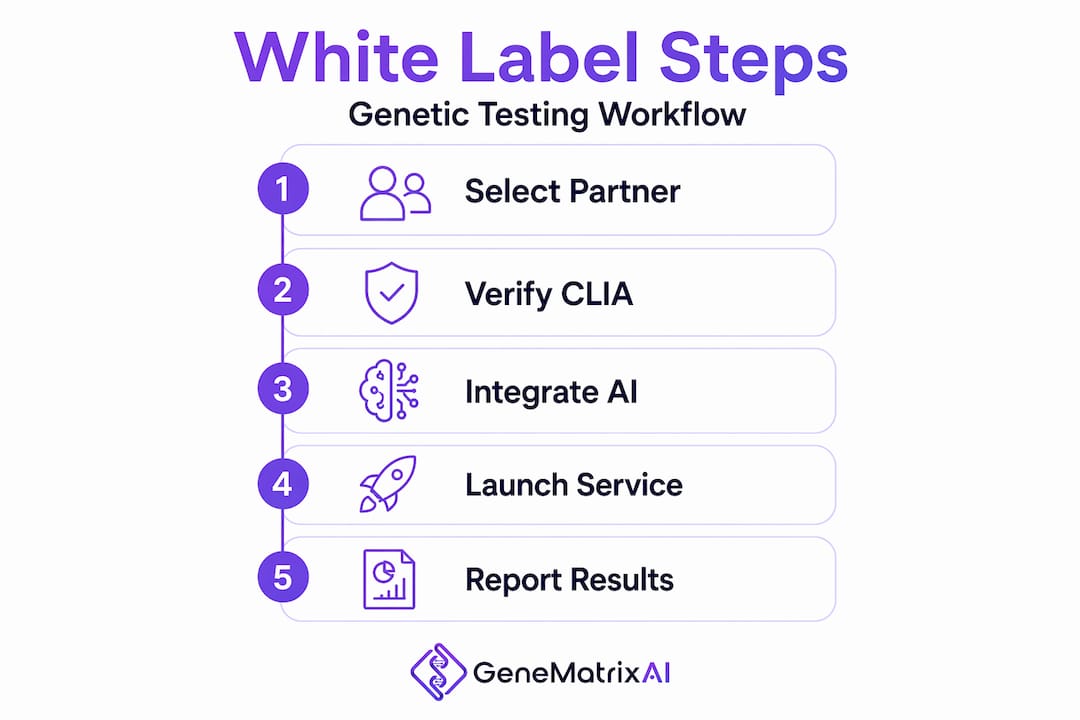
A well-designed white label genetic testing workflow does not add steps to your clinical process. It replaces manual, error-prone steps with automated, documented ones. Here is how a complete implementation looks in practice:
- Automated family history collection and risk stratification. The patient completes a structured digital intake that captures three-generation pedigree data. The AI engine applies validated risk models and flags patients who meet NCCN criteria for testing.
- Panel selection aligned with risk and pedigree. Based on the risk output, the ordering physician selects the appropriate hereditary cancer panel (for example, a BRCA1/BRCA2 panel vs. a broader multi-gene panel for Lynch syndrome) or a PGx panel for medication management.
- Sample collection and processing. The white label partner provides collection kits under your brand. Samples are processed in their CLIA-certified lab. The provider-facing experience is entirely branded; the lab infrastructure is the partner's.
- Report generation and physician review. The AI platform generates the initial analysis. A board-certified physician reviews and validates the report before it is released. The final report integrates into your EHR and is available in your provider portal.
- Genetic counseling referral and patient education. NCCN guidelines recommend standardized referral pathways for genetic counseling based on familial cancer risk. Patients with positive or elevated-risk results are referred through a documented pathway, either to in-house counselors or through the partner's network.
The benefits of this workflow are concrete, not abstract:
- Expanded access: Providers in community settings can offer the same genetic testing capabilities as major academic centers without the capital investment.
- Reduced workload: Automated intake and risk stratification eliminate hours of manual chart review per week.
- Faster clinical decisions: 72-hour turnaround means personalized hereditary cancer testing results inform treatment planning within the same care episode, not weeks later.
- Better patient outcomes: Early identification of BRCA1/BRCA2 carriers or Lynch syndrome patients enables preventive interventions that demonstrably reduce cancer mortality.
- Billing efficiency: Pre-built CPT code documentation reduces administrative burden and claim denial rates.
Pro Tip: Build your VUS protocol before you launch. Define in advance who gets notified when a variant is reclassified, who updates the patient record, and who contacts the patient. Practices that handle this reactively create liability. Those with a documented protocol treat it as a standard of care. Review family genetic testing tips to align patient communication with best practices from the start.
Having outlined clinical workflow, next we offer our unique perspective on maximizing white label service partnerships.
Rethinking white label genetic testing: a healthcare provider's edge in personalized care
Here is what most articles on this topic will not tell you: the providers who get the most value from white label genetic testing partnerships are not the ones who treat it as a lab outsourcing arrangement. They are the ones who integrate it as a clinical capability and build care pathways around it.
The distinction sounds subtle. It is not. A provider who orders a hereditary cancer panel and waits for a result is using genetic testing as a diagnostic tool. A provider who uses automated risk stratification to identify at-risk patients before they present with symptoms, routes them through a documented counseling pathway, and updates their care plan based on PGx results is practicing precision medicine. The white label infrastructure makes both possible. The clinical mindset determines which one you actually do.
We have seen providers underestimate how quickly a well-integrated genetic testing program can expand their service portfolio. Hereditary cancer screening, PGx for psychiatry (GeneMind), pediatric panels (GeneBaby), and nutrigenomics (GeneDiet) are all accessible through a single white label partnership. That breadth, offered under your brand, is a meaningful differentiator in a competitive healthcare market.
The compliance angle deserves more attention than it typically gets. Choosing a partner without current CLIA and CAP credentials does not just create billing risk. It creates legal exposure if a patient outcome is tied to a test result from a non-compliant lab. The providers portal you use to manage orders and reports should give you real-time visibility into partner compliance status, not just test results.
One more thing: do not let AI confidence become clinical overconfidence. The hybrid interpretation model exists for a reason. Genetic variants exist in clinical context. A patient's medication list, comorbidities, and family history all affect how a variant finding should be communicated and acted on. AI surfaces the pattern; the physician applies the judgment. That division of labor is not a limitation of the technology. It is the correct clinical model.
Partner with Gene Matrix for white label hereditary cancer and pharmacogenomic testing
Gene Matrix brings CLIA-certified, AI-powered genetic testing to healthcare providers who want to offer hereditary cancer screening and pharmacogenomics under their own brand, without building lab infrastructure from scratch.

Our GeneMatrixAI platform is trained on over 500,000 genetic profiles and delivers actionable reports within 72 hours, aligned with current NCCN guidelines. From GeneCancer and GenePGx to GeneMind and GeneBaby, our testing modules cover the full spectrum of precision medicine your patients need. We process over 10,000 hereditary cancer tests annually with 99.9% accuracy. Our nationwide genetic testing service supports hospitals and physician practices across the country, and our providers portal gives your team a single interface for ordering, reporting, and patient follow-up. Explore our R&D and innovation capabilities to see how we stay ahead of the science so you can stay ahead of your patients' needs.
Frequently asked questions
What is a white label genetic testing service?
It is a service where healthcare providers offer genetic testing under their own brand by partnering with a certified lab that performs the testing, analysis, and reporting behind the scenes.
Why is CLIA certification important for genetic testing labs?
CLIA certification is required for all US labs performing human specimen testing for diagnosis, prevention, or treatment, and it is mandatory for any lab billing Medicare or Medicaid for genetic services.
How does AI improve hereditary cancer screening?
Automating family history collection with AI tools that integrate NCCN guidelines and validated risk models identifies 100% of eligible patients for testing quickly, without the manual burden that makes traditional screening programs unsustainable at scale.
Can healthcare providers rely solely on AI for genetic test interpretation?
No. Hybrid human-AI interpretation is the clinical standard, combining AI-generated analysis with physician-reviewed reports to ensure accuracy and contextual clinical validity for every patient result.
What are the key factors when selecting a white label genetic testing partner?
Verify CLIA certification and CAP accreditation, assess AI integration with your EHR, confirm turnaround times and physician review processes, and ensure the partner provides billing compliance support to prevent Medicare claim denials.