

TL;DR:
- Hereditary cancer makes up 5-10% of cases and can be inherited through specific gene variants.
- Multigene panel testing using NGS technology helps identify inherited risks and guides personalized prevention.
- Results include positive, negative, or uncertain variants, each requiring tailored follow-up and counseling.
Most people believe cancer strikes randomly or results from lifestyle choices alone. That assumption leaves a critical piece of the picture out. 5-10% of cancers are directly hereditary, meaning they trace back to specific inherited gene variants passed down through families. For people with a family history of breast, ovarian, colorectal, or other cancers, that figure is not just a statistic. It is a signal worth acting on. Hereditary cancer testing helps you understand your inherited risk, so you can make smarter, earlier, more personalized health decisions instead of waiting and wondering.
Table of Contents
- What is hereditary cancer testing?
- How does hereditary cancer testing work?
- Interpreting test results: What do they really mean?
- Benefits, limitations, and expert nuances
- Perspectives: What most guides miss about hereditary cancer testing
- Get started with hereditary cancer testing
- Frequently asked questions
Key Takeaways
| Point | Details |
|---|---|
| Identifies inherited cancer risk | Hereditary cancer testing finds inherited gene changes that can increase cancer risk for you and your family. |
| Informs personalized prevention | Test results can lead to tailored screening, early interventions, or preventive treatments. |
| Requires expert guidance | Interpreting results and making health decisions works best with genetic counseling and up-to-date medical advice. |
| Has benefits and limitations | Testing offers powerful insights but may not detect every risk and can yield uncertain results. |
What is hereditary cancer testing?
Hereditary cancer testing goes well beyond a standard health checkup. It specifically looks for inherited changes in genes known to increase cancer risk. These changes are called germline variants because they exist in every cell of your body and can be passed to your children.
As defined by leading patient advocacy resources, hereditary cancer testing is germline genetic testing that identifies inherited pathogenic or likely pathogenic variants in cancer predisposition genes, assessing lifetime cancer risk. That definition matters because it draws a clear line between this kind of testing and general wellness DNA tests or ancestry kits.
The genes most people recognize are BRCA1 and BRCA2, which are strongly linked to breast and ovarian cancer risk. But the landscape is much wider. Testing can also identify variants in Lynch syndrome genes (MLH1, MSH2, MSH6, PMS2), which elevate risk for colorectal, uterine, and other cancers, as well as genes like PALB2, ATM, CHEK2, and many others.
Here is why this matters for your family, not just for you:
- A positive result means your first-degree relatives (parents, siblings, children) each have roughly a 50% chance of carrying the same variant.
- This opens the door to cascade testing, where family members get tested based on a known result in the family, often at reduced cost.
- Your result can directly shape your relatives' screening schedules and prevention options.
- A negative result in a family with a known variant is also highly actionable and reassuring.
Think of your genetic risk assessment as a map of inherited terrain. Even before symptoms appear, it tells you where to focus attention and what paths to take.
"Knowing your inherited cancer risk is not about fear. It is about replacing uncertainty with a concrete, personalized action plan."
How does hereditary cancer testing work?
Understanding what hereditary cancer testing is lays the foundation. Now let's explore how the testing process actually works and what technology powers it.

The process is straightforward. You do not need surgery or a complicated procedure. Testing uses blood, saliva, or cheek swab analyzed via next-generation sequencing (NGS) for multigene panels. NGS reads thousands of genetic positions simultaneously, making it far faster and more thorough than older single-gene methods.
Here is what the typical testing journey looks like:
- Referral or self-referral: Your physician orders the test, or you connect with a provider that offers direct access.
- Pre-test genetic counseling: A certified counselor explains what the test covers, its limitations, and what results could mean for you and your family.
- Sample collection: A blood draw, saliva kit, or cheek swab is collected, often at home or in a clinic.
- Lab analysis: Your sample is processed using NGS and lab technology to read and analyze your gene sequences.
- Results and follow-up counseling: You receive a detailed report and discuss next steps with your care team.
One of the most important choices in the process is which gene panel to use. Panels vary significantly in scope.
| Panel type | Genes covered | Example cancers screened |
|---|---|---|
| Focused panel | 5 to 20 genes | Breast, ovarian |
| Mid-size panel | 40 genes | Breast, colorectal, ovarian |
| Large panel | 82+ genes | 12+ tumor types including prostate, pancreatic |
For most patients today, a mid-size to large gene panel testing approach is standard, based on NCCN guidelines that recommend multigene panel testing when hereditary cancer risk is suspected.
Pro Tip: If you are unsure which panel fits your situation, ask your provider specifically about panels that cover at least 40 genes. A broader panel means fewer gaps and less chance of missing a clinically relevant variant. This guide to genetic screening can help you prepare the right questions.
Interpreting test results: What do they really mean?
Once a sample is processed, you will receive results. But what do those results actually mean, and how should you respond?
Results fall into three categories, and each one calls for a different response.
| Result type | What it means | What to do next |
|---|---|---|
| Positive | A known harmful variant was identified | Begin enhanced screening, consider preventive options, notify relatives |
| Negative | No pathogenic variants found in tested genes | Continue standard screening, note that some risk remains |
| VUS | Variant of uncertain significance | Monitor for reclassification, discuss with your genetic counselor |
Positive results are the ones people worry most about, but they are also the most actionable. Knowing you carry a BRCA1 variant, for example, allows you and your doctor to move from standard annual mammograms to enhanced MRI-based surveillance, discuss risk-reducing medications, or consider preventive surgical options. It also directly informs your family members about their own risk.
Negative results are widely misunderstood. A negative does not mean zero cancer risk. It means no pathogenic variant was found in the genes the panel tested. Other hereditary or environmental factors may still apply, which is why ongoing standard screening remains important.
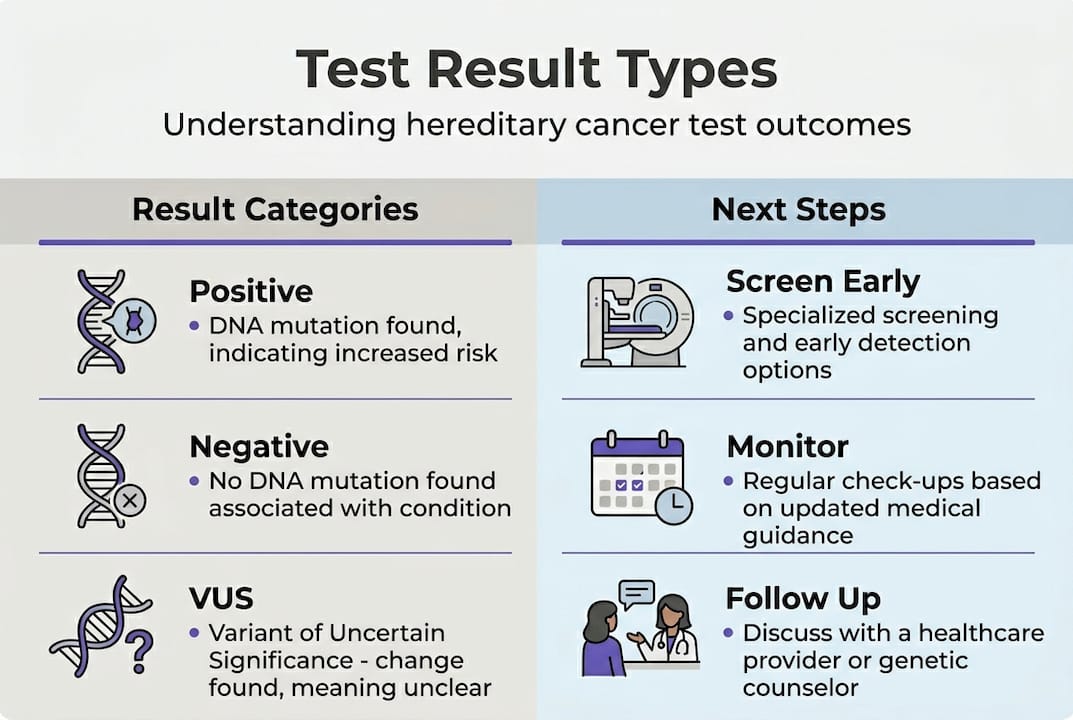
The most nuanced category is the VUS (variant of uncertain significance). As research shows, VUS is common, affecting roughly 40% of results in ClinVar databases, with higher rates in non-European populations. A VUS result is not a diagnosis of increased risk. It means science does not yet have enough data to classify that variant. Many VUS results get reclassified over time as evidence accumulates.
For family testing decisions, a VUS is particularly important to handle carefully. Relatives should not make major health decisions based on an unclassified variant alone.
Key stat: Up to 40% of hereditary cancer test results in some populations include at least one VUS, underscoring the need for ongoing follow-up with a genetic counselor rather than a one-time test-and-forget approach.
Benefits, limitations, and expert nuances
Interpreting your results is crucial, but understanding the real-world impact and nuances adds another layer of clarity.
What hereditary cancer testing does well:
- Enables personalized, risk-based screening schedules instead of one-size-fits-all guidelines
- Identifies candidates for proven prevention strategies (medications, risk-reducing surgery)
- Guides family members toward testing before symptoms arise
- Informs treatment decisions for people already diagnosed with cancer
- Supports personalized medicine benefits that go beyond cancer alone
What it cannot do:
- Detect all hereditary cancer risk (polygenic risk and environmental factors remain outside current panel scope)
- Eliminate uncertainty entirely, given VUS rates
- Replace clinical judgment or ongoing surveillance
A striking reality: testing uptake is under 48% among eligible individuals, with notable disparities by race, income, and geography. That means more than half of people who could benefit from this information are not getting it. Cost, access, and awareness all play a role.
On the technology side, multigene panel testing (MGPT) using NGS is now the standard approach, and the field continues to move fast. Advances in MGPT include whole exome sequencing, genome sequencing, and long-read sequencing technologies that promise to reduce VUS rates and expand what panels can detect.
Pro Tip: Genetic counseling is not optional for interpreting these results. Whether your result is positive, negative, or a VUS, a board-certified genetic counselor provides context that a lab report alone cannot. This kind of support is central to any precision medicine for families approach.
Perspectives: What most guides miss about hereditary cancer testing
Having weighed benefits and drawbacks, here are the realities most guides skip over entirely.
First, a negative result has real value, and most people do not appreciate it enough. Confirming the absence of a known family variant can justify a return to standard screening instead of more intensive protocols. That is a meaningful quality-of-life and cost outcome.
Second, ancestry-based DNA tests are not a substitute for clinical hereditary cancer testing. They scan a limited number of variants, often miss population-specific mutations, and are not validated for medical decision-making. We see patients arrive with ancestry test results thinking they have been screened. They have not.
Third, the emotional and insurance dimensions are real and underaddressed. A positive result can carry psychological weight, affect family dynamics, and raise questions about insurance coverage. Understanding the Genetic Information Nondiscrimination Act (GINA) is essential before testing.
Finally, evolving technologies will continue to reduce the VUS problem and expand actionable insights. Patients deserve counseling that reflects these changes, not outdated simplified summaries. The value of rapid testing extends beyond speed. It means acting on current science while it is most relevant to your care decisions.
Get started with hereditary cancer testing
After all this information, you may be wondering how to apply it to your own personalized health journey.
Gene Matrix delivers AI-powered hereditary cancer testing through its GeneCancer module, built on broad multigene panel coverage and our science overview that draws from over 500,000 genetic profiles. Results are available within 72 hours, paired with actionable reports designed for both patients and their providers.

Beyond the test itself, Gene Matrix supports you with expert guidance to help you understand and act on your results. Whether you are a patient exploring your options or a provider looking to offer hereditary cancer screening, explore the latest through innovations in hereditary cancer testing. Proactive health decisions start with the right information, and that information starts here.
Frequently asked questions
Who should consider hereditary cancer testing?
Individuals with a personal or family history of cancer, or those concerned about inherited risk, should consider testing after discussing with a healthcare provider.
What types of cancers are covered by hereditary cancer testing panels?
Testing typically covers genes linked to breast, ovarian, colorectal, prostate, pancreatic, and other cancers, with larger panels covering 12 or more tumor types.
What happens if my result is a VUS (variant of uncertain significance)?
A VUS means it is unclear if the variant increases cancer risk. Follow up over time, as reclassification is possible as new research emerges.
Does a negative result mean I have no cancer risk?
No. A negative result means no known variants were detected, but some risk remains from hereditary or environmental factors not covered by current panels.