

TL;DR:
- Genetic counseling provides personalized guidance on health risks, prevention, and treatment beyond just testing.
- It is vital for hereditary cancer risk assessment, medication response, and supporting family health decisions.
- Access challenges exist, but telehealth and ongoing engagement maximize its practical, long-term benefits.
Most people assume genetic counseling is reserved for expectant parents or those with rare inherited diseases. That assumption leaves a lot of families in the dark. Genetic counseling is actually a practical, personalized health service that shapes cancer prevention strategies, guides medication decisions, and helps families understand inherited risks they might not even know they carry. Whether you're managing a family history of breast cancer, struggling with medication side effects, or simply trying to make smarter health choices, genetic counseling offers concrete, actionable guidance that goes far beyond a simple lab test.
Table of Contents
- Understanding genetic counseling: What it is and how it works
- Hereditary cancer risk: How genetic counseling guides prevention
- Medication response and pharmacogenomics: Personalizing your treatment
- Interpreting results and uncertainty: Navigating variants of unknown significance
- Access, equity, and practical applications: Making genetic counseling available to all
- A fresh perspective: Why non-directive support and practical context matter most
- Ready to take the next step? Find trusted genetic counseling and testing options
- Frequently asked questions
Key Takeaways
| Point | Details |
|---|---|
| Personalized risk guidance | Genetic counseling helps you understand cancer or health risks specific to your genes and family history. |
| Empowered health decisions | Professional counseling clarifies complex test results, allowing you to make confident choices about prevention and treatment. |
| Medication safety benefits | By identifying how your body may react to drugs, pharmacogenomic counseling helps avoid adverse reactions. |
| Support through uncertainty | Genetic counselors explain uncertain findings, track new information, and support your family across generations. |
| Access and equity are evolving | Digital tools and multidisciplinary teams are making genetic counseling more available, but gaps remain for some communities. |
Understanding genetic counseling: What it is and how it works
Genetic counseling is not just about running a test and handing you a report. As defined in the clinical literature, genetic counseling is "a process of helping people understand and adapt to the medical, psychological, and familial implications of genetic contributions to disease, involving risk assessment, education, and support." That definition matters because it puts the emphasis on you, not just your DNA.
The process typically follows a clear, structured path. Your counselor begins with an intake session to gather your personal and family health history, sometimes going back two or three generations. From there, they assess your risk profile, walk you through relevant testing options, and help you interpret results in plain language. Critically, they also provide psychosocial support, because receiving genetic information can be emotionally complex. According to the CDC, sessions cover collecting personal and family health history, assessing risks, discussing testing options, interpreting results, providing psychosocial support, and referrals, with most sessions lasting one hour or more.
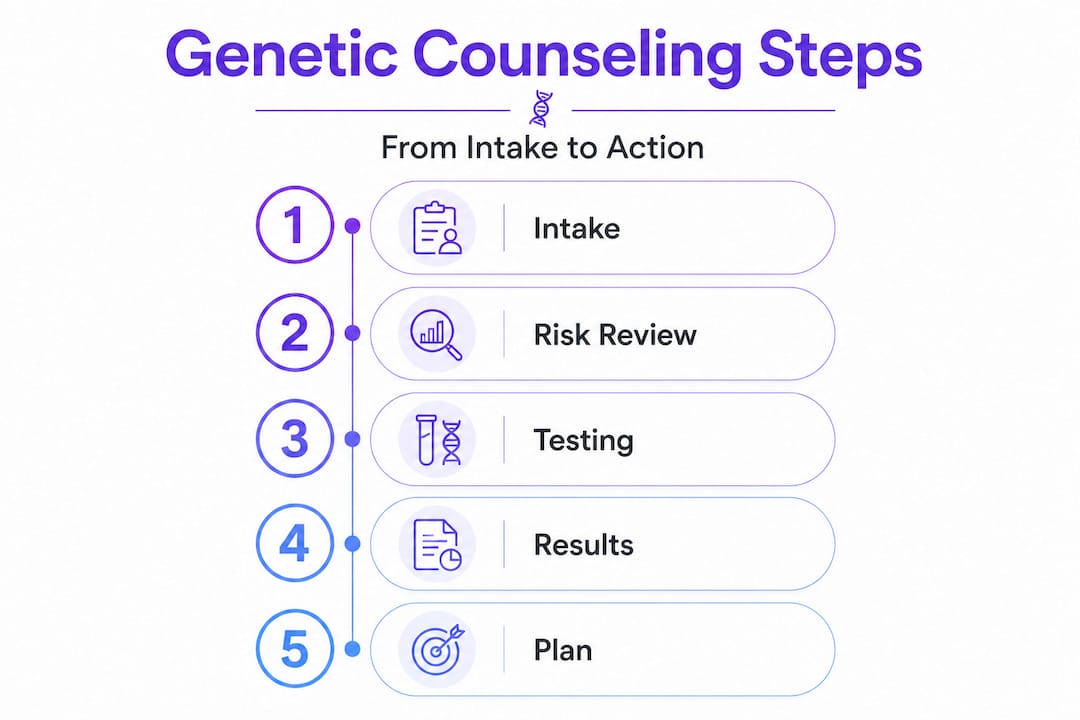
Here is a quick overview of what the process looks like from start to finish:
| Stage | What happens | Time estimate |
|---|---|---|
| Intake | Personal and family history collected | 20-30 minutes |
| Risk assessment | Counselor identifies relevant genetic factors | 15-20 minutes |
| Education | Testing options explained in plain terms | 15-20 minutes |
| Testing decision | You decide whether and what to test | Ongoing |
| Results interpretation | Counselor explains findings and implications | 30+ minutes |
| Follow-up support | Referrals, monitoring plans, emotional support | Ongoing |
Sessions are available in-person, by phone, or via video, making them accessible for most families regardless of location. Understanding your genetic risk assessment before your first appointment can help you arrive prepared with the right questions.
Key things to know before your first session:
- Bring a detailed family health history, including cancers, heart disease, and any known genetic conditions
- Note any medications you or close relatives have had unusual reactions to
- Prepare questions about surveillance, prevention, and what a positive result would mean for your family
- Ask your counselor about the difference between diagnostic and predictive testing
A solid genetic screening guide can also help you understand what types of tests might be recommended based on your history. And if you're wondering whether family history and screening eligibility are connected, the answer is almost always yes.
"Genetic counseling is not a one-size-fits-all service. It is a dynamic, evolving conversation between a trained professional and a patient navigating some of the most consequential health information they will ever receive."
Now that we've unpacked what genetic counseling really means, let's look at its real-world benefits for personal and family health.
Hereditary cancer risk: How genetic counseling guides prevention
With a clear understanding of the counseling process, let's see how it transforms cancer prevention for families.
Hereditary cancers account for roughly 5 to 10 percent of all cancer diagnoses, but their impact on individual families can be devastating and disproportionate. Genetic counseling plays a central role in identifying who carries elevated risk and, more importantly, what to do about it. The NCCN patient guide on genetics identifies specialties relevant to hereditary cancer risks, including BRCA testing via multigene panels, with pre- and post-test counseling described as essential to responsible care.
Here is how hereditary cancer risk assessment generally unfolds:
- Family history review: Your counselor maps out which relatives had cancer, what type, and at what age. Patterns matter enormously here.
- Risk stratification: Based on your history, you are placed into a risk category that determines what testing is appropriate.
- Multigene panel testing: Rather than testing one gene at a time, modern panels screen dozens of genes simultaneously, including BRCA1, BRCA2, and Lynch syndrome genes.
- Result interpretation: A positive result does not mean you will get cancer. It means your risk is elevated, and there are specific steps you can take.
- Intervention planning: Options range from enhanced surveillance (more frequent mammograms or colonoscopies) to preventive medications or, in some cases, risk-reducing surgery.
| Gene or syndrome | Associated cancers | Recommended action |
|---|---|---|
| BRCA1/BRCA2 | Breast, ovarian, prostate | Enhanced imaging, risk-reducing surgery |
| Lynch syndrome | Colorectal, endometrial, ovarian | Annual colonoscopy, gynecologic surveillance |
| PALB2 | Breast, pancreatic | Enhanced breast screening |
| CDH1 | Stomach, lobular breast | Prophylactic gastrectomy considered |
Pro Tip: If a first-degree relative (parent, sibling, or child) has been diagnosed with a hereditary cancer, consider requesting a referral for genetic counseling even before symptoms appear. Early knowledge gives you the most options.
Encouraging family testing tips can help you bring reluctant relatives into the conversation, because a positive result in one family member has direct implications for others. Encouraging family participation in screening is one of the most powerful things you can do for your family's long-term health.
Medication response and pharmacogenomics: Personalizing your treatment
While cancer risk is a major focus, medication response is another area where genetic counseling has immediate, personal impact.

Pharmacogenomics, often abbreviated as PGx, is the study of how your genes affect the way your body processes medications. It sounds technical, but the real-world implications are straightforward: the same drug at the same dose can be life-saving for one person and dangerous for another, based entirely on their genetic makeup. The NCCN guide specifically highlights pharmacogenomics applications such as DPYD variants affecting fluorouracil toxicity and UGT1A1 variants affecting irinotecan processing, two chemotherapy drugs where genetic differences can mean the difference between effective treatment and severe, even fatal, side effects.
This is not limited to cancer drugs. Antidepressants, blood thinners, pain medications, and cardiovascular drugs are all affected by genetic variation. A landmark study of 76,000 genomes linked specific genetic variants to adverse drug reactions (ADRs), confirming that PGx data has real, measurable power to prevent harm.
Here is a snapshot of common drug-gene interactions that genetic counseling can address:
| Drug class | Gene involved | Potential issue without PGx testing |
|---|---|---|
| Antidepressants (SSRIs) | CYP2D6, CYP2C19 | Under or over-medication |
| Blood thinners (warfarin) | CYP2C9, VKORC1 | Bleeding or clotting risk |
| Chemotherapy (fluorouracil) | DPYD | Severe, potentially fatal toxicity |
| Pain relief (codeine) | CYP2D6 | Toxicity in rapid metabolizers |
| Statins | SLCO1B1 | Muscle damage risk |
Key benefits of integrating PGx into your care:
- Fewer trial-and-error prescriptions: Your doctor starts with a medication more likely to work for your genetic profile
- Reduced adverse reactions: Knowing your metabolizer status prevents dangerous drug buildups
- Better mental health treatment: Psychiatric medication selection improves significantly with genetic guidance
- Informed chemotherapy planning: Oncologists can adjust doses based on your actual metabolic capacity
Rapid testing for medication safety is increasingly important, especially for patients starting new treatment regimens. Reviewing gene panel testing insights can help you understand what a comprehensive PGx panel actually covers and how to use those results with your prescribing physician. For a broader look at how biomarker analysis fits into personalized health, the connection to PGx is direct and growing.
Pro Tip: Before starting any new medication, especially a psychiatric drug, blood thinner, or chemotherapy agent, ask your doctor whether a PGx test is appropriate. One test can inform medication decisions for the rest of your life.
Interpreting results and uncertainty: Navigating variants of unknown significance
Getting test results can be stressful, especially when they're unclear. This section explains how genetic counselors support families through uncertainty.
One of the most common sources of confusion after genetic testing is receiving a result labeled a "variant of unknown significance," or VUS. A VUS is a genetic change that has been detected but whose health impact is not yet established by current research. It is neither clearly harmful nor clearly benign. For families expecting a definitive yes or no, a VUS can feel like a non-answer, but it is actually important information managed carefully by a skilled counselor.
Multigene panels, which test many genes at once, increase the overall diagnostic yield but also raise VUS rates. The same research found that reclassification of VUS results clarified 19 out of 82 neonatal cases, boosting the diagnostic rate by 2.8 percent. That reclassification process is ongoing as scientific databases grow and more population data becomes available.
What a genetic counselor does with a VUS result:
- Explains clearly that a VUS is not a diagnosis and should not drive major medical decisions on its own
- Documents the variant and monitors published research for reclassification updates
- Recommends periodic follow-up so you are notified if the variant is reclassified as pathogenic or benign
- Provides emotional support and helps you communicate the result to other family members accurately
Digital tools are also changing how counselors manage uncertainty. AI-assisted digital assistants have been shown to reduce face-to-face counseling time by 69 percent for low-risk patients, freeing counselors to spend more time with complex cases. This is not about replacing human judgment. It is about using technology to extend the reach of expert guidance.
"A VUS is not a verdict. It is a data point in an ongoing conversation between your genome, your counselor, and the evolving body of genetic science."
Understanding how results connect to wellness and prevention planning is essential, especially when results are ambiguous. The field of epigenetics and wellness adds another layer, showing how environment and lifestyle interact with your genetic baseline over time.
Access, equity, and practical applications: Making genetic counseling available to all
Now that we've covered the main challenges, let's close with a critical look at where genetic counseling is heading and what it really means for families navigating modern health choices.
Access to genetic counseling is not equal. The NSGC position statement on at-home genetic testing acknowledges significant challenges, including disparities in access, the complexity of moderate penetrance genes, and the importance of a multidisciplinary approach to care. These are not abstract policy concerns. They affect real families every day.
Specific access barriers include:
- Ancestry gaps in research databases: Most large genetic studies have historically overrepresented European populations, meaning variants common in other ancestries are less well characterized
- Urban versus rural gaps: Genetic counselors are concentrated in major medical centers, leaving rural families with fewer in-person options
- Digital divide: Telehealth expands access, but only for families with reliable internet and digital literacy
- Cost and insurance uncertainty: Even when testing is available, coverage gaps can make it financially out of reach
Telehealth has meaningfully improved the situation. Video and phone-based sessions now allow families in underserved areas to connect with board-certified genetic counselors without traveling hours to a specialty clinic. Multidisciplinary teams, where genetic counselors work alongside oncologists, cardiologists, and primary care physicians, produce better outcomes than any single provider working alone.
Pro Tip: If you cannot access an in-person genetic counselor, look for telehealth platforms that offer board-certified counselors. Many hospital systems now offer virtual genetic counseling as a standard service.
Practical steps to maximize your access to genetic counseling:
- Ask your primary care physician for a referral, especially if you have a relevant family history
- Check whether your employer's health plan covers genetic counseling as a preventive service
- Explore AI-powered genomics platforms that can deliver rapid results with integrated counseling support
- Review a DNA testing preparation guide so you arrive at your session informed and ready
- After a diagnosis, seek out post-diagnosis support resources that work alongside your genetic counseling team
A fresh perspective: Why non-directive support and practical context matter most
Here is the uncomfortable truth about genetic counseling that most technology-focused discussions miss: the most powerful thing a genetic counselor does is not run a test. It is helping you decide what to do with the result.
The NSGC recommends counseling for consumer genetic tests precisely because raw data without context is not just unhelpful, it can be actively harmful. A BRCA1 positive result, delivered without counseling, can trigger unnecessary anxiety, premature medical decisions, and family conflict. The same result, delivered with skilled guidance, becomes a roadmap for proactive, informed action.
The non-directive model of genetic counseling is deliberate. Counselors are trained to present options and implications without steering you toward a specific choice. That approach respects your autonomy and recognizes that the right decision for one family may be completely wrong for another. Preventive surgery, for example, is a rational choice for some BRCA carriers and not for others, depending on personal values, family circumstances, and medical history.
We also see families make a critical mistake: treating genetic counseling as a one-time event. You get tested, you get results, you move on. But genetics is not static in terms of how we understand it. Variants get reclassified. New genes are linked to new conditions. Your family history evolves as relatives age and receive new diagnoses. A precision medicine guide for families makes clear that the most effective approach treats genetic counseling as an ongoing relationship, not a single appointment.
The families who benefit most are those who stay engaged, share results with relatives, revisit their risk profile as science advances, and work with counselors who know their history. That kind of sustained engagement is where the real value lives.
Ready to take the next step? Find trusted genetic counseling and testing options
If this article has shown you anything, it is that genetic counseling is not a niche service for rare cases. It is a practical, evidence-based resource for anyone who wants to make smarter decisions about cancer prevention, medication safety, and family health.

Gene Matrix makes that next step straightforward. Our CLIA-certified platform combines AI-driven analysis trained on over 500,000 genetic profiles with expert counseling support, delivering actionable reports within 72 hours. Whether you are exploring hereditary cancer testing for the first time, looking for PGx insights to optimize your medications, or managing a complex family history, we have the tools and expertise to guide you. Learn more about the science behind Gene Matrix or download the mobile genetic health app to start tracking your genomic health on your own terms.
Frequently asked questions
Who should consider genetic counseling?
Anyone with a personal or family history of cancer, unusual medication reactions, or questions about inherited conditions can benefit from genetic counseling. The NCCN guide identifies hereditary cancer risks, pharmacogenomics, and personalized health as core specialties where counseling adds measurable value.
How long does a typical genetic counseling session last?
Most sessions last an hour or more, depending on your questions and background. The CDC confirms that sessions are available in-person, by phone, or via video to accommodate different schedules and locations.
What is a variant of unknown significance (VUS)?
A VUS is a genetic change whose health impact is currently unknown but may be clarified as research advances. Reclassification studies show that ongoing data review regularly resolves VUS findings into actionable categories.
Does insurance cover genetic counseling and testing?
Coverage depends on your insurance plan, the specific test ordered, and the medical indication documented by your provider. Always verify your benefits before scheduling a session and ask your counselor's office to confirm prior authorization requirements.
Can I use at-home genetic tests without counseling?
You can, but the NSGC strongly recommends professional counseling to interpret consumer genetic test results accurately, responsibly, and in the context of your full health picture.
Recommended
- Genetic risk assessment: What it means for your health
- How Genetic Testing Drives Better Wellness, Health, and Prevention
- Precision medicine step by step: A practical guide for families
- Family genetic testing tips for informed health choices
- Personalized GLP-1 Dosing | RenewMD
- Does Family History Affect OBSP Screening Eligibility? | Complete 2025 Guide - Valence Medical Imaging