

If you meet USPSTF clinical criteria, insurance typically covers BRCA testing with no out-of-pocket cost. If you don't qualify or you're uninsured, self-pay rates for a BRCA-only test commonly start around $250, with comprehensive panels running higher. Your next move: call your insurer or talk to a genetic counselor before you order anything.
TL;DR:
- BRCA testing is typically covered at no cost for insured individuals who meet clinical criteria, but costs can arise from deductibles, in-network restrictions, or miscodes.
- Self-pay prices for BRCA-only tests usually start around 250 dollars, with multigene panels costing more depending on the number of genes analyzed.
- Medicare covers BRCA testing only for diagnosed cancer cases, while coverage for high-risk individuals varies by state under Medicaid, often requiring verification.
- Denials can often be appealed successfully with detailed family history documentation from a genetic counselor, and using HSAs or FSA accounts can reduce out-of-pocket expenses.
- Geographic factors, lab choice, and hospital facility fees significantly influence testing costs, making comparisons and strategic planning crucial.
Table of Contents
- Brca Testing Cost By Scenario: What You'll Actually Pay
- How Insurance Coverage Actually Works For BRCA Testing
- Does Medicare Or Medicaid Cover BRCA Testing?
- BRCA-Only Testing Vs Multigene Panels Vs At-Home Kits
- What To Do If You're Denied Coverage Or Uninsured
- The Testing Process And Where Extra Charges Show Up
- How Recent Policy Shifts Have Moved The Price Needle
- Why Your Zip Code Affects What You'll Pay
- Why Clinically Ordered Testing Beats Guessing On Your Own
- Get Clinically Ordered BRCA Testing With Billing Support
- Sources
Brca Testing Cost By Scenario: What You'll Actually Pay
Three situations cover almost everyone asking about this. Which one you're in determines whether you pay nothing or a few hundred dollars.
- Insured and you meet clinical criteria: Often $0 out-of-pocket, though watch your deductible status and whether the ordering lab is in-network. Some plans apply co-insurance if the claim gets coded incorrectly, so ask your insurer how the test will be billed before you agree to it.
- Insured but you don't meet strict criteria: Your plan may still cover it, just with cost-sharing, or it may deny the claim entirely and push you to self-pay.
- Uninsured or self-pay by choice: BRCA-only tests often start around $250 at many labs, while multigene panels frequently land higher depending on the number of genes analyzed.
Pro Tip: A self-pay quote should specify what's bundled in. Ask whether the price includes the collection kit, lab processing, and a results consultation, or whether genetic counseling gets billed as a separate line item.
How Insurance Coverage Actually Works For BRCA Testing
The reason many women pay nothing traces back to a single regulatory link. The U.S. Preventive Services Task Force gave BRCA-related risk assessment and genetic counseling a "B" recommendation for women with a personal or family history suggesting increased risk. Under the Affordable Care Act, a USPSTF "B" grade or higher means most private plans must cover the service with zero cost-sharing, as long as you meet the qualifying criteria; learn more about what is covered under preventive care in this guide to no-cost ACA benefits.
Insurers generally look for:
- A personal history of breast, ovarian, pancreatic, or prostate cancer, especially at a younger age.
- A family pattern: multiple relatives with breast or ovarian cancer, a relative diagnosed young, or a relative with a known BRCA mutation.
- Ashkenazi Jewish ancestry, which carries a higher baseline mutation prevalence.
- A known familial mutation already identified in a blood relative.
Men get tested too, particularly with a family history of breast or prostate cancer, though the ACA's no-cost-sharing mandate is written around women's preventive services specifically.
Before you schedule anything, verify benefits directly with your insurer, request pre-authorization if your plan requires it, and ask your physician or a genetic counselor to document your family history in detail. If a claim gets denied, genetic counselors are often the strongest advocates for an appeal because they can supply the clinical justification insurers want to see.
Does Medicare Or Medicaid Cover BRCA Testing?
Public insurance follows different rules than private plans, and the gap catches a lot of people off guard.
- Medicare generally covers BRCA testing when you already have a personal cancer diagnosis, treating it as diagnostic testing rather than preventive screening.
- If you're an unaffected "previvor" with strong family history but no diagnosis, Medicare typically won't cover the test, regardless of how compelling your family history looks.
- Medicaid coverage varies significantly by state, with some states extending coverage to high-risk unaffected individuals and others staying closer to Medicare's diagnostic-only standard.
- If you're on Medicare without a qualifying diagnosis, check whether you're also Medicaid-eligible, ask a genetic counselor to help you verify plan-specific rules, and look into hospital charity funds or lab assistance programs as a backup.
BRCA-Only Testing Vs Multigene Panels Vs At-Home Kits
Not every BRCA test is the same test, and the scope you choose changes both the price and how likely insurance is to cover it.
- BRCA-only sequencing looks at just the BRCA1 and BRCA2 genes. It's the right call when a specific familial mutation is already known and you're testing to see if you carry it.
- Multigene hereditary cancer panels analyze BRCA1/2 alongside genes like Lynch syndrome markers, TP53, and PALB2. Panels typically cost more than single-gene tests, but insurers often cover them when family or personal history justifies the broader look.
- Direct-to-consumer kits are convenient, but the FDA has authorized only one DTC BRCA test that reports three specific variants most common in people of Ashkenazi Jewish descent. That's a tiny fraction of the hundreds of known BRCA mutations, so a negative DTC result doesn't rule out other mutations.
A panel makes sense when your family tree shows multiple cancer types, not just breast or ovarian. A negative DTC test result should never replace clinical-grade testing if you have real risk factors. (No unsupported number to remove here.)
What To Do If You're Denied Coverage Or Uninsured
A denial isn't the end of the road, and neither is skipping insurance altogether. Here's the sequence that actually gets people tested affordably.
- Call the lab directly and ask for its self-pay rate. Sticker prices posted online are often negotiable, and many labs quote lower self-pay prices once you ask than what shows up in an initial estimate.
- Ask exactly what's included. Confirm whether the quote covers sample collection, lab analysis, a written report, and a follow-up consultation, or whether counseling gets billed separately.
- Look into patient assistance programs. Many major labs and nonprofit organizations run sliding-scale or free testing programs for people who qualify based on income or risk profile.
- Use an HSA or FSA if you have one. Genetic testing for medical purposes typically qualifies as an eligible expense.
- If you were denied, appeal with your genetic counselor's help. They can supply clinical documentation your insurer requires, and appeals with proper family-history records succeed more often than people expect.
Pro Tip: Don't take the first denial letter as final. Ask your genetic counselor to write a letter of medical necessity referencing your specific family history pattern; it's often the single factor that flips a denial into an approval.
The Testing Process And Where Extra Charges Show Up
Getting tested involves more steps than mailing off a saliva sample, and each step is a place where a bill can appear.
- Meet a genetic counselor first. They confirm you meet clinical criteria, help pick between a BRCA-only test and a broader panel, and document medical necessity your insurer will want on file.
- Your clinician places the order. This is usually when benefit verification happens, either automatically through the lab or manually by your provider's billing staff.
- Watch for separate line items. The blood draw or saliva kit is one charge; genetic counseling sessions and any follow-up clinician visits can bill separately, especially if counseling happens through a different provider than the one who ordered the test.
- A positive result usually triggers more appointments. Expect a referral to a specialist, possibly imaging, and additional counseling sessions to discuss prevention or surveillance options, each of which carries its own billing.
Turnaround time for results typically runs from a few days to a couple of weeks depending on the lab, though some newer platforms now deliver actionable reports within 72 hours.
How Recent Policy Shifts Have Moved The Price Needle
The regulatory ground under BRCA testing has shifted more than most patients realize, and it's worth understanding why your bill might look different than a friend's from a few years ago. Increased scrutiny over "genetic testing fraud," including telemarketing schemes that billed Medicare for unnecessary panels, pushed CMS to tighten documentation requirements. That means Medicare beneficiaries now often face more paperwork before a diagnostic BRCA test gets approved, even when the medical case is legitimate.
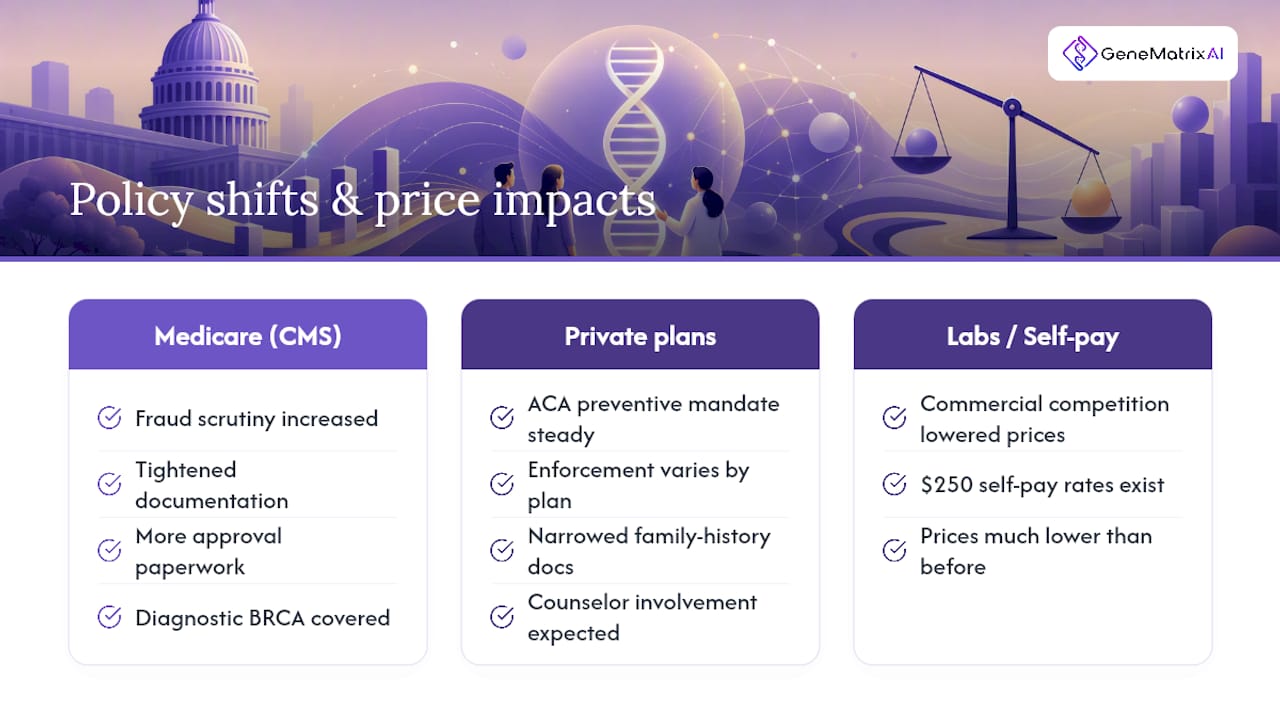
On the private insurance side, the ACA's preventive-services mandate has held steady, but enforcement and plan interpretation still vary. Some insurers have narrowed the documentation they'll accept for family-history claims, which is part of why genetic counselor involvement has become close to a practical requirement rather than a nice extra.
Labs have responded to cost pressure from a different direction. Competition among commercial genetic testing companies has pushed self-pay list prices down substantially over the past several years, which is part of why $250 self-pay rates now exist for tests that once cost several times that. At the same time, GINA protects you from having a BRCA result used against you for health insurance or employment purposes, though that protection stops short of life, disability, and long-term care insurance. That gap matters if you're weighing whether to apply for those policies before or after testing.
Why Your Zip Code Affects What You'll Pay
Geography shapes your bill more than most people expect. Academic medical centers in major metro areas, think Boston, New York, or Chicago, often charge more for the clinical visit and counseling portion, even when the underlying lab test comes from the same national reference lab everyone else uses. Rural patients frequently face the opposite problem: fewer local genetic counselors, which means either a telehealth consultation or a longer drive, both of which add time and sometimes cost to the process.
State Medicaid variability compounds the geographic effect. A high-risk unaffected patient in a state that expanded Medicaid genetic testing coverage might pay nothing, while an identical patient one state over pays full self-pay price because that state's Medicaid program treats the same test as non-covered.
Lab choice matters just as much as location. Reference labs with high testing volume typically post lower self-pay rates than smaller specialty labs, simply because they process enough volume to spread fixed costs. Hospital-based labs sometimes charge more for the exact same BRCA1/2 sequencing you could get through a direct clinical laboratory, because the hospital adds its own facility fee on top of the lab charge. If you're comparing quotes, ask whether the price you're given includes any hospital or facility fee, since that single line item can shift a quote by hundreds of dollars.
Why Clinically Ordered Testing Beats Guessing On Your Own
I've looked at enough insurance denials and self-pay confusion to say this plainly: skipping the genetic counselor step to save time almost always costs more later, either in a denied claim or a test that doesn't answer the question you actually needed answered. Gene Matrix LLC is a Chicago-based, CLIA-certified biotechnology company built around exactly that gap, pairing AI-driven analysis with clinician-reviewed results. Its GeneMatrixAI platform delivers actionable genomic insights within 72 hours, which matters when a family history conversation is already stressful enough without a two-week wait.
— Tarek
Get Clinically Ordered BRCA Testing With Billing Support
Gene Matrix offers hereditary cancer screening built around exactly the process this article walks through: a clinician-reviewed order, CLIA-certified lab processing, and counseling access, instead of a mail-order kit that leaves you guessing whether your result even needs medical follow-up. Where DTC kits check three variants, Gene Matrix's hereditary cancer panel screens far more broadly, and its team can help you pre-verify insurance benefits before you commit to a self-pay quote.

If you've read this far wondering whether you'd qualify for no-cost coverage or need to budget for self-pay, that's exactly the question Gene Matrix's intake process is built to answer. Check your eligibility and start the hereditary cancer screening process today, or begin with a quick health intake to see what your specific situation looks like before you spend a dollar.
This article is general information, not a substitute for advice from a qualified doctor. Consult a qualified healthcare professional about your own circumstances before acting on anything here.
Sources
- Genetic counseling | CDC
- Breastcancer
- Guidance on the Genetic Information Nondiscrimination Act (GINA) | HHS