

TL;DR:
- A harmful BRCA1 variant significantly increases the risk of breast and ovarian cancer, but management options exist. Genetic testing and counseling can help individuals understand their risk and choose proactive strategies. Knowing one's BRCA1 status is an actionable map, not a verdict, enabling early detection and risk reduction.
BRCA1 is a gene that helps your cells repair damaged DNA and acts as a brake on uncontrolled cell growth. When you inherit a harmful change in this gene, that brake weakens, and your lifetime risk for certain cancers, especially breast and ovarian cancer, rises significantly. The good news: knowing your BRCA1 status opens the door to real options.
The short version:
- A pathogenic BRCA1 variant raises lifetime breast cancer risk substantially above the general population baseline and increases ovarian cancer risk as well.
- Because BRCA1 follows an autosomal dominant inheritance pattern, each biological child of a carrier has about a 50% chance of inheriting the same variant.
- Genetic testing and counseling are available, and management options, from enhanced screening to risk-reducing surgery, can meaningfully change outcomes.
A BRCA1 change increases risk. It does not guarantee cancer, and it does not leave you without options.
Table of Contents
- What does the BRCA1 gene normally do in your cells?
- How BRCA1 changes affect your cancer risk
- Who should consider BRCA1 testing and genetic counseling?
- How BRCA1 genetic testing works and how to read your results
- Managing risk with a BRCA1 pathogenic variant
- What BRCA1 status means if cancer develops
- Population differences, founder variants, and rare biallelic effects
- Insurance, cost, and practical next steps in the U.S.
- Key Takeaways
- The part most people miss about BRCA1
- Genematrix can support your next step
- Authoritative sources and further reading
What does the BRCA1 gene normally do in your cells?
Think of BRCA1 as your genome's repair crew chief. Every time a cell divides, DNA can get damaged. BRCA1 produces a protein that spots double-strand breaks, the most dangerous type of DNA damage, and coordinates the machinery needed to fix them accurately. According to MedlinePlus Genetics, the BRCA1 protein interacts with several other proteins to mend these breaks and also helps regulate other genes involved in cell growth.

The repair process BRCA1 favors is called homologous recombination, a precise copy-and-paste method that uses the undamaged chromosome as a template. Without BRCA1, cells fall back on error-prone repair shortcuts, which let mutations accumulate. BRCA1 also acts as a gatekeeper at cell-cycle checkpoints, pausing cell division when damage is detected so repairs can happen before the cell copies itself again.
When BRCA1 works properly:
- DNA double-strand breaks are repaired accurately, keeping the genome stable.
- Cell division pauses when damage is present, preventing faulty copies.
- Tumor suppressor signals stay active, limiting abnormal cell growth.
When a harmful BRCA1 change is present, those safeguards erode. Mutations accumulate faster, genomic instability rises, and cells are more likely to develop the additional changes that drive cancer. The NCBI Gene database notes that BRCA1 mutations are responsible for a substantial proportion of inherited breast and ovarian cancers.
How BRCA1 changes affect your cancer risk
What the numbers actually mean
BRCA1 and BRCA2 produce proteins that help repair damaged DNA, and both are classified as tumor suppressor genes. A pathogenic BRCA1 variant does not cause cancer on its own. Cancer typically requires a second "hit," a somatic mutation in a specific tissue, on top of the inherited germline change. That two-hit requirement explains why not every carrier develops cancer, and why risk varies across individuals.
Research published in PMC puts lifetime breast cancer risk in BRCA1 mutation carriers at up to 70%, compared with roughly 12% in non-carriers. Ovarian cancer risk is also substantially elevated. Exact figures vary by study, by the specific variant, and by other factors like family history and modifier genes, which is exactly why genetic counseling is individualized rather than formulaic.
Statistic to know: Hereditary factors, including BRCA1 and BRCA2 mutations, account for an estimated 5%–10% of breast cancer cases overall. The U.S. population baseline for breast cancer is about 1 in 8 women (roughly 12.5%). Most breast cancers occur in people without any BRCA1 or BRCA2 variant.
Cancers linked to BRCA1
Beyond breast and ovarian cancer, a pathogenic BRCA1 variant is associated with elevated risk for:
- Male breast cancer (rare but real)
- Pancreatic cancer
- High-grade prostate cancer
There is also a rare scenario worth knowing: when a person inherits two harmful BRCA1 changes, one from each parent (biallelic mutations), the result is a condition called Fanconi anemia, a serious disorder affecting bone marrow and DNA repair. This is uncommon but relevant for families where both parents carry BRCA1 variants.
Relative risk at a glance
| Group | Approximate lifetime breast cancer risk | Approximate lifetime ovarian cancer risk |
|---|---|---|
| General population (U.S. women) | ~12% | ~1–2% |
| BRCA1 carriers | Up to ~70% | Substantially elevated (varies by study) |
| BRCA2 carriers | Elevated (lower than BRCA1) | Elevated (lower than BRCA1) |
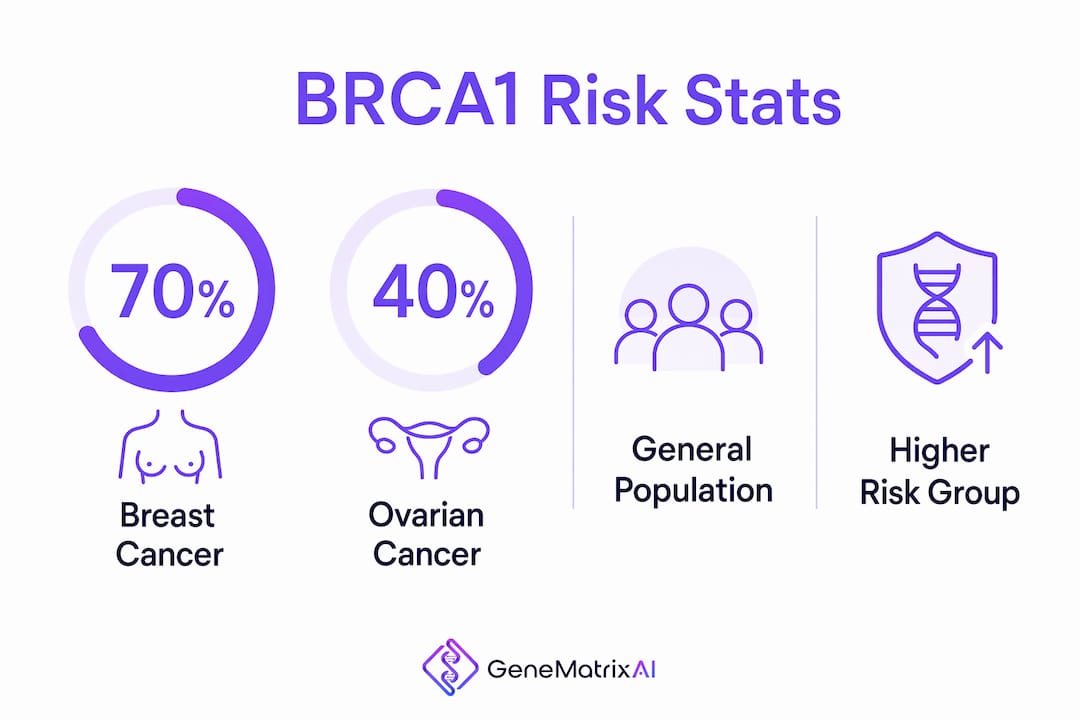
Risk estimates are ranges, not fixed predictions. Your personal risk profile depends on your specific variant, family history, and other biological factors. A genetic counselor integrates all of those variables into a personalized assessment.
Who should consider BRCA1 testing and genetic counseling?
Testing is not recommended for everyone, but certain patterns in your personal or family history are strong signals to discuss it with a clinician or genetic counselor. Common indications include:
- Breast cancer diagnosed before age 50
- Ovarian, fallopian tube, or primary peritoneal cancer at any age
- Two or more close relatives (first- or second-degree) with breast or ovarian cancer
- A known pathogenic BRCA1 or BRCA2 variant already identified in your family
- Male breast cancer in any relative
- Ashkenazi Jewish, Icelandic, or other ancestry associated with founder variants
- Pancreatic cancer or high-grade prostate cancer in a close relative
- Triple-negative breast cancer (a subtype more common in BRCA1 carriers)
If a pathogenic variant is confirmed in one family member, their biological relatives should consider cascade testing, which means testing specifically for that known variant rather than running a full panel. It is faster, often less expensive, and gives relatives a clear yes-or-no answer. Family health history is the foundation of that process, so gathering as much detail as possible before any appointment matters.
A board-certified genetic counselor is the right starting point for personalized assessment. They weigh your full picture, not just a single data point, before recommending whether and how to test.
How BRCA1 genetic testing works and how to read your results
The testing process
Most clinical BRCA1 tests use either a saliva sample or a blood draw. The sample goes to a CLIA-certified laboratory, where technicians sequence the BRCA1 gene (and usually BRCA2 and other hereditary cancer genes at the same time, in what is called a multigene panel). CLIA certification means the lab meets federal quality standards for clinical diagnostic testing, which matters because the results will guide real medical decisions.
Turnaround typically runs two to four weeks for standard testing, though some labs offer faster options. If a result is unexpected or ambiguous, a second confirmatory test from a different sample is sometimes ordered before clinical decisions are made.
What your results actually mean
BRCA1 and BRCA2 testing results fall into a few categories, and understanding them prevents unnecessary panic or false reassurance:
Pathogenic or likely pathogenic: A change that is known or strongly suspected to impair BRCA1 function. This is the result that triggers active risk management. "Likely pathogenic" carries nearly the same clinical weight as "pathogenic" and is managed the same way.
Variant of uncertain significance (VUS): A change exists, but current evidence is insufficient to say whether it is harmful or harmless. Per NCBI guidance, clinical practice treats a VUS as non-actionable for major preventive decisions until it is reclassified. VUS results are common and often get reclassified over time as more data accumulates. Do not make major surgical decisions based on a VUS alone.
Negative (no variant detected): No pathogenic change was found. This reduces, but does not eliminate, hereditary risk, especially if a specific family variant was not tested for. A negative result in someone with a strong family history still warrants discussion with a genetic counselor.
Inheritance and your relatives
BRCA1 risk is inherited in an autosomal dominant pattern. You have two copies of the gene, one from each parent. A single harmful copy is enough to raise risk. Each biological child of a carrier has about equal chance of inheriting that variant. Siblings face the same odds. That is why a positive result in one person is, in effect, health information for the whole family.
Managing risk with a BRCA1 pathogenic variant
A confirmed pathogenic BRCA1 variant is not a diagnosis. It is a signal to act proactively. Clinical management is individualized and can include several approaches:
- Enhanced imaging surveillance: Annual breast MRI (typically starting at age 25–30) combined with mammography, offering earlier detection than standard screening alone. Cancer screening strategies for BRCA1 carriers differ from general population guidelines.
- Chemoprevention: Tamoxifen or other agents may reduce breast cancer risk in appropriate candidates; eligibility depends on age, menopausal status, and other health factors.
- Risk-reducing surgery: Prophylactic bilateral mastectomy substantially lowers breast cancer risk. Risk-reducing salpingo-oophorectomy (removal of the ovaries and fallopian tubes) reduces both ovarian and breast cancer risk and is typically recommended after childbearing is complete for BRCA1 carriers.
- Clinical trials: Participation in prevention or early-detection trials may offer access to emerging strategies and contributes to the evidence base for future carriers.
What diet and exercise can and cannot do
No specific food or supplement can turn off a BRCA1 mutation. MedlinePlus is direct on this: there is no scientific evidence that diet prevents or reverses the effect of an inherited BRCA1 change. A balanced diet and regular exercise support overall health and may reduce cancer risk at a population level, but they are not substitutes for clinical surveillance or medical risk management. Anyone who tells you otherwise is selling something.
Pro Tip: Consult a multidisciplinary team, including a genetic counselor, medical oncologist, breast surgeon, and your primary care physician, before deciding on any risk-management strategy. No single specialist has the full picture alone.
What BRCA1 status means if cancer develops
If cancer does develop in a BRCA1 carrier, the underlying DNA repair defect that raised risk in the first place can actually influence treatment options. Because BRCA1-defective tumor cells cannot repair certain types of DNA damage, they are vulnerable to therapies that exploit that weakness.

PARP inhibitors are the clearest example. PARP is an enzyme that helps cells repair single-strand DNA breaks. When PARP is blocked in a BRCA1-deficient tumor cell, the cell accumulates so much unrepaired damage that it dies. Normal cells, which still have functioning BRCA1, can use alternative repair pathways and survive. This concept is called synthetic lethality, and it is the scientific basis for PARP inhibitor approvals in BRCA1-associated breast, ovarian, and other cancers.
BRCA1-deficient tumors can also be more sensitive to certain platinum-based chemotherapies, which work by creating DNA crosslinks that BRCA1-defective cells cannot repair. Clinical use of any of these therapies depends on cancer type, stage, prior treatment, and the oncologist's judgment. BRCA1 status also affects eligibility for clinical trials, many of which specifically enroll patients with hereditary DNA repair defects. If you or a family member is diagnosed with cancer and BRCA1 status is unknown, discussing tumor or germline testing with the oncology team is worth raising early.
Population differences, founder variants, and rare biallelic effects
BRCA1 pathogenic variants occur across all populations, but their frequency is not uniform. In the general U.S. population, the overall prevalence of BRCA1 or BRCA2 pathogenic variants is relatively low. Certain groups carry a higher pretest probability because of founder variants, specific mutations that arose in a common ancestor and became concentrated in a population over generations.
The most studied example involves Ashkenazi Jewish ancestry. Three founder variants (two in BRCA1, one in BRCA2) occur at notably higher frequency in this population, which changes the most efficient testing strategy. Rather than sequencing the entire gene first, labs may screen for those three variants as an initial step. Similar founder effects have been documented in Icelandic, Norwegian, and certain other populations.
Ancestry matters for another reason: if your family's ethnic background raises the pretest probability of a specific variant, a standard panel that misses founder variants could give a falsely reassuring result. Discussing ancestry with your genetic counselor before testing helps ensure the right approach is used.
The rare biallelic scenario, inheriting two harmful BRCA1 changes, one from each parent, leads to Fanconi anemia subtype FANCS. This is distinct from the elevated cancer risk seen in single-copy carriers and requires specialized pediatric and hematologic management. It is uncommon but worth knowing if both parents in a family are identified as BRCA1 carriers.
Insurance, cost, and practical next steps in the U.S.
Insurance coverage for BRCA1 testing varies, but many plans cover it when specific clinical criteria are met. The Affordable Care Act requires most private insurers to cover genetic counseling and BRCA testing for women at increased risk without cost-sharing, based on U.S. Preventive Services Task Force recommendations. Medicare and Medicaid coverage follows separate rules and may require prior authorization. Out-of-pocket costs for multigene panel testing, when not covered, can range widely depending on the lab and the panel ordered. Some labs offer financial assistance programs.
Before your genetic counseling appointment, it helps to gather your personal medical history (including any prior cancer diagnoses and pathology reports), a three-generation family history with cancer types and ages at diagnosis, and any prior genetic test results in the family. The more complete that picture, the more useful the counseling session.
Pro Tip: Confirm that any lab you use is CLIA-certified and that the report you receive is a clinical-grade document, not a consumer wellness report. Clinical-grade reports are what physicians and genetic counselors use to guide medical decisions.
For readers exploring hereditary cancer testing options, understanding the difference between clinical and direct-to-consumer tests matters before you order anything.
Key Takeaways
A pathogenic BRCA1 variant raises lifetime breast cancer risk substantially and elevates ovarian cancer risk, but proactive management with a qualified clinical team can meaningfully change outcomes.
| Point | Details |
|---|---|
| BRCA1 is a tumor suppressor | It repairs DNA double-strand breaks; harmful variants let mutations accumulate and raise cancer risk. |
| Breast cancer risk rises sharply | Carriers face a much higher lifetime breast cancer risk compared to the general U.S. population. |
| Inheritance is autosomal dominant | Each biological child of a carrier has a 50% chance of inheriting the variant; cascade testing for relatives is recommended. |
| VUS results need patience | A variant of uncertain significance is not actionable for major preventive decisions until reclassified; follow family-based management. |
| Genematrix offers CLIA-certified testing | Genematrix provides clinical-grade hereditary cancer testing with AI-driven analysis and genetic counseling support for eligible patients. |
The part most people miss about BRCA1
Most conversations about BRCA1 focus on the fear, and that is understandable. A lifetime breast cancer risk up to 70% is a number that stops people cold. But the framing that gets lost is this: BRCA1 is one of the most actionable genetic findings in all of medicine. You are not reading a verdict. You are reading a map.
The conventional wisdom treats a positive result as a crisis. The more accurate way to think about it is that you now have information most people with the same underlying biology never get. Enhanced surveillance catches cancers earlier, when they are most treatable. Risk-reducing surgery, for those who choose it, can reduce breast cancer risk dramatically. PARP inhibitors exist precisely because researchers understood the biology well enough to exploit it. None of those options exist for someone who does not know their status.
What I think people underestimate is the emotional weight of uncertainty versus the emotional weight of a clear answer. A VUS result, or a family history with no confirmed variant, can be harder to sit with than a definitive pathogenic finding, because a definitive finding at least tells you what to do next. The goal of testing is not to generate anxiety. It is to replace vague worry with a specific plan.
Genematrix can support your next step
If you have a family history of breast or ovarian cancer, a known BRCA1 variant in your family, or other risk factors discussed in this article, clinical-grade genetic testing is worth discussing with your physician or genetic counselor.

Genematrix is a Chicago-based, CLIA-certified biotechnology company offering hereditary cancer testing through its GeneMatrixAI platform, trained on 500,000+ genetic profiles. The GeneCancer panel covers BRCA1, BRCA2, Lynch syndrome, and other hereditary cancer genes, with clinical-grade reports delivered within 72 hours and genetic counseling support available. Testing is designed for people who meet clinical criteria, not as a substitute for physician guidance.
If you are ready to explore whether testing is appropriate for your situation, start your health intake at Genematrix. Bring the results to your clinician or genetic counselor for interpretation and next steps.
This article provides general health information, not medical advice. Confirm current guidelines and your personal risk profile with a qualified clinician or board-certified genetic counselor.
Authoritative sources and further reading
The following U.S.-focused resources provide reliable, in-depth information on BRCA1 and hereditary cancer risk:
- NCI: BRCA Gene Changes, Cancer Risk and Genetic Testing — National Cancer Institute overview of BRCA variants, risk estimates, and testing guidance.
- MedlinePlus Genetics: BRCA1 gene — Plain-language gene summary from the National Library of Medicine.
- GeneReviews: BRCA1- and BRCA2-Associated Hereditary Breast and Ovarian Cancer — Detailed clinical resource for genetic counselors and clinicians.
- StatPearls: BRCA1 and BRCA2 Mutations — Evidence-based clinical summary covering management and risk data.
- Johns Hopkins Medicine: Inherited Cancer Risk, BRCA Mutation — Patient-facing overview of inheritance patterns and clinical implications.
- Hippocratic Cancer Research Foundation: Why Cancer Screening Matters — Accessible resource on the value of early detection and surveillance strategies.
When choosing a lab or genetic counselor, confirm CLIA certification for any laboratory and board certification (through the American Board of Genetic Counseling) for any counselor you work with. Both credentials signal that the professional meets established quality standards for clinical genetic services.