

TL;DR:
- Family health history tracks diseases across multiple generations and guides personalized preventive care. It combines genetic and environmental factors, helping clinicians recommend earlier and targeted screenings. Regular updates improve risk assessment, and genetic testing complements family history insights for better health management.
Family health history is a structured record of diseases and medical conditions present in your biological relatives across multiple generations. Clinicians and researchers recognize it as the most cost-effective first step in genetic risk assessment, providing a window into your inherited and shared environmental risks. The role of family health history extends well beyond simple curiosity about your relatives. It directly shapes which screenings you receive, when you receive them, and whether a clinician refers you for advanced genetic testing. The U.S. Surgeon General and major clinical studies consistently affirm its predictive value for conditions including heart disease, cancer, type 2 diabetes, and mental health disorders.
What does family health history actually include?
Collecting family health information across multiple generations delivers the most accurate risk assessment for diseases like cancer and heart disease. The data points that matter most are not just which diseases appeared in your family, but the specific details surrounding each diagnosis.
A thorough family health history covers three tiers of relatives:
- First-degree relatives: parents, siblings, and children
- Second-degree relatives: grandparents, aunts, uncles, and half-siblings
- Third-degree relatives: great-grandparents and first cousins
For each relative, the key details include the disease or condition diagnosed, the age at diagnosis, the cause of death if applicable, and ethnic background. Ethnicity matters because certain genetic variants are more prevalent in specific populations. Ashkenazi Jewish ancestry, for example, carries a higher prevalence of BRCA1 and BRCA2 mutations linked to hereditary breast and ovarian cancer.
Age at diagnosis is one of the most clinically significant data points. Early diagnosis in relatives implies a significantly higher inherited risk than a diagnosis occurring in old age. A grandfather diagnosed with colon cancer at 45 carries a very different risk signal than one diagnosed at 78.
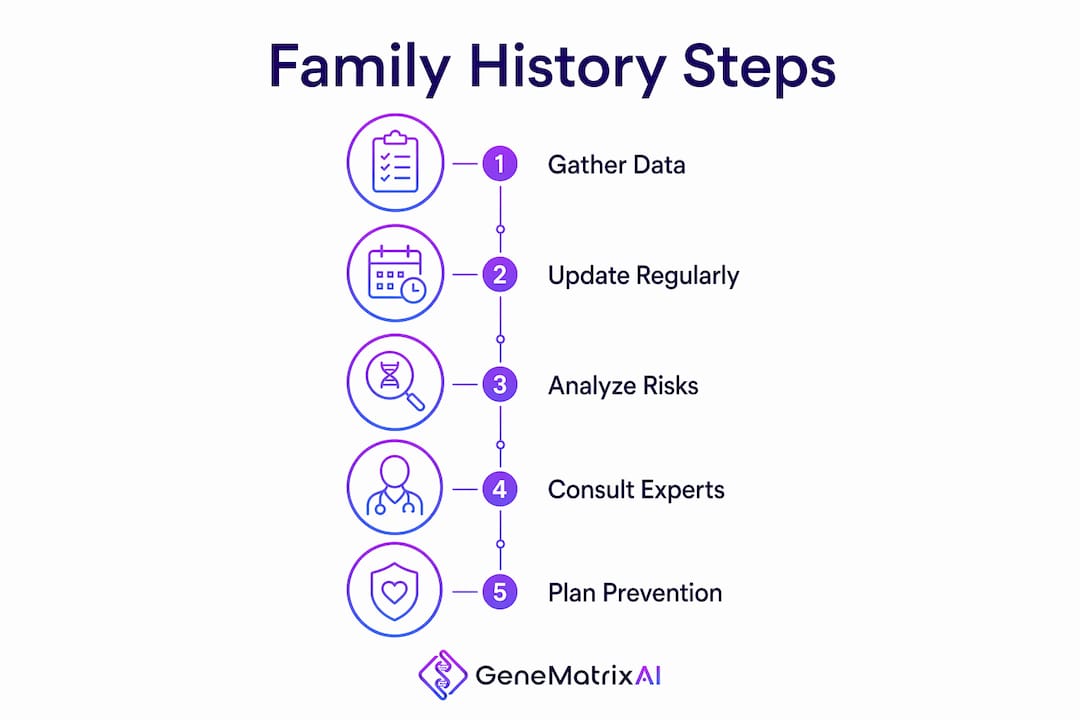
Family health history is also a living document. New diagnoses in relatives, updated treatment outcomes, and newly discovered genetic conditions should all be added over time. Regular updates allow clinicians to adjust your screening schedule dynamically as your family's health picture evolves.
Pro Tip: Interview relatives at family gatherings and record details in a shared digital document. Ask specifically about age at diagnosis, not just the name of the condition. Vague answers like "Grandma had cancer" are far less useful than "Grandma was diagnosed with ovarian cancer at 52."
How does family history combine genetics and environment?
Family health history captures more than inherited DNA. It also reflects shared lifestyle habits, diet patterns, geographic exposures, and socioeconomic conditions that run through families. This integrated risk picture is more comprehensive than genetic testing alone for common complex diseases.
Consider type 2 diabetes. A family pattern of the disease may reflect inherited insulin resistance genes, but it also reflects shared dietary habits, physical activity levels, and even neighborhood food access. Separating these threads is difficult, which is exactly why family history captures both simultaneously.
Polygenic risk scores are an emerging complement to family history. These scores use a single biological sample to identify individuals at high risk for common diseases, and their integration into primary care enables personalized screening schedules that can reduce premature mortality. They work best when interpreted alongside a detailed family history, not as a standalone tool.
Epigenetic influences add another layer. Environmental exposures like tobacco smoke, chronic stress, or chemical exposure can modify how genes express themselves. These modifications can be passed across generations, meaning your family history encodes environmental signals as well as genetic ones.
The table below shows how three common risk information sources compare:
| Risk information source | What it captures | Best used for |
|---|---|---|
| Family health history | Genetics plus shared environment and lifestyle | Initial risk screening, clinical decision-making |
| Genetic testing (DNA) | Specific inherited variants | Confirming hereditary conditions, targeted prevention |
| Lifestyle and environment | Personal behaviors and exposures | Modifiable risk reduction strategies |
Pro Tip: If you have a strong family history of a condition but a negative genetic test result, do not dismiss the risk. The test may not cover every relevant variant, and shared environmental factors still apply.
How do clinicians use family history to guide preventive care?
Family health history helps clinicians shift from reactive treatment to preventive care by prompting earlier and more targeted screenings. This is one of the most concrete benefits of knowing your family medical history.

Many health screenings are initiated based on family history even when the patient has no symptoms. A person with a first-degree relative diagnosed with breast cancer before age 50 may receive annual mammograms starting at 30 rather than the standard 40. A family history of high cholesterol or early heart disease triggers earlier lipid panels and more aggressive management targets.
Hereditary cancer screening protocols follow a similar logic. Patterns of colorectal cancer in multiple relatives, particularly at young ages, prompt referral for colonoscopy years ahead of standard guidelines. Lynch syndrome, a hereditary condition affecting DNA repair, is identified through exactly this kind of pattern recognition in family history before genetic testing confirms it.
Here is how clinicians typically act after gathering a detailed family health history:
- Identify disease patterns across generations and note age of onset for each condition.
- Stratify risk as average, moderate, or high based on number of affected relatives and their relationship to the patient.
- Adjust screening timelines to start earlier or occur more frequently than standard population guidelines.
- Refer for genetic counseling when patterns suggest a hereditary syndrome such as BRCA mutations or Lynch syndrome.
- Recommend lifestyle modifications targeted at the specific conditions running in the family.
- Order confirmatory genetic testing when counseling supports it, using results to refine the risk picture further.
Family health history remains the gold standard first step for genetic risk assessment and cost-effective clinical guidance, even as direct genetic testing technology advances. Genetic testing confirms what family history suggests. It rarely replaces the initial clinical conversation.
For people whose family history points toward hereditary cancer risk, genetic counseling provides the expert interpretation needed to translate that history into a concrete prevention plan.
How to collect and maintain your family health history
Gathering a complete family medical history takes deliberate effort, but the process is manageable with the right approach. The goal is to collect enough detail that a clinician can make meaningful risk assessments, not just a list of disease names.
Start with these practical steps:
- Talk directly to relatives. Phone calls and family gatherings are the best opportunities. Ask open-ended questions first, then follow up with specifics about age and diagnosis.
- Request medical records where possible. Death certificates and hospital records can fill gaps when relatives are unavailable or deceased.
- Use a structured tool. The U.S. Surgeon General's My Family Health Portrait is a free, web-based tool that helps you organize and store information in a clinically useful format.
- Record ethnic background for all branches. Ancestry affects which genetic variants are most relevant to screen for.
- Note treatments and outcomes. Knowing that a relative responded well to a specific medication can also inform your own pharmacogenomic profile.
Treat your family health history as a document you update regularly, not a one-time form you fill out at a doctor's office. Sharing this history with both your relatives and your healthcare providers improves preventive care decisions and helps inform future generations. A cousin who does not know about a pattern of early heart disease in your shared grandparents cannot act on that information.
For families navigating complex genetic histories, family genetic testing tips can help you decide when professional genetic evaluation makes sense alongside your documented history.
Epigenetic testing is another avenue worth considering when family history suggests inherited environmental exposures. Resources like the SpermEGT DNA Methylation Test illustrate how epigenetic analysis can add depth to what family history alone reveals.
Key Takeaways
Family health history is the most cost-effective and clinically proven starting point for understanding your inherited disease risk and guiding personalized preventive care.
| Point | Details |
|---|---|
| Multi-generational data matters | Collect information from first-, second-, and third-degree relatives for accurate risk profiling. |
| Age of diagnosis is critical | Early diagnosis in a relative signals significantly higher inherited risk than late-life diagnosis. |
| History captures more than genes | Shared lifestyle and environment are encoded in family history alongside inherited genetic variants. |
| Clinicians act on patterns | Family history triggers earlier screenings, genetic referrals, and targeted lifestyle recommendations. |
| Update it regularly | New diagnoses in relatives should be added promptly so screening schedules can be adjusted. |
Why I think most people underestimate their family history
Most people treat their family health history as a form they fill out once and forget. That is a missed opportunity. What I have observed is that the families who benefit most from preventive medicine are the ones who treat this history as an ongoing conversation, not a paperwork exercise.
The most common mistake is focusing only on immediate relatives. A pattern of pancreatic cancer across three cousins on your mother's side is clinically significant even if your parents are healthy. Patterns reveal what individual cases cannot.
Genetics set your baseline risk, but they do not write your outcome. Knowing that heart disease runs in your family gives you a specific, actionable target for diet, exercise, and medication decisions. That knowledge is not a sentence. It is a head start.
The psychological benefit of informed prevention is real. People who understand their risks and act on them report less health anxiety than those who avoid the information. Knowing what you are watching for is far less stressful than waiting for something unexpected to happen.
My strongest recommendation: have the conversation with your relatives this year. Write it down. Share it with your doctor. Then update it every time something changes in your family's health. That habit alone puts you ahead of the majority of people who walk into a clinic with no family history on record.
— Tarek
Genematrix brings precision to your family health picture

Knowing your family health history is the foundation. Acting on it with precision is where Genematrix comes in. Genematrix is a CLIA-certified biotechnology company based in Chicago that uses AI-driven analysis trained on 500,000+ genetic profiles to deliver hereditary cancer screening and pharmacogenomics reports within 72 hours. Their platform, GeneMatrixAI, covers hereditary cancer risk including BRCA1, BRCA2, and Lynch syndrome, as well as specialized modules for pharmacogenomics, pediatric health, and nutrigenomics. For anyone whose family history points toward elevated cancer risk, Genematrix's GeneCancer testing translates that history into a clinically grounded, personalized risk report. The science behind the platform is built for exactly this kind of proactive, prevention-first care.
FAQ
What is the role of family health history in disease prevention?
Family health history identifies inherited and shared environmental risks for conditions like cancer, heart disease, and diabetes. Clinicians use it to trigger earlier screenings and genetic referrals before symptoms appear.
How many generations should a family health history cover?
A complete family health history covers three generations, including first-degree relatives like parents and siblings, second-degree relatives like grandparents and aunts, and third-degree relatives like great-grandparents and first cousins.
Is family health history more useful than genetic testing?
Family health history and genetic testing serve different purposes. Family history is the most cost-effective first step and captures both genetic and environmental risk, while genetic testing confirms specific inherited variants identified through that history.
How often should I update my family health history?
Update your family health history whenever a relative receives a new diagnosis or dies. Regular updates allow your clinician to adjust your screening schedule as your family's health picture changes over time.
What tools help with documenting family health history?
The U.S. Surgeon General's My Family Health Portrait is a free, structured tool designed to help individuals record and organize their family medical history in a format useful for clinical care.