

TL;DR:
- Hereditary cancer accounts for 5 to 10 percent of all cases and involves inherited gene mutations from parents. Recognizing family patterns, early age at diagnosis, and personal symptoms helps identify those at risk. Genetic testing confirms mutations, guides prevention, and benefits from family history collection and counseling.
Hereditary cancer is defined as cancer caused by an inherited gene mutation passed from parent to child, and it accounts for 5–10% of all cancer cases. That fraction is small, but the personal risk for carriers is dramatically higher than average. Knowing how to recognize hereditary cancer symptoms means looking beyond your own health and reading your family's cancer history as a clinical document. The patterns are specific, the warning signs are learnable, and catching them early changes outcomes.
How to recognize hereditary cancer symptoms in your family history
Family history is the first and most telling signal of hereditary cancer risk. Hereditary cancer syndromes produce recognizable clusters: the same cancer appearing in multiple relatives, cancers striking at unusually young ages, and rare cancer types showing up where they statistically should not. These patterns differ from sporadic cancer, which develops from random cell mutations over a lifetime.
The key red flags to watch for in your family include:
- Two or more relatives on the same side of the family diagnosed with the same cancer type, such as breast, ovarian, or colorectal cancer
- Cancer diagnosed at an early age, specifically breast or colorectal cancer at or below age 50, or prostate cancer at or below age 55
- Cancer across multiple generations, meaning a grandparent, parent, and sibling all affected
- Rare cancer types in your family, such as male breast cancer, adrenocortical carcinoma, or fallopian tube cancer
- Multiple primary cancers in one person, for example a relative who had both breast cancer and ovarian cancer at different points in life
- Specific cancer combinations that cluster in hereditary syndromes, such as colorectal and endometrial cancer together, which is a hallmark of Lynch syndrome
Pro Tip: Ask relatives on both your mother's and father's side. Hereditary mutations travel through either parent, and many people only document one side of their family tree.
The distinction between hereditary and familial cancer matters here. Familial cancer clusters in families due to shared lifestyle or environmental factors without a defined gene mutation. Hereditary cancer involves a specific inherited mutation that genetic testing can identify. The patterns above point toward the hereditary category.
What personal symptoms and signs may indicate hereditary cancer?
Beyond family history, your own medical history carries warning signs worth examining. The clearest personal signal is a diagnosis of multiple primary cancers, meaning two or more separate cancer diagnoses in your lifetime, not a recurrence of the same cancer. A person who had colorectal cancer at 38 and then endometrial cancer at 45 fits a pattern consistent with Lynch syndrome.

Early age at diagnosis is the second major personal signal. Population averages for most cancers skew toward older adults. When cancer appears decades earlier than expected, a germline mutation is a plausible explanation.
Physical symptoms that warrant prompt evaluation include:
- Unusual lumps or masses that appear and persist, particularly in the breast, thyroid, or lymph nodes
- Unexplained weight loss of significant amount over a short period without dietary changes
- Blood in stool or urine without an obvious cause such as hemorrhoids or a urinary tract infection
- Persistent abdominal pain or bloating that does not resolve, which can signal ovarian or colorectal pathology
- Skin changes or lesions that are new, growing, or irregular in color and border
Some hereditary syndromes also produce physical features outside of cancer itself. Cowden syndrome, caused by PTEN mutations, produces benign skin growths called trichilemmomas. Familial adenomatous polyposis causes hundreds of polyps in the colon visible on colonoscopy. These non-cancer findings are clinical clues that a genetic syndrome is present.
Pro Tip: Do not wait for a cancer diagnosis to act on symptoms. Genetic counseling is available to anyone with a concerning family history, even if you are currently healthy.
How to collect and map your family cancer history for risk assessment
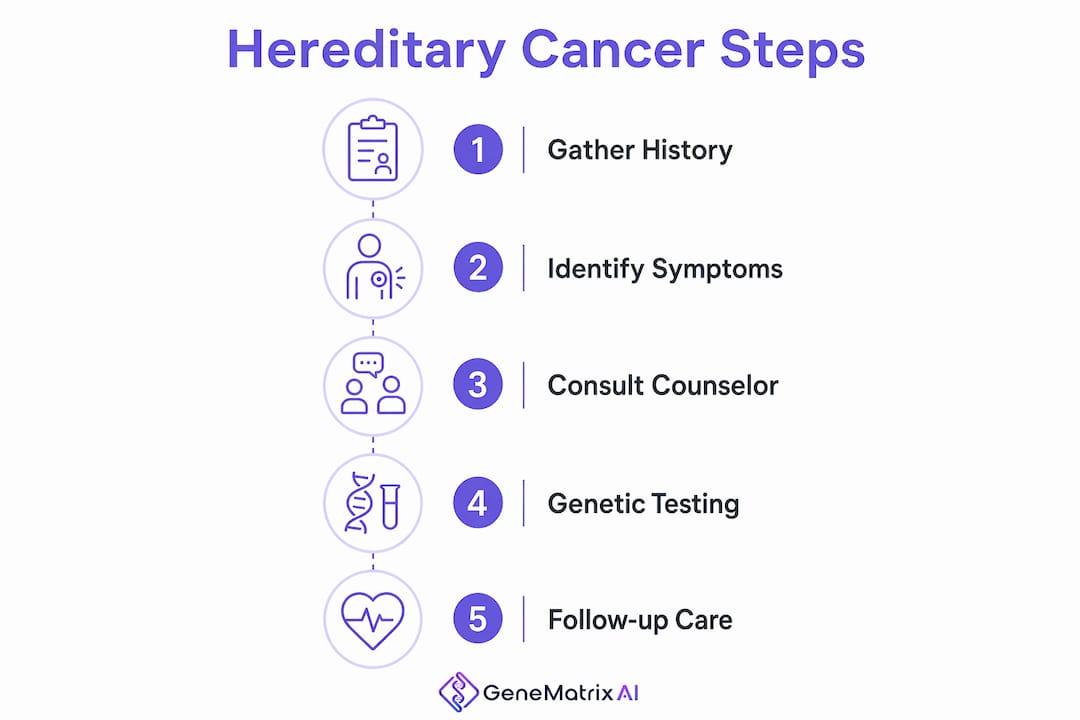
A three-generation pedigree is the standard tool genetic counselors use to assess hereditary cancer risk. Mapping this pedigree before any genetic testing helps clinicians separate hereditary risk from coincidental family clustering. The pedigree covers your parents, siblings, grandparents, aunts, uncles, and first cousins on both sides.
Follow these steps to build your family cancer history:
- List every cancer diagnosis in your family, including the type of cancer, not just "cancer."
- Record the age at diagnosis for each affected relative, not the age at death.
- Note which side of the family each relative belongs to, maternal or paternal.
- Identify bilateral cancers, meaning cancer in both breasts or both kidneys in a single relative.
- Collect medical records or death certificates where possible to verify diagnoses, since family recollections are often inaccurate about cancer type.
- Note ancestry, particularly Ashkenazi Jewish heritage, which carries a higher probability of BRCA mutations and warrants specific testing consideration.
| Information to collect | Why it matters |
|---|---|
| Cancer type and primary site | Distinguishes hereditary syndromes by cancer combination |
| Age at diagnosis | Early onset is a primary red flag for inherited mutations |
| Maternal vs. paternal side | Mutations travel through one parent's line |
| Bilateral or multiple primaries | Strongly suggests germline mutation |
| Ethnic background | Certain ancestries carry higher mutation prevalence |
Incomplete information is common and should not stop you from proceeding. Genetic counselors are trained to work with partial family histories and can still provide meaningful risk estimates. When records are unavailable, note what relatives have told you and flag it as unverified.
What does genetic testing involve for hereditary cancer risk?
Genetic testing for hereditary cancer uses a blood or saliva sample to analyze your germline DNA, the inherited genetic code present in every cell of your body. This is distinct from somatic tumor testing, which analyzes mutations that developed only within a tumor. Germline testing is what confirms a hereditary cancer syndrome.
The most clinically significant tests target genes like BRCA1, BRCA2, MLH1, MSH2, MSH6, and PMS2. BRCA mutations drive hereditary breast and ovarian cancer. MLH1 and MSH2 mutations are the primary drivers of Lynch syndrome, which raises risk for colorectal, endometrial, and several other cancers.
| Situation | Recommended action |
|---|---|
| Multiple relatives with same cancer | Seek genetic counseling and consider panel testing |
| Personal diagnosis under age 50 | Request germline testing through your oncologist |
| Affected relative available for testing | Test the affected member first to maximize diagnostic yield |
| Mutation identified in family | Pursue cascade testing for at-risk relatives |
| Ashkenazi Jewish ancestry | Discuss BRCA-specific testing with a counselor |
Testing an affected family member first is the most efficient approach. Cascade testing then allows relatives to receive targeted tests for the specific mutation already identified, which is faster and less expensive than broad panel testing.
Insurance coverage for hereditary cancer genetic testing commonly applies when family history or personal diagnosis criteria are met. Check your plan before testing, and ask your genetic counselor to document medical necessity in writing.
After results arrive, the path forward depends on what the test finds. A positive result triggers a prevention and surveillance plan tailored to the specific mutation. A negative result in someone with a strong family history may still warrant continued monitoring. Detailed family histories collected by genetic counselors guide these decisions and prevent unnecessary follow-up testing. Genematrix delivers AI-driven genomic analysis trained on 500,000+ genetic profiles, producing reports within 72 hours through its GeneMatrixAI platform, which gives clinicians and patients a clear picture of what a result actually means.
Pro Tip: At-home testing kits with follow-up consultations make hereditary cancer testing more accessible. Ask your provider or testing company whether a kit-based option is available before scheduling an in-person draw.
Key takeaways
Recognizing hereditary cancer symptoms requires reading both your family's cancer history and your own clinical presentation as a connected picture, not separate events.
| Point | Details |
|---|---|
| Family patterns are the first signal | Two or more relatives with the same cancer, especially at young ages, is the clearest red flag. |
| Early age at diagnosis matters | Breast or colorectal cancer at or below age 50 triggers the need for genetic counseling evaluation. |
| Build a three-generation pedigree | Document cancer type, age at diagnosis, and family side for all relatives before meeting a counselor. |
| Test affected members first | Starting with a diagnosed relative maximizes the chance of identifying a specific mutation. |
| Insurance often covers testing | Check your plan proactively, and have your counselor document medical necessity before testing. |
What I have learned about hereditary cancer that most people get wrong
Most people assume that hereditary cancer means inevitable cancer. That assumption is wrong, and it stops people from getting information that could protect them.
A positive BRCA1 or BRCA2 result does not mean you will develop cancer. It means your risk is elevated and that you now have specific, evidence-based options: enhanced screening schedules, risk-reducing medications, or preventive surgery in high-risk cases. Knowledge produces options. Ignorance produces nothing.
The second misconception I see constantly is the belief that familial cancer and hereditary cancer are the same thing. They are not. A family where four members smoked and three developed lung cancer has a familial pattern driven by environment. A family where three women across two generations developed ovarian cancer before age 55 has a hereditary pattern that warrants BRCA testing. The distinction changes everything about what to do next.
The most practical advice I can offer is this: start the conversation before a crisis forces it. Gathering family history at a holiday dinner is far easier than trying to reach distant relatives after a diagnosis. Write it down. Verify what you can. Bring it to your doctor. A cancer gene risk assessment is not a sentence. It is a map.
— Tarek
Genematrix and hereditary cancer genetic testing
Genematrix is a Chicago-based, CLIA-certified biotechnology company that offers AI-powered hereditary cancer screening through its GeneMatrixAI platform. Its GeneCancer module tests for mutations in BRCA1, BRCA2, Lynch syndrome genes, and dozens of other hereditary cancer genes, with reports delivered within 72 hours.

Genematrix serves patients, physicians, and health systems nationwide and worldwide. If your family history or personal symptoms raise concern, the hereditary cancer testing intake process is straightforward and designed to connect you with the right test and follow-up support. For a deeper look at the science behind the platform, the precision medicine research page outlines how Genematrix translates genomic data into clinical decisions.
FAQ
What percentage of cancers are hereditary?
Approximately 5–10% of all cancers are linked to inherited gene mutations. The remaining cases arise from random mutations or environmental and lifestyle factors.
What are the most common hereditary cancer syndromes?
Hereditary breast and ovarian cancer syndrome, caused by BRCA1 and BRCA2 mutations, and Lynch syndrome, caused by mutations in MLH1, MSH2, MSH6, and PMS2, are the most clinically recognized hereditary cancer syndromes.
At what age should hereditary cancer symptoms prompt genetic testing?
A breast or colorectal cancer diagnosis at or below age 50, or prostate cancer at or below age 55, are established age thresholds that signal the need for genetic counseling referral.
Does a negative genetic test mean I have no hereditary cancer risk?
A negative result reduces but does not eliminate risk, particularly when family history is strong. Genetic counselors use the full family pedigree alongside test results to determine ongoing surveillance needs.
Who should get tested first in a family with hereditary cancer?
Testing an affected family member first is the recommended approach. Identifying the specific mutation in a diagnosed relative allows targeted cascade testing for all other at-risk family members.