

TL;DR:
- Gene-based cancer risk reflects inherited genetic mutations that increase the likelihood of developing certain cancers. Most cancers are caused by environmental or lifestyle factors, but hereditary risk can be detected before cancer appears. Testing and early prevention strategies enable personalized management of risk, especially for high-penetrance mutations like BRCA1 and BRCA2.
Gene-based cancer risk is defined as the increased likelihood of developing cancer due to inherited genetic mutations passed down through families. Approximately 5% to 15% of cancers are hereditary, meaning the remaining 85% to 95% arise from environmental or lifestyle factors. That distinction matters because hereditary risk is detectable before cancer ever appears. Genes like BRCA1, BRCA2, and PALB2 are among the most studied gene cancer risk factors, and understanding your status with any of them changes what screening and prevention look like for you. Genetic predisposition to cancer is about probability, not destiny. Knowing your risk gives you options.
What is gene-based cancer risk and which genes matter most?

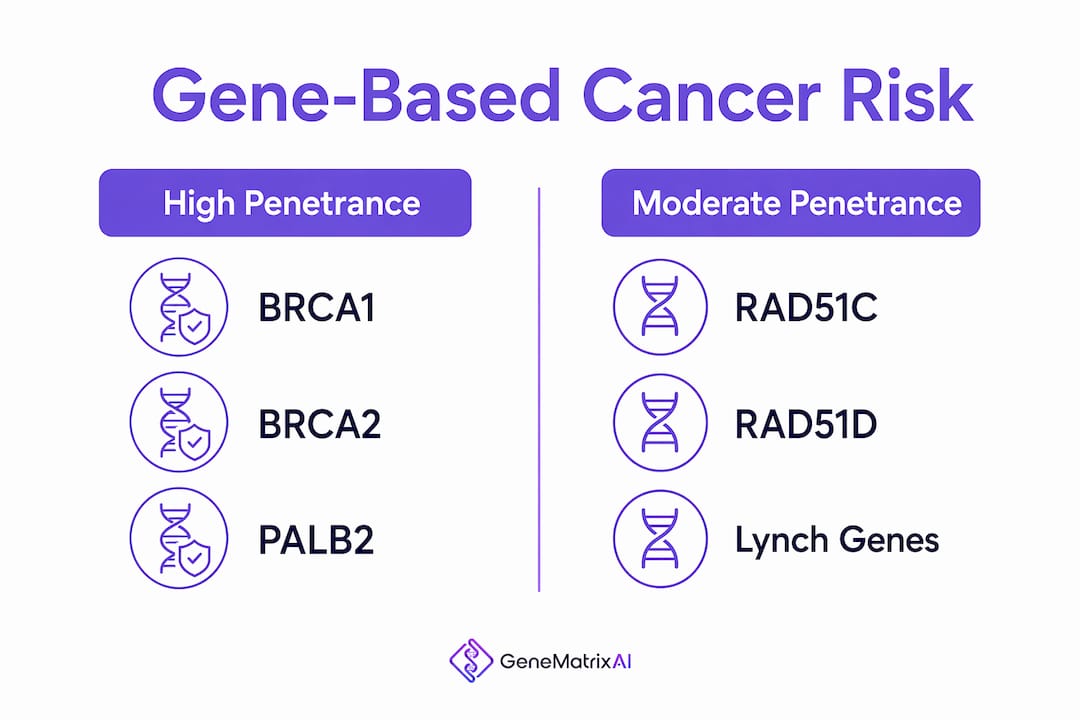
Inherited cancer risk falls into two categories: high-penetrance mutations and moderate-penetrance mutations. The difference is how dramatically a mutation raises your lifetime cancer odds compared to the general population.
High-penetrance mutations like BRCA1, BRCA2, PALB2, and PTEN are linked to lifetime cancer risks of 60% or higher. That is not a small elevation. A woman with a BRCA1 mutation faces a lifetime breast cancer risk that is several times higher than average. PTEN mutations are associated with Cowden syndrome, which raises risk for breast, thyroid, and endometrial cancers simultaneously.
Moderate-penetrance mutations, such as RAD51C and RAD51D variants, carry a 20–40% lifetime breast cancer risk. These mutations are less dramatic but still clinically significant. They often go undetected because they do not trigger the same alarm bells as BRCA mutations in family histories.
Lynch syndrome genes, including MLH1, MSH2, MSH6, and PMS2, work differently. They primarily elevate colorectal and endometrial cancer risk rather than breast cancer. Lynch syndrome is one of the most common hereditary cancer syndromes, yet many people carrying it have no idea.
| Gene | Associated Cancer Types | Penetrance Level |
|---|---|---|
| BRCA1 / BRCA2 | Breast, ovarian, pancreatic | High |
| PALB2 | Breast, pancreatic | High |
| PTEN | Breast, thyroid, endometrial | High |
| RAD51C / RAD51D | Breast, ovarian | Moderate |
| MLH1 / MSH2 | Colorectal, endometrial | High |
Pro Tip: If you have a first-degree relative diagnosed with cancer before age 50, ask your doctor about a referral to a genetic counselor before assuming your risk is average.
How is hereditary cancer risk identified?
Family history is the first signal. Patterns that suggest inherited cancer risk include cancer diagnosed before age 50, multiple relatives on the same side of the family with related cancers, rare cancer types like male breast cancer, or the same person developing more than one primary cancer. These patterns do not confirm a hereditary mutation, but they justify a closer look.
Genetic counselors are the right starting point for anyone with a concerning family history. A counselor reviews your personal and family medical history, calculates your pre-test probability of carrying a mutation, and recommends the most appropriate test panel. Genetic counseling helps interpret risk, guide decisions on surveillance or preventive options, and support family communication after results come in.
Genetic testing uses blood or saliva samples to detect inherited mutations in your germline, meaning the DNA you were born with and can pass to your children. This is distinct from tumor genetic testing, which analyzes mutations within a cancer itself and is used to guide treatment rather than assess inherited risk.
Inheritance patterns follow predictable rules. A parent carrying a BRCA1 or BRCA2 mutation passes a 50% chance of inheriting that mutation to each child. That probability applies equally to sons and daughters. Many people assume hereditary cancer risk only affects women, but BRCA2 mutations, for example, raise pancreatic and prostate cancer risk in men significantly.
Here is how the identification process typically unfolds:
- Review family history. Document cancer diagnoses across at least three generations, including cancer type, age at diagnosis, and which side of the family.
- Consult a genetic counselor. A counselor assesses whether your history meets clinical criteria for testing and which gene panel fits your situation.
- Complete germline testing. A saliva or blood sample is sent to a certified laboratory. Results typically return within two to four weeks.
- Interpret results with professional support. A positive, negative, or variant of uncertain significance result each carries different implications that require expert interpretation.
- Share relevant findings with family members. First-degree relatives may need their own testing based on your results.
Pro Tip: A negative germline test result does not guarantee you carry no elevated risk. Negative results only reflect the specific gene panel tested and known mutations at the time of testing.
How do genetic risk results shape prevention and screening?
Knowing your genetic risk converts a vague concern into a specific plan. Individuals with genetic mutations can take preventive steps including increased screening frequency, lifestyle changes, and in some cases risk-reducing surgery. The plan looks different depending on which mutation you carry and what cancers it is associated with.
Inherited gene mutations provide a personalized roadmap for targeted screening rather than a blanket approach. A person with a BRCA1 mutation, for example, typically begins annual breast MRI screenings in their late 20s, well before the age at which standard mammography screening begins for the general population. That earlier start catches cancers at more treatable stages.
Preventive options for people with confirmed high-risk mutations include:
- Earlier and more frequent imaging. Annual breast MRI alongside mammography for BRCA carriers. Colonoscopy starting at age 20–25 for Lynch syndrome carriers instead of the standard age 45.
- Chemoprevention. Medications like tamoxifen or raloxifene reduce breast cancer risk in high-risk individuals. These are not appropriate for everyone, but genetic risk status is one factor that makes them worth discussing with an oncologist.
- Risk-reducing surgery. Prophylactic mastectomy or salpingo-oophorectomy (removal of ovaries and fallopian tubes) dramatically lowers cancer risk for BRCA1 and BRCA2 carriers. This is a significant decision that requires careful counseling.
- Lifestyle modifications. Lifestyle and environmental factors interact with genetic susceptibility. Even with a high-risk mutation, maintaining a healthy weight, limiting alcohol, and avoiding smoking reduce overall cancer risk. Genetics sets the floor, not the ceiling.
- Multidisciplinary care coordination. High-risk individuals benefit from a team that includes a genetic counselor, oncologist, radiologist, and primary care physician working from the same information.
Genetic information also guides treatment if cancer is diagnosed. BRCA mutation carriers with breast or ovarian cancer respond differently to certain chemotherapy agents and targeted therapies like PARP inhibitors. Knowing the mutation before treatment begins means the oncology team can select the most effective approach from the start.
What are the most common misconceptions about inherited cancer risk?
The biggest misconception is that a positive genetic test result means cancer is inevitable. An inherited mutation is an increased risk, not a certainty. Many people with BRCA mutations never develop cancer. The mutation raises the probability; it does not write the outcome.
A second common confusion is between hereditary cancer and familial cancer. Hereditary cancer is caused by a specific inherited mutation. Familial cancer clusters in families due to shared environment, lifestyle, or a combination of low-risk genetic variants that do not show up on standard panels. Not all cancers in families are due to inherited mutations. A family with three members who smoked and developed lung cancer is not necessarily carrying a hereditary lung cancer gene.
Several other misconceptions deserve direct correction:
- Consumer genetic tests are not clinical tests. Direct-to-consumer genetic tests are not equivalent to clinical tests. They check a limited number of variants and do not include the comprehensive gene panels used in clinical settings. A negative result from a consumer kit does not rule out a clinically significant mutation.
- Only women need to worry about BRCA mutations. Men with BRCA2 mutations face elevated prostate, pancreatic, and breast cancer risks. Male carriers also pass the mutation to half their children.
- Genetic risk is fixed and unchangeable. The mutation itself does not change, but how it expresses in your body is influenced by lifestyle, screening adherence, and medical interventions.
Pro Tip: Genetic counseling supports management of complex family dynamics when sharing results. Planning how and when to tell relatives about a positive result is a conversation worth having with a counselor before you share the news.
Understanding hereditary cancer symptoms early can also help you recognize patterns in your own health that warrant a genetics referral.
Key Takeaways
Gene-based cancer risk is a measurable, manageable factor, and knowing your genetic status is the most direct path to a personalized prevention plan.
| Point | Details |
|---|---|
| Hereditary cancers are a minority | Only 5%–15% of cancers are hereditary; most arise from lifestyle and environment. |
| High-penetrance mutations carry serious risk | BRCA1, BRCA2, PALB2, and PTEN mutations raise lifetime cancer risk to 60% or higher. |
| Germline testing identifies inherited risk | Blood or saliva tests detect inherited mutations; tumor tests serve a different purpose. |
| A positive result enables a concrete plan | Earlier screening, chemoprevention, and surgery are all evidence-based options for mutation carriers. |
| Consumer tests are not clinical tests | Only comprehensive clinical panels with genetic counseling provide reliable, actionable results. |
The part most people get wrong about genetic risk
People tend to treat a genetic test result as a verdict. I have seen this reaction repeatedly, and it is the most counterproductive way to process the information. A positive result for BRCA2 or Lynch syndrome is not a diagnosis. It is a data point, and a useful one.
What frustrates me about the current conversation around genetic cancer risk is how rarely people talk about what comes after the test. The test itself is almost the easy part. The harder work is building a surveillance plan, having honest conversations with family members, and finding a care team that treats your genetics as one input among many rather than the whole story.
The other thing I want to push back on is the idea that consumer genetic kits are a reasonable substitute for clinical testing. They are not. The gene panels are narrower, the interpretation is automated rather than clinical, and a false negative from a consumer kit can create dangerous complacency. If your family history raises any flags, a clinical panel reviewed by a certified genetic counselor is the only test worth trusting.
Genetic risk assessment is not about fear. It is about information. The people who do best with a positive result are the ones who treat it as a starting point for a conversation with their medical team, not as a reason to panic or, worse, to avoid finding out at all.
— Tarek
Genematrix and your genetic health picture
Understanding your genetic cancer risk is one thing. Having a system to track it, act on it, and connect it to your broader health decisions is another.

Genematrix is a CLIA-certified, Chicago-based biotechnology company that delivers AI-powered hereditary cancer screening through its GeneMatrixAI platform. The platform is trained on 500,000+ genetic profiles and delivers reports within 72 hours. Its GeneCancer module covers BRCA1/BRCA2, Lynch syndrome, and a broad panel of hereditary cancer genes. The GeneMatrixAI mobile app lets you organize your genetic results, review personalized risk insights, and connect with clinical guidance, all from your phone. For anyone who has received a genetic result and is not sure what to do with it, that structure matters.
FAQ
What is gene-based cancer risk in simple terms?
Gene-based cancer risk means you inherited a genetic mutation that raises your likelihood of developing certain cancers compared to the general population. It is a measure of probability, not a guarantee.
Which genes carry the highest cancer risk?
BRCA1, BRCA2, PALB2, and PTEN are among the highest-risk genes, each linked to lifetime cancer risks of 60% or higher for specific cancer types.
Who should get gene testing for cancer?
Testing is recommended when family history shows early-onset cancer before age 50, multiple relatives with related cancers, or a known mutation already identified in the family.
Does a positive genetic test mean I will get cancer?
No. A positive result means your risk is elevated, not that cancer is certain. Many people with high-risk mutations never develop cancer, especially with proactive screening and prevention.
Are consumer DNA kits reliable for cancer risk?
Consumer kits test a limited number of variants and are not equivalent to clinical genetic panels. A negative consumer result does not rule out a clinically significant mutation. Clinical testing with genetic counseling is the standard for accurate cancer risk assessment.