

TL;DR:
- A BRCA genetic mutation significantly increases the risk of breast and ovarian cancers, with carriers facing up to 85% and 46% risks, respectively. Testing is recommended for individuals with specific personal or family history factors and involves DNA sequencing, with results guiding personalized surveillance and prevention strategies. Understanding test results, especially variants of uncertain significance, and consulting professionals help manage hereditary cancer risk effectively.
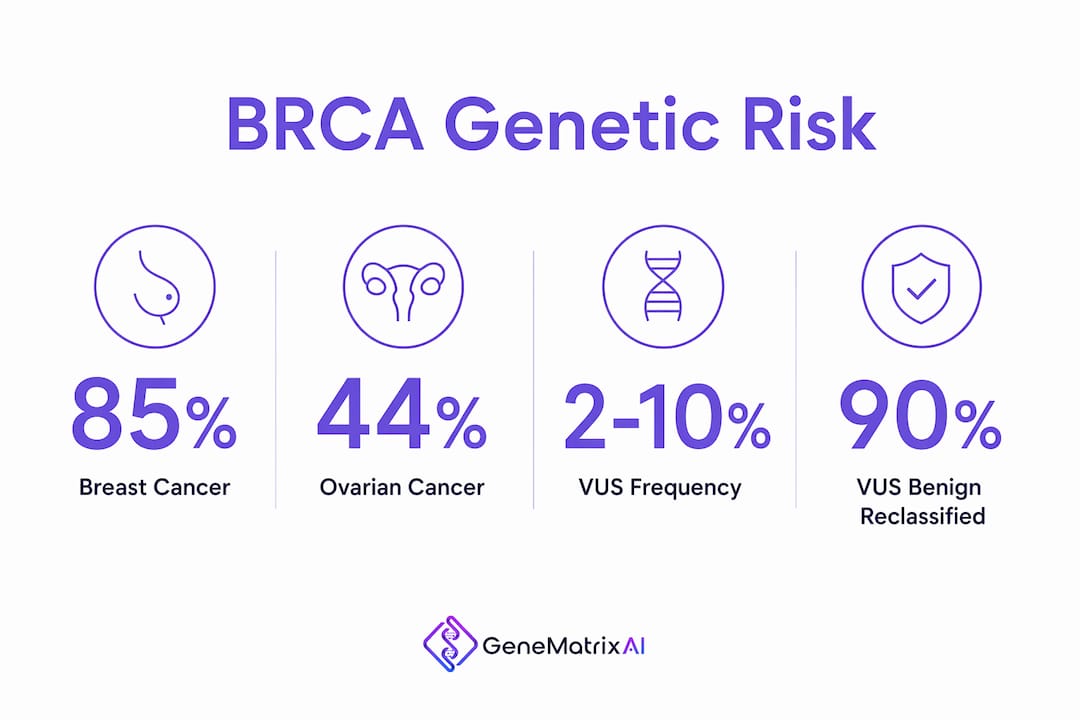
A BRCA genetic mutation is defined as a pathogenic change in the BRCA1 or BRCA2 genes that disables the body's ability to repair damaged DNA, significantly raising lifetime cancer risk. This guide to BRCA genetic risk covers who should get tested, how to read every result type, and what to do next. Individuals with a BRCA mutation face a 45%–85% lifetime risk of breast cancer and a 10%–46% risk of ovarian cancer. Compare that to the general U.S. population's 12% breast cancer risk and less than 1% ovarian cancer risk, and the stakes become clear. Understanding your BRCA mutation risk assessment is not about fear. It is about having the information you need to act early and act wisely.
What is BRCA risk and who does it affect?

BRCA1 and BRCA2 are tumor suppressor genes. In healthy cells, they produce proteins that repair broken DNA strands. When a pathogenic mutation disables one of these genes, damaged DNA accumulates, and cells can turn cancerous. The mutation is hereditary, meaning it passes from parent to child with a 50% probability per pregnancy. Both men and women can carry and transmit BRCA mutations.
The risk is not equal across both genes. BRCA1 mutations carry a higher ovarian cancer risk, while BRCA2 mutations are more strongly linked to breast cancer in men. Men with BRCA2 mutations face an 8% lifetime breast cancer risk and up to a 50% prostate cancer risk, with NCCN guidelines recommending prostate screening starting at age 40. That figure surprises most people, because BRCA risk is often discussed as a women's health issue exclusively.
For a deeper look at how specific mutation types affect risk levels, the resource on BRCA gene mutation types breaks down the clinical distinctions clearly.
Who should consider BRCA genetic testing?
Testing is not recommended for everyone. Clinical guidelines identify specific personal and family history factors that make BRCA testing medically appropriate. Knowing these criteria helps you have a more productive conversation with your doctor.
2026 clinical guidelines recommend BRCA testing for individuals who meet any of the following criteria:
- Diagnosed with breast cancer before age 50
- Diagnosed with triple-negative breast cancer at any age
- Diagnosed with male breast cancer
- Of Ashkenazi Jewish ancestry with a personal or close family cancer diagnosis
- Have two or more close relatives with breast, ovarian, or related cancers
- Have a first-degree relative with a known BRCA mutation
Family history on both the maternal and paternal sides counts. BRCA mutations are autosomal dominant, so a father's family history carries the same weight as a mother's. Many people overlook the paternal side entirely, which leads to missed diagnoses.
Pro Tip: Before your appointment, write out a three-generation family health history covering both sides. Include cancer type, age at diagnosis, and any known genetic test results. This single document can change your doctor's testing recommendation.
Consulting a physician or certified genetic counselor before testing is the right first step. Self-ordered consumer tests exist, but they screen for only a small subset of known BRCA variants and can produce false reassurance.
How does BRCA genetic testing work?
The testing process is straightforward. Understanding each step removes the uncertainty that keeps many people from moving forward.
- Sample collection. A blood draw or saliva sample is collected at a clinic or sent via a home collection kit. Both methods provide sufficient DNA for full gene sequencing.
- Laboratory sequencing. The lab uses next-generation sequencing (NGS) to read the full BRCA1 and BRCA2 gene sequences. NGS detects point mutations, insertions, deletions, and large rearrangements.
- Variant analysis. Each identified variant is compared against clinical databases such as ClinVar and population studies to determine its significance.
- Report generation. Results are classified and returned to the ordering provider, typically within two to four weeks.
- Genetic counseling review. A certified genetic counselor or physician reviews the results with you and explains what they mean for your health plan.
Understanding your result type
Three result categories are possible, and each carries different implications.
| Result Type | What It Means | Recommended Action |
|---|---|---|
| Positive (pathogenic) | A disease-causing mutation is confirmed | Begin enhanced surveillance and discuss risk-reduction options |
| True negative | No mutation found; family mutation is known and absent | Return to general population screening guidelines |
| Uninformative negative | No mutation found; family mutation is unknown | Continue enhanced screening if family history is strong |
| Variant of Uncertain Significance (VUS) | A change found but clinical impact is unclear | Monitor; do not make surgical decisions based on this result |
VUS results occur in 2%–10% of tests. Approximately 90% of VUS findings are eventually reclassified as benign within 2–5 years. That reclassification rate matters because some patients receive a VUS result and consider preventive surgery prematurely.
Pro Tip: Ask your lab or provider to enroll you in a VUS tracking registry. When a VUS is reclassified, you will receive an updated interpretation automatically rather than waiting years to find out.
For a full breakdown of how to read each result category, the genetic test results guide covers the clinical nuances in plain language.
What do BRCA test results mean for your cancer risk?
A positive BRCA result is a risk indicator, not a cancer diagnosis. Risk-reducing interventions can decrease cancer risk by up to 90% when implemented appropriately. That number reframes the entire conversation: a positive result opens the door to highly effective prevention.
Surveillance recommendations for BRCA mutation carriers
Current clinical standards advise BRCA mutation carriers to begin intensive surveillance at age 25 with annual breast MRIs, adding mammograms at age 30. This schedule detects tumors at earlier, more treatable stages than standard population screening. Ovarian cancer surveillance typically includes transvaginal ultrasound and CA-125 blood tests every six months, though these tools have limitations and are not a substitute for surgical risk reduction in high-risk individuals.
Risk-reduction options
Carriers have several evidence-based options beyond surveillance:
- Chemoprevention. Medications such as tamoxifen and raloxifene reduce breast cancer risk in high-risk individuals. These are prescription decisions made with an oncologist.
- Prophylactic surgery. Risk-reducing mastectomy and salpingo-oophorectomy (removal of fallopian tubes and ovaries) are the most effective interventions for carriers who choose them. Timing and extent are highly personal decisions.
- Lifestyle factors. Limiting alcohol, maintaining a healthy weight, and avoiding hormone replacement therapy after menopause each reduce risk modestly but meaningfully.
Negative results require context
A negative BRCA result does not guarantee zero cancer risk. A true negative result, where a known family mutation is confirmed absent, returns your risk to general population levels. An uninformative negative result, where no mutation is found but the family mutation is unknown, leaves residual risk unresolved. Negative BRCA test results require careful interpretation because strong family history may still indicate an unidentified hereditary syndrome.
How to build a personalized BRCA risk management plan
A test result alone does not constitute a plan. Translating BRCA findings into a personalized prevention and screening strategy requires collaboration with the right professionals.
Certified genetic counselors are trained to interpret BRCA results within the full context of your personal and family history, ancestry, and other risk factors. Genetic counseling costs an average of $250–$350 per session and is frequently covered by insurance when ordered by a physician. The counselor's role is not just explanation. They help you prioritize next steps, coordinate referrals, and update your plan as new evidence emerges.
If your BRCA result is negative but your family history remains concerning, expanded panel testing is the logical next step. Multigene panel tests screen for additional hereditary cancer genes including PALB2, CHEK2, and ATM, which are associated with elevated breast and ovarian cancer risks that a BRCA-only test would miss entirely. These panels are increasingly standard in comprehensive hereditary cancer risk assessment.
Communicating your results with blood relatives is one of the most impactful things you can do after testing. First-degree relatives of a BRCA mutation carrier have a 50% probability of carrying the same mutation. Cascade testing, where relatives test sequentially based on a known family mutation, is far more efficient and cost-effective than independent testing.
Practical steps for building your plan include:
- Schedule a post-result appointment with a certified genetic counselor
- Share results with first-degree relatives and encourage cascade testing
- Establish a surveillance calendar with your gynecologist and breast specialist
- Ask your provider about expanded panel testing if BRCA results are negative but family history is significant
- Connect with support organizations such as FORCE (Facing Our Risk of Cancer Empowered) for peer resources
Pro Tip: Keep a digital copy of your full genetic test report, not just the summary. Future providers, new guidelines, and VUS reclassifications all depend on having the complete raw data available.
For individuals navigating the emotional weight of hereditary cancer risk, genetic counseling resources can also provide psychological support alongside clinical guidance.
Key Takeaways
BRCA mutation carriers face dramatically elevated cancer risks, but early testing, accurate result interpretation, and personalized management plans reduce that risk substantially.
| Point | Details |
|---|---|
| Know your baseline risk | BRCA mutation carriers face up to 85% lifetime breast cancer risk versus 12% in the general population. |
| Test criteria matter | Clinical guidelines target testing at specific triggers: early cancer, triple-negative diagnosis, male breast cancer, or Ashkenazi Jewish ancestry. |
| Results have three types | Positive, negative, and VUS each require different follow-up actions; a negative result is not always reassuring. |
| Surveillance starts early | BRCA carriers should begin annual MRI at age 25 and add mammograms at age 30 per 2026 guidelines. |
| Expand testing if needed | A negative BRCA result with strong family history warrants multigene panel testing for PALB2, CHEK2, and ATM. |
Why I think most people misread their BRCA results
Most people walk out of a BRCA result appointment focused entirely on the positive or negative label. That binary framing misses the point. I have seen individuals with a true negative result stop all enhanced screening because they assumed they were "in the clear," only to face a cancer diagnosis years later tied to a different hereditary gene. The result is one data point, not a verdict.
The other misconception I encounter constantly is that a positive result means cancer is inevitable. It does not. The 45%–85% risk range is wide for a reason. Penetrance varies by mutation location, family history, lifestyle, and other genetic modifiers. Two people with the same BRCA1 mutation can have meaningfully different risk profiles. That is exactly why personalized interpretation matters more than the label itself.
The emotional weight of hereditary cancer risk is real, and I do not minimize it. But the patients who manage that weight best are the ones who treat their result as the beginning of a conversation, not the end of one. They ask hard questions, they bring family members into the process, and they revisit their plan as guidelines evolve. Knowledge without action is just anxiety. Knowledge with a plan is power.
— Tarek
Genematrix and hereditary cancer risk assessment
Genematrix is a Chicago-based, CLIA-certified biotechnology company built specifically for hereditary cancer risk assessment. Their GeneCancer testing module covers BRCA1, BRCA2, and a broad panel of additional hereditary cancer genes, with AI-driven analysis trained on 500,000+ genetic profiles delivering reports within 72 hours.

The GeneMatrixAI platform supports ongoing health management by tracking your genetic risk profile, flagging guideline updates, and connecting your results to your care team. For individuals ready to move from uncertainty to a clear, evidence-based plan, hereditary cancer genetic testing through Genematrix is available nationwide and worldwide. Their laboratory certifications and scientific methodology are publicly documented for anyone who wants to verify the standards behind their results.
FAQ
What is BRCA genetic risk?
BRCA genetic risk refers to the elevated lifetime probability of developing breast, ovarian, or related cancers caused by a pathogenic mutation in the BRCA1 or BRCA2 genes. Carriers face up to 85% lifetime breast cancer risk compared to 12% in the general population.
How do I know if I should get BRCA testing?
Clinical guidelines recommend testing if you were diagnosed with breast cancer before age 50, have triple-negative breast cancer, are of Ashkenazi Jewish ancestry with a cancer history, or have multiple affected relatives. A physician or genetic counselor can confirm whether you meet testing criteria.
What does a negative BRCA test result actually mean?
A negative result is either a true negative, meaning a known family mutation is absent, or an uninformative negative, meaning no mutation was found but the family mutation is unknown. An uninformative negative does not rule out hereditary risk and may warrant expanded panel testing.
What should I do with a VUS result?
A variant of uncertain significance should not drive any surgical decisions. Approximately 90% of VUS findings are reclassified as benign within 2–5 years, so the correct response is to monitor for reclassification updates and continue standard surveillance.
Can men be affected by BRCA mutations?
Men can carry and transmit BRCA mutations. Male BRCA2 carriers face an 8% lifetime breast cancer risk and up to 50% prostate cancer risk, with NCCN guidelines recommending prostate screening starting at age 40.