

TL;DR:
- Genetic test results are classified into five categories, guiding different clinical actions.
- Interpreting results requires structured lab processes and professional counseling for accurate understanding.
- Ongoing communication with specialists is essential as variants can be reclassified over time.
Receiving your genetic test results can stop you cold. A string of abbreviations, classifications, and clinical language sits in front of you, and suddenly the decision to get tested feels both urgent and confusing. Whether you tested for hereditary cancer risk, medication compatibility, or personalized wellness, those results carry real weight for the choices ahead. This guide breaks down exactly what each result category means, how labs arrive at those conclusions, and what you should do next. You will leave with a clear framework for turning raw genomic data into confident, evidence-based health decisions.
Table of Contents
- What your genetic test is really telling you
- How genetic test results are interpreted: Step by step
- Interpreting results: From cancer risk to medication response
- Special scenarios: Uncertain findings, updates, and common challenges
- A smarter approach to your genetic results: What most miss
- Get guidance and next steps with expert support
- Frequently asked questions
Key Takeaways
| Point | Details |
|---|---|
| Result categories matter | Knowing if your result is pathogenic, benign, or uncertain shapes next steps. |
| Expert guidance is crucial | Certified counselors provide the context and clarity raw data can’t. |
| Results can change | VUS and other findings may be updated as science advances. |
| Take evidence-based action | Act only on variants with strong clinical support to avoid unnecessary treatment. |
| Personal context counts | Always consider your unique health history and consult with professionals. |
What your genetic test is really telling you
Genetic test results are not simply positive or negative. Labs report findings in five standardized classifications, and knowing the difference between them changes everything about how you respond.
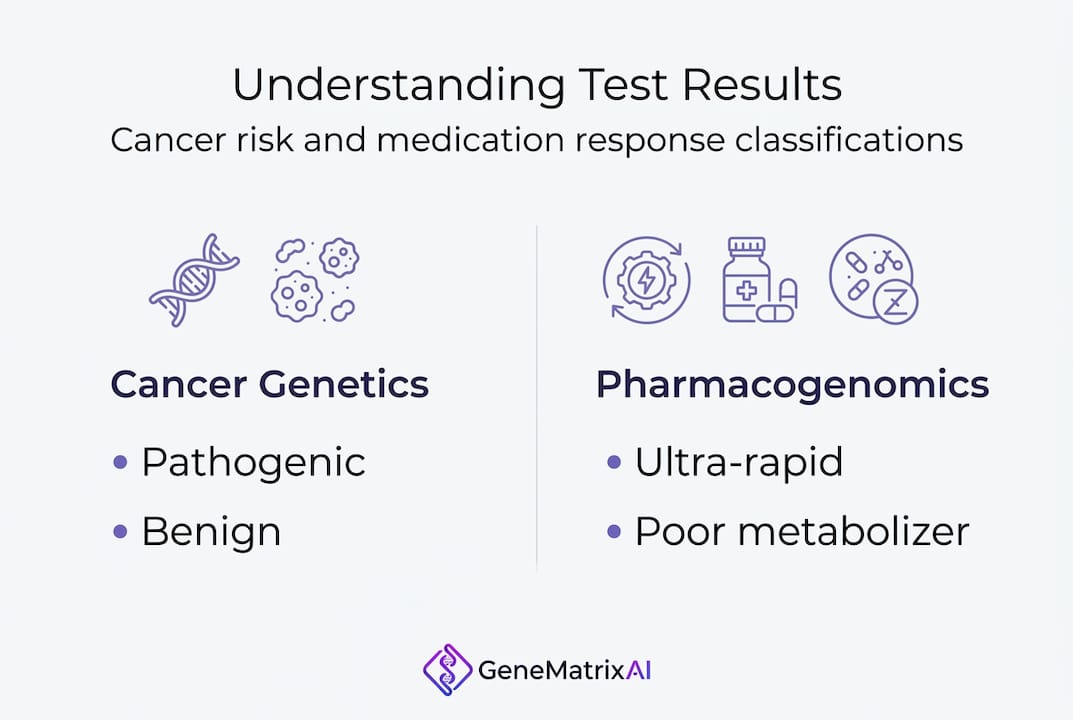
Genetic test results for cancer risk are classified as pathogenic, likely pathogenic, benign, likely benign, or variant of uncertain significance, commonly called VUS. Each category carries a different level of clinical confidence and triggers a different recommended action. Interpretation follows ACMG/AMP guidelines with five classifications designed to standardize how labs communicate findings worldwide.
Here is how each classification breaks down in practice:
| Classification | What it means | Typical next step |
|---|---|---|
| Pathogenic | Gene change is known to cause disease | Immediate specialist referral, risk management |
| Likely pathogenic | Strong evidence of disease causation | Treat similarly to pathogenic, discuss with counselor |
| VUS | Effect on health is unknown | Monitor; no immediate clinical action recommended |
| Likely benign | Probably harmless, little evidence of risk | Routine care, no special action |
| Benign | Confirmed not disease-causing | No clinical action needed |
What matters most to your immediate health decisions:
- Pathogenic or likely pathogenic: You carry a gene change with strong or definitive evidence of increased disease risk. Action is warranted.
- VUS: This is not a diagnosis. It means science does not yet have enough data to classify this variant. Treat it as benign until reclassified.
- Benign or likely benign: These findings do not increase your risk. They are often reported simply for transparency.
One statistic catches many people off guard: up to 1 in 5 results from multi-gene panel tests are VUS findings. That is a significant portion of people walking away with an inconclusive answer. Understanding genetic risk assessment basics helps you put that uncertainty into proper context rather than assuming the worst.
For pharmacogenomics, classifications work a bit differently. Instead of disease risk, the result tells you how efficiently your body metabolizes a specific drug, ranging from poor metabolizer to ultrarapid metabolizer. The same five-step classification logic applies, but the clinical implications point toward medication adjustments rather than cancer screening.
How genetic test results are interpreted: Step by step
Understanding the result labels is the first step. The next is knowing how those labels come to be.
Clinical labs do not guess. They follow a structured process to turn your raw DNA sequence into a clinically meaningful report. Here is how that process works:
- Sample collection: Your saliva, blood, or tissue is collected and sent to a CLIA-certified laboratory.
- DNA sequencing: High-throughput sequencing reads your genetic code, identifying every nucleotide across the target genes.
- Variant identification: The lab flags positions in your DNA that differ from a reference genome. These are called variants.
- Evidence review: Each variant is evaluated against population data, computational predictions, and functional studies to determine its clinical significance.
- Clinical reporting: The lab assigns a classification, writes your report, and flags variants that require specialist review.
"The strength of this system lies in its consistency. When labs follow ACMG/AMP evidence frameworks, your results mean the same thing whether they are generated in Chicago or Boston."
Specialists matter at every stage. Certified genetic counselors are trained to contextualize results for your personal and family history, something a report alone cannot do. If your results include a pathogenic or likely pathogenic finding, a genetic counselor will help you understand penetrance, which is the likelihood that the gene change will actually lead to disease in your lifetime.

Before your appointment, review genetic counseling tips and prepare for DNA testing so you arrive with the right questions ready.
Pro Tip: A negative result does not mean zero risk. It means no pathogenic variant was found in the genes tested. If your family history is strong, your specialist may recommend additional testing or clinical screening regardless.
Interpreting results: From cancer risk to medication response
With a sense of the lab process, let us see how real results drive medical decisions, especially for cancer and drug response.
Hereditary cancer results and pharmacogenomic results serve two different clinical purposes. They look similar on paper but lead to very different action plans.
For cancer risk, NCCN guidelines recommend pre- and post-test counseling, multi-gene panels, and risk management actions like enhanced screening or preventive surgery in high-risk cases. A BRCA1 pathogenic variant, for example, significantly raises lifetime breast and ovarian cancer risk and triggers an intensive surveillance protocol.
For pharmacogenomics, CPIC guidelines map genotypes to phenotypes and specific medication recommendations. If you are a poor metabolizer of a common antidepressant, your prescriber may switch you to a drug your body processes more efficiently, avoiding side effects before they start. Review CPIC allele function tables to understand how genotype-to-phenotype mapping applies to specific drug classes.
| Result type | Clinical area | Recommended action |
|---|---|---|
| Pathogenic (cancer gene) | Hereditary cancer risk | Enhanced screening, surgical options, family testing |
| Likely pathogenic (cancer gene) | Hereditary cancer risk | Counseling, consider surveillance upgrades |
| Poor metabolizer (PGx) | Medication response | Dose adjustment or alternative drug |
| Ultrarapid metabolizer (PGx) | Medication response | Higher dose may be needed or different drug |
| VUS (any area) | Unclear | Monitor; no immediate clinical action |
Key situations where further action or monitoring is advised:
- You carry a pathogenic or likely pathogenic variant in a cancer gene like BRCA1, BRCA2, or Lynch syndrome genes
- A PGx result shows extreme metabolizer status for a medication you currently take
- A family member has a known pathogenic variant and you have not yet been tested
- Your VUS is in a gene associated with a condition relevant to your personal or family history
Read gene panel health insights for a deeper look at how multi-gene panels inform clinical decisions. The genetic screening practical guide and genetic testing for prevention are also useful companions.
Genetic counselors play a central role here. Consulting specialists to inform screening, treatment, and family recommendations is the standard of care, not an optional add-on.
Pro Tip: Only act on actionable variants backed by high clinical evidence. Rushing to surgery or stopping a medication based on a VUS or low-confidence finding does more harm than good.
Special scenarios: Uncertain findings, updates, and common challenges
Even with clear reports, complex or ambiguous findings can arise. Here are the tricky cases and how to approach them.
A VUS is probably the most emotionally challenging result to receive. It is not a diagnosis, but it is not a clean bill of health either. Multi-gene panels increase VUS rates, and reports may update over time as labs collect more data from people with similar variants. The right move is to document the finding, share it with your healthcare team, and schedule periodic check-ins.
"Results do not always stay the same. Labs gather new evidence constantly, and a VUS classified today can become pathogenic or benign within a few years. Staying connected to your provider keeps you protected."
Other challenging scenarios include:
- Secondary findings: These are variants found in genes unrelated to your original test purpose. Secondary findings occur in roughly 0.57% of cancer panels and can reveal risks you were not expecting, like a cardiovascular or neurological predisposition.
- Mosaicism: Some variants are present in only a subset of your cells, making them harder to detect and interpret reliably.
- VUS reclassification: A variant initially classified as uncertain may be upgraded to pathogenic or downgraded to benign as science advances. This is why labs communicate updates and why staying engaged with your provider matters.
- Emotional impact: Learning about a potential hereditary risk, especially one that could affect your children, is not just a clinical event. It is a personal one. Give yourself room to process it and seek family genetic counseling as needed.
The key rule for uncertain or complex findings is simple: do not act alone. Bring the report to a specialist, ask about reclassification timelines, and make sure your lab knows how to reach you when an update occurs.
A smarter approach to your genetic results: What most miss
Here is the part most articles skip. People tend to treat genetic results as binary: positive means crisis, negative means safety. Neither framing is accurate, and both lead to poor decisions.
A pathogenic result does not guarantee disease. Penetrance, meaning how often a variant actually leads to clinical illness, varies widely by gene and individual context. A BRCA2 variant, for example, carries lifetime cancer risk that is elevated but not certain. Panic-driven decisions without specialist input can lead to unnecessary interventions.
On the flip side, a negative result does not erase risk. Family history, lifestyle, environment, and genes not yet covered by current panels all contribute to your overall picture. The science is moving fast, and today's negative panel result may look different in five years.
The real advantage comes from treating your results as one input in a larger, evolving conversation with qualified professionals. Read precision medicine for families for a look at how that longer-term view shapes better decisions over time.
Pro Tip: Write down your specific questions before your genetic counseling appointment. Memory under stress is unreliable, and the session moves fast. A written list keeps you focused and ensures nothing important gets skipped.
Get guidance and next steps with expert support
If you want to make confident choices with your genetic results, the right resources make all the difference.
At Gene Matrix, we built our platform specifically for moments like this one. Our CLIA-certified lab and GeneMatrixAI platform process results with AI trained on over 500,000 genetic profiles, then deliver actionable reports within 72 hours. Every report is designed to be clinically meaningful, not just data-dense.

Whether you are navigating hereditary cancer risk, medication optimization, or a confusing VUS finding, our team supports evidence-guided interpretation from start to finish. Explore our hereditary cancer testing options or review the science behind our approach at genetic testing research. You deserve clarity, not confusion, and that is exactly what expert-reviewed genomic insights deliver.
Frequently asked questions
What does a 'variant of uncertain significance' mean for me?
A VUS means the effect on your health is currently unclear. Treat it as negative for now, but stay connected with your provider because reclassification is possible as new evidence accumulates.
Should I change my medical care based on a positive genetic test?
Discuss any positive result with your healthcare provider before making changes. Penetrance varies widely, meaning a pathogenic finding does not automatically require drastic intervention, though increased screening or family testing may be advised.
Can my results change over time?
Yes. VUS findings can be reclassified as labs gather more scientific evidence, so maintaining ongoing communication with your healthcare team ensures you receive updates that could affect your care.
Who can help me understand complex or stressful results?
Certified genetic counselors are your best resource. Pre- and post-test counseling from trained specialists covers both the clinical interpretation and the emotional dimensions of receiving significant findings.
What's the difference between pharmacogenomic and cancer genetic results?
Cancer results reflect inherited disease risk, while PGx results predict how your body processes specific medications. CPIC guidelines map genotype to medication recommendations, making PGx results directly actionable for prescribing decisions.