

TL;DR:
- Not all DNA testing franchises provide clinical-grade hereditary cancer risk assessments; many focus on wellness and ancestry testing.
- Evaluating a franchise's clinical infrastructure, regulatory compliance, counseling pathways, and lab accreditation is essential for patient safety and legal protection.
Not every DNA test is created equal, and nowhere is that gap more consequential than in hereditary cancer risk assessment. While the consumer genomics market has exploded with ancestry kits and trait reports, a completely different category of genetic testing operates under strict clinical oversight, regulatory requirements, and counseling obligations. For health-conscious investors and individuals exploring franchise opportunities in this space, understanding that divide is not just good business sense. It could directly shape patient outcomes and your long-term liability.
Table of Contents
- Understanding the genetic testing franchise landscape
- Comparing franchise models: DNA-only vs comprehensive lab testing
- What makes hereditary cancer genetic testing different?
- Key considerations when evaluating a franchise opportunity
- Why franchise due diligence in genetic testing matters more than ever
- Interested in franchise-ready hereditary cancer genetic testing?
- Frequently asked questions
Key Takeaways
| Point | Details |
|---|---|
| Not all franchises are equal | Many franchises offer DNA testing, but only a few specialize in hereditary cancer risk assessment with robust clinical standards. |
| Clinical oversight is critical | The best opportunities ensure clinical interpretation, regulatory compliance, and post-test counseling for meaningful results. |
| Evidence-driven evaluation is essential | Always check technical documentation and empirical performance data over marketing claims when considering a franchise investment. |
| Operational benchmarks count | Key success factors include lab accreditation, turnaround time, reporting quality, and staff training—not just cost or branding. |
Understanding the genetic testing franchise landscape
The phrase "genetic testing franchise" covers a surprisingly wide range of business models. At one end, you have broad lab testing franchises that offer dozens of services including drug screening, blood panels, and DNA add-ons. At the other end, you have specialized platforms built specifically around hereditary cancer risk, pharmacogenomics, and clinical-grade genomic reporting.
Franchise models for genetic testing vary significantly in what they actually deliver to patients and providers. A franchise that primarily handles workplace drug testing and adds a consumer DNA option is fundamentally different from one built around BRCA1/BRCA2 screening, Lynch syndrome panels, and AI-driven variant interpretation. The clinical infrastructure, staff training, regulatory clearances, and reporting workflows are entirely different categories of operation.
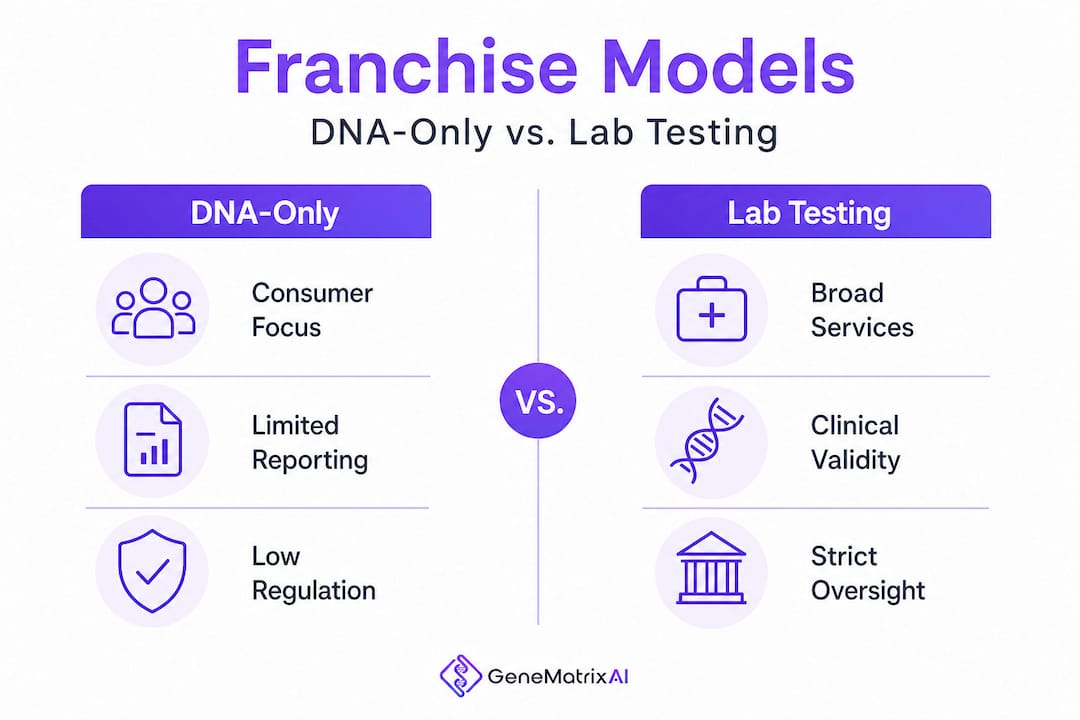
As noted in the Lab Testing Franchise Directory, many operators offer genetic-testing related franchise opportunities, but most are broader lab testing concepts that include DNA as one item on a long service menu rather than specialized hereditary cancer risk platforms.
Here is how the landscape breaks down:
- Broad lab testing franchises: Offer a wide menu of tests including blood work, drug panels, and consumer DNA. Revenue comes from volume and variety, not clinical depth.
- Consumer DNA add-on models: Primarily ancestry or trait-based testing sold directly to consumers with no clinical oversight or counseling requirement.
- Specialized hereditary cancer platforms: Designed around clinical workflows, accredited lab partnerships, genetic counseling integration, and actionable medical reporting.
- Hybrid precision medicine models: Combine hereditary cancer screening with pharmacogenomics and wellness genomics under one clinical umbrella.
"The difference between a consumer DNA franchise and a hereditary cancer risk platform is not cosmetic. It is the difference between entertainment and medicine."
Understanding where a franchise sits in this spectrum determines its clinical value, its regulatory obligations, and ultimately its relevance to the leading DNA testing companies that serve health systems and physicians.
Comparing franchise models: DNA-only vs comprehensive lab testing
With that context established, comparing actual franchise propositions reveals real-world differences in investment, scope, and clinical suitability. Not all franchises are designed for health-conscious clients seeking medically actionable results.
| Feature | Consumer DNA franchise | Broad lab testing franchise | Clinical hereditary cancer platform |
|---|---|---|---|
| Core service | Ancestry, traits, wellness | Blood panels, drug tests, DNA | Hereditary cancer, PGx, clinical genomics |
| Regulatory status | Direct-to-consumer | Varies by test type | CLIA-certified, physician-ordered |
| Counseling included | No | Rarely | Yes, centralized or integrated |
| Turnaround time | Days to weeks | 24-72 hours typical | 72 hours with AI-driven reporting |
| Clinical actionability | Low | Moderate | High |
| Target client | General consumer | Employers, individuals | Physicians, health systems, patients |
| Investment range | Lower entry cost | Moderate | Moderate to higher, with clinical infrastructure |
ARCpoint Labs, for example, is marketed as a lab testing franchise that includes DNA testing and preventive wellness screening as part of its broader service menu. That model works for volume-driven lab services, but it does not provide the clinical depth that hereditary cancer risk assessment requires.
How do you evaluate whether a franchise's service menu aligns with genuine clinical value? Follow these steps:
- Review the test menu in detail. Does it include BRCA1/BRCA2, Lynch syndrome, or multi-gene hereditary cancer panels? Or is "genetic testing" limited to ancestry and wellness traits?
- Check the ordering model. Is testing clinician-ordered or direct-to-consumer? Clinician-ordered models carry stronger clinical validity and legal protections.
- Ask about variant handling. Does the franchise have a policy for variants of uncertain significance (VUS) and reclassification? This is a non-negotiable in clinical genomics.
- Confirm counseling pathways. Are genetic counselors available before and after testing? Counseling is not optional in hereditary cancer risk workflows.
- Verify lab accreditation. Is the underlying lab CLIA-certified? Does it have CAP accreditation? These are baseline requirements for clinical reporting.
Pro Tip: Ask any franchise you are evaluating to show you a sample clinical report. A consumer DNA report and a clinical hereditary cancer report look nothing alike. If the sample report lacks variant classification, clinical significance ratings, or physician-facing language, it is not a clinical product.
You can explore more about the evolving landscape on the genetic testing blog to stay current on what clinical-grade testing actually requires.
What makes hereditary cancer genetic testing different?
Hereditary cancer testing occupies a uniquely demanding corner of the genomics market. The technical requirements, regulatory obligations, and clinical responsibilities are categorically different from ancestry testing or basic wellness panels.
Here is what sets it apart:
- Gene panels with clinical significance: Tests like BRCA1/BRCA2 and Lynch syndrome panels analyze specific variants linked to significantly elevated cancer risk. These are not exploratory or recreational results.
- CLIA certification and CAP accreditation: Labs running hereditary cancer panels must meet federal standards for analytical accuracy and quality control that consumer DNA labs are not required to follow.
- Physician involvement: Most states require a licensed clinician to order hereditary cancer tests, review results, and coordinate follow-up care.
- Genetic counseling workflows: Pre-test counseling sets expectations and helps patients understand what a positive result means. Post-test counseling translates results into actionable medical decisions.
- Variant of uncertain significance (VUS) management: Not every variant has a clear clinical meaning. A credible platform tracks VUS classifications over time and notifies patients and providers when reclassification occurs.
| Testing type | Clinical standard | Counseling required | Regulatory oversight | VUS policy |
|---|---|---|---|---|
| Ancestry/trait DNA | None | No | Minimal | Not applicable |
| Consumer wellness DNA | Low | No | Limited | Rarely addressed |
| Hereditary cancer panel | High | Yes | CLIA/CAP required | Mandatory |
| Pharmacogenomics (PGx) | High | Recommended | CLIA required | Tracked |
Statistic callout: Studies show that BRCA1/BRCA2 carriers face a lifetime breast cancer risk of up to 72%, yet the majority of people with hereditary mutations remain unidentified without proactive screening. That is the clinical gap that properly structured hereditary cancer franchises are positioned to close.
A credible model for expanding hereditary cancer testing access involves partnering with accredited labs for wet-lab processing combined with centralized clinical geneticist interpretation, rather than treating results as retail raw DNA reports. This model protects patients and creates defensible clinical value for franchise operators.
The hereditary cancer risk services that drive real health outcomes are built on this clinical infrastructure. Without it, a franchise is selling the appearance of medical testing without the substance.
Key considerations when evaluating a franchise opportunity
Turning knowledge into action means applying a structured due diligence process before committing to any franchise in this space. The stakes are high on both sides: clinical missteps can harm patients, and operational gaps can expose franchisees to significant liability.
Operational metrics matter as much as brand recognition. Franchise models that emphasize operational training, quality processing pipelines, and turnaround timelines demonstrate a commitment to clinical performance, not just marketing. A 72-hour turnaround with AI-assisted reporting is a meaningful operational benchmark. A vague promise of "fast results" is not.
Here is a practical due diligence checklist:
- Regulatory status: Is the lab CLIA-certified? Does the franchise operate under a physician ordering model or direct-to-consumer?
- Clinical oversight: Who interprets results? Is there a board-certified clinical geneticist or pathologist reviewing reports?
- Counseling inclusion: Is genetic counseling built into the workflow, or is it an optional add-on that most patients skip?
- Variant handling: Does the franchise have a documented VUS policy? How are reclassifications communicated?
- Staff training: What clinical training do franchise staff receive? Are they equipped to explain results at a basic level and route patients appropriately?
- Throughput and turnaround: What is the guaranteed turnaround time? How does the franchise handle high-volume periods?
- Referral pathways: Does the franchise have established relationships with oncologists, genetic counselors, and health systems for follow-up care?
"Verify regulatory status, ordering model, interpretation and counseling workflow, and how variants are handled, including VUS and reclassification policies, before signing any franchise agreement." This guidance from franchise review resources reflects what experienced operators already know.
Common pitfalls include choosing a franchise based on brand recognition alone, assuming that "DNA testing" in a service menu means clinical-grade hereditary cancer screening, and underestimating the counseling infrastructure required for compliant operations.
Pro Tip: Ask the franchisor for their VUS reclassification policy in writing. If they cannot produce one, that tells you everything you need to know about their clinical depth.
For investors interested in how DNA, nutrition, and wellness testing intersects with hereditary cancer platforms, understanding the full genomic service spectrum helps you assess whether a franchise can grow with the precision medicine market over time.
Why franchise due diligence in genetic testing matters more than ever
Here is the uncomfortable truth most franchise directories will not tell you: the genetic testing franchise market is full of opportunities that look compelling on a marketing sheet and fall apart under clinical scrutiny. The glossy pitch deck rarely mentions VUS reclassification policies, counseling compliance rates, or lab accreditation renewal timelines. Those details live in the documentation that most investors never ask to see.

The real-world genetic testing impact on patients is not captured in franchise disclosure documents. It shows up in whether a patient with a BRCA2 mutation gets appropriate surgical consultation, or whether they receive a raw report with no follow-up pathway and make decisions in an information vacuum. That gap is not a marketing problem. It is a clinical infrastructure problem.
Most public franchise lists and investment blogs treat genetic testing as a category alongside food service or retail. They compare initial investment ranges, royalty structures, and territory availability. What they rarely examine is whether the underlying clinical product is valid, whether the lab's analytic performance has been independently verified, and whether the counseling model meets the standard of care.
Empirical benchmarks like clinical performance, validated analytic validity, and downstream clinical outcomes require checking the franchise and lab's underlying technical and clinical documentation, not just marketing claims. That is the standard we hold ourselves to, and it is the standard any serious investor should apply.
The franchises that will define this market over the next decade are not the ones with the most locations or the lowest entry cost. They are the ones with the most defensible clinical infrastructure, the strongest lab partnerships, and the clearest evidence of patient outcomes. In a market where the product is a person's cancer risk profile, that is the only standard that matters.
Interested in franchise-ready hereditary cancer genetic testing?
Gene Matrix is built on exactly the clinical foundation this article describes. As a CLIA-certified, Chicago-based biotechnology company, Gene Matrix delivers AI-powered hereditary cancer screening, pharmacogenomics, and precision medicine reporting within 72 hours, backed by analysis trained on over 500,000 genetic profiles.

If you are evaluating a franchise opportunity in hereditary cancer genetic testing, Gene Matrix offers the clinical rigor, regulatory compliance, and operational infrastructure that serious partners require. Explore the Gene Matrix franchise innovation platform to understand how the technology and clinical model work together. Review the lab certifications and science that underpin every report. Then reach out to discuss what a franchise partnership with a clinically validated, precision medicine platform looks like in practice.
Frequently asked questions
Are all genetic testing franchises able to offer hereditary cancer risk assessments?
No, many only offer basic DNA or wellness labs. True hereditary cancer testing requires specialized clinical processes, CLIA-certified lab infrastructure, and proper regulatory clearance that most broad lab testing franchises do not have.
Who handles interpretation and counseling in a clinical genetic testing franchise?
Accredited clinical teams typically provide centralized oversight, reporting, and post-test guidance. A centralized model with in-house clinical geneticist interpretation and accredited wet-lab partners is the standard for credible hereditary cancer testing services.
How do franchisees know a lab is clinically valid and trustworthy?
Check underlying technical documentation for clinical performance, lab certifications, and analytic validity. Empirical benchmarks like validated analytic performance require reviewing the lab's actual documentation, not just the franchise marketing materials.
What operational metrics matter most in a genetic testing franchise?
Turnaround time, reporting pipelines, and staff training matter as much as brand recognition. Franchise models that prioritize operational training and quality processing pipelines over marketing alone are the ones most likely to deliver consistent clinical performance.