

TL;DR:
- Genetic testing identifies inherited and acquired DNA variants impacting health risks and drug metabolism.
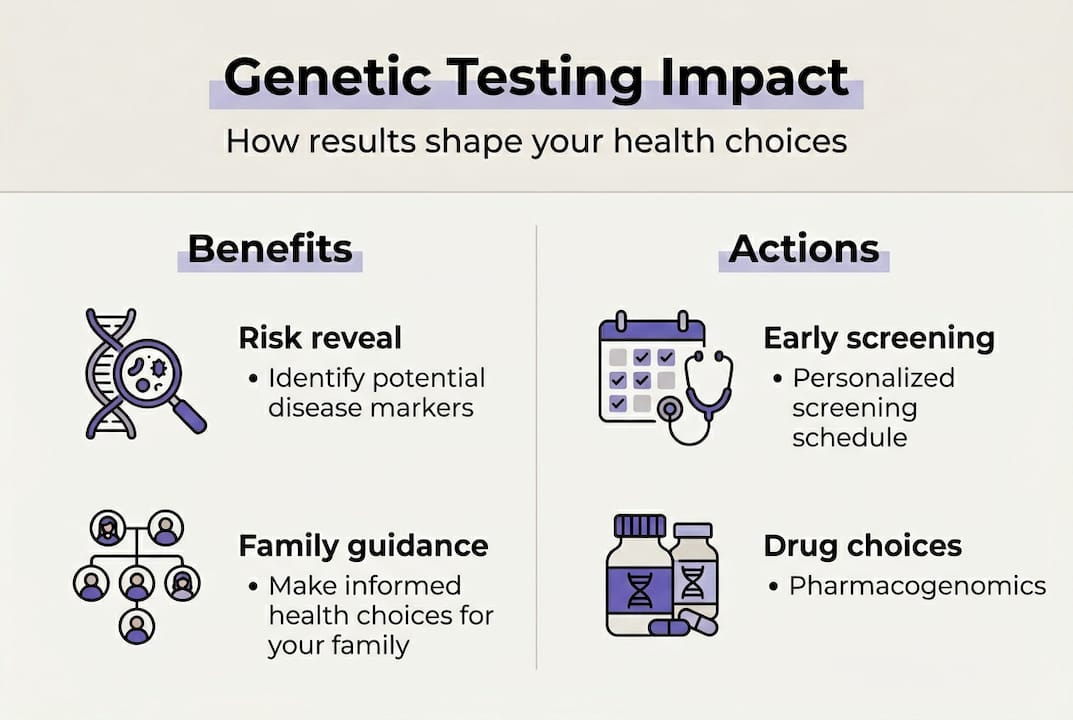
- Acting on genetic insights can improve early detection, personalized treatment, and family planning strategies.
- Limitations include uncertain variants and access barriers, emphasizing the need for professional guidance and informed interpretation.
Most people assume their health is shaped mostly by lifestyle choices. But genetics quietly influence everything from your cancer risk to how your body processes a common antidepressant. The gap between knowing your genetic blueprint and acting on it can mean the difference between catching a hereditary cancer early or facing a late-stage diagnosis. Germline and somatic testing both provide powerful, actionable insights that most standard checkups simply can't offer. This guide breaks down what genetic testing is, why it matters for your real health decisions, and how to navigate its limitations with confidence.
Table of Contents
- What is genetic testing and how does it work?
- Why genetic testing changes how you manage health risks
- Limitations, nuances, and challenges in genetic testing
- Barriers to genetic testing and how to overcome them
- A fresh perspective: What most guides don't tell you about genetic testing
- Explore evidence-based genetic testing with Gene Matrix
- Frequently asked questions
Key Takeaways
| Point | Details |
|---|---|
| Reveals hidden health risks | Genetic testing uncovers risks you can't see or feel, guiding targeted prevention and intervention. |
| Optimizes medication choices | Pharmacogenomic testing can help you avoid side effects and find the best treatments faster. |
| Requires expert guidance | Test results often need explanation from medical professionals to avoid missteps or confusion. |
| Barriers can be overcome | With the right resources and advocacy, most people can access actionable genetic testing. |
What is genetic testing and how does it work?
Genetic testing reads the instructions encoded in your DNA to identify variants that affect health. But not all testing is the same, and understanding the difference shapes how you act on results.
Germline testing analyzes inherited DNA. It uses a blood or saliva sample to examine the genes you were born with, meaning variants found apply to every cell in your body and can be passed to your children. Somatic testing, by contrast, looks at genetic changes that developed over time, usually within tumor tissue or circulating tumor DNA (ctDNA). As confirmed by research on genetic testing methods, germline testing uses inherited variants while somatic testing focuses on acquired changes specific to cancer cells.
| Feature | Germline testing | Somatic testing |
|---|---|---|
| Sample type | Blood or saliva | Tumor tissue or ctDNA |
| What it finds | Inherited variants | Acquired mutations |
| Who it affects | You and your relatives | You only |
| Example use | BRCA1/BRCA2 screening | Cancer treatment targeting |
| Passed to children | Yes | No |
Common sample types include a simple saliva swab, a blood draw, or a biopsy of tissue. At-home kits are increasingly used for germline testing, but clinical-grade tests ordered through a physician remain the gold standard for medical decision-making.
Here is what genetic testing can and cannot tell you:
- Can tell you: Your inherited risk for specific cancers, whether you carry recessive variants that could affect children, how your body metabolizes certain drugs, and ancestry-related disease patterns
- Cannot tell you: That you will definitely develop a condition, what lifestyle changes will fully offset risk, or provide certainty from a variant of uncertain significance
- Cannot replace: Clinical evaluation, imaging, biopsies, or ongoing medical follow-up
Exploring the wellness benefits from genetic testing or reviewing panel testing options can help you understand which test type aligns with your specific health goals. The right test depends on your personal history, family history, and what question you are trying to answer.
Why genetic testing changes how you manage health risks
Knowing your genetic data is one thing. Acting on it is where the real health gains happen.

Take cancer risk. If you carry a pathogenic BRCA1 or BRCA2 variant, your lifetime breast cancer risk can exceed 70%. With that knowledge, your care team can schedule earlier and more frequent screenings, recommend risk-reducing medications, or discuss preventive surgery. Without it, you follow standard screening timelines that may miss a tumor at a critical window.
Pharmacogenomics is another area where results drive immediate, practical changes. Your CYP2D6 gene, for example, controls how quickly your liver processes dozens of medications. If you are a poor metabolizer, a standard antidepressant dose may build to toxic levels. If you are an ultra-rapid metabolizer, that same dose may do nothing. Pharmacogenomic testing identifies variants that affect drug metabolism, and randomized controlled trials show 27 to 41% higher remission rates in depression when treatment is guided by these results.
| Drug category | Gene tested | Clinical impact |
|---|---|---|
| Antidepressants (SSRIs) | CYP2D6, CYP2C19 | Dosing accuracy, reduced side effects |
| Blood thinners | CYP2C9, VKORC1 | Bleeding risk reduction |
| Pain medications | CYP2D6 | Efficacy and overdose prevention |
| Statins | SLCO1B1 | Muscle toxicity risk |
Carrier screening adds another layer, especially for couples planning a family. Exome sequencing for carrier screening detects recessive risks that neither parent would know about otherwise. If both partners carry a variant for the same recessive condition, each pregnancy carries a 25% chance of an affected child.
Consider two patients with the same family history of colon cancer. One pursues genetic testing, learns they carry a Lynch syndrome variant, and starts annual colonoscopies at age 30. The other skips testing and follows standard screening guidelines beginning at 45. The first patient has a polyp caught and removed at 34. The second is diagnosed with stage III colon cancer at 47. Same family history, very different outcomes.
Pro Tip: When starting a new medication for a chronic condition, ask your provider about pharmacogenomic testing before you begin. It could save months of trial and error. Learn more about family testing tips and review how a full genetic risk assessment could change your care plan.
Limitations, nuances, and challenges in genetic testing
Genetic testing is powerful. It is not perfect. Knowing where results can mislead you is just as important as acting on them.
One of the most misunderstood concepts is the Variant of Uncertain Significance, or VUS. A VUS means a change was detected in your DNA, but researchers do not yet have enough evidence to classify it as harmful or benign. According to NCCN guidance on genetics, VUS findings are common, not always actionable, and uninformative negatives do not rule out risk. Many patients panic when they see a VUS, when in fact no clinical change may be warranted yet.
Other pitfalls to watch for:
- False reassurance: A negative result does not mean zero risk. It means no known variant was found with the panel used.
- Incomplete penetrance: Carrying a high-risk variant does not guarantee you will develop the associated condition. BRCA2, for example, does not cause cancer in every carrier.
- Ancestry bias: Most genetic databases are built from populations of European descent, which means variants common in other ancestral backgrounds may be less well characterized.
- Direct-to-consumer limitations: Consumer tests screen for a narrow set of variants and are not designed to replace clinical-grade analysis.
Results can and do get reclassified. A VUS from five years ago may now be classified as pathogenic based on new population data. This is why it is worth requesting an updated interpretation every few years, particularly if your family's medical history has changed.
"Proactive testing empowers, but must be paired with skilled counseling."
For guidance on proactive health through testing, always work with a certified genetic counselor who can contextualize your results within your full clinical picture. Resources from cancer.gov on genetic counseling also offer strong guidance on what to ask and when to seek specialist input. Your results are a starting point, not a final verdict.
Pro Tip: Before you finalize any clinical decisions based on genetic results, schedule a session with a board-certified genetic counselor. They are trained to interpret nuance that a lab report alone cannot convey.
Barriers to genetic testing and how to overcome them
Even when people understand the value of genetic testing, access remains a real problem for millions.
Studies show that only 55 to 63% of eligible patients with breast or ovarian cancer receive BRCA testing. That gap is not due to lack of scientific value. It is due to systemic and personal barriers that can be addressed when you know what you are facing.
The most common barriers, in order of frequency:
- Low awareness: Many patients and even some primary care physicians do not know when genetic testing is clinically indicated.
- Insurance coverage gaps: Coverage for genetic testing varies widely by insurer, plan type, and diagnosis status. Preauthorization can delay or block access.
- Emotional and psychological stress: Fear of what results might reveal keeps many people from pursuing testing at all.
- Provider knowledge gaps: Guidelines change. Not every physician is current on which panels are recommended for which risk profiles.
Strategies that help break through these barriers include seeking referrals to genetics clinics at academic medical centers, using patient advocacy organizations to appeal insurance denials, and asking specifically about how AI is improving access to genetic insights for underserved populations. AI-driven triage tools can now flag patients who should be referred for testing based on clinical records alone, which reduces the burden on providers to manually identify candidates.
For cost concerns, programs through pharmaceutical manufacturers, nonprofit organizations, and federally qualified health centers often provide subsidized testing for those who qualify. You do not need to navigate this alone.
A fresh perspective: What most guides don't tell you about genetic testing
Most articles treat genetic testing like a one-time event. Get the test. Read the result. Done. That framing misses most of what actually matters.
The real value of genetic testing lives in what happens after the result arrives. How you interpret it, who you share it with, and how your understanding of it evolves as science advances. A result that seemed reassuring in 2021 may carry entirely different weight in 2026, given reclassification of variants and expanding databases.
There is also a family dimension that rarely gets discussed directly. Your genetic result is not just yours. A BRCA1 finding affects your siblings, your parents, and your children. Choosing not to share that information is a decision with real downstream consequences for people who love you.
Finally, the direct-to-consumer testing industry has made genetics feel approachable, which is genuinely good. But it has also created a false equivalence between a saliva swab for ancestry and a clinically validated cancer risk panel. They are not the same. For those pursuing wellness outcomes with genomics, working within a medical framework with qualified support is not optional. It is the whole point.
Explore evidence-based genetic testing with Gene Matrix
If you are ready to move from curiosity to clinical clarity, Gene Matrix provides a structured path forward. Their CLIA-certified platform combines AI-driven genomic analysis with real clinical support, so your results are not just data points but actionable guidance.

Gene Matrix's science and technology underpins every test, from hereditary cancer screening (BRCA1/BRCA2, Lynch syndrome) to pharmacogenomics and family planning panels. Their research and development ensures your results reflect the most current evidence base. Physicians and health systems can access resources and referral pathways through the healthcare provider portal to integrate genetic insights directly into patient care. Results are delivered within 72 hours, backed by AI trained on over 500,000 genetic profiles.
Frequently asked questions
Can genetic testing really predict my future health risks?
Genetic testing reveals inherited risks and drug reaction patterns but does not guarantee you will develop any specific condition. Results guide screening schedules, preventive options, and medical decisions rather than serving as a definitive forecast.
Is pharmacogenomic testing helpful for everyday medications?
Yes. Testing for gene variants that affect drug metabolism can prevent harmful side effects and improve treatment outcomes, particularly for mental health, cardiac, and pain medications. Pharmacogenomic results directly guide dosing and drug selection in clinical practice.
Why does my test report say 'Variant of Uncertain Significance'?
A VUS is common and means current evidence is insufficient to classify the variant as harmful or benign. It may be reclassified as new data accumulates, so follow up with your provider over time.
How do I find a reputable genetic testing provider?
Prioritize labs that hold CLIA certification, offer access to certified genetic counselors, and publish information about their testing methodology and quality standards. Transparency about how AI or algorithms are used in your report is also a strong indicator of reliability.