
TL;DR:
- AI transforms DNA analysis by converting sequencing data into image formats for rapid, high-accuracy variant classification. It integrates family data, functional predictions, and clinical reasoning to provide meaningful health insights quickly with GPU acceleration. This approach makes comprehensive, interpretable genomic information accessible for personalized medical decisions.
Your genome contains roughly 3 billion base pairs, and a single sequencing run produces enough raw data to fill a small hard drive. Traditional analysis methods required weeks of computational work and teams of specialists to make sense of it. Understanding how does AI analyze DNA changes that picture entirely. Through a field called computational genomics, AI systems can now process sequencing data, identify meaningful variants, and produce clinically relevant reports in a fraction of the time, opening precision medicine to a much wider audience.
Table of Contents
- Key takeaways
- How AI processes raw DNA sequencing data
- AI model architectures for variant classification
- Advanced AI models for functional genomics
- Speed: what GPU acceleration actually changes
- From AI output to health insights you can use
- My take on what most people miss about AI and DNA
- See your genome through Genematrix AI
- FAQ
Key takeaways
| Point | Details |
|---|---|
| AI encodes DNA as images | Raw sequencing reads are converted into pileup image tensors that neural networks can classify with high accuracy. |
| CNNs drive variant detection | Convolutional neural networks identify genetic variants by learning visual patterns in encoded genomic data. |
| Speed gains are dramatic | GPU-accelerated workflows cut DNA analysis from hours to minutes, making real-time health decisions more practical. |
| Context improves accuracy | Models like DeepTrio integrate family data directly, detecting inherited mutations more reliably than single-sample approaches. |
| AI connects to clinical action | The most useful AI systems pair variant predictions with guideline-aligned reasoning to produce health reports you can act on. |
How AI processes raw DNA sequencing data
Before any machine learning model sees your genetic information, the raw sequencing output needs significant preparation. This step is where most of the technical work happens, and getting it right determines everything downstream.
Modern DNA sequencing produces millions of short "reads," each representing a tiny fragment of your genome. The first job is aligning these reads to a reference genome so the system knows where each fragment belongs. Once aligned, the pipeline scans for positions where your reads differ from the reference, flagging these as candidate variant sites worth examining.
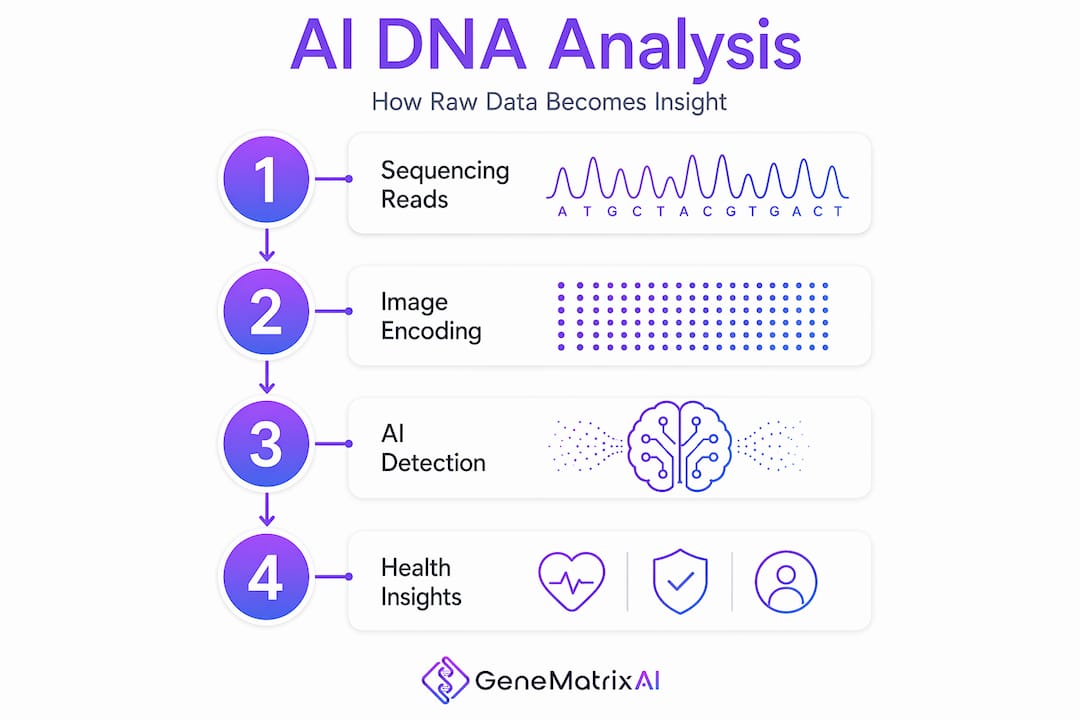
Here is where AI fundamentally departs from traditional methods. Rather than applying statistical rules to those candidates, tools like Google's DeepVariant convert genomic evidence into multi-channel pileup image tensors. Think of it as taking a photograph of every suspicious position in your genome, where each pixel encodes read depth, base quality, strand direction, and mapping confidence simultaneously. The component responsible for this step, called "make_examples`, produces structured image data that a convolutional neural network can process the same way it would recognize objects in a photo.
Key inputs captured during this encoding stage include:
- Base calls: The actual nucleotide letters read at each position
- Base quality scores: Confidence values from the sequencer for each base call
- Mapping quality: How uniquely a read maps to that genomic region
- Strand orientation: Whether the read came from the forward or reverse strand
- Allele frequency: The proportion of reads supporting each variant allele
Pro Tip: When evaluating any AI-powered genetic test, ask whether the platform uses image-based or probabilistic variant calling. Image-based approaches trained on large ground-truth datasets tend to generalize better across different sequencing technologies.
AI model architectures for variant classification
Once the pileup images are ready, the neural network takes over. This is where the actual "intelligence" in AI DNA analysis lives, and the architecture choices matter enormously.
DeepVariant uses a modified InceptionV3 convolutional backbone, a neural network design originally built for image recognition tasks. The model was retrained on genomic pileup images rather than photographs, but the core principle is identical. It learns to recognize visual patterns that correspond to real genetic variants versus sequencing artifacts.
The output of the classification step is a probability score for each of three genotype states:
- Homozygous reference (hom-ref): Both copies of your DNA at that position match the reference genome, meaning no variant is present.
- Heterozygous: One copy carries the variant and one does not, the most common pattern for inherited disease variants.
- Homozygous alternate (hom-alt): Both copies carry the variant, which can indicate higher disease risk for recessive conditions.
Beyond standard single-sample calling, specialized models handle more complex situations. DeepTrio processes family trios by stacking pileup images from a child and both parents into a single input. This lets the model detect de novo mutations by simultaneously seeing what variants are present in the child but absent in both parents, without requiring separate post-processing steps. DeepSomatic applies the same integrated logic to tumor-normal pairs, detecting somatic variants that arise in cancer cells rather than being inherited.
The training data for these models comes from high-quality truth sets curated by organizations like the Genome in a Bottle (GIAB) Consortium. Restricting training labels to "confident regions" of the genome, where variant calls are verified with high certainty, prevents the model from learning on ambiguous or incorrect examples.
Advanced AI models for functional genomics
Variant calling is only one layer of what AI can do with DNA. A deeper and increasingly important application involves predicting how your genome functions, not just cataloging what variants it contains. This is where AI applications in genomics are moving into genuinely new scientific territory.
Traditional variant callers tell you what is different in your genome. Foundation models go further, predicting what that difference means biologically. Consider this comparison:
| Approach | What it predicts | Data it uses | Best for |
|---|---|---|---|
| Variant calling (e.g., DeepVariant) | Presence or absence of sequence variants | Aligned sequencing reads | Identifying genetic mutations |
| DNA foundation models (e.g., SUCCEED) | Regulatory activity, chromatin structure, gene expression | Thousands of functional genomics tracks | Understanding variant consequences |
| Clinical interpretation AI (e.g., RareDAI) | Diagnostic recommendations | Variant data plus clinical guidelines | Translating findings to health decisions |
SUCCEED, a recently published DNA foundation model, integrates convolution and Transformer layers to predict cell-type-specific epigenomic profiles, 3D chromatin contacts, and denoised regulatory signals. It performs comparably to or better than previous models like Enformer across most functional genomics benchmarks. This matters for health and wellness because many disease-associated variants sit in regulatory regions of the genome, areas that do not code for proteins but still control which genes turn on and off in different tissues.
For a person curious about their genetic health, this means AI can now move beyond telling you that you carry a variant and start predicting whether that variant is likely to disrupt a gene's activity in, say, liver tissue versus brain tissue.

Pro Tip: The distinction between "sequence variant detected" and "variant likely to affect gene regulation" represents a significant leap in clinical utility. When reviewing genomic insights for health, look for reports that address functional consequences, not just variant lists.
Speed: what GPU acceleration actually changes
The accuracy of AI-powered DNA analysis gets most of the attention, but speed deserves equal focus. Processing a whole genome with traditional pipelines could take 24 to 48 hours on standard compute hardware. That timeline is incompatible with clinical decision-making.
GPU-accelerated workflows like NVIDIA Parabricks have fundamentally changed this equation. According to recent benchmarks, RTX PRO 4500 GPUs deliver 2x speedups in alignment and variant calling compared to previous-generation L4 GPUs, with fq2bam conversion running 2.4x faster. Full genome analysis that once required hours now completes in under 30 minutes on optimized hardware.
| Workflow step | Traditional time | GPU-accelerated time | Speedup |
|---|---|---|---|
| Read alignment (fq2bam) | 3 to 4 hours | Under 30 minutes | 2.4x |
| Variant calling | 6 to 8 hours | 1 to 2 hours | 4 to 6x |
| Full pipeline | 24 to 48 hours | Under 3 hours | 8 to 16x |
Why does this matter to you personally? Faster analysis means a health provider can run multiple analytical scenarios on your genome, testing different reference panels or reanalyzing your data as new variants of interest are discovered, without imposing a multi-week delay each time. For hereditary cancer screening in particular, where a diagnosis drives urgent clinical decisions, this speed difference is not an abstraction. It translates to faster answers when they matter most.
The benefits of AI-powered genomics extend beyond speed alone, but compute efficiency is what makes those benefits accessible at scale rather than limited to well-funded research centers.
From AI output to health insights you can use
Technical accuracy and processing speed mean little if the final report is incomprehensible. This is where the translation problem in AI genetic analysis becomes critical, and where the most patient-focused work is happening right now.
Raw variant calls are probabilities and coordinates in a reference genome. Converting those into health guidance requires an additional layer of reasoning. Systems like RareDAI demonstrate what this looks like in practice: the model applies structured clinical reasoning modeled on how a medical geneticist would evaluate findings, checking variants against published guidelines, considering phenotype context, and generating recommendations that align with standards like ACMG criteria.
For the individual user, AI-enhanced genetic analysis now delivers:
- Risk stratification: Your likelihood of developing conditions like hereditary breast cancer or Lynch syndrome, expressed in terms that support genuine decision-making rather than vague probabilities
- Drug-gene interaction alerts: Pharmacogenomics data showing which medications your genetic profile suggests you metabolize differently, with direct implications for prescribing
- Carrier status: Whether you carry one copy of a recessive disease variant that could affect your children's risk
- Nutrigenomic signals: Genetic variants that influence how your body processes nutrients, informing dietary choices with more specificity than population averages
The key word in all of this is interpretable. An AI genetic testing platform that returns only a list of detected variants with rsID numbers is not useful for most people. The ones worth using pair variant detection with guideline-aligned explanation and, where appropriate, direct access to clinical specialists who can act on the findings.
My take on what most people miss about AI and DNA
I've spent considerable time working alongside the genomics pipeline, and the thing I find most underappreciated is how much of the analytical work happens before the AI model ever runs. The hybrid pipeline design, where deterministic alignment and candidate generation feed into AI classification, is not a compromise. It's the right architecture. Trying to let a neural network handle everything from raw reads to final calls adds unnecessary error surface. The best AI systems I've seen are disciplined about what they hand off to learned models versus what they handle with proven algorithms.
The second thing people overlook is data quality at the training stage. Labeling variability in uncertain genomic regions is not a minor technical footnote. It determines whether a model learns real biology or learns to mimic noise with confidence. Any AI genomics provider that cannot explain how their training data was curated and validated deserves healthy skepticism.
Finally, I think the field is genuinely undervaluing interpretability. Predicting a variant's presence with 99% accuracy is impressive. Explaining what that variant means for a real person's health decisions, in a way they and their physician can act on, is harder and more important. The most significant progress I expect to see in the next few years will come from clinical reasoning layers built on top of variant callers, not from marginal accuracy improvements in the callers themselves.
— Tarek
See your genome through Genematrix AI
Genematrix brings together everything described in this article into a single, clinical-grade platform. The GeneMatrixAI science platform is CLIA-certified, trained on over 500,000 genetic profiles, and delivers reports within 72 hours covering hereditary cancer risk, pharmacogenomics, and personalized wellness.

Whether you are evaluating your BRCA1/BRCA2 status, exploring drug-gene interactions through GenePGx, or looking for nutrigenomic guidance through GeneDiet, Genematrix translates raw genomic data into reports that are genuinely useful for health decisions. The GeneMatrix mobile app puts those insights in your pocket, making it easy to share findings with your care team and track your genetic health profile over time. If you are ready to move from curiosity about your DNA to real answers, Genematrix is where to start.
FAQ
How does AI analyze DNA differently from traditional methods?
Traditional methods use statistical rules and probability models to identify variants from sequencing reads. AI systems like DeepVariant convert that same data into image-based formats and use convolutional neural networks to classify variants by learning patterns directly from verified training data, achieving higher accuracy across diverse sequencing technologies.
Can AI predict genetic diseases from a DNA sample?
AI can assess your risk for hereditary conditions based on detected variants, but "predict" requires nuance. Systems like RareDAI use guideline-aligned reasoning to translate variant findings into clinically grounded risk assessments rather than deterministic disease predictions, which is both more accurate and more useful for real health decisions.
What is a pileup image tensor in DNA analysis?
A pileup image tensor is a multi-channel visual representation of sequencing reads at a specific genomic position. Each channel encodes a different property of the reads, such as base quality or strand direction, allowing a convolutional neural network to classify the site as a variant or reference call.
How fast is AI-powered DNA analysis compared to older pipelines?
GPU-accelerated AI workflows can reduce full genome analysis from 24 to 48 hours down to under 3 hours. NVIDIA Parabricks benchmarks show specific steps like read alignment running 2.4x faster on current-generation GPUs compared to the previous generation.
What should I look for in an AI genetic testing report?
Look for reports that go beyond a raw list of variants and provide clinically contextualized risk information, guideline alignment such as ACMG criteria, and pharmacogenomic interpretation. A useful report also tells you how to interpret your genetic results in terms of next steps with your healthcare provider.