

TL;DR:
- Most mental health DNA tests focus on pharmacogenomics, revealing how your body metabolizes medications rather than diagnosing conditions. These tests primarily analyze CYP2D6 and CYP2C19 genes, which influence drug dosing, with clinical interpretation necessary alongside comprehensive medical context. Provider-ordered panels with clinician support offer more accurate, actionable insights than consumer tests, especially for treatment-resistant cases.
Most people who order a mental health dna test expect to get a diagnosis. They want to know if their anxiety is "in their genes" or whether depression is written into their DNA. The reality is more nuanced and, frankly, more useful. These tests are primarily pharmacogenomic tools, meaning they tell you how your body processes psychiatric medications rather than whether you have a mental illness. Understanding that distinction before you test changes everything about how you read your results and what you do with them.
Table of Contents
- Key takeaways
- What a mental health DNA test actually measures
- How the testing process works
- Real-world clinical utility
- Consumer tests vs. provider-ordered testing
- Who should consider testing and how to prepare
- My take on where this technology actually stands
- Explore personalized genetic insights with Genematrix
- FAQ
Key takeaways
| Point | Details |
|---|---|
| Not a diagnostic tool | A mental health DNA test reveals medication metabolism patterns, not mental illness diagnoses. |
| CYP genes matter most | CYP2D6 and CYP2C19 have the strongest clinical evidence for guiding psychiatric drug dosing. |
| Clinician context is critical | Genetic results only become useful when interpreted alongside your full clinical picture and current medications. |
| Consumer tests have limits | Direct-to-consumer kits lack the clinical follow-up needed to translate results into treatment decisions. |
| Phenoconversion complicates results | Other drugs you take can override your genetic profile, making DNA alone an incomplete picture. |
What a mental health DNA test actually measures
The phrase "DNA test for mental health" covers two very different things, and most people conflate them. The first is genetic association testing, which looks at variants linked to risk of conditions like depression or schizophrenia. The second, and far more clinically developed, is pharmacogenomic testing, which examines how your genes affect your body's ability to metabolize psychiatric medications. Most tests marketed for mental health are doing the second thing.
The genes with the most clinical weight are CYP2D6 and CYP2C19. These are metabolizing enzymes in your liver, and CYP2D6 and CYP2C19 have robust, clinically actionable links for psychotropic medication metabolism and dosing. If your version of CYP2D6 is overactive, you may burn through antidepressants like fluoxetine faster than standard doses account for. If it's underactive, those same drugs can accumulate and cause toxic side effects.
Here is where things get technically important:
- Pharmacokinetic (PK) genes like CYP2D6 and CYP2C19 control how quickly your body absorbs, distributes, and eliminates a drug. These have the most established clinical dosing guidelines.
- Pharmacodynamic (PD) genes affect how your brain responds to a drug at the receptor level. Think of genes related to serotonin transport (SLC6A4) or dopamine receptors. The evidence here is weaker and more contested.
- Many commercial panels include dozens of genes beyond these core ones. The clinical utility of extensive gene panels should be interpreted cautiously since high-confidence drug interactions are limited to a narrow gene set.
Mental health conditions themselves are polygenic, meaning they involve hundreds of variants with small effects. No single gene causes depression. No combination of genes tested today gives you a reliable diagnosis. That distinction matters enormously.
Pro Tip: When reviewing any genetic panel, ask your clinician specifically which genes have CPIC (Clinical Pharmacogenomics Implementation Consortium) guidelines attached to them. Those are the markers with real clinical weight.
How the testing process works
One reason people hesitate around genetic testing for mental health is unfamiliarity with the process itself. It is far less complicated than most expect.
- Sample collection. Most tests use a cheek swab or saliva sample. A cheek swab or saliva sample is standard for mental health genetic testing. Some clinical settings use blood, but it offers no meaningful advantage for pharmacogenomic panels.
- Lab processing. Your sample goes to a CLIA-certified lab, where technicians analyze your DNA at specific gene locations. CLIA certification means the lab meets federal standards for accuracy and reliability.
- Results delivery. Results are typically returned within one to two weeks, though some platforms now deliver within 72 hours using AI-assisted analysis. Your clinician receives a report detailing your metabolizer status for each relevant gene.
- Clinician interpretation. This step is non-negotiable. Genetic results focus on medication selection and titration rather than diagnosing a disorder, which means a trained clinician must translate the genetic findings into actual prescribing decisions.
- Ongoing monitoring. Your metabolizer status is fixed. But your clinical picture changes. Follow-up conversations with your provider integrate the genetic baseline with current symptoms, drug interactions, and treatment response.
The metabolizer categories you will see in most reports are: poor metabolizer, intermediate metabolizer, normal (extensive) metabolizer, and ultrarapid metabolizer. Each category carries specific dosing implications depending on the drug.
A critical nuance that most patient-facing resources skip: your genetic metabolizer status can be altered by the other drugs you take. This is called phenoconversion. Other medications can cause phenoconversion, modifying the genotype-to-phenotype interpretation. For example, if you are a normal CYP2D6 metabolizer but also taking a strong CYP2D6 inhibitor like bupropion, you may functionally behave as a poor metabolizer. Your DNA has not changed. Your effective drug metabolism has.
Pro Tip: Before your results appointment, bring a complete list of every medication and supplement you take. Phenoconversion is real, and your clinician needs that information to interpret your genetic report accurately.
Real-world clinical utility
Genetic testing for mental health has moved from research curiosity to genuine clinical tool in several major health systems. The clearest example of this in practice is pharmacogenomic alert systems integrated directly into electronic health records.

UCSF employs an advanced pharmacogenetic testing program that delivered over 19,000 automated alerts to clinicians at the point of prescribing in a single year. These alerts flag potential gene-drug mismatches before a prescription is written, not after a patient has already experienced an adverse reaction. That kind of proactive infrastructure represents exactly how genetic data should function in clinical care.
The practical benefits of this approach include:
- Reduction in trial-and-error prescribing, which is the norm in psychiatry today
- Lower rates of medication side effects in patients identified as poor or ultrarapid metabolizers
- Meaningful cost savings related to genetic testing implementation, based on studies of approximately 500 patients
- Faster identification of patients unlikely to respond to first-line agents
That said, the limitations are real and the FDA has been explicit about them. FDA issued a safety communication warning against sole reliance on genetic tests without clinical evaluation, particularly noting that many genes on commercial panels lack established links to antidepressant effectiveness. The warning from 2018 has not been rescinded and remains relevant as panels continue to expand.
Realizing the full benefits of pharmacogenomics in psychiatry also requires substantial health system infrastructure, clinician education, and clinical decision support tools. It works well when it is embedded in a functioning clinical workflow. It works poorly when results are handed to a patient without any interpretive support.
| Scenario | Likely benefit from genetic testing | Key limitation |
|---|---|---|
| Treatment-resistant depression | High. Identifies poor CYP2D6 metabolism affecting drug levels | Does not address non-pharmacological factors |
| First psychiatric medication | Moderate. Reduces trial-and-error prescribing | Many genes on panels lack strong evidence |
| Side effects on current medication | High. May explain adverse reaction via metabolizer status | Phenoconversion must be ruled out clinically |
| General mental wellness curiosity | Low. Tests do not diagnose or predict mental illness | Polygenic complexity limits predictive accuracy |
Consumer tests vs. provider-ordered testing
The market for DNA mental health assessments now includes both direct-to-consumer kits and clinician-ordered pharmacogenomic panels. They are not the same product.
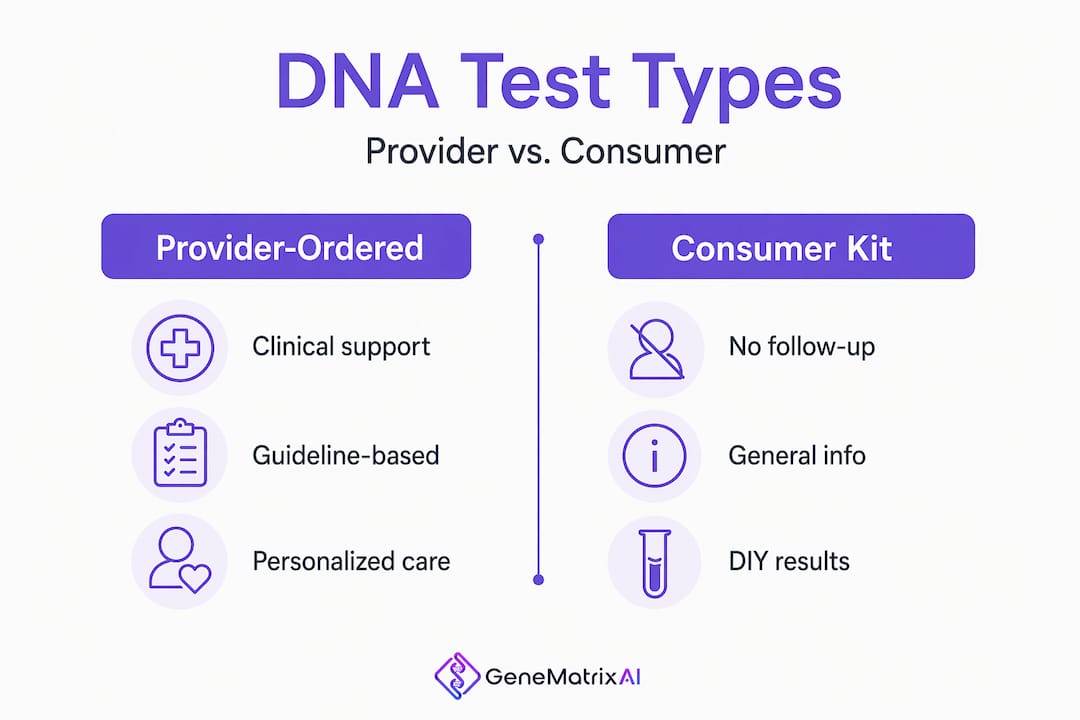
Direct-to-consumer tests lack the clinical follow-up and interpretation present in healthcare provider-ordered tests, and this difference directly impacts how useful and accurately you can understand your results. Consumer tests tend to report genetic trait associations, framed as likelihoods. They might tell you that you carry a variant associated with higher anxiety sensitivity. What they typically do not tell you is what medication would work better for you because of it, because that requires both clinical-grade pharmacogenomic analysis and a licensed clinician to interpret the output.
Provider-ordered tests, by contrast, emphasize pharmacogenomic markers with established dosing guidelines. They come with clinical interpretation built in. The report is designed to inform a prescribing decision, not satisfy curiosity. If you are managing a mental health condition and considering genetic testing, a clinician-supervised pharmacogenomic panel will almost always yield more clinically relevant guidance than a consumer kit.
The risk of misinterpretation without clinical context is not theoretical. Patients who learn they have a variant associated with serotonin transport sometimes conclude they are "resistant" to SSRIs and stop medications without consulting their doctor. That is a dangerous outcome from a misread result.
Who should consider testing and how to prepare
Not everyone needs a mental health DNA test right now. The people who stand to gain the most are those already navigating specific challenges in treatment.
You are a strong candidate for testing if you:
- Have tried two or more psychiatric medications without adequate response or with intolerable side effects
- Are starting a new psychiatric medication and want to avoid predictable adverse reactions
- Are being managed for a complex condition requiring multiple psychiatric drugs simultaneously
- Want to prevent adverse drug reactions proactively before starting treatment
If you decide to move forward, here is how to make the most of the process. Start by raising it with your psychiatrist or prescribing clinician rather than ordering independently. A clinician-ordered test means results feed directly into your treatment plan. Bring your full medication list to every related appointment, including over-the-counter drugs and supplements, for the phenoconversion reason discussed above.
When your results arrive, resist the urge to interpret them alone. Metabolizer categories are meaningless without knowing which drug, at which dose, in which clinical context. The report is a tool for your clinician to use with you, not a verdict to act on independently.
Pro Tip: Ask your clinician whether their practice has integrated pharmacogenomic results into the EHR or whether they will need to review the PDF report manually. Understanding their workflow helps you know what follow-up to expect and when.
My take on where this technology actually stands
I have watched pharmacogenomic testing move from a niche research concept to something psychiatrists are genuinely using to make better prescribing decisions. And I think it is one of the most underutilized tools in mental health care today. But I also have to be honest about the gap between what the technology promises and what it delivers.
In my experience, the patients who benefit most are not the ones who tested out of curiosity. They are the ones who came to testing after years of medication failures, who had a clinician willing to engage with the results, and who understood from the start that genetics was one data point among many. The test did not solve their problem. It gave their doctor better information to work with.
The misconception I encounter most often is that a poor metabolizer result explains everything. It does not. It explains one part of how your body handles one category of drug. Clinical factors like organ function, concurrent medications, and psychological context still drive the treatment plan. Genetics informs it.
What I am genuinely optimistic about is the trajectory. The integration of automated pharmacogenetic alerts into prescribing workflows is the right direction. When genetic data meets clinical judgment at the moment a prescription is written, outcomes improve. That is not a hypothesis. Broad adoption requires infrastructure, education, and policy support. But the clinical case is already made.
— Tarek
Explore personalized genetic insights with Genematrix
If you are ready to move beyond guesswork in your psychiatric care, Genematrix offers the kind of rigorous, clinically grounded genetic testing that makes a real difference. Their GeneMind psychiatric testing module is built on AI-driven analysis trained on over 500,000 genetic profiles, processed in a CLIA-certified lab, and designed to deliver results your clinician can actually use.

Genematrix's GeneMatrixAI platform integrates pharmacogenomic results into a format that supports prescribing decisions, not just patient curiosity. Results are available within 72 hours, and the GeneMatrix mobile app gives you ongoing access to your genomic insights in one place. Whether you are exploring genetic predisposition to mental illness or trying to optimize your current medication regimen, Genematrix brings the science and the clinical infrastructure together to make that process meaningful.
FAQ
What does a mental health DNA test actually test for?
A mental health DNA test primarily analyzes pharmacogenomic markers, particularly CYP2D6 and CYP2C19, which determine how your body metabolizes psychiatric medications. It does not diagnose mental health conditions.
Can DNA predict whether I will develop depression or anxiety?
No. Mental health conditions are polygenic, meaning they involve hundreds of genetic variants each with small effects. Current testing shows associations and likelihoods, not diagnostic certainty.
What is a metabolizer status and why does it matter?
Your metabolizer status, which can be poor, intermediate, normal, or ultrarapid, tells your clinician how fast your body processes a specific drug. This directly influences which medication and dose is appropriate for you.
Does phenoconversion affect my genetic test results?
Your DNA does not change, but other medications you take can functionally alter your metabolizer status through phenoconversion. Always share your full medication list with your clinician when interpreting pharmacogenomic results.
Is a direct-to-consumer mental health genetic test worth it?
Consumer tests provide genetic associations without clinical follow-up, which limits their practical utility for medication decisions. A provider-ordered pharmacogenomic panel offers more clinically relevant and actionable results for those managing psychiatric treatment.