

Nutrigenomics tests in the U.S. typically run from about $100 for a basic mail-in kit to over $2,000 for a full clinical panel with a registered dietitian consult, with most consumer options clustering around $200 to $600. Standard health insurance rarely covers this category, and advertised kit prices often exclude consultation and interpretation fees, which can add to the total cost. The breakdown below shows exactly where your money goes.
TL;DR:
- Costs for nutrigenomics tests in the U.S. range from approximately $100 for basic kits to over $2,000 for comprehensive panels with professional consultation.
- The price difference mainly depends on gene panel size, sequencing method, professional review, and lab accreditation, with higher tiers offering more extensive testing and expert guidance.
- Most consumer kits include the sample collection, results report, and educational material, but extras like live consultations, follow-up testing, and ongoing updates often incur additional fees.
- Insurance unlikely to reimburse these tests, but HSA and FSA funds may cover costs if purchased through a clinician, emphasizing the importance of clear payment structures.
- The value of a nutrigenomics test hinges on how you plan to use the results, with professional interpretation often justifying higher prices for actionable, safe dietary recommendations.
Table of Contents
- Nutrigenomics Test Cost: Typical Price Bands in the U.S.
- What's Actually Included in the Kit Price?
- Does Insurance or an HSA/FSA Cover the Cost?
- Is a Nutrigenomics Test Worth the Price?
- How Long Does It Take to Get Results?
- Why Clinical-Grade Providers Justify a Higher Price
- Comparing Costs Across Nutrigenomics Providers
- Hidden Costs That Can Inflate Your Total Bill
- The Real Question Isn't Price. It's What You're Paying For.
- Get Clinical-Grade Nutrigenomics Without the Guesswork on Pricing
- Where This Information Comes From
- Sources
Nutrigenomics Test Cost: Typical Price Bands in the U.S.
Advertised prices can underestimate what you'll actually pay once interpretation and consultation fees are included. Understanding the three rough tiers helps you compare apples to apples instead of getting surprised at checkout.
Entry-level kits ($100 to $250) usually cover a narrow set of gene markers tied to specific traits like caffeine metabolism or lactose tolerance. You get a digital report and sometimes a brief video explainer, but rarely a live consult. Mid-tier tests ($250 to $600) expand the gene panel and often bundle a short consultation. This is where most consumers land. Premium clinical panels ($600 to $2,000+) add a comprehensive gene panel, a full consultation with a registered dietitian or genetic counselor, and sometimes ongoing coaching.
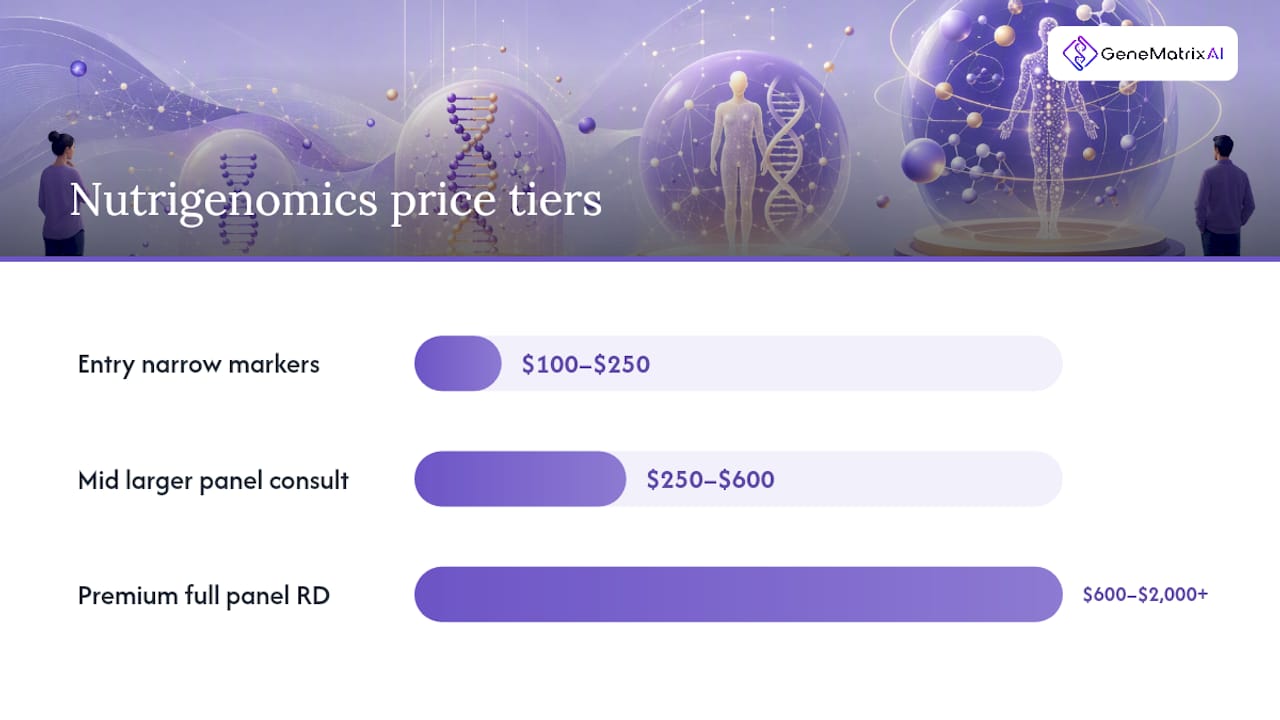
Real-world examples back this up. Public pricing guides show nutrigenomics tests ranging from roughly $100 to over $2,000 depending on scope, while many consumer DNA health tests fall between $200 and $400 before add-ons. One clinic-packaged 70-gene test lists prices from $249 to $479 when bundled with a consult, climbing higher for specialized panels sold separately.
What actually drives the price difference between these tiers:
- Gene panel size: a 10-marker kit costs far less to sequence and report than a 70-plus gene panel.
- Sequencing method: targeted SNP arrays are cheaper than whole-exome or clinical-grade confirmatory sequencing.
- Clinical reporting: a report reviewed and signed off by a dietitian or genetic counselor adds professional labor cost.
- Lab accreditation: CLIA-certified labs carry compliance overhead that basic consumer labs may skip.
What's Actually Included in the Kit Price?
The number on the landing page rarely tells the whole story. Some kits are genuinely all-inclusive; others are a loss-leader that gets you in the door before the real costs show up.
Typical inclusions across most nutrigenomics products:
- The collection kit itself (cheek swab or saliva tube)
- Prepaid return shipping in most cases
- A digital or printed results report
- Basic educational material explaining what the markers mean
Common extras that get billed separately:
- A live consultation with a registered dietitian or clinician
- In-depth interpretation beyond the standard report
- Confirmatory or follow-up genetic testing
- Ongoing subscription access to updated recommendations as the science evolves
Clinics like Cleveland Clinic's integrative nutrition program routinely split the kit fee from the professional consultation charge, treating them as two distinct line items rather than one bundled price. Some consumer products fold a short consult into the kit price; others sell the kit and consultation as entirely separate purchases. Neither model is wrong, but you need to know which one you're buying before you check out.
Pro Tip: Before you buy, email or call the provider and ask for a full itemized price list, including consult fees and any required follow-up testing. A company that hesitates to answer is telling you something about how the rest of the relationship will go.
Does Insurance or an HSA/FSA Cover the Cost?
Standard health insurance almost never pays for nutrigenomics testing. Insurers classify it as a wellness or lifestyle service rather than a medically necessary diagnostic, the same category Cleveland Clinic places it in when billing for its own nutrition programs.
HSA and FSA funds are a different story. These accounts can sometimes cover genetic testing, but usually only when the test is ordered through a clinician pathway with proper documentation, not a pure over-the-counter purchase. That distinction matters when you're deciding which provider to use.
A few ways to bring the out-of-pocket number down:
- Ask providers about seasonal promotions or bundle discounts on multi-test panels.
- Check if your employer's wellness benefit stipend covers genetic testing.
- Ask clinics about payment plans that spread the cost over several months.
- Confirm HSA/FSA eligibility before purchase rather than trying to get reimbursed after the fact.
Is a Nutrigenomics Test Worth the Price?
Value here depends entirely on what you plan to do with the results. A $150 kit that tells you nothing you'll act on is a worse deal than a $500 test that changes how you eat for the next decade.
Run through this checklist before buying:
- Do you have a family or personal history that makes nutrition-related genetic risk relevant (metabolic conditions, cholesterol issues, weight management struggles)?
- Will you actually change behavior based on the results, or is this curiosity shopping?
- Do you need clinician interpretation to translate raw data into a safe plan, or are you comfortable reading a self-service report?
- Do you want a research-grade panel covering dozens of genes, or is a narrow, cheaper test enough for your question?
Without a clinician's involvement, raw genetic reports often lack the context needed to turn a data point into a safe, personalized recommendation. A published overview of nutrigenomics decision criteria points to the same three factors: medical relevance, planned behavior change, and access to interpretation. High-value use cases include someone managing a lipid disorder with dietary levers; low-value cases include buying a kit purely because it was on sale.
How Long Does It Take to Get Results?
Standard consumer kits typically return results in two to six weeks, largely driven by mail transit time and batch lab processing. Clinical lab workflows tied to a physician or dietitian often move faster, sometimes within days to two weeks, because samples get prioritized outside the consumer batch queue.
Rapid-turnaround options exist too. Some clinically oriented providers now offer analysis pipelines that return results in as little as 72 hours, though expedited or clinician-prioritized processing typically carries a premium over standard timelines. Once results arrive, budget time (and possibly an extra fee) for scheduling the consultation that actually makes the report useful.
Why Clinical-Grade Providers Justify a Higher Price
A higher price tag isn't automatically a red flag. It often reflects real infrastructure and expertise you're paying to access, not markup for its own sake.
Genematrix's model illustrates what that looks like in practice:
- CLIA-certified lab processing, the federal quality standard for clinical testing, detailed on the company's science and lab certifications page.
- GeneMatrixAI-driven analysis built to return actionable insights in roughly 72 hours rather than weeks.
- GeneDiet, a dedicated nutrigenomics module rather than a bolt-on feature of a broader ancestry product.
- Clinician-validated reports, so results come reviewed rather than as raw, uninterpreted data.
Separating the kit fee from the consultation fee, as Genematrix does, mirrors the practice most reputable clinics already follow. It's a more honest structure than a single low headline price that hides the real cost of getting a usable answer.
Comparing Costs Across Nutrigenomics Providers
Pricing across the category varies more by what's bundled than by any dramatic quality gap in the DNA sequencing itself. A basic mail-in test with no consult will almost always undercut a service that includes a dietitian, and that gap can run into the hundreds of dollars.
Broadly, three pricing philosophies show up across the market. Some providers sell a low-cost kit and monetize through an ongoing subscription for updated recommendations, which can push total spend well past the sticker price over a year. Others sell a one-time bundled package, higher upfront but with no recurring charge. A third group, typically clinics and clinically oriented labs, prices the test and the consultation as separate, transparent line items, giving you the clearest picture of what you're actually paying for.
When comparing options, don't just look at the headline number. Ask three questions: does this price include a real consult with a qualified professional, is there a recurring fee after the first purchase, and does the panel size match what you actually need? A $180 kit and a $580 kit can both be reasonable purchases. They're just answering very different questions about your genetics.
Hidden Costs That Can Inflate Your Total Bill
The advertised price is rarely the final price. A few categories of extra cost show up often enough that you should budget for them before you buy.
Shipping and collection kit fees. Most kits include prepaid return shipping, but some charge for the initial kit shipment or require you to pay for expedited return service if you want faster results.
Follow-up or confirmatory testing. If a result flags something significant, a clinician may recommend a confirmatory clinical-grade test, which carries its own separate charge.
Subscription interpretation services. Several providers keep the base report cheap but charge an ongoing fee to access updated recommendations as new research emerges. This can quietly understate the real long-term cost of what looked like a bargain purchase.

Consultation and coaching add-ons. A one-time consult may be included, but ongoing coaching sessions, follow-up calls, or plan revisions are almost always billed separately.
Panel upgrades. Some companies let you start with a small gene panel and pay incrementally to unlock additional markers later, which can end up costing more than buying the full panel upfront.
Ask for the total cost of ownership over a year, not just the day-one price, before you commit.
The Real Question Isn't Price. It's What You're Paying For.
Most cost comparisons in this category fixate on the sticker price and skip the harder question: what happens after you get your results? A $150 report that sits unread in your inbox is worthless regardless of how cheap it was. A $600 report that comes with a real conversation with a dietitian who tells you exactly what to change is a better deal even though the number is higher.
The conventional advice to "shop around for the lowest price" undersells how much clinician interpretation matters. Raw genetic data without context is just data. If you have a real medical reason to test, mentioned family history, medication concerns, a metabolic condition, prioritize access to interpretation over shaving fifty dollars off the kit price. If you're testing out of general curiosity with no plan to act on results, a basic kit is fine and spending more buys you very little.
Before buying anything, use a buyer's checklist to figure out which tier actually fits your situation, rather than defaulting to whatever ranks highest in a search result.
— Tarek
Get Clinical-Grade Nutrigenomics Without the Guesswork on Pricing
Genematrix prices nutrigenomics testing the way a good clinic does: kit and consultation as separate, clearly stated line items, not one number that hides what you're actually paying for.

The GeneDiet module runs through Genematrix's CLIA-certified lab and GeneMatrixAI pipeline, built to return results in roughly 72 hours with a clinician-validated report rather than a raw data dump. If you have a family history relevant to nutrition and metabolism, or you simply want a professional walking you through what your results mean, that clinical backing is worth the premium over a bare-bones consumer kit. If you just want a quick answer to one narrow question with no follow-up plan, a basic kit may serve you fine.
Check your HSA/FSA eligibility for genetic testing before you buy. It can cut your net cost significantly, and it takes five minutes to confirm. From there, review hereditary cancer screening and the full test lineup to see which panel matches your goals.
Where This Information Comes From
This guide draws on Cleveland Clinic's integrative nutrition pricing model, consumer test pricing data from GoodRx and MyGeneFood, and Genematrix's own genetic testing cost guide and nutrigenomics usage guide.
This article is general information, not a substitute for advice from a qualified doctor. Consult a qualified healthcare professional about your own circumstances before acting on anything here.
Sources
- Nutrition | Center for Integrative & Lifestyle Medicine | Cleveland Clinic
- How Much Should DNA Testing Cost?
- Nutritional Genomics (Nutrigenomics): What to Know