

TL;DR:
- Multiple professionals named Tarek Younis work in psychology, biotechnology, and nutrition, leading to potential confusion. Dr. Tarek Younis, a psychologist and researcher, critically examines how institutional frameworks perpetuate harm under the guise of neutrality. His work emphasizes that addressing structural racism in mental health requires systemic change, not just individual bias awareness.
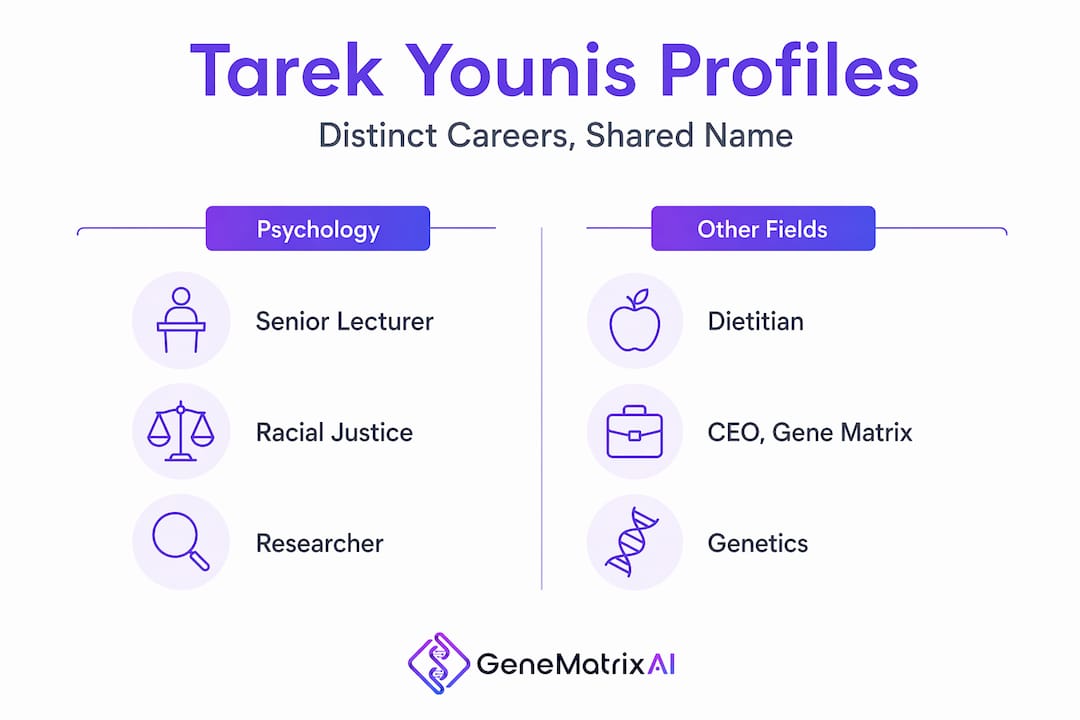
If you searched for Tarek Younis and landed here, you may already sense that something is off. The name belongs to more than one person, and depending on what you were looking for, the results can send you in completely different directions. One Tarek Younis is a psychologist and academic whose research on racism, Islamophobia, and mental health has made him one of the more challenging voices in British psychology today. Another leads a biotechnology company focused on hereditary cancer screening. Understanding which Tarek Younis you are looking for, and what each has actually contributed, is exactly what this article covers.
Table of Contents
- Key Takeaways
- Tarek Younis, Psychologist and Racial Justice Researcher
- His major research contributions and published work
- Clarifying the confusion: other professionals named Tarek Younis
- Practical implications for mental health practitioners
- My perspective on why this work is harder to ignore than it looks
- Precision medicine and genetic testing from Gene Matrix
- FAQ
Key Takeaways
| Point | Details |
|---|---|
| Multiple people share the name | At least three professionals named Tarek Younis work in psychology, dietetics, and biotechnology respectively. |
| Dr. Tarek Younis is a psychologist | He is a Senior Lecturer at Middlesex University researching Islamophobia, racism, and the politics of mental health care. |
| His research challenges clinical neutrality | His 2026 report argues that mental health spaces suppress political solidarities under the guise of neutrality. |
| A separate Tarek Younis leads Gene Matrix | The CEO of Gene Matrix AI focuses on hereditary cancer genetic testing and precision medicine. |
| Context changes everything | Knowing which field you are researching saves time and leads you to the right body of work. |
Tarek Younis, Psychologist and Racial Justice Researcher
The most cited Tarek Younis in academic and mental health circles is Dr. Tarek Younis, a Senior Lecturer at Middlesex University whose research sits at the intersection of clinical psychology, racism, and political theory. His Tarek Younis biography is not a conventional one. He did not build a career around therapy models or cognitive frameworks. He built it around a harder question: what happens to marginalized people when the institutions meant to help them are also part of the system that harms them?
His academic focus covers Islamophobia in mental health settings, the securitization of clinical spaces, and the ways that culture and politics shape psychological practice. He is also a registered psychologist who works clinically with individuals who have experienced racism, Islamophobia, and state violence. That dual identity, researcher and practitioner, gives his work a grounding that purely theoretical critiques often lack.
Key areas of his research and career include:
- Islamophobia in mental health: How anti-Muslim bias operates within clinical assessments and treatment decisions
- Securitization of psychology: The way counter-terrorism logic has entered clinical settings and reshaped how practitioners view Muslim patients
- Political psychology: How state power and political ideology influence what gets labeled as pathology versus legitimate grievance
- Marginalized communities: Clinical work with individuals whose distress is directly tied to racism and state violence
Pro Tip: If you are reading Dr. Younis's work for the first time, start with his shorter essays before moving to the full reports. His writing is dense with political theory, and the essays give you the conceptual scaffolding you need.
His Tarek Younis career trajectory reflects a deliberate choice to stay in the uncomfortable space where psychology meets politics. That choice has made him polarizing in some clinical circles and essential reading in others.
His major research contributions and published work
The centerpiece of Dr. Younis's recent output is a report published in February 2026 titled The Violence of Liberal Racism: What Palestine Reveals About British Mental Health Care, produced in collaboration with Healing Justice Ldn. The title alone signals what the report does. It does not soften its argument.
The report makes several interconnected claims that have generated significant discussion among mental health practitioners and researchers:
- British mental health institutions present themselves as neutral and apolitical, but that neutrality is itself a political position that protects dominant power structures.
- The logic of counter-terrorism has quietly entered clinical spaces, shaping how Muslim patients are perceived and treated in ways that most practitioners do not consciously recognize.
- The response to Palestine among health professionals revealed how clinical spaces suppress solidarity, forcing practitioners to self-censor political views or risk professional consequences.
- Liberal racism, as Dr. Younis defines it, is the kind that operates through inclusion and tolerance rhetoric while maintaining the same structural exclusions.
"Mental health care is inherently political, and clinical spaces enforce disciplinary measures that erase political solidarities." — from The Violence of Liberal Racism, Healing Justice Ldn, 2026
This framing is deliberately provocative. Dr. Younis is not arguing that individual therapists are racist. He is arguing that the institutions they work within carry political logics that reproduce harm even when practitioners have good intentions. That distinction matters enormously for how his work should be read and applied.
| Research Theme | Core Argument | Implication for Practice |
|---|---|---|
| Liberal racism | Inclusive rhetoric can mask structural oppression | Practitioners must examine institutional frameworks, not just personal bias |
| Counter-terrorism logic | Security frameworks have entered clinical assessments | Muslim patients may be assessed through a threat lens rather than a care lens |
| Clinical neutrality | Neutrality claims silence political expression | Suppressing solidarity is itself a form of harm |
| Palestine as case study | The professional response to Palestine exposed these dynamics clearly | Real-world events test whether anti-racist commitments are genuine |
His earlier work, published through SAGE and other academic outlets, covers securitisation and culture's impact on psychology with the same critical lens. The Tarek Younis accomplishments that matter most to his field are not awards or appointments. They are the frameworks he has built for understanding how power operates in clinical settings.
Clarifying the confusion: other professionals named Tarek Younis
Searching for Tarek Younis without context will surface at least three distinct individuals. Each operates in a completely different field, and mixing them up leads to real confusion about who said what and who does what.
Here is a direct comparison:
| Name | Field | Primary Role | Key Contribution |
|---|---|---|---|
| Dr. Tarek Younis | Psychology | Senior Lecturer, Middlesex University | Research on racism, Islamophobia, and mental health |
| Tarek Younis (Dietitian Younis) | Nutrition and dietetics | Registered dietitian | Nutrition plans and transformation programs for over 1,000 clients |
| Tarek Younis (Gene Matrix) | Biotechnology | CEO of Gene Matrix AI | Hereditary cancer genetic testing and precision medicine |
The dietitian operates under the brand Dietitian Younis and offers services including customized nutrition plans and multi-month transformation programs. The work is entirely separate from psychology or genetics.
The Gene Matrix CEO, also named Tarek Younis, leads a Chicago-based CLIA-certified company focused on AI-powered genetic testing for hereditary cancers and pharmacogenomics. His work sits in biotechnology and precision medicine, not psychology or nutrition.
A few things worth knowing when you are searching for the right Tarek Younis:
- Search terms like "Tarek Younis psychology" or "Tarek Younis Middlesex" will narrow results to the psychologist
- "Tarek Younis Gene Matrix" or "Tarek Younis genetics" will surface the biotechnology CEO
- "Dietitian Younis" is the clearest path to the nutrition professional
The Tarek Younis profile you find depends entirely on the context you bring to the search. This is not unusual for common names, but it matters here because the fields are so different that a misattribution could genuinely mislead someone looking for clinical research versus dietary advice versus genetic testing.
Practical implications for mental health practitioners
Dr. Tarek Younis's research does not stay in the abstract. It has direct implications for how mental health practitioners think about their work, their institutions, and their patients. His argument that anti-racist clinical care requires structural engagement rather than surface-level inclusivity is one that many practitioners find uncomfortable precisely because it asks them to examine systems they operate within, not just their own attitudes.

The self-censorship dynamic he identifies is particularly concrete. When a Muslim patient discusses political events as part of their distress, and a clinician feels pressure to redirect toward individualized coping strategies rather than acknowledging structural causes, that is not neutral care. It is a form of erasure. Dr. Younis's research names this pattern and traces it back to the counter-terrorism frameworks that have shaped institutional policy in British healthcare.
Practical implications for clinicians and health systems include:
- Audit intake processes for language or screening criteria that reflect securitization logic rather than care-centered frameworks
- Examine supervision culture for whether political expression by practitioners or patients is treated as unprofessional or destabilizing
- Distinguish between distress and pathology when working with patients whose suffering is rooted in racism, displacement, or state violence
- Engage with structural causes of mental health disparities rather than defaulting to individual-level explanations
Pro Tip: Dr. Younis's work pairs well with scholarship on racial trauma and liberation psychology. Reading him alongside practitioners like Resmaa Menakem or the work coming out of community psychology gives you a fuller picture of how structural racism operates in clinical settings.
The Tarek Younis influence on mental health discourse is growing precisely because his critiques are specific and documented rather than general. He is not arguing that racism is bad. He is showing exactly how it operates inside institutions that claim to be fighting it.
My perspective on why this work is harder to ignore than it looks
I have spent time with Dr. Younis's research, and the thing that strikes me most is not the conclusions. It is the mechanism. Most critiques of racism in healthcare focus on individual bias, implicit or explicit. What Dr. Younis does is locate the problem in the institutional logic itself, in the frameworks that shape what questions get asked, what distress gets legitimized, and what solidarities get suppressed.
That is a harder target to address. You cannot fix it with a diversity training or a revised intake form. It requires practitioners to ask whether the frameworks they were trained in are themselves part of the problem. That question is genuinely uncomfortable, and I think the discomfort is exactly why his work gets dismissed in some quarters and embraced urgently in others.
What I find most credible about his approach is the clinical grounding. He is not writing from outside the system. He works with patients whose experiences confirm the patterns his research describes. That combination of critical anti-racist psychology and direct clinical practice is rare, and it gives his arguments a weight that purely theoretical critiques do not carry.
The Tarek Younis news cycle around his 2026 report shows that the field is paying attention. Whether institutions respond with genuine structural change or with the kind of liberal inclusion that his research critiques is the open question.
— Tarek
Precision medicine and genetic testing from Gene Matrix

While Dr. Tarek Younis works at the intersection of psychology and racial justice, a separate Tarek Younis is advancing a different kind of healthcare transformation. As CEO of Gene Matrix, he leads a company that makes hereditary cancer testing accessible to individuals, physicians, and health systems nationwide and worldwide. Gene Matrix uses an AI platform trained on over 500,000 genetic profiles to deliver reports within 72 hours, covering BRCA1/BRCA2, Lynch syndrome, pharmacogenomics, and more. If you are exploring genetic health options, DNA testing plans start at $69/month and include specialized modules for cancer risk, medication optimization, and pediatric genetics. The mission is the same as what drives the best work in any health field: move from reactive treatment to proactive understanding. You can start with a health intake assessment to find the right testing path for your needs.
FAQ
Who is Dr. Tarek Younis?
Dr. Tarek Younis is a Senior Lecturer at Middlesex University and a registered psychologist who researches Islamophobia, racism in mental health, and the political dimensions of clinical psychology. He also works clinically with individuals who have experienced state violence and racism.
What is The Violence of Liberal Racism about?
Published in February 2026 with Healing Justice Ldn, the report argues that British mental health institutions suppress political solidarities under claims of neutrality, and that counter-terrorism logic has entered clinical spaces in ways that harm Muslim patients.
Is there more than one person named Tarek Younis?
Yes. At least three professionals share the name: a psychologist and academic, a registered dietitian, and the CEO of Gene Matrix AI, a biotechnology company focused on hereditary cancer genetic testing.
What does Tarek Younis (Gene Matrix) do?
The Tarek Younis who leads Gene Matrix AI oversees AI-powered hereditary cancer screening and pharmacogenomics services from Chicago. The company offers DNA testing subscription plans and serves hospitals, physicians, and health systems.
How does Dr. Tarek Younis's work affect clinical practice?
His research asks practitioners to examine how counter-terrorism frameworks and institutional neutrality claims can silence marginalized patients and suppress legitimate political expression in clinical settings, pointing toward structural rather than individual solutions.