

TL;DR:
- Early hereditary cancer screening can prevent deaths if paired with confirmatory diagnostics and timely care. AI-powered tools like GeneMatrixAI improve variant interpretation speed and triage but require complete pathways before scaling. Building an effective program involves careful pathway design, validated technology, and continuous monitoring for meaningful outcomes.
Early detection focused on hereditary risk can prevent cancer deaths and enable curative treatment — but only when backed by confirmatory diagnostics, timely care, and validated AI-powered tools like GeneMatrixAI. The National Cancer Institute is clear: screening programs must demonstrate that mortality benefits outweigh harms, including false positives and overdiagnosis. The World Health Organization adds that without diagnostic confirmation and treatment access, even well-designed programs fall short.
TL;DR for clinical leaders:
- Screen patients with documented hereditary risk first (BRCA1/BRCA2, Lynch syndrome) — highest yield, clearest evidence.
- Expect stage-shift and mortality reduction only when a closed pathway from testing to treatment is in place.
- First operational step: confirm CLIA/CAP lab certification and genetic counseling capacity before launching any AI-enabled program.
Table of Contents
- What is the difference between screening and early diagnosis?
- What does the evidence actually say about benefits and harms?
- Why hereditary-risk screening is a high-yield early-detection strategy
- How does AI-powered genetic testing change the trade-offs?
- Practical implementation checklist for hereditary AI-powered screening
- How do you know your program is delivering value?
- Gene Matrix LLC: an AI-enabled hereditary screening workflow
- Key Takeaways
- The gap between launching a program and running one
- Genematrix: a turnkey hereditary screening partner for health systems
- Authoritative sources to consult next
What is the difference between screening and early diagnosis?
These terms get used interchangeably in planning meetings, and that confusion causes real program failures. Screening targets asymptomatic populations with the goal of catching disease before symptoms appear. Early diagnosis targets symptomatic individuals and aims to shorten the time from symptom onset to confirmed diagnosis. Different goals, different infrastructure, different consent language.
A screening program needs population invitation systems, recall mechanisms, and a clear pathway for managing screen-positive patients who feel perfectly well. An early diagnosis program needs rapid-access clinics, triage protocols, and urgent referral routes. Conflating the two leads to consent forms that mislead patients, counseling workflows that are under-resourced, and test selections that were never validated for the intended use case.
Pro Tip: Never apply a population screening tool to a symptomatic patient without re-evaluating its clinical validity in that context. Sensitivity and specificity figures from asymptomatic cohorts do not transfer automatically.
What does the evidence actually say about benefits and harms?
The benefits of early cancer screening are real and well-documented for several cancer types. A systematic review across seven tumor types found that patients diagnosed at earlier stages had substantially higher survival rates, lower mortality, and lower healthcare costs compared to those diagnosed at advanced stages. Breast, cervical, colorectal, and lung programs each have mortality-reduction evidence behind them.
Statistic: Approximately half of cancers are still detected at an advanced stage, where treatment options narrow and outcomes worsen significantly.
The harms are equally real. False positives trigger anxiety and unnecessary procedures. Overdiagnosis leads to treatment of lesions that would never have caused harm. Cascade testing after a positive result can expose relatives to procedural risks. Lead-time and length-time biases can make screening appear more effective than it is when programs report survival statistics rather than cancer-specific mortality. PSA testing for prostate cancer remains contested precisely because overdiagnosis rates are high.
Pro Tip: During informed consent, present absolute risk reduction alongside relative risk reduction. Patients and referring clinicians consistently overestimate relative benefit when absolute figures are withheld.
Why hereditary-risk screening is a high-yield early-detection strategy
Germline pathogenic variants in high-penetrance genes like BRCA1, BRCA2, MLH1, MSH2, MSH6, and PMS2 (Lynch syndrome) confer lifetime cancer risks that dwarf population-average rates. Targeting screening resources to carriers concentrates benefit where detection yield is highest and where risk-reduction interventions — surveillance, chemoprevention, prophylactic surgery — have the strongest evidence.

Cascade testing amplifies that yield further. When a proband tests positive, systematic outreach to first- and second-degree relatives can identify additional carriers before cancer develops. Precision strategies that use germline genomic susceptibility direct limited resources to people most likely to benefit.
| Gene Category | Example Genes | Screening Implication |
|---|---|---|
| High-penetrance | BRCA1, BRCA2, MLH1, MSH2 | Intensive surveillance; risk-reduction options available |
| Moderate-penetrance | CHEK2, ATM, PALB2 | Enhanced screening; shared decision-making required |
| Low/uncertain penetrance | VUS, polygenic risk scores | Monitoring; insufficient for standalone clinical action |
Pro Tip: Build a genetic counseling pathway before you begin cascade testing. Without it, relatives who test positive have nowhere to go, and the program creates harm rather than benefit.
How does AI-powered genetic testing change the trade-offs?
AI changes three things that matter operationally: variant interpretation speed, variant of uncertain significance (VUS) triage, and risk stratification. Models trained on large, diverse genetic datasets can flag likely pathogenic variants faster than manual review and can integrate family history with polygenic risk scores into a single risk estimate. That improves positive predictive value and reduces the false-positive cascade that burdens downstream services.
The operational questions to ask any AI-enabled vendor before contracting:
- What is the training dataset size, and how diverse is it across ancestry groups?
- Has the model been validated in a peer-reviewed publication on an independent cohort?
- What is the documented sensitivity and specificity for the gene panel you are deploying?
- What is the CLIA/CAP certification status of the processing laboratory?
- What is the contractual turnaround-time SLA, and what happens when it is missed?
AI-enabled genetic testing shows genuine promise for hereditary cancer risk stratification, but randomized clinical trial evidence is still needed to establish population-level effectiveness for many multi-cancer detection approaches. Vendor claims about sensitivity must be scrutinized against the specific population you serve, not just the training cohort.
Pro Tip: Request the demographic breakdown of the training dataset. A model trained predominantly on European-ancestry cohorts will underperform on patients of African, Asian, or Hispanic ancestry — a direct equity risk for your program.
Practical implementation checklist for hereditary AI-powered screening
High-quality implementation requires more than a good test. Every link in the pathway must hold.
Pre-launch governance:
- Form a clinical steering committee with oncology, genetics, legal, and compliance representation.
- Conduct an ELSI (ethical, legal, and social implications) review covering data governance, consent standards, and equity.
- Complete a budget and ROI assessment including downstream diagnostic and counseling costs.
Ordered implementation steps:
- Confirm CLIA/CAP lab certification for the testing partner.
- Establish EHR integration with result routing and alert logic.
- Implement HIPAA-compliant data governance covering genetic data storage and access controls.
- Define patient eligibility criteria (personal/family history thresholds, age, cancer type).
- Develop and IRB-review consent language that covers hereditary findings, incidental findings, and data use.
- Contract genetic counseling capacity — embedded counselors or a referral network with defined turnaround times.
- Map confirmatory diagnostic pathways and referral-to-treatment timelines.
- Identify CPT codes (e.g., 81162 for BRCA1/BRCA2 sequencing), confirm payer coverage, and engage payers early.
- Train staff on sample logistics, result escalation, and multidisciplinary tumor board linkage.
The most common program failure is not a bad test. It is a good test with no place to send a positive result. Build the treatment pathway before you run the first sample.
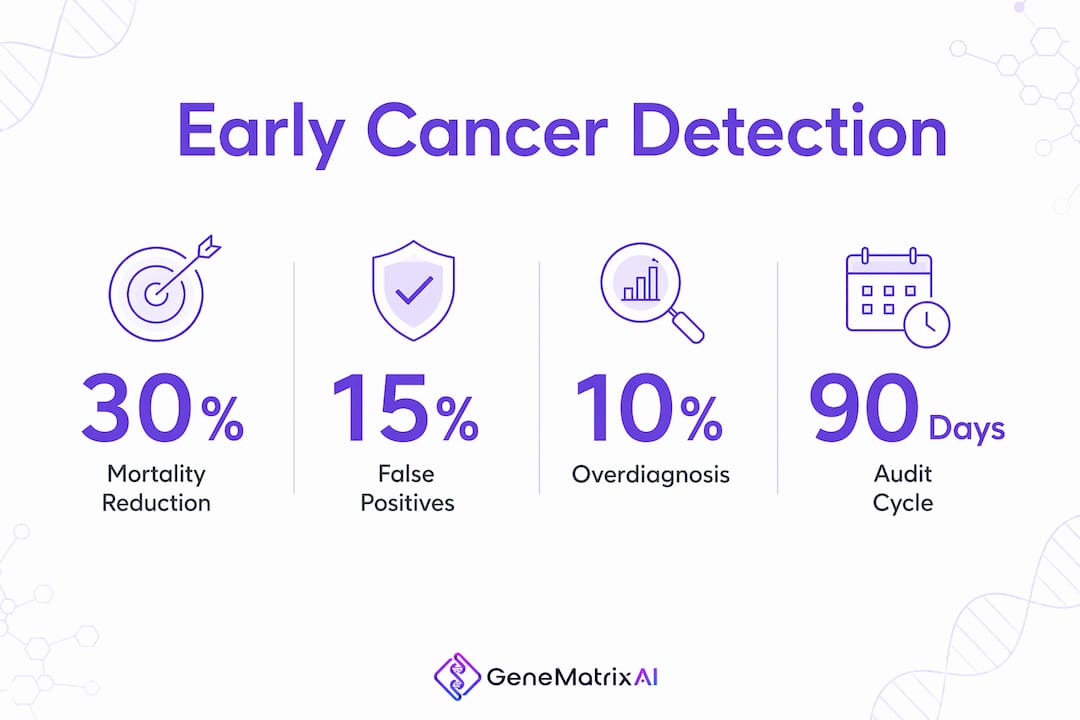
Pro Tip: Pilot in a defined population of patients at elevated hereditary risk. Run a closed-loop audit at 90 days — tracking time from test order to counseling to confirmatory testing — before scaling.
How do you know your program is delivering value?
Tracking the right metrics separates programs that improve outcomes from programs that generate activity.
| Metric | Rationale | Minimal Target |
|---|---|---|
| Stage shift (early vs. late at diagnosis) | Primary evidence of detection benefit | Increase in stage I/II proportion over baseline |
| Cancer-specific mortality | True program effectiveness measure | Downward trend at 3–5 years |
| Positive predictive value (PPV) | Measures false-positive burden | Benchmark against published program data |
| Time from test to treatment initiation | Captures pathway efficiency | Defined by tumor type urgency |
| Counseling completion rate | Confirms informed consent integrity | >90% of screen-positive patients |
| Cascade-testing uptake | Measures population amplification | Track relative contact and uptake rates |
| Demographic representation | Equity signal | Matches served population demographics |
Gene Matrix LLC: an AI-enabled hereditary screening workflow
Gene Matrix LLC is a Chicago-based, CLIA-certified biotechnology company. Their GeneMatrixAI platform delivers actionable genomic reports within 72 hours, with AI trained on more than 500,000 genetic profiles. The GeneCancer module covers BRCA1/BRCA2, Lynch syndrome genes, and a broad hereditary panel. GenePGx adds pharmacogenomics for medication optimization within the same workflow.
The operational sequence runs: patient eligibility identification → informed consent and sample collection → AI-enabled variant analysis on the GeneMatrixAI platform → 72-hour report delivery → genetic counseling (embedded or referral) → confirmatory testing where indicated → referral to treatment with multidisciplinary tumor board linkage.
Trust signals to verify during procurement: CLIA-certified laboratory, AI model trained on 500,000+ profiles, documented 72-hour turnaround SLA, and LIMS integration for sample tracking and reporting.
Vendor evaluation should go beyond the brochure. Request the dataset demographic breakdown, the peer-reviewed validation publication, and a pilot agreement with pre-specified outcome metrics before signing a full contract.
Pro Tip: Ask Genematrix for a pilot design that includes a 90-day closed-loop audit. Specify stage-shift detection rate, counseling completion rate, and turnaround-time compliance as contractual success criteria.
Key Takeaways
Early cancer detection reduces mortality and treatment burden, but only when hereditary-risk targeting, validated AI tools, and a complete diagnostic-to-treatment pathway are built together from the start.
| Point | Details |
|---|---|
| Screening vs. diagnosis | Screening targets asymptomatic patients; early diagnosis targets symptomatic ones — each demands different infrastructure and consent. |
| Hereditary risk is highest yield | BRCA1/BRCA2 and Lynch syndrome carriers benefit most from intensive surveillance; cascade testing multiplies population benefit. |
| AI improves PPV, not just speed | AI-enabled variant interpretation reduces false-positive burden when trained on diverse, large cohorts with peer-reviewed validation. |
| Pathway completeness is non-negotiable | A test without confirmed counseling, diagnostics, and treatment access can cause net harm — close every loop before scaling. |
| Genematrix as a turnkey partner | Gene Matrix LLC offers CLIA-certified AI-powered hereditary screening with 72-hour reports and integrated LIMS for health systems ready to pilot. |
The gap between launching a program and running one
Standing up a hereditary cancer screening program looks straightforward on paper. The clinical steering committee agrees, the vendor is selected, the consent forms are approved. Then the first wave of positive results arrives and the gaps become visible fast: the EHR alert fires but no counselor is available for three weeks, the payer denies the claim because the CPT code was submitted without the right diagnosis modifier, and the oncologist who was supposed to receive the referral never got credentialed in the new system.
The teams that get through that phase share one trait: they piloted small and audited obsessively. A 90-day closed-loop review of 300–400 patients tells you more about your program's real performance than any vendor demo. Reduced time-to-referral and the detection of actionable pathogenic variants in patients who had no prior genetic workup are the early wins that justify scaling. Those wins also build clinician trust in AI-assisted reports, which matters because the biggest adoption barrier is usually not cost or technology — it is a skeptical oncologist who does not yet trust a 72-hour AI-generated variant interpretation.
Staff training should focus on one skill above all others: explaining to a patient what a variant of uncertain significance actually means. That conversation, done poorly, causes more harm than almost any false positive.
Genematrix: a turnkey hereditary screening partner for health systems
Health systems that have completed the governance and pathway work described above often reach the same bottleneck: finding a lab partner that combines CLIA-certified processing, AI-powered variant interpretation, and a turnaround time fast enough to keep clinical workflows moving.

Genematrix was built for exactly that gap. The GeneMatrixAI platform delivers hereditary cancer screening reports within 72 hours, with AI trained on more than 500,000 genetic profiles. The GeneMatrix LIMS handles sample tracking, result routing, and SLA monitoring out of the box. Modules include GeneCancer for hereditary risk, GenePGx for pharmacogenomics, and GeneMind for psychiatric pharmacogenomics — all deployable within a single integrated workflow. Genematrix targets hospitals, physician groups, and health systems, and supports pilot agreements with defined outcome metrics. To request validation documentation or start a pilot, visit genematrix.io.
Authoritative sources to consult next
"The primary objective of a cancer screening program is to reduce cancer-specific mortality. Benefits must be weighed against harms — including false positives, overdiagnosis, and the risks of follow-up procedures — and communicated clearly to patients as part of informed consent." — NCI Cancer Screening Overview (PDQ®)
- NCI Cancer Screening Overview (PDQ®): Start here for evidence summaries on established screening programs and the criteria a test must meet before clinical deployment.
- WHO Early Diagnosis Guidance: Use for the distinction between screening and early diagnosis, and for infrastructure requirements in low- and high-resource settings.
- USPSTF Recommendations: The authoritative U.S. source for population-level screening recommendations by cancer type, including grade-A and grade-B recommendations that drive payer coverage.
- StatPearls — Cancer Screening (NCBI Bookshelf): Best reference for understanding lead-time and length-time bias when interpreting your program's survival statistics.
- Science — "Early Detection of Cancer": Peer-reviewed overview of detection biology, overdiagnosis challenges, and the state of multi-cancer detection research.
- Nature Reviews Clinical Oncology — Cancer Screening Guide: Current synthesis of established programs and where AI and multi-cancer detection technologies are headed.
This article provides general clinical and operational information. Consult current USPSTF guidelines, your institution's legal and compliance teams, and a board-certified genetic counselor for guidance specific to your patient population and jurisdiction.