

TL;DR:
- Genetic privacy grants individuals control over who accesses and shares their unique DNA information, but laws like HIPAA, GINA, and GDPR offer varying protections depending on the testing environment. Consumer direct-to-consumer testing often lacks federal safeguards, exposing data to sale, transfer, or bankruptcy-related risks that can impact families and relatives. Proactive management of genetic data, including careful review of privacy policies and active deletion requests, is essential for protecting personal and familial genetic information today.
Genetic privacy is the right to control who accesses, uses, and shares your unique DNA information. Most people assume submitting a saliva sample to a testing service is a private act. It is not. Your genetic data can be sold, transferred in bankruptcy proceedings, or shared with third parties under terms buried in a privacy policy you clicked past. This guide to genetic privacy covers the legal frameworks protecting your data, the real gaps those laws leave open, and the concrete steps you can take to protect your genetic information today.
What is the guide to genetic privacy, and why does it matter?
Genetic privacy, formally called genomic data confidentiality in clinical and legal contexts, refers to protecting identifiable genetic information from unauthorized access, disclosure, or misuse. It matters because your DNA is not just personal. It is permanent, and it reveals information about your biological relatives, your disease risks, and your ancestry in ways no other data type does.
Two testing environments exist, and the privacy rules governing them are completely different. Clinical genetic testing, ordered by a physician and processed by a certified lab, falls under HIPAA. Direct-to-consumer (DTC) testing, ordered by you through a company like a consumer service, generally does not. Privacy protections are fundamentally stronger with clinical genetic testing under healthcare provider oversight, whereas DTC genetic testing relies mostly on company privacy policies. That distinction determines nearly everything about your rights.
The Genetic Information Nondiscrimination Act (GINA), the Health Insurance Portability and Accountability Act (HIPAA), and the European Union's General Data Protection Regulation (GDPR) are the three primary legal frameworks most individuals encounter. Each protects different things, in different contexts, with different enforcement mechanisms. Understanding which one applies to your situation is the starting point for any serious approach to genetic data protection.
How do clinical and direct-to-consumer genetic tests differ in privacy protection?
The gap between clinical and consumer genetic testing privacy is wider than most people realize. HIPAA typically does not apply to DTC genetic testing companies acting as consumer services without healthcare provider oversight. That means the company holding your raw DNA data may operate under no federal health privacy law at all.
The table below summarizes the key differences:
| Protection area | Clinical genetic testing | DTC genetic testing |
|---|---|---|
| HIPAA coverage | Yes, if held by a covered entity | Generally no |
| GINA protections | Yes, health insurance and employment | Limited; does not cover life or disability insurance |
| GDPR rights | Applies if EU-based or EU resident | Applies only if company is EU-based or serves EU residents |
| Data deletion rights | Governed by HIPAA and state law | Governed by company policy or applicable state law |
| Third-party data sharing | Restricted under HIPAA | Permitted under company terms of service |
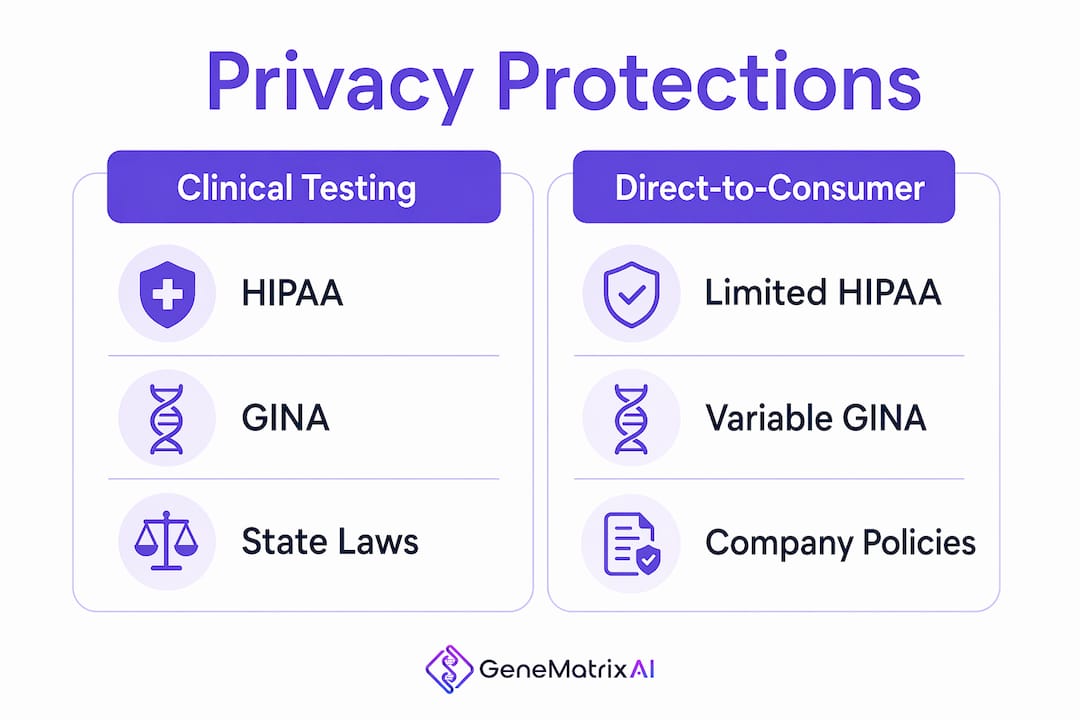
GINA prohibits health insurers and employers from discriminating based on genetic information, but it does not regulate how companies store or sell your data. It also does not cover life insurance, disability insurance, or long-term care insurance. Those markets remain entirely unprotected. Legal protections vary by where genetic data resides. Identical genetic data held by a hospital lab carries HIPAA protections; the same data held by a consumer app does not.
State laws add another layer of complexity. California's Genetic Information Privacy Act (GIPA), Texas's Genetic Privacy Act, and similar statutes in other states extend some protections to DTC testing. But coverage is inconsistent, and most states have no specific genetic privacy statute at all.
Pro Tip: Before submitting a sample to any DTC testing service, search the company's privacy policy for the words "sell," "transfer," and "bankruptcy." Those three clauses tell you more about your actual data rights than any marketing language on the homepage.
How do HIPAA, GINA, and GDPR protect your genetic information?
Each law protects a different slice of your genetic privacy, and none of them covers everything.
HIPAA defines genetic information as Protected Health Information (PHI) when it is individually identifiable and held by a covered entity such as a hospital, physician's office, or certified lab. Genetic test results, family history, and fetal genetic tests processed by HIPAA covered entities all qualify. Once data is de-identified, HIPAA protections no longer apply, which is a significant limitation for research contexts.
GINA operates as an anti-discrimination law, not a data protection law. It prevents health insurers from using genetic test results to deny coverage or set premiums, and it prevents employers from using genetic information in hiring or promotion decisions. It does not give you the right to delete your data, access what a company holds, or stop a sale.
GDPR offers the strongest individual rights of the three. Under GDPR, genetic data are classified as "special category" personal data under Article 9, requiring explicit consent before any processing. If you are an EU resident, or if the company you tested with is EU-based, you hold the following rights:
- The right to access all genetic data a company holds about you
- The right to correct inaccurate data
- The right to data portability, meaning you can download your raw data
- The right to withdraw consent at any time
- The right to erasure, commonly called the "right to be forgotten"
GDPR's right to erasure is the most powerful tool available to individuals. Companies must permanently delete genetic data from all systems, including backups, within approximately one month of a valid request, and they must notify any third parties they shared your data with to do the same. No equivalent federal right exists in the United States, though the proposed Genomic Data Protection Act of 2025 would change that.
What are the real risks in protecting genetic privacy today?
Legal frameworks address some risks. They do not address all of them. The most significant gaps involve corporate transactions, the relational nature of DNA, and the operational complexity of true data deletion.
The 23andMe bankruptcy in 2025 is the clearest recent example. Genetic data of millions of consumers were sold to a related nonprofit after the company filed for bankruptcy, with future sales potentially involving buyers with fewer privacy commitments. Corporate changes such as bankruptcy treat genetic data as transferable assets, and consumers have little legal recourse once a sale is complete under current US law.
The relational risk is equally serious and far less discussed. Genetic privacy risk is relational and affects families. When you submit your DNA, you are also revealing partial genetic profiles of your parents, siblings, and children, none of whom consented. One person's decision to test can expose a family member's predisposition to a hereditary condition, ancestry information, or biological relationships they may not have known about.
UNESCO recommends protecting genetic data linked to identifiable persons against unauthorized third-party disclosure unless in narrow public interest cases or with express consent. Most consumer testing terms of service fall well short of this standard.
Deletion is also more complicated than it sounds. Account deactivation is not deletion. Backups, derivative data, and metadata may persist long after you close an account. Consumers should explicitly ask companies whether deletion covers backups, anonymized research datasets, and any data shared with third parties before assuming their information is gone.
What practical steps can you take to protect your genetic information?
Protecting your genetic data requires active management, not passive trust in a company's privacy policy. These steps apply whether you have already tested or are considering it.
- Request a copy of your raw genetic data. Download it directly from the testing platform and store it in an encrypted folder on a personal device. Services like VeraCrypt provide free, open-source file encryption for this purpose.
- Review your data sharing settings. Most DTC platforms default to broad sharing for research purposes. Log into your account settings and opt out of any research or third-party sharing programs you did not explicitly choose.
- Submit a formal deletion request. Do not simply deactivate your account. Send a written request asking the company to delete your genetic data, your biological sample if retained, and any derived data. Ask specifically whether backups and anonymized research copies are included. Many companies retain genetic data indefinitely unless deletion is explicitly requested.
- Monitor company news. Set a Google Alert for any testing company that holds your data. Mergers, acquisitions, and bankruptcy filings are the events most likely to trigger an unwanted data transfer.
- Choose clinical testing when health decisions are involved. For decisions about hereditary cancer risk, pharmacogenomics, or any medically significant condition, work with a healthcare provider who orders testing through a HIPAA-covered lab. The privacy protections are categorically stronger.
- Consider genetic counseling before testing. A certified genetic counselor can explain what a specific test reveals, who might access the results, and what the implications are for your family members. The National Society of Genetic Counselors maintains a searchable directory.
Pro Tip: If you are comparing testing services, check whether the company is CLIA-certified and whether it offers EU-based data hosting. CLIA certification signals lab quality standards; EU hosting means GDPR protections apply regardless of where you live.
The proposed Genomic Data Protection Act of 2025 would give US consumers federal rights to access, delete genomic data, and destroy biological samples within 30 days, with FTC enforcement. Until that bill passes, your best protection is informed, proactive management of your own data.
Key takeaways
Genetic privacy protection depends entirely on where your data lives, who holds it, and which laws apply to that specific context.
| Point | Details |
|---|---|
| Clinical vs. DTC gap | HIPAA covers clinical genetic data; DTC testing relies on company policy with no federal health privacy law. |
| GDPR is the strongest tool | EU residents can demand deletion from all systems, including backups, within one month. |
| Bankruptcy transfers data | Corporate restructuring can move your genetic data to new owners with fewer privacy commitments. |
| DNA risk is relational | Testing reveals partial profiles of relatives who never consented, creating family-wide privacy exposure. |
| Deletion requires confirmation | Account deactivation is not data deletion; always request written confirmation of full deletion scope. |
Why genetic privacy deserves more urgency than most people give it
I have spent years watching people treat genetic testing like a consumer product purchase, something you do, enjoy the results of, and move on from. The 23andMe bankruptcy changed that perception for a lot of people, but the lesson runs deeper than one company's collapse.
The uncomfortable reality is that no single law fully protects your genetic data in the United States right now. HIPAA covers clinical records. GINA covers discrimination. GDPR covers EU residents. The gaps between those three frameworks are where most consumer genetic data actually lives. State laws help in California and a handful of other states, but the majority of Americans have no specific statutory right to delete their genetic data from a consumer platform.
What I find most underappreciated is the family dimension. When someone asks me whether they should take a consumer DNA test, I always ask whether they have spoken to their siblings about it. Most people have not. The decision to test is not just personal. It is a decision made on behalf of everyone who shares your DNA. That relational responsibility deserves more weight in how individuals and policymakers think about genetic data protection.
The Genomic Data Protection Act of 2025 is a meaningful step, but legislation moves slowly. In the meantime, the most effective protection is a combination of choosing the right testing context, reading the terms carefully, and treating deletion as an active process rather than a one-click assumption. Genetic counseling, which remains underutilized, gives you the clearest picture of what a test will reveal and who might eventually see it. That conversation is worth having before you submit a sample, not after.
— Tarek
Genetic testing with privacy built in from the start
Genematrix takes a fundamentally different approach to genetic data than consumer platforms. As a CLIA-certified lab based in Chicago, Genematrix operates under HIPAA from the moment your sample is collected, meaning your genetic information is Protected Health Information with full federal privacy rights attached.

The GeneMatrixAI platform, trained on more than 500,000 genetic profiles, delivers reports on hereditary cancer risk, pharmacogenomics, and personalized wellness within 72 hours. Every test is ordered through a physician or health system, which means your data never sits in a consumer database outside federal oversight. You can explore Genematrix's lab certifications and science to understand exactly how your data is handled, stored, and protected. For anyone weighing the privacy tradeoffs of genetic testing, the clinical pathway Genematrix provides is the one that comes with enforceable rights.
FAQ
What is genetic privacy?
Genetic privacy is the right to control who accesses, uses, and shares your personal DNA information. It covers genetic test results, family history data, and biological samples held by healthcare providers, labs, and consumer testing companies.
Does HIPAA protect my DNA from a consumer testing kit?
HIPAA generally does not apply to DTC genetic testing companies that operate as consumer services without healthcare provider oversight. Your data is protected only by the company's own privacy policy and any applicable state laws.
What rights do I have to delete my genetic data?
Under GDPR, EU residents can request permanent deletion of genetic data from all company systems, including backups, within one month. US consumers have deletion rights only under state laws like California's GIPA or through company policy, unless the Genomic Data Protection Act of 2025 passes into federal law.
Can my genetic data be sold if a testing company goes bankrupt?
Yes. The 23andMe bankruptcy in 2025 demonstrated that genetic data can be treated as a transferable asset during corporate restructuring. Consumers have limited legal recourse once a sale is approved by a bankruptcy court under current US law.
Does my DNA test affect my relatives' privacy?
It does. Because genetic data reveals partial profiles of biological relatives, one person's decision to test exposes information about family members who never consented. This relational privacy risk is not addressed by most existing genetic privacy laws.