

TL;DR:
- Top psychiatric care alternatives in 2026 include platforms like Talkiatry, Grow Therapy, and LifeStance Health, whose eligibility depends mainly on insurance coverage. Insured patients benefit most from large networks offering medication management and specialized care, while uninsured individuals may prefer direct-pay options like Sesame and MD Live. Future-focused providers aim to build layered, data-informed models, integrating genomic insights and complementary therapies beyond simple appointment booking.
What are the top psychiatric care alternatives to americanpsychcare.com?
The strongest americanpsychcare.com alternatives in 2026 are Talkiatry, Grow Therapy, LifeStance Health, Brightside Health, and Thriveworks, each offering distinct combinations of insurance acceptance, telehealth access, and specialty coverage. Your best pick depends on one thing above all else: whether you have insurance. Platform selection hinges primarily on insurance status and cost structure, not clinical features alone. Grow Therapy suits insured patients with its large network of providers, while Sesame and Brightside Health serve those paying out of pocket.
The 16 providers below cover every major care mode available in the US, from pure telehealth to hybrid in-person practices, subscription plans to fee-for-service visits.
| Provider | Care Type | Insurance | Specialties | Availability | Best For |
|---|---|---|---|---|---|
| Talkiatry | Online | Yes, in-network | Psychiatry, medication management | Fast, days | Insured patients needing medication management |
| Brightside Health | Online | Yes | Psychiatry, therapy, depression, anxiety | 1–2 days | Subscription-based combined care |
| 2nd Arc Psychiatric Associates | In-person + telehealth | Yes | Broad psychiatric specialties | Varies | Local clinician trust, comprehensive care |
| Balanced Psychiatry | Hybrid | Yes, major plans | Psychiatry, therapy | Flexible | Blended in-person and virtual care |
| Circle Medical | Online | Yes | Primary care + psychiatry | Same-day | Integrated physical and mental health |
| Grow Therapy | Online + in-person | Yes | Therapy, psychiatry, ADHD, couples | 1–2 days | Insured patients, widest provider choice |
| Doctor On Demand | Online | Yes | Psychiatry, therapy, primary care | Fast | App-based quick access |
| Talkspace | Online | Yes | Therapy, psychiatry, messaging | 1–3 days | Text-based therapy with medication option |
| MD Live | Online | Yes, major plans | Psychiatry, therapy | 1–3 days | Non-subscription telehealth visits |
| Teladoc Health | Online | Yes | Psychiatry, therapy, chronic care | Varies | Comprehensive telehealth with insurance |
| Thriveworks | Online + in-person | Yes | Therapy, psychiatry, couples, family | 1–3 days | Personalized clinician-led care |
| Cerebral | Online | Yes | Psychiatry, therapy, ADHD, anxiety | Fast | Digitally integrated ongoing care |
| Sesame | Online | No (direct pay) | Psychiatry, therapy, primary care | 1–3 days | Uninsured, low-cost direct access |
| Skypiatrist | Online | Varies | Telepsychiatry, medication management | Same-day | Fast psychiatric evaluations |
| Cordial Psychiatry | Online + in-person | Varies | Psychiatry, behavioral health | Varies | Personalized, patient-centered care |
| LifeStance Health | Online + in-person | Yes, broad | Psychiatry, therapy, child/adolescent | Varies | Broad specialty access, insurance coverage |
A few things stand out across this group. Talkspace and Teladoc Health follow strict telehealth regulations limiting controlled substance prescribing, a policy that became standard after COVID-era emergency flexibilities expired. Patients who need medications like stimulants for ADHD should confirm prescribing policies before signing up. Talkiatry handles this better than most, with state-compliant controlled substance policies built into its clinical model.
How do these psychiatric care providers actually compare?
Insurance networks and what they cover
Insurance acceptance separates this group more than any other single factor. Grow Therapy, Talkspace, Thriveworks, and MD Live accept a broad range of major carriers, and Talkspace and Thriveworks both let you check coverage before you commit. LifeStance Health operates one of the widest in-person and telehealth networks in the country, accepting most major plans across dozens of states. Circle Medical stands out for integrating primary care with psychiatry under one insurance claim, which matters for patients managing both physical and mental health conditions.
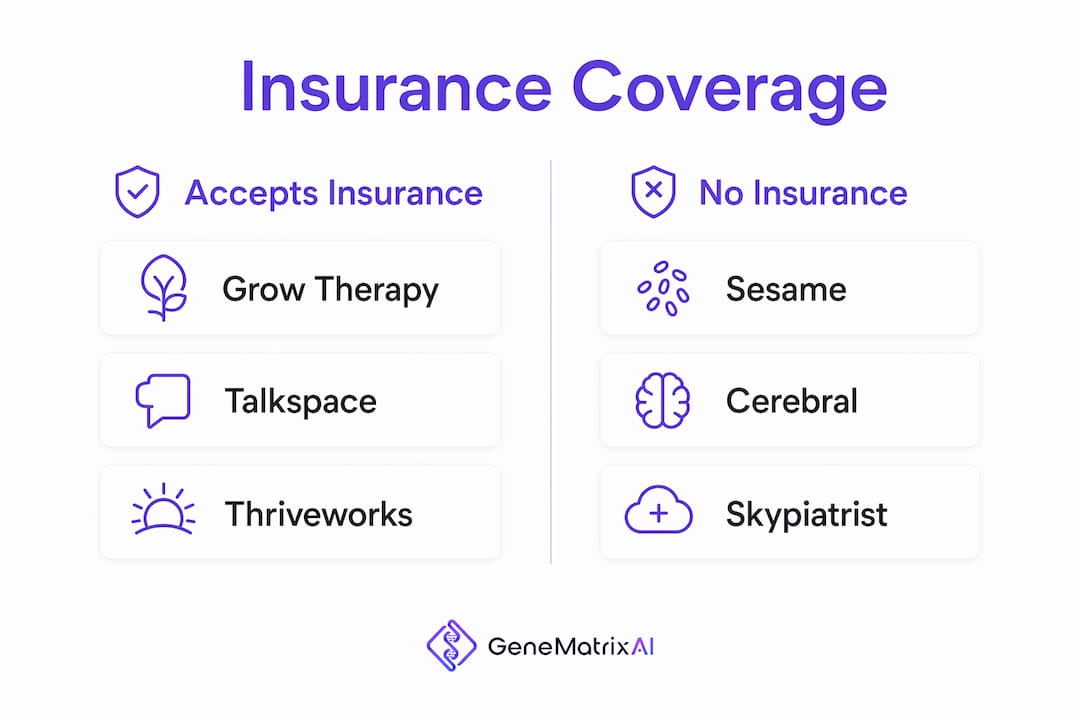
Sesame sits at the opposite end. It charges transparent flat rates with no insurance involvement at all, starting at low flat rates per visit. That model works well for patients who are uninsured, underinsured, or simply want to avoid the prior-authorization process entirely.
Telehealth technology and app quality
Doctor On Demand and Teladoc Health offer the most polished app experiences, with flexible scheduling and clean video interfaces. Cerebral leans heavily into its digital platform, offering ongoing symptom tracking between appointments, which appeals to patients who want more than a monthly check-in. Talkspace adds asynchronous messaging to its video sessions, giving patients a way to communicate with their provider between scheduled visits.

Brightside Health takes a different approach. Its platform combines therapy and psychiatry under one subscription, with continuous monitoring built in. Patients dealing with depression or anxiety who want coordinated care without juggling two separate providers tend to find this model easier to manage.
Specialty services: ADHD, family therapy, and adolescent care
ADHD care is one of the trickier specialties in telehealth because of controlled substance prescribing rules. Talkiatry and Cerebral both offer ADHD evaluation and medication management, though policies vary by state. Grow Therapy's network of over 19,000 providers includes specialists in ADHD, couples therapy, and child and adolescent psychiatry, giving insured patients the widest selection.

LifeStance Health is the strongest option for child and adolescent psychiatry in a hybrid setting. Its multidisciplinary teams include child psychiatrists and therapists who coordinate care, which is harder to find on pure telehealth platforms. Thriveworks also offers family and couples therapy with strong follow-up between sessions, a feature that sets it apart from providers focused purely on individual care.
Pricing models compared
The fee structures across these platforms fall into three broad categories.
- Subscription plans: Brightside Health and Cerebral charge monthly fees that bundle therapy and psychiatry visits. Brightside charges monthly fees for combined therapy and psychiatry visits, with insurance.
- Fee-for-service: MD Live charges per visit without insurance, requiring no ongoing commitment. Sesame operates similarly, with flat per-visit pricing and no subscription required.
- Insurance-billed visits: Talkiatry, Grow Therapy, Thriveworks, and LifeStance Health bill your insurer directly, with copays depending on your plan. Out-of-pocket costs vary widely.
Pro Tip: Before signing up for any platform, call your insurance company and ask specifically whether the provider is in-network for behavioral health, not just general telehealth. The distinction affects your copay significantly.
Skypiatrist and Cordial Psychiatry do not publicly list standardized pricing, so patients should contact them directly for current rates. 2nd Arc Psychiatric Associates and Balanced Psychiatry also offer transparent pricing on request, with major insurance plans accepted.
What patients report about each provider
Thriveworks draws consistent praise for therapist responsiveness between sessions, a feature that matters most to patients managing ongoing anxiety or mood disorders. Talkiatry patients frequently cite fast appointment access and clear medication management as strengths. Sesame users highlight the absence of insurance friction as a major plus, particularly for one-off psychiatric consultations.
Cerebral has faced scrutiny over prescribing practices in past years, and while the platform has since tightened its clinical protocols, patients seeking ADHD medication management should review current policies carefully. Talkspace receives mixed feedback on provider consistency, though its large provider base means switching to a better-matched clinician is usually straightforward.
How to choose the right psychiatric care provider for your needs
Start with insurance. If you have coverage, Grow Therapy, Talkiatry, or LifeStance Health will almost always cost less than paying out of pocket, and all three have broad enough networks to find a provider who matches your specific needs. If you are uninsured or prefer direct payment, Sesame or MD Live give you the most pricing transparency.
Once you have narrowed by cost, check these specifics:
- Clinician credentials: Verify that the provider is a licensed psychiatrist or psychiatric nurse practitioner, not just a licensed counselor, if you need medication management. Most platforms list credentials on provider profiles.
- Specialty fit: If you need ADHD evaluation, couples therapy, or child psychiatry, confirm the platform has credentialed specialists before signing up, not after.
- Prescribing policies: Federal telehealth regulations restrict controlled substance prescribing via telehealth in most states. Ask directly whether the platform can prescribe the medication you need.
- Appointment speed: Same-day access matters in a crisis. Circle Medical and Skypiatrist both offer same-day appointments. Most others schedule within 1–3 days.
- Communication style: Some patients do better with asynchronous messaging (Talkspace). Others need synchronous video. A few platforms, like Thriveworks, offer both.
Trust signals worth checking
A clinician-founded platform signals that clinical standards drove the design, not just product metrics. 2nd Arc Psychiatric Associates and Cordial Psychiatry both carry this credential. Patient testimonials on third-party sites like Zocdoc or Healthgrades give a more honest picture than curated reviews on a provider's own website.
Red flags to watch for: no listed provider credentials, vague cancellation policies, or platforms that require a subscription before you can see a clinician's profile. Hidden fees for "care coordination" or "platform access" on top of session costs are also worth scrutinizing.
Pro Tip: Give any new provider at least 90 days before deciding the fit is wrong. Therapeutic progress typically stabilizes after that window, and switching too early often resets the process rather than improving it.
What makes the leading online psychiatric platforms different?
The platforms below represent the clearest choices for patients who want care delivered primarily online.
- Talkiatry focuses exclusively on psychiatry, not general therapy, which keeps its clinical model tight. Patients get matched to a psychiatrist, not a counselor, and medication management is central to every care plan.
- Brightside Health combines therapy and psychiatry in one subscription, with built-in monitoring between appointments. Patients dealing with depression or anxiety who want both services coordinated report fewer gaps in care.
- Cerebral offers rapid access and ongoing symptom tracking, making it useful for patients who want data-driven check-ins rather than purely session-based care.
- Talkspace adds text-based messaging to its video sessions, which suits patients who find it easier to communicate in writing between appointments. Its provider base is large enough that finding a specialty match is usually quick.
- Sesame strips away the insurance layer entirely. Patients pay a flat rate, choose their provider, and book directly. No prior authorization, no surprise bills.
- Doctor On Demand prioritizes speed and app usability. Its platform handles psychiatry, therapy, and primary care in one place, which is useful for patients who want a single digital front door for health.
- MD Live offers per-visit psychiatric care without a subscription, accepts major insurance plans, and handles medication management. It suits patients who want telehealth psychiatry without a long-term commitment.
- Teladoc Health operates at scale, with high clinical standards and a broad provider network. Its mental health services sit within a larger telehealth ecosystem that includes chronic disease management, which matters for patients with co-occurring physical conditions.
- Skypiatrist focuses narrowly on telepsychiatry evaluations and medication management, with same-day appointments and state-licensed providers. It is a practical choice for patients who need a fast psychiatric assessment without a long intake process.
Grow Therapy and LifeStance Health round out the online options with the widest provider networks and the strongest insurance coverage. Both offer in-person care as well, which gives patients the flexibility to shift between telehealth and office visits as their needs change.
Precision psychiatric care through genomic insights
Most psychiatric care platforms match you to a provider based on your symptoms and insurance. Genematrix takes a different starting point: your DNA.

Genematrix is a CLIA-certified biotechnology company based in Chicago. Its GeneMind module uses pharmacogenomics (PGx) testing to identify how your genetic profile affects your response to psychiatric medications, including antidepressants, antipsychotics, and mood stabilizers. That matters because two patients with identical diagnoses can respond completely differently to the same drug, and the reason is often genetic. Rather than cycling through medications by trial and error, a pharmacogenomics report from Genematrix gives your prescribing clinician a data-driven starting point.
The GeneMatrixAI platform delivers reports within 72 hours, trained on over 500,000 genetic profiles. Beyond GeneMind, Genematrix offers GeneCancer (hereditary cancer screening), GenePGx (broad drug-gene interaction analysis), GeneBaby (pediatric genomics), and GeneDiet (nutrigenomics). For patients already working with a psychiatrist or telehealth provider, adding a PGx test through Genematrix can sharpen the medication selection process without replacing the clinical relationship. It is a complement to the platforms listed above, not a substitute for them. Learn more about precision medicine fundamentals and how genomic data fits into a broader care plan.
Key Takeaways
The strongest psychiatric care alternatives to americanpsychcare.com in 2026 combine insurance acceptance, specialty depth, and appointment speed, and the right choice depends almost entirely on your coverage status and care goals.
| Point | Details |
|---|---|
| Insurance drives the decision | Insured patients get the most value from Grow Therapy, Talkiatry, or LifeStance Health; uninsured patients should look at Sesame or MD Live. |
| Controlled substance policies vary | Talkspace and Teladoc Health restrict controlled substance prescribing; confirm policies before signing up if you need ADHD or anxiety medications. |
| Specialty fit matters more than platform size | Child psychiatry, ADHD, and couples therapy require credentialed specialists; verify availability before committing to any platform. |
| Commit to 90 days before switching | Therapeutic progress typically stabilizes after a 90-day window; switching providers too early often resets rather than improves outcomes. |
| Genematrix adds a genomic layer | Genematrix's GeneMind PGx testing helps prescribing clinicians choose psychiatric medications based on your genetic profile, reducing trial-and-error prescribing. |
What the telepsychiatry market gets wrong
The conversation around online psychiatric care has become almost entirely about convenience: same-day appointments, app ratings, subscription prices. Those things matter, but they have pushed a more important question to the margins. The question is not which platform books fastest. It is whether the clinical model behind the platform is actually built to treat psychiatric illness or just to move appointments.
Telepsychiatry works well for medication management, follow-up care, and mild-to-moderate conditions. The evidence base for telehealth in psychiatry is real and growing. But several of the platforms in this comparison are primarily technology businesses that happen to employ clinicians, and the distinction shows up in outcomes. Patients with complex presentations, treatment-resistant depression, or co-occurring substance use disorders often need more than a 20-minute video visit every four weeks.
The integrative care model is worth taking seriously here. Complementary therapies like meditation and acupuncture lack strong clinical evidence for treating severe mental illness on their own, but they serve as genuine adjuncts for wellbeing alongside mainstream treatment. The same logic applies to genomic testing: it does not replace a psychiatrist, but it gives the psychiatrist better information. The platforms that will matter most in five years are the ones building toward that kind of layered, data-informed care, not just faster booking.
My honest advice: pick a platform that lets you see a real psychiatrist, not just a therapist, if medication is part of your treatment. Verify credentials before your first appointment. And give the relationship time before you decide it is not working.
Useful sources for further research
These sources provide authoritative background on telepsychiatry regulations, platform comparisons, and integrative care options.
- SAMHSA: Mental Health Treatment Resources — Federal guidance on mental health treatment access and telehealth policy.
- HHS Telehealth: Prescribing Controlled Substances via Telehealth — Official policy on controlled substance prescribing rules post-COVID.
- DEA Controlled Substance Schedules — Reference for understanding which medications face telehealth prescribing restrictions.
- American Psychiatric Association: Telepsychiatry — Clinical standards and guidance from the leading US psychiatric professional body.
- HelpGuide: Best Online Therapy Platforms of 2026 — Tested and reviewed comparison of major platforms including Grow Therapy, Talkspace, Brightside Health, and Sesame.
- Rethink: Complementary and Alternative Treatments for Mental Health — Evidence-based overview of integrative care options alongside mainstream psychiatry.
- JMIR Mental Health: Telehealth Efficacy Research — Peer-reviewed research on telehealth outcomes in psychiatric care.
- One Small Step: Peer Support and the 3-Month Rule — Background on therapeutic commitment periods and peer support models.