

TL;DR:
- Cancer genomics in 2026 relies on AI-driven multimodal data integration and multi-omic profiling for personalized cancer treatment.
- The field is shifting to AI as an analytical backbone, enabling more accurate patient stratification and real-time clinical decision support.
Cancer genomics in 2026 is defined by the convergence of AI-driven multimodal data integration and multi-omic profiling to deliver genuinely personalized oncology care. This is the standard the field now calls precision oncology, and the pace of change is accelerating fast. Oncology now accounts for 32% of biotech venture investment deal value, up from 23% in 2020. That capital shift reflects a field-wide bet on data-driven cancer medicine. Researchers and clinicians who understand where the future of cancer genomics 2026 is heading will be better positioned to translate these advances into clinical outcomes.
How AI and multimodal data are reshaping cancer genomics in 2026
AI is no longer a supporting tool in cancer genomics. It is the analytical backbone of precision oncology. Multimodal AI foundation models now integrate radiological imaging, genomic sequences, and clinical health records into a single analytical framework. That integration produces patient stratification far more accurate than any single data type alone.

The clearest example of this shift is MutationProjector. This AI tumor genome model analyzes mutation co-dependencies across 30,000 tumors spanning 10 solid cancer types to predict chemotherapy response and metastatic outcomes. It outperforms standard machine learning baselines. That performance gap matters clinically because it means fewer patients receive ineffective treatments.
Presentations at ASCO 2026 and AACR reinforced this direction. Key themes included:
- Adaptive patient classification using fused genomic and imaging data to identify treatment-resistant subgroups earlier
- Therapy response prediction at the individual tumor level rather than population averages
- Real-time clinical decision support where AI models flag high-risk mutation patterns during active treatment
The challenge is that heterogeneous clinical data complicates deployment. Electronic health records vary in structure, imaging formats differ across institutions, and genomic pipelines are not standardized. Regulatory frameworks have not yet caught up with the speed of AI model iteration in oncology.
Pro Tip: When evaluating AI tools for cancer genomics research, prioritize platforms trained on diverse, multi-institutional datasets. Models trained on narrow cohorts tend to underperform when applied to real-world patient populations.
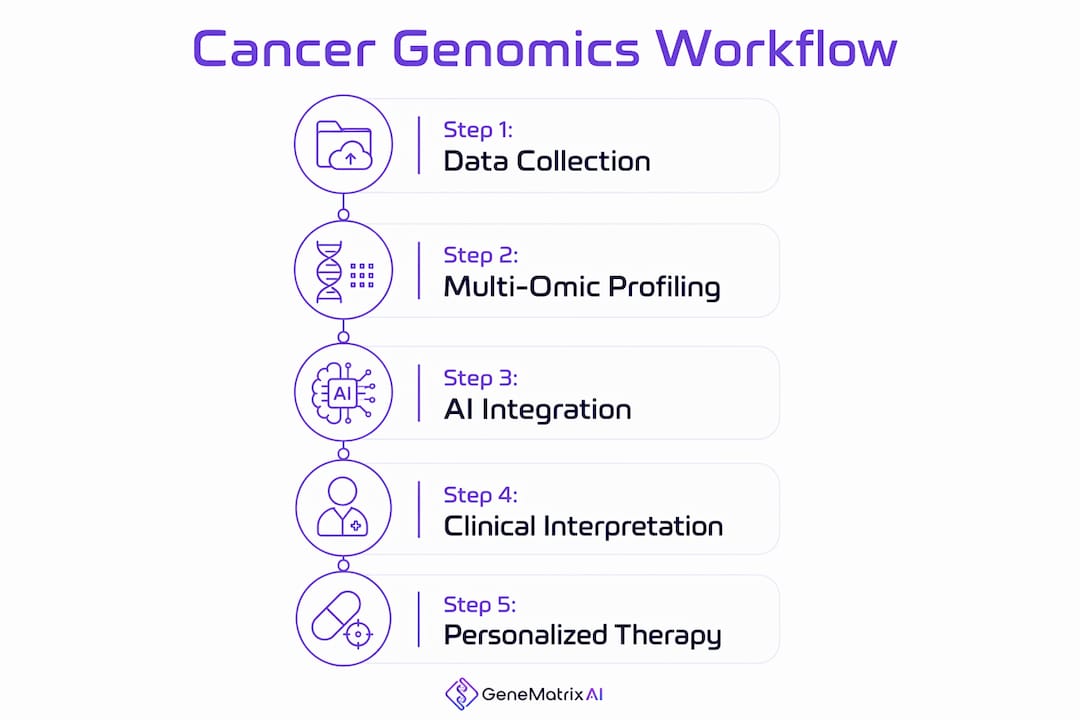
Why multi-omic approaches are becoming the new standard in personalized cancer therapy
Genomics alone no longer tells the full story. Cancer genomics is shifting from single-omics to multi-omic workflows that incorporate proteogenomics, metabolomics, and spatial biology to reveal biomarkers invisible to DNA sequencing alone. This shift is not incremental. It represents a fundamental change in how researchers define actionable tumor targets.
Proteogenomic integration is the most clinically mature of these approaches. It identifies variant peptides and splice isoforms that standard genomic sequencing misses entirely. These molecular features are now considered the clinical gold standard for discovering biomarkers that can actually guide treatment decisions. A tumor that looks genomically unremarkable may carry a proteomic signature that predicts resistance to a first-line therapy.
The practical steps for building a multi-omic research workflow follow a clear progression:
- Establish a genomic baseline. Whole-exome or targeted panel sequencing identifies somatic mutations and copy number variations.
- Layer proteogenomic data. Mass spectrometry-based proteomics maps the expressed protein landscape, catching splice isoforms and post-translational modifications.
- Integrate metabolomics. Genome-scale metabolic modeling reveals how individual tumors rewire energy pathways, which drives treatment resistance in many solid cancers.
- Apply spatial biology. Spatial transcriptomics maps gene expression within the tumor microenvironment, showing which cell populations are driving progression.
- Synthesize for biomarker discovery. Cross-omic analysis identifies the subset of features with genuine predictive value for therapy selection.
An open-access dataset of 900,000+ patient survival profiles across 17 cancer types now supports personalized metabolic tumor modeling at scale. That resource accelerates the validation of multi-omic biomarkers across diverse cancer populations.
Pro Tip: Metabolic heterogeneity within a single tumor is one of the most underappreciated drivers of treatment failure. Genome-scale metabolic modeling, even at a basic level, should be part of any multi-omic biomarker discovery pipeline.
How circulating tumor DNA is changing early-stage cancer management
Circulating tumor DNA, or ctDNA, has moved from a research curiosity to a clinical tool that directly shapes treatment decisions. The core shift is from static biomarkers measured at diagnosis to dynamic molecular monitoring that tracks tumor behavior throughout treatment. That real-time visibility changes what clinicians can do and when they can do it.
ASCO Breakthrough 2026 highlighted ctDNA's growing role in early-stage cancer management. The key clinical applications now include:
- Treatment intensification. Rising ctDNA levels after surgery signal residual disease, prompting escalation before clinical relapse is visible on imaging.
- De-escalation decisions. Patients with undetectable ctDNA after neoadjuvant therapy may safely avoid additional toxic treatment cycles.
- Risk stratification. ctDNA positivity post-resection identifies patients at high relapse risk with greater precision than pathological staging alone.
- Therapy monitoring. Serial ctDNA sampling tracks clonal evolution and emerging resistance mutations in real time.
The ctDNA-guided approach complements traditional clinical risk factors rather than replacing them. Pathological staging, imaging, and clinical history remain part of the decision framework. ctDNA adds a molecular layer that those tools cannot provide. For researchers, the priority is now standardizing ctDNA assay sensitivity and defining the clinical thresholds that trigger treatment changes. Those thresholds vary by cancer type, and the field has not yet reached consensus.
Platforms like Genematrix's GeneCancer testing module are built to deliver this kind of molecular insight within clinical workflows, supporting the shift toward serial genomic monitoring in hereditary cancer management.
What are the practical challenges of implementing next-gen cancer genomics in clinical practice?
Deploying next-generation cancer genomics at scale is harder than the research literature suggests. Data heterogeneity in real-world clinical environments is the primary obstacle. AI models trained on curated research datasets frequently underperform when exposed to the inconsistent data formats, missing fields, and variable quality of routine clinical records. That gap between research performance and clinical performance is the defining implementation challenge of 2026.
Sequencing strategy is another practical decision point. The table below compares the two dominant approaches for clinical liquid biopsy applications.
| Feature | Long-read sequencing | Short-read sequencing |
|---|---|---|
| Structural variant detection | High accuracy | Limited |
| Per-base accuracy | Lower | High |
| Cost per sample | Higher | Lower |
| Clinical adoption | Emerging | Established |
| Best use case | Complex rearrangements, phasing | SNV and indel detection |
Hybrid sequencing strategies that pair long-read and short-read approaches address both accuracy and cost constraints. Long-read compensates for structural variation detection gaps. Short-read maintains the per-base accuracy needed for variant calling in clinical reporting. Neither approach alone is sufficient for comprehensive liquid biopsy diagnostics.
Regulatory frameworks present a third challenge. Current approval pathways treat AI diagnostic tools as static devices. Cancer genomics AI models are not static. They are retrained as new data accumulates, and their performance characteristics change over time. Adaptive post-market regulatory frameworks that evaluate AI models as evolving systems are a clinical necessity, not a future aspiration. Institutions integrating genomic AI tools should build model governance protocols now, before regulatory requirements force the issue.
Key takeaways
The future of cancer genomics in 2026 requires integrating AI-driven multimodal data, multi-omic profiling, and dynamic ctDNA monitoring to move precision oncology from concept to clinical standard.
| Point | Details |
|---|---|
| AI models predict therapy response | MutationProjector analyzes 30,000+ tumors to predict chemo response and metastatic outcomes. |
| Multi-omics reveals hidden biomarkers | Proteogenomic integration identifies variant peptides and splice isoforms that genomics alone misses. |
| ctDNA enables dynamic monitoring | Serial ctDNA sampling guides treatment intensification and de-escalation in early-stage cancers. |
| Hybrid sequencing balances cost and accuracy | Pairing long-read and short-read sequencing addresses structural variant detection and per-base accuracy. |
| Data heterogeneity limits AI deployment | Real-world clinical data variability demands adaptive regulatory frameworks and ongoing model validation. |
The uncomfortable truth about where cancer genomics is actually headed
The field talks a great deal about AI and multi-omics, but the honest bottleneck is not technology. It is data governance. I have watched promising AI models fail in clinical pilots not because the algorithms were wrong, but because the training data did not reflect the messy reality of hospital records. Researchers who treat data curation as a secondary task will keep hitting that wall.
The multi-omic shift is real and necessary. But proteogenomics and spatial biology generate data volumes that most clinical informatics teams are not equipped to handle. The gap between what is scientifically possible and what is operationally deployable is wider than most conference presentations acknowledge. Closing that gap requires multidisciplinary teams where bioinformaticians, clinicians, and data engineers work from the same protocol, not in parallel silos.
ctDNA monitoring is the area where I see the most immediate clinical impact. The technology is mature enough for broad adoption, the clinical evidence from ASCO 2026 is compelling, and the decision framework is becoming clearer. The barrier is assay standardization and reimbursement, not scientific validity. Institutions that build ctDNA monitoring into their oncology workflows now will have a meaningful head start.
Ethical considerations around genomic data use are also underweighted in most 2026 discussions. Large datasets like the 900,000-patient survival profile resource are scientifically powerful. They also carry real obligations around consent, data sharing, and equitable access. Precision oncology built on datasets that underrepresent certain populations will produce tools that underserve those same populations. That is not a future problem. It is a current one.
— Tarek
Genematrix and the next phase of precision oncology
Researchers and clinicians building genomic workflows in 2026 need a platform that matches the pace of the science. Genematrix is a CLIA-certified, Chicago-based biotechnology company that delivers AI-powered hereditary cancer screening and pharmacogenomics within 72 hours.

The GeneMatrixAI platform is trained on 500,000+ genetic profiles and covers hereditary cancer risk assessment through GeneCancer, drug-gene interaction analysis through GenePGx, and specialized modules for psychiatric, pediatric, and nutrigenomic applications. Explore the science and certifications behind Genematrix's testing methodology, or review the AI-powered genomics benefits that are reshaping clinical practice. For clinicians and health systems ready to integrate molecular monitoring into patient care, Genematrix provides the infrastructure to do it at scale.
FAQ
What defines cancer genomics in 2026?
Cancer genomics in 2026 is defined by the integration of AI foundation models, multi-omic profiling, and dynamic molecular monitoring to deliver personalized oncology care. The field has moved well beyond single-gene testing toward whole-system tumor analysis.
How does ctDNA improve cancer treatment decisions?
ctDNA enables serial molecular monitoring that tracks tumor evolution in real time, guiding decisions on treatment intensification or de-escalation based on molecular evidence rather than imaging alone.
What is the advantage of hybrid sequencing in clinical oncology?
Hybrid sequencing combines long-read methods for structural variant detection with short-read sequencing for per-base accuracy, addressing the limitations of either approach used alone in liquid biopsy diagnostics.
Why does data heterogeneity matter for AI in cancer genomics?
Real-world clinical data varies in format, completeness, and quality across institutions. AI models trained on curated research datasets frequently underperform when deployed in routine clinical environments with inconsistent data.
How does Genematrix support precision oncology research?
Genematrix provides CLIA-certified AI-driven genomic testing, including hereditary cancer screening and pharmacogenomics, with results delivered within 72 hours to support clinical decision-making and research workflows.