

TL;DR:
- Genetic mutations vary from single-letter substitutions to large chromosomal rearrangements, each impacting gene function differently. Examples like sickle cell disease, cystic fibrosis, Huntington's, BRCA mutations, and Lynch syndrome illustrate how mutation type influences disease risk, severity, and inheritance patterns. Understanding whether mutations are germline or somatic, beneficial or uncertain, guides clinical decisions, family counseling, and emerging therapies.
Genetic mutations are specific changes in a DNA sequence that alter how genes function, and the examples of genetic mutations most studied in medicine range from single-letter substitutions to large chromosomal rearrangements. Conditions like cystic fibrosis, sickle cell disease, and Huntington's disease each represent a distinct mutation class, making them the clearest entry points for understanding how DNA errors translate into real health consequences. Whether you are a student building foundational biology knowledge, a researcher interpreting genomic data, or a parent weighing genetic risk assessment for your family, this guide maps the most instructive mutation examples to the biology behind them.
1. Examples of genetic mutations by type: a practical overview
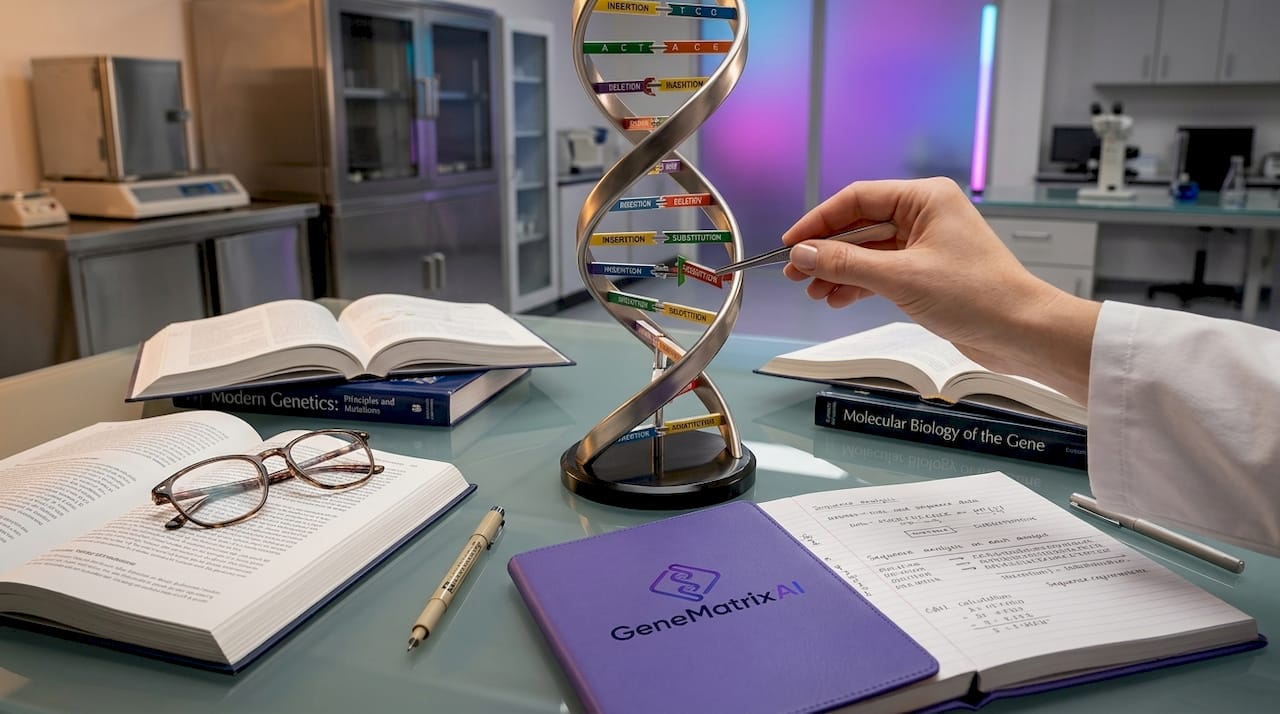
Genetic mutations fall into several structural categories, and knowing which type you are dealing with changes everything about how you interpret its effects. The main classes are substitutions, insertions, deletions, duplications, and repeat expansions. Each produces a different kind of disruption to the protein a gene encodes.
- Substitution (point mutation): One nucleotide is swapped for another. The sickle cell mutation is the textbook case: a single A-to-T change in the HBB gene converts glutamic acid to valine in hemoglobin, reshaping red blood cells into a rigid crescent.
- Insertion/Deletion (indel): One or more bases are added or removed. When the number of bases is not a multiple of three, the entire downstream reading frame shifts, usually producing a nonfunctional protein. This is called a frameshift mutation.
- Repeat expansion: A short DNA sequence is copied far more times than normal. In Huntington's disease, the CAG triplet in the HTT gene expands beyond 36 repeats, producing a toxic protein that destroys neurons.
- Duplication/Deletion (chromosomal): Large segments of a chromosome are copied or lost. DiGeorge syndrome results from a deletion on chromosome 22q11.2, removing dozens of genes at once.
Insertions and deletions not in multiples of three cause frameshifts, while substitutions are classified as transitions or transversions depending on which nucleotide replaces which. That distinction matters when predicting whether a substitution will be silent, missense, or nonsense.
Pro Tip: When reading a genetic report, look for the mutation class first. A frameshift in a tumor suppressor gene carries a very different clinical weight than a synonymous substitution in the same gene.
2. Sickle cell disease: the most studied substitution mutation
Sickle cell disease is caused by inheriting two copies of the hemoglobin S gene, making it the most cited example of a single-nucleotide substitution with direct clinical consequences. The misshapen red blood cells block small blood vessels, causing pain crises, organ damage, and chronic anemia. People who carry only one copy, known as sickle cell trait, generally do not develop the disease but can pass the mutation to their children.
What makes sickle cell so instructive is the chain from one DNA letter to a systemic disease. The substitution changes hemoglobin's surface chemistry, causing molecules to polymerize under low-oxygen conditions. Gene therapy approaches are now being evaluated as potentially curative treatments, illustrating how understanding a mutation at the molecular level opens the door to targeted intervention.
3. Cystic fibrosis: over 2,000 variants in one gene
Cystic fibrosis results from mutations in the CFTR gene, and over 2,000 variants have been identified in that single gene. The most common is F508del, a three-base deletion that removes phenylalanine at position 508 of the CFTR protein. Approximately 85% of people with cystic fibrosis carry the F508del mutation, and 44% are homozygous for it.
The CFTR case is a masterclass in genotype-phenotype complexity. Two people with the same F508del mutation can have meaningfully different lung function because additional polymorphisms and transcript-level variations modulate how much functional protein is actually produced. This is why CFTR genotype-to-phenotype relationships require functional assay validation alongside DNA sequencing to guide treatment decisions, particularly for CFTR modulator therapies like elexacaftor/tezacaftor/ivacaftor.
4. Huntington's disease: when repeat expansions cross a threshold
Huntington's disease is caused by CAG trinucleotide repeat expansion in the HTT gene, and it illustrates a mutation class that behaves very differently from substitutions or indels. Normal HTT alleles carry fewer than 36 CAG repeats. Once the count exceeds 36, the resulting mutant huntingtin protein aggregates in neurons and triggers progressive neurodegeneration.
One feature unique to repeat expansion diseases is anticipation: the repeat count tends to grow with each generation, meaning children of an affected parent may develop symptoms earlier and more severely. CRISPR studies targeting HTT have reduced mutant protein and improved symptoms in mouse models, pointing toward future therapies. Detecting repeat expansions also requires specialized assays, since standard next-generation sequencing often misses large repeat tracts entirely.
5. BRCA1 and BRCA2: germline mutations with family-wide consequences
BRCA1 and BRCA2 mutations are among the most clinically significant examples of inherited mutations because they dramatically raise lifetime risk for breast and ovarian cancer. These are germline mutations, meaning they are present in every cell of the body and can be passed from parent to child. A woman carrying a pathogenic BRCA1 variant faces a lifetime breast cancer risk estimated between 50% and 72%, compared to roughly 12% in the general population.
The BRCA example also shows why genetic counseling matters for families, not just individuals. A positive result in one family member immediately raises the question of risk for siblings, parents, and children. Cascade testing, where relatives of a confirmed carrier are offered targeted testing for the known familial variant, is now standard practice in hereditary cancer programs.
6. Lynch syndrome: mismatch repair gene mutations and cancer risk
Lynch syndrome is caused by germline mutations in mismatch repair genes, primarily MLH1, MSH2, MSH6, and PMS2. These genes normally correct errors that occur during DNA replication. When they are inactivated, errors accumulate rapidly, driving colorectal, endometrial, and other cancers at unusually young ages.
Lynch syndrome is one of the clearest examples of how a single inherited mutation class can affect multiple organ systems. Carriers face a lifetime colorectal cancer risk of up to 80% without surveillance. The condition also illustrates somatic second-hit mechanisms: the inherited mutation disables one copy of a repair gene, and a somatic mutation in the remaining copy completes the loss of function in a specific tissue.
7. Somatic mutations vs. germline mutations: why the distinction matters
Germline mutations are inherited and present in egg or sperm cells, passing to offspring, while somatic mutations arise during a person's lifetime and are confined to the cells where they occur. This distinction has direct consequences for how you interpret a genetic test result and what it means for your relatives.
Consider two scenarios:
- A BRCA1 pathogenic variant found in a blood-based germline test means every cell in the body carries that mutation, and first-degree relatives have a 50% chance of inheriting it.
- A TP53 mutation found only in a tumor biopsy is somatic. It drove cancer in that tissue but does not increase the patient's children's cancer risk.
Somatic mutations are not inherited, so they do not affect family members' risk. That said, somatic mutations in driver genes like KRAS, EGFR, and PIK3CA are critical for selecting targeted therapies in oncology. Understanding which type of mutation you are dealing with determines whether the clinical response is a family conversation or a treatment decision.
Pro Tip: If a genetic test report does not specify whether a variant is germline or somatic, ask your provider directly. The answer changes the entire clinical and family context.
8. Beneficial mutations: lactase persistence and CCR5-Δ32
Not all mutations cause disease. The lactase persistence mutation enables adults to digest lactose by keeping the LCT gene active past childhood, an adaptation that provided a significant nutritional advantage in populations that domesticated dairy animals. This mutation spread rapidly in certain European and East African populations, making it one of the strongest signals of recent positive selection in the human genome.
The CCR5-Δ32 mutation offers a different kind of advantage: resistance to HIV infection. CCR5 is a co-receptor HIV uses to enter immune cells. The 32-base-pair deletion disrupts the receptor, blocking viral entry. The allele is more common in European populations, possibly because it also conferred protection against historical pathogens like smallpox or plague. Both examples demonstrate that mutations are not inherently harmful. They are simply changes, and their value depends entirely on the environment in which they occur.
9. Variants of uncertain significance: the gray zone of mutation interpretation
Variants of uncertain significance, or VUS, are mutations where the evidence for pathogenicity is incomplete. Many genetic variants found in autoinflammatory diseases are classified as VUS, complicating both diagnosis and treatment decisions. A VUS is not a benign variant and not a confirmed pathogenic one. It sits in a gray zone that can cause significant anxiety for patients and families.
Computational predictions alone are insufficient for resolving VUS classifications. Functional assays that test what a variant actually does to protein activity are required to improve accuracy. This is why choosing a clinical genomics provider with rigorous variant interpretation protocols matters enormously. A VUS reclassified as pathogenic years after initial testing can change a patient's entire surveillance and treatment plan.
Key takeaways
Genetic mutations span a wide spectrum of types and effects, and knowing the specific class of a mutation is the first step toward understanding its clinical and familial significance.
| Point | Details |
|---|---|
| Mutation type determines impact | Substitutions, frameshifts, repeat expansions, and chromosomal deletions each disrupt protein function differently. |
| Germline vs. somatic distinction | Germline mutations affect all cells and can be inherited; somatic mutations are tissue-specific and do not pass to children. |
| Common inherited examples | CFTR F508del, hemoglobin S, CAG repeats in HTT, and BRCA1/BRCA2 variants are the most clinically studied inherited mutations. |
| Beneficial mutations exist | Lactase persistence and CCR5-Δ32 show that mutations can confer evolutionary and health advantages in the right context. |
| VUS requires functional validation | Variants of uncertain significance need functional assay data, not just computational prediction, to be properly interpreted. |
What working with genetic data has taught me about mutation examples
The standard teaching approach lists mutation types and assigns a disease to each one, which is useful but misleading. It implies that mutations are clean, one-to-one relationships between a DNA change and a clinical outcome. In practice, the same F508del deletion in CFTR produces wildly different disease severity in different patients, and a BRCA1 variant that devastates one family may sit quietly in another for generations before triggering cancer.
What I find most underappreciated is the VUS problem. Families receive a report flagging a variant of uncertain significance and assume it is either dangerous or irrelevant. Neither interpretation is correct, and the emotional weight of that ambiguity is real. The science of variant interpretation is advancing quickly, with functional genomics tools now capable of testing thousands of variants simultaneously in cell models. But the gap between what labs can detect and what they can confidently interpret remains wide.
The other thing worth saying plainly: the beneficial mutation examples are not just interesting footnotes. They are evidence that the human genome is a dynamic, adaptive system. CCR5-Δ32 carriers were not "lucky mutations." They were the survivors of selection pressures we are still working to understand. That framing matters for how families approach genetic information. A mutation is not a verdict. It is data, and data requires context to become knowledge.
— Tarek
Discover your genetic risk with Genematrix

Genematrix is a Chicago-based, CLIA-certified precision medicine company built specifically for the kind of genetic complexity this article describes. Their hereditary cancer testing covers BRCA1/BRCA2, Lynch syndrome mismatch repair genes, and dozens of additional high-risk variants, with AI-driven analysis trained on over 500,000 genetic profiles. Reports are delivered within 72 hours through the GeneMatrixAI platform, with clear clinical classifications that distinguish pathogenic variants from VUS. For families, researchers, or clinicians who need answers grounded in rigorous science, the GeneMatrix AI app puts personalized genomic insights directly in your hands.
FAQ
What are the most common examples of genetic mutations?
The most studied examples include the F508del mutation in CFTR causing cystic fibrosis, the hemoglobin S substitution causing sickle cell disease, CAG repeat expansion in HTT causing Huntington's disease, and BRCA1/BRCA2 variants linked to hereditary breast and ovarian cancer.
How do germline and somatic mutations differ?
Germline mutations are present in reproductive cells and pass to offspring, affecting every cell in the body. Somatic mutations arise in non-reproductive cells during a person's lifetime and are not inherited by children.
Can genetic mutations be beneficial?
Yes. The lactase persistence mutation allows adults to digest dairy, and the CCR5-Δ32 deletion confers resistance to HIV infection. Both spread through populations because they provided survival or reproductive advantages in specific environments.
What is a variant of uncertain significance?
A variant of uncertain significance, or VUS, is a genetic change where current evidence is insufficient to classify it as pathogenic or benign. Resolving a VUS typically requires functional laboratory assays in addition to computational analysis.
How are repeat expansion mutations detected?
Standard next-generation sequencing often misses large repeat expansions. Specialized assays such as repeat-primed PCR or long-read sequencing are required to accurately size repeat tracts in conditions like Huntington's disease or fragile X syndrome.