

A responsible genetic-testing company encrypts your data both at rest and in transit, enforces strict role-based access with continuous logging, and maps every file type it holds, from raw sequencing files to your final report, to a retention schedule that follows College of American Pathologists (CAP) and CLIA guidance. It also gives you a clear way to see, download, or delete your own records. Before you spit in a tube or mail a swab, verify four things:
- Encryption applied at rest and in transit, not just claimed on a marketing page
- A written retention period for each file type, not a vague "as long as needed" clause
- Independent proof of security, such as a SOC 2 report or a completed third-party penetration test
- A visible incident-response history, including how the company (or, if relevant, the Federal Trade Commission) has handled past problems
Pro Tip: Ask the lab, in writing, "What happens to my raw files if I close my account?" A company that can't answer that in one paragraph hasn't actually built the policy yet.
Key Takeaways
Responsible genetic data storage combines encryption, mapped retention by file type, verified third-party audits, and clear patient access rights, not marketing language alone.
| Point | Details |
|---|---|
| Verify encryption directly | Ask whether data is encrypted at rest and in transit, and how keys are managed. |
| Match retention to file type | Expect at least 2 years for supporting files and 10 years or more for reports, per ACMG guidance. |
| Demand independent proof | Request SOC 2 reports or penetration test summaries, not just self-description. |
| Know your access rights | Under HIPAA's designated record set, you can typically request your report and underlying data. |
| Genematrix's approach | CLIA-certified lab, CAP-aligned retention, encrypted storage, and patient/clinician export portals. |
Table of Contents
- What Genomic Files and Records Does Genetic Data Storage Actually Cover?
- How Do Companies Protect Genomic Files in Storage?
- What Actually Causes Genetic Data Breaches?
- How Long Should a Lab Keep Your Genetic Data?
- What Should You Ask a Genetic-Testing Company Before Testing?
- What Happens After a Genetic Data Breach?
- How Genematrix Approaches Genetic Data Storage
- Why Secure Genetic Data Storage Deserves More Scrutiny Than It Gets
- Get Started With Secure Hereditary Cancer Screening
- Frequently Asked Questions About Genetic Data Storage
- Sources
What Genomic Files and Records Does Genetic Data Storage Actually Cover?
Genetic data storage isn't one file. It's a stack, and each layer carries different weight. At the bottom sit raw reads (FASTQ), the unprocessed output straight off the sequencer. Above that are alignment files (BAM), which map those reads to a reference genome, and variant-calling files that flag where your DNA differs from that reference. On top sit the pieces most patients actually see: the annotated VCF, the clinician-facing report, karyograms or images for certain tests, and the audit or provenance logs that record who touched what and when.
| File type | What it is | Why retention differs |
|---|---|---|
| FASTQ / BAM | Raw and aligned sequencing output | Enables future reanalysis as science advances |
| VCF | Called and annotated variants | Bridges raw data and the clinical report |
| Clinical report | Final interpreted results | Primary medical record, often kept longest |
| Provenance/audit logs | Who accessed or modified data | Supports compliance and breach investigation |
Under HIPAA, the designated record set (DRS) determines which of these files you can formally request. It generally includes your report and the data used to generate it, though raw FASTQ and BAM files sometimes fall into a gray area depending on the lab's own DRS policy.
How Do Companies Protect Genomic Files in Storage?
The controls that matter aren't exotic. Encryption at rest and in transit, with documented key management, is the baseline. Role-based access, built on least-privilege principles, means a customer-support agent never sees the same data a bioinformatics engineer does. Multi-factor authentication, separation between development and production environments, and continuous audit logging round out the technical core. The HIPAA Security Rule's technical safeguards spell out most of this directly: access control, audit controls, integrity checks, authentication, and transmission security.
Cloud storage adds its own risk profile. Most exposures don't come from broken cryptography. They come from configuration drift, an access control list left too open, a backup bucket nobody remembered to lock down. That's why mature labs run automated scans that flag public-facing storage the moment it appears, rather than relying on a one-time setup review. NIST SP 800-66 frames this as an ongoing risk-management cycle, not a checkbox exercise: inventory your systems, assess risk regularly, log everything, and have an incident response plan ready before you need it.
Organizational safeguards matter just as much as the technical ones. Look for evidence of third-party penetration testing, an information security program aligned to ISO 27001 or SOC 2, documented employee training, and vetting requirements for any subcontractor that touches your data. A review of direct-to-consumer genetic testing practices found that many DTC companies fall outside HIPAA entirely and rely on self-regulation and state law instead, which is exactly why contractual protections and independent audits carry more weight in this space than they might elsewhere.
Pro Tip: If a company's security page uses the phrase "industry-standard encryption" without naming a standard (AES-256, for example) or a key-management approach, treat that as a placeholder, not a proof point.
What Actually Causes Genetic Data Breaches?
Misconfiguration, not the cloud itself, is the common thread behind almost every publicized exposure. A storage bucket gets set up during development, someone forgets to lock it down before launch, and it sits open to the internet for months before anyone notices.
The recurring failure patterns look like this:
- Publicly accessible cloud storage buckets containing raw genetic files
- Missing or inconsistent encryption across different systems
- No real inventory of where sensitive data lives across cloud environments
- Ignored or delayed response to internal security warnings
- Privacy policies that change retroactively after data has already been shared
- Third-party sharing arrangements broader than what customers actually consented to
The Federal Trade Commission's own account of a genetic-testing enforcement matter captures this pattern almost exactly.
The agency described cloud storage "buckets" that were accessible from the open internet, alongside allegations of missing encryption, no meaningful access monitoring, and a failure to act on repeated internal warnings before the exposure was discovered.
That combination, weak configuration plus slow response, shows up again and again across data-breach investigations, in genomics and well beyond it.
How Long Should a Lab Keep Your Genetic Data?
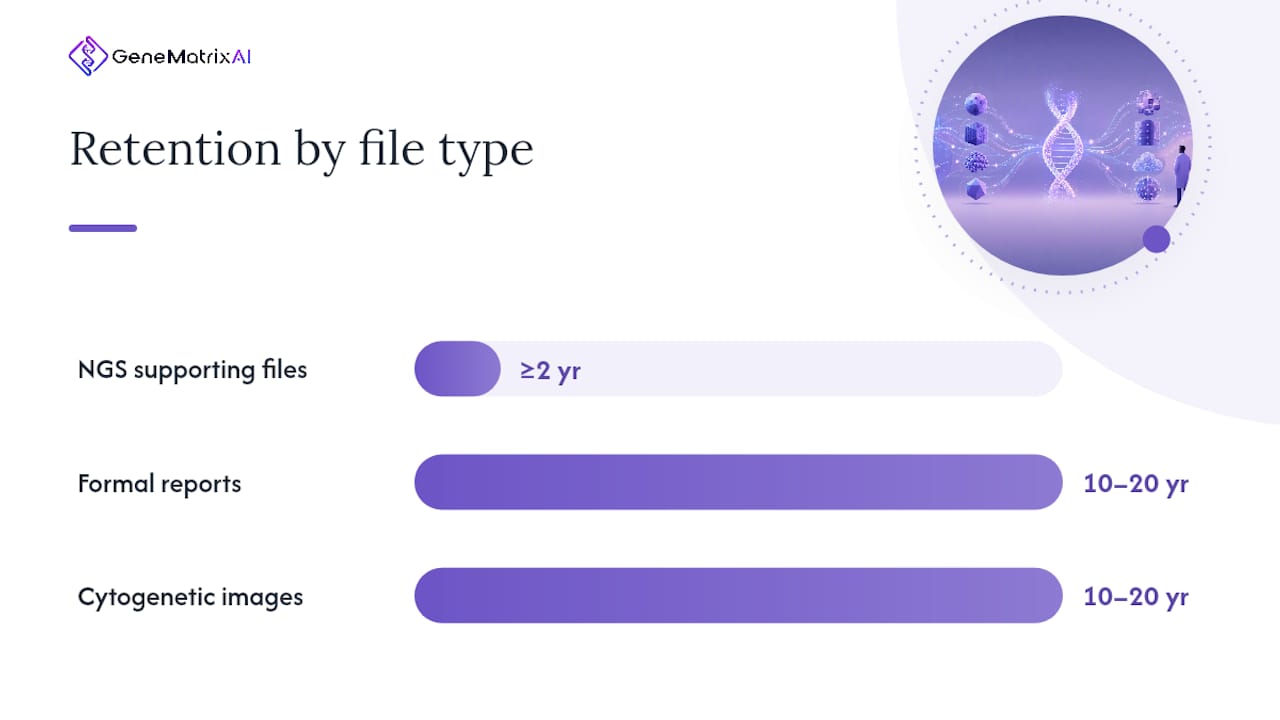
Retention isn't one number. It depends on the file type, and ACMG's points-to-consider statement lays out the general expectations: NGS supporting files commonly need at least two years of retention, while formal reports and cytogenetic images often require ten to twenty years depending on the test. State laws can extend those minimums further, so a lab's policy should never undercut CAP or CLIA guidance.
Your access rights run parallel to that retention clock. Under HIPAA's designated record set framework, you can request your report and the data behind it, typically delivered as a PDF or through a secure patient portal. Larger raw files sometimes ship on an encrypted drive at cost, since email was never built for gigabyte-scale genomic data. For a deeper look at export mechanics, Genematrix's guide to raw data portability walks through what a clinician-facing request typically looks like.
To request your own data:
- Contact the lab's patient services or privacy office directly, not general customer support
- Specify exactly which files you want (report only, or full raw data)
- Ask about delivery format, any associated fee, and expected turnaround
- Get written confirmation once the export or deletion is complete
What Should You Ask a Genetic-Testing Company Before Testing?
Before you submit a sample, request specific evidence rather than accepting general assurances.
- Ask for proof of encryption at rest and in transit, and how encryption keys are managed
- Request a copy of (or summary of) their most recent third-party audit, SOC 2 report, or penetration test
- Confirm CLIA certification and CAP accreditation for the lab actually processing your sample
- Ask for the written retention schedule, broken down by file type
- Ask which third parties receive your data and under what consent terms
Watch for these red flags along the way:
- Vague language like "we use industry-standard security" with no specifics attached
- No documented retention policy you can actually read
- No clinician or patient portal for accessing your own results
- Reluctance to discuss past incidents or an unclear breach history
If a company can't answer these plainly, that's information too. Genematrix's own overview of genetic privacy rights walks through the consent language worth scrutinizing before you sign anything.
What Happens After a Genetic Data Breach?
An effective response follows a sequence: contain the exposure, run a forensic review to determine what was accessed, notify affected patients, then fix the root cause, rotating keys, closing open storage, adding monitoring, and bring in an independent assessor to confirm the fix actually holds.
The FTC's enforcement narrative around a genetic-testing firm's cloud misconfiguration illustrates what regulators scrutinize most closely: unencrypted storage, absent access monitoring, and a company that had been warned before the exposure became public.
Regulators focus less on whether a company uses the cloud and more on whether it actively manages that environment, tracking configuration, watching for drift, and acting on warnings before an incident becomes a breach.
As a patient, expect a notification letter with a specific timeline, sometimes an offer of credit monitoring or similar remediation, and in serious cases, a public enforcement action that forces policy changes going forward.
How Genematrix Approaches Genetic Data Storage
Genematrix operates a CLIA-certified lab and maps retention schedules to CAP-aligned minimums by file type, rather than applying one blanket policy across raw files, reports, and logs. Data is encrypted at rest and in transit with documented key management, and both clinicians and patients get portal access with export options built in. Reports from the GeneMatrixAI platform, trained on more than 500,000 genetic profiles, are typically delivered within 72 hours.
What patients and clinicians can verify directly:
- CLIA certification status for the lab processing samples
- Adherence to CAP retention checklists by file type
- Published data protection and security terms, including HIPAA and GDPR posture
- Stated turnaround times for hereditary cancer and pharmacogenomics panels
| Trust signal | What to look for | Where to verify |
|---|---|---|
| Lab certification | CLIA number, current status | Public lab records or company site |
| Retention policy | File-type-specific schedule | Written security or privacy policy |
| Regulatory posture | HIPAA/GDPR alignment | Company compliance page |
| Access controls | Patient/clinician portal with export | Product demo or account dashboard |
Why Secure Genetic Data Storage Deserves More Scrutiny Than It Gets
The core answer here hasn't changed since the first paragraph: encryption, mapped retention, and real patient control aren't optional extras, they're the baseline. What surprises me is how often the conversation stops at "is it encrypted" and skips the harder question of whether anyone is actually watching the configuration day to day. Ask any lab, including us, to show you the policy in writing. If they can't, that answer matters more than anything on their homepage.
Get Started With Secure Hereditary Cancer Screening
Genematrix runs its testing through a CLIA-certified lab with CAP-aligned retention schedules, encrypted storage, and a patient portal built for export and access requests, not a policy you have to hunt for in fine print.

If you're weighing whether to test for BRCA1/2 or Lynch syndrome risk, you can review the technical and lab certification details on the our science page before you commit. When you're ready, the hereditary cancer screening panel covers 108 genes and comes with the same security practices covered throughout this guide. Clinicians interested in partnership terms or a security summary can start an intake through Genematrix's health intake page.
Frequently Asked Questions About Genetic Data Storage
What is genetic data storage, exactly? It refers to how a testing company stores, secures, and manages your genomic files, from raw sequencing data to your final clinical report, including who can access it and how long it's kept.
Is my genetic data protected by HIPAA? Only if the company is a HIPAA-covered entity or business associate. Many direct-to-consumer firms fall outside that scope, which is why contractual protections and independent audits matter more in that context.
Can I get my raw DNA data deleted? Most labs offer a deletion or export request process. Ask specifically what "delete" includes, since some retain de-identified data for research even after account closure.
How long do labs keep genetic test results? It varies by file type. CAP and CLIA guidance generally expects a minimum of two years for supporting sequencing files and ten to twenty years for many formal reports.
What's the biggest red flag when evaluating a genetic-testing company? Vague security language with no specifics, no written retention policy, and no clear way to access or export your own data.
This article is general information, not a substitute for advice from a qualified doctor. Consult a qualified healthcare professional about your own circumstances before acting on anything here.