

TL;DR:
- Genomics-based patient management integrates genomic data into clinical decisions using advanced tools like NGS, AI, and interoperable systems. Proper infrastructure, workflow integration, and clinician involvement are essential for scalable, accurate, and actionable precision medicine. Emerging AI technologies and living genomic datasets will further transform personalized care while addressing current organizational and educational challenges.
Genomics-based patient management is the practice of integrating an individual's genomic data directly into clinical decisions to guide diagnosis, treatment selection, and ongoing monitoring. Precision medicine, the recognized industry standard term for this discipline, has moved from research labs into routine care settings, powered by next-generation sequencing (NGS), AI-driven clinical decision support, and interoperable data platforms. The eMERGE study demonstrated this at scale: nearly 35% of 23,840 participants received high-risk genome-informed results, with 78.5% of adults completing one-on-one results sessions. That figure confirms genomic risk assessment is no longer a boutique service. It is a scalable clinical function that healthcare systems must be equipped to deliver.
What are the essential tools for genomics-based patient management?
Effective genomics-based patient management begins with sequencing infrastructure, but it does not end there. NGS platforms generate the raw data; the clinical value depends entirely on what happens next. Three layers of digital infrastructure determine whether genomic data reaches the bedside or stalls in a bioinformatics pipeline.

Sequencing and data storage. NGS platforms from Illumina and Thermo Fisher Scientific produce whole-genome, whole-exome, or targeted panel data depending on clinical context. The critical design principle is that versioned, interoperable storage allows dynamic re-analysis as scientific understanding evolves. A static PDF report becomes obsolete the moment a variant is reclassified. A structured, queryable genomic record does not.
Laboratory and clinical system integration. Laboratory Information Management Systems (LIMS) connect sequencing output to clinical workflows. AI-powered LIMS platforms like Labrynix combine pharmacogenomics (PGx) reporting with lab workflow management, reducing manual handoffs between sequencing and clinical teams. Integration with Electronic Health Records (EHR) systems such as Epic or Oracle Health is the final step that places genomic findings in front of the ordering clinician at the point of care.
Clinical decision support (CDS). AI-enabled CDS tools translate variant data into prescribing recommendations, risk flags, and referral triggers. The table below compares the primary infrastructure categories by function and clinical role.
| Tool category | Primary function | Clinical role |
|---|---|---|
| NGS sequencing platform | Generate variant data | Diagnostic foundation |
| LIMS software | Manage lab data and reporting | Workflow and quality control |
| EHR integration layer | Embed genomic data in records | Point-of-care access |
| AI-powered CDS | Interpret variants, flag drug interactions | Treatment decision support |
| Genomic knowledge base | Curate variant classifications | Guideline concordance |
Pro Tip: When evaluating LIMS vendors, confirm that their system supports HL7 FHIR-compliant data exchange. Without it, genomic data will not flow into most major EHR platforms without costly custom integration work.
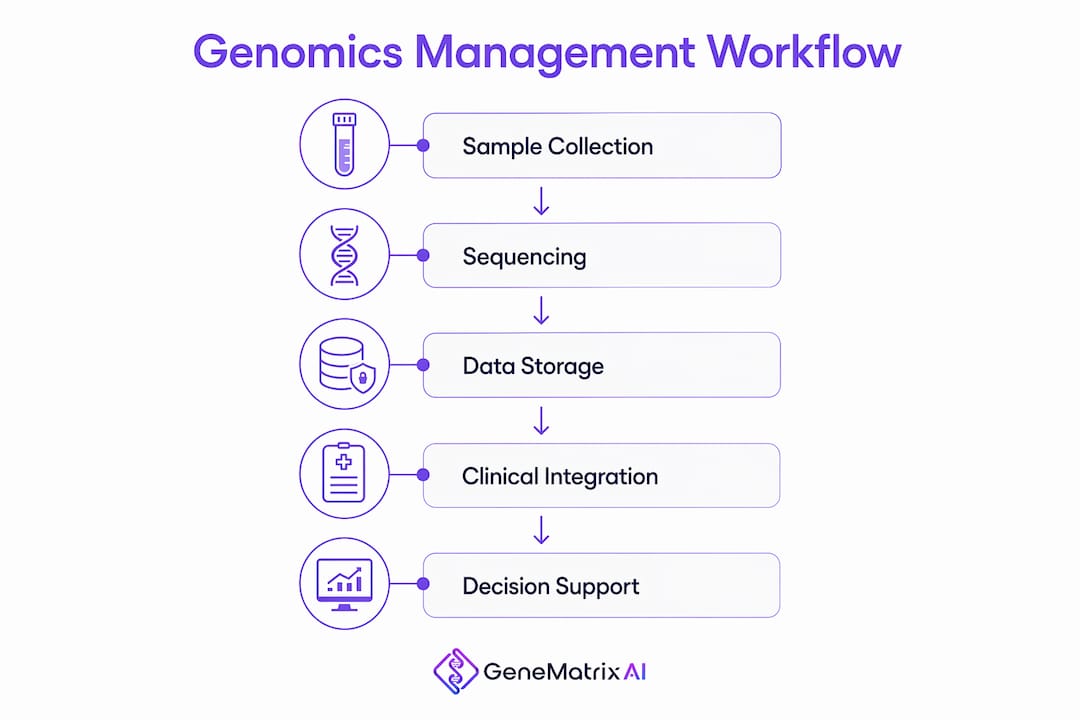
How to integrate genomic data into clinical workflows
Embedding genomic insights into daily clinical practice requires a structured approach. Dropping a variant report into an EHR without workflow design is the fastest way to generate alert fatigue and clinician disengagement. Co-designing CDS tools with front-line clinicians, including GPs, nurses, and pharmacists, is the single most reliable predictor of adoption success.
A practical integration sequence looks like this:
- Define the clinical use case first. Pharmacogenomics for medication optimization, hereditary cancer risk assessment, and rare disease diagnosis each require different data flows and alert logic. Mixing them in a single undifferentiated CDS layer creates noise.
- Map the existing workflow before adding genomic triggers. Identify where clinicians currently make the decisions that genomic data should inform. Insert genomic alerts at those exact moments, not at order entry or discharge where they will be ignored.
- Implement reflex testing protocols. Reflex testing workflows, where an initial result automatically triggers a secondary test, are decisive for variant classification. Targeted reflex RNA-sequencing reclassified 42.2% of variants of uncertain significance (VUS), increasing diagnostic yield by 1.6% and prompting clinical management changes in 71% of positive-result cases. That is not a marginal improvement. It means nearly three-quarters of patients with a previously unactionable result received a changed care plan.
- Constrain alert volume deliberately. Alert fatigue is the primary reason CDS tools fail in practice. Every genomic alert that fires without clinical relevance trains clinicians to dismiss the next one. Set thresholds based on actionability, not completeness.
- Build a feedback loop. Clinicians who can flag incorrect or unhelpful alerts contribute to continuous improvement of the CDS logic. Without this mechanism, errors persist silently.
Best practices for front-line clinician engagement include scheduling brief genomics case reviews during existing team huddles, assigning a genomics champion within each department, and providing decision aids that translate variant classifications into plain clinical language for patient conversations.
Pro Tip: Pilot your CDS integration in a single specialty, such as oncology or cardiology, before health-system-wide rollout. Specialty-specific workflows expose design flaws that a general deployment would spread across the entire organization.
What are the clinical applications and benefits of genomic patient care?
Precision medicine delivers measurable clinical value across three primary domains: rare disease diagnosis, pharmacogenomics-guided prescribing, and precision oncology.
In rare disease, reflex testing pipelines convert variants from uncertain to actionable, preventing diagnostic dead-ends that cost patients years of misdiagnosis. A patient with a VUS in a hereditary cardiomyopathy gene who undergoes reflex RNA-sequencing may receive a definitive diagnosis that changes surveillance frequency, triggers cascade testing in family members, and informs surgical planning.
In pharmacogenomics, genetic factors affecting medication response determine whether a patient metabolizes a drug normally, too fast, or not at all. CYP2D6 poor metabolizers prescribed standard doses of codeine or certain antidepressants face predictable adverse events that genomic testing prevents. Precision medicine eliminates trial-and-error prescribing for these patients entirely.
In oncology, genomics-aware clinical agents evaluated across 375 clinician questions and multiple cancer types demonstrate that workflow-orchestrated AI with curated knowledge outperforms unrestricted large language models on guideline concordance, reasoning, safety, and transparency. That finding matters because oncology decisions carry the highest stakes and the most complex variant-drug interaction profiles.
Key patient benefits from genomics-based care include:
- Faster diagnosis for rare and hereditary conditions, reducing the average diagnostic odyssey from years to weeks
- Reduced adverse drug events through PGx-guided prescribing before the first dose
- Targeted therapy selection in oncology based on tumor genomic profile rather than histology alone
- Proactive risk stratification for conditions like hereditary breast and ovarian cancer (BRCA1/BRCA2) and Lynch syndrome before symptoms appear
- Improved medication adherence when patients understand the genomic rationale for their treatment
What are common challenges in genomic data management?
The barriers to widespread genomics adoption are well-documented and persistent. Challenges including data governance, AI generalizability, and reimbursement models continue to limit equitable access despite decades of sequencing cost reductions. Healthcare organizations that treat these as IT problems will fail. They are organizational and policy problems that require clinical leadership.
| Challenge | Impact | Mitigation strategy |
|---|---|---|
| Data governance and consent | Limits data sharing and re-analysis | Implement dynamic consent frameworks aligned with HIPAA and IRB standards |
| Reimbursement gaps | Reduces test ordering and follow-through | Engage payers early with clinical utility evidence; use CPT code documentation rigorously |
| Clinician genomic literacy | Leads to misinterpretation or avoidance | Embed genomics education in CME programs and residency curricula |
| Alert fatigue from CDS | Causes clinician disengagement | Co-design alert logic with end users; limit alerts to high-actionability variants |
| VUS management | Creates clinical uncertainty | Implement reflex RNA-seq protocols and schedule periodic variant re-analysis |
Front-line clinicians are the principal users of genomic data in practice, yet they are rarely involved in designing the tools they are expected to use. Participatory design, where GPs, nurses, and pharmacists co-develop CDS logic and alert thresholds, is the most effective mitigation for both alert fatigue and low adoption rates. Pharmacogenomics offers a particularly tractable model for this approach because the drug-gene interaction rules are well-curated and the clinical decisions are discrete and repeatable.
Patient genomic literacy deserves equal attention. Patients who understand their results are more likely to complete follow-up testing, share results with family members, and adhere to genomics-informed treatment plans. Plain-language result summaries and structured genetic counseling sessions are not optional add-ons. They are core components of a functional genomic care program.
How will AI and emerging technologies shape genomic patient care?
The next generation of genomics-based patient management will be defined by agentic AI systems, multiomic integration, and standardized cross-institutional knowledge bases. Each of these shifts the ceiling on what precision medicine can deliver at scale.
Agentic AI for pharmacogenomic recommendations achieves 91.9% accuracy across biomedical literature and drug labels, outperforming manual curation. That accuracy level, evaluated on 22 articles and 24 clinical recommendations, means AI-generated PGx guidance is approaching the reliability threshold required for unsupervised clinical deployment. The implication is that PGx recommendations could be generated and updated continuously as new literature publishes, rather than waiting for periodic guideline committee reviews.
Emerging capabilities that will reshape clinical genomics include:
- Multiomic integration: Combining genomic, transcriptomic, proteomic, and metabolomic data increases diagnostic resolution for complex diseases where single-omic analysis is insufficient
- Standardized knowledge bases: Cross-institutional genomic databases reduce the variant classification inconsistencies that currently produce conflicting clinical recommendations across health systems
- Workflow-orchestrated agents: Constrained AI agents with curated tool access outperform general-purpose models on safety and guideline adherence, making them more deployable in regulated clinical environments
- Real-time variant re-analysis: As dynamic genomic data management replaces static reports, patients benefit automatically from new variant classifications without requiring a repeat test
"Workflow-orchestrated clinical agents using curated knowledge offer safer, more accountable precision oncology decisions than less-restricted AI models." — Nature npj Systems Biology and Applications
The accountability question will define how fast these technologies reach patients. AI systems that can explain their reasoning, cite their sources, and flag uncertainty are deployable. Black-box models that cannot are not, regardless of their accuracy metrics.
Key takeaways
Genomics-based patient management succeeds when genomic data is treated as a living clinical asset, embedded in co-designed workflows, and supported by AI tools constrained to curated, guideline-concordant knowledge.
| Point | Details |
|---|---|
| Infrastructure is the foundation | NGS, LIMS, EHR integration, and AI-powered CDS must work as a connected system, not isolated tools. |
| Reflex testing converts uncertainty | RNA-seq reflex workflows reclassified 42.2% of VUS, changing management in 71% of positive cases. |
| Co-design prevents CDS failure | Involving front-line clinicians in alert logic design is the primary defense against alert fatigue and low adoption. |
| AI accuracy is clinically significant | Agentic AI achieves 91.9% accuracy in PGx recommendations, approaching the threshold for scalable deployment. |
| Governance and literacy are non-negotiable | Reimbursement gaps and clinician education deficits limit genomic adoption more than sequencing costs do. |
Why genomic data should never be treated as a static report
I have seen the same failure pattern repeat across health systems that invest in genomic testing but not in genomic infrastructure. A clinician orders a panel, receives a PDF, acts on the result, and files it. Two years later, a variant that was classified as uncertain is reclassified as pathogenic. Nobody knows. The patient is never recalled. The opportunity is lost.
Treating genomic data as a living dataset stored in versioned, queryable formats is not a technical preference. It is a clinical obligation. The science moves faster than any individual clinician can track, which means the infrastructure has to do the tracking.
The second pattern I find consistently underestimated is the cost of excluding clinicians from CDS design. A genomic alert that fires at the wrong moment in a workflow, uses terminology a GP does not recognize, or requires three clicks to dismiss will be dismissed every time. The genomic data was correct. The implementation was wrong. Those two failures look identical from the patient's perspective.
My honest recommendation: before any health system expands its genomic testing menu, it should audit whether its existing genomic results are being acted on, re-analyzed as classifications change, and communicated to patients in a form they can use. Expansion without that foundation produces volume, not outcomes.
— Tarek
How Genematrix supports precision genomic patient care
Genematrix delivers the infrastructure and AI-powered analysis that health systems need to move from genomic testing to genomic patient management. The GeneMatrixAI platform processes hereditary cancer screening, pharmacogenomics, and personalized wellness reports within 72 hours, trained on 500,000+ genetic profiles. For laboratories, Genematrix LIMS provides AI-enhanced workflow management that connects sequencing output directly to clinical reporting.

Genematrix's specialized modules, including GeneCancer for BRCA1/BRCA2 and Lynch syndrome risk, GenePGx for drug-gene interaction analysis, and GeneMind for psychiatric pharmacogenomics, are built for health systems that need scalable, CLIA-certified genomic programs. Explore hereditary cancer testing and precision medicine services to see how Genematrix supports clinical genomics at the institutional level.
FAQ
What is genomics-based patient management?
Genomics-based patient management is the integration of a patient's genomic data into clinical decisions to personalize diagnosis, treatment selection, and monitoring. It relies on NGS sequencing, AI-powered CDS tools, and interoperable data systems to translate genetic findings into care actions.
How does genomic testing improve treatment outcomes?
Genomic testing eliminates trial-and-error prescribing in pharmacogenomics and enables targeted therapy selection in oncology. Reflex RNA-sequencing workflows have been shown to prompt clinical management changes in 71% of cases where a previously uncertain variant was reclassified.
What is a variant of uncertain significance (VUS)?
A VUS is a genetic variant whose clinical impact has not yet been established. Reflex testing protocols, particularly targeted RNA-sequencing, reclassify a significant proportion of VUS findings into actionable categories, enabling treatment decisions that would otherwise be impossible.
Why do CDS tools fail in genomic workflows?
Poor CDS tool design that ignores clinical workflow context is the primary cause of failure. Alert fatigue, irrelevant timing, and unfamiliar terminology drive clinician disengagement. Co-designing tools with GPs, nurses, and pharmacists is the most effective solution.
How accurate is AI for pharmacogenomic recommendations?
Agentic AI systems for PGx recommendations achieve 91.9% accuracy across biomedical literature and drug labels, outperforming manual curation methods. This level of accuracy positions AI as a viable tool for scalable, continuously updated PGx guidance in clinical settings.