

TL;DR:
- Clinical genomics analyzes an individual's full genome to guide diagnosis, treatment, and prevention more comprehensively than traditional genetics. It requires CLIA-certified laboratories, multidisciplinary interpretation, and delivers results within days, enabling personalized medicine applications across healthcare. Unlike consumer tests, clinical genomics provides diagnostic accuracy, dynamic updates, and essential clinical guidance for informed medical decision-making.
Clinical genomics is the medical practice of analyzing an individual's complete genetic makeup to guide diagnosis, personalized treatment, and disease prevention. Unlike traditional genetics, which focuses on single-gene disorders, clinical genomics examines interactions across the entire genome to give physicians a far more complete picture of a patient's health. This field sits at the intersection of molecular biology, bioinformatics, and clinical medicine. Genematrix, a CLIA-certified precision medicine company based in Chicago, applies this science daily to deliver personalized genomic insights that shift care from reactive treatment to proactive prevention.
What is clinical genomics and how does it differ from traditional genetics?
Clinical genomics is defined as the integration of whole-genome data into routine medical practice for diagnosis, treatment planning, and preventive care. Traditional genetics examines one gene or a small panel of genes at a time. Clinical genomics sequences nearly the entire genome, capturing variants, mutations, and gene interactions that a targeted panel would miss entirely.

The practical difference is significant. A cardiologist ordering a traditional genetic panel for a patient with unexplained arrhythmia might test 50 known genes. A clinical genomics workup sequences all 20,000-plus protein-coding genes and the regulatory regions between them. That broader view regularly uncovers diagnoses that targeted panels overlook, particularly in rare disease cases where the causative gene is not yet on any standard panel.
Clinical genomics also requires a multidisciplinary team. Medical geneticists, genetic counselors, oncologists, and primary care physicians all contribute to interpreting results in the context of a patient's full clinical picture. This collaborative model is what separates a clinical genomics report from a consumer ancestry kit.
How does clinical genomics testing work?
The testing process follows a structured pathway from sample collection to clinical report, and understanding each step helps patients and clinicians set realistic expectations.
-
Sample collection. Testing begins with a biological sample, most commonly a blood draw, though hair, skin, or saliva samples are also used depending on the clinical question. The sample is sent to a certified laboratory for processing.
-
Laboratory sequencing. The lab performs whole-genome sequencing (WGS) or whole-exome sequencing (WES) using next-generation sequencing (NGS) technology. Clinical-grade labs are CLIA-certified and CAP-accredited, which means they meet federal and professional standards for diagnostic accuracy. Consumer tests, by contrast, use microarray technology that samples less than 0.1% of the genome.
-
Bioinformatics analysis. Raw sequencing data is processed through computational pipelines that identify variants, flag pathogenic mutations, and cross-reference findings against curated databases such as ClinVar and OMIM.
-
Multidisciplinary interpretation. A team of medical geneticists and counselors reviews the variant data in the context of the patient's clinical history, family history, and presenting symptoms. This step is where clinical genomics earns its "clinical" designation.
-
Report delivery and counseling. The patient receives a structured clinical report, followed by a genetic counseling session to explain findings, implications for family members, and recommended next steps.
Physician-ordered clinical-grade whole-genome sequencing typically costs around $499, though insurance coverage varies widely depending on the indication and payer. Results from platforms like Genematrix's GeneMatrixAI are delivered within 72 hours, compared to weeks for many traditional lab workflows.
Pro Tip: Always confirm that your genomics provider operates a CLIA-certified lab before ordering. A certificate number should be publicly verifiable. Providers without CLIA certification cannot legally report diagnostic results in the United States.
What are the key applications and benefits of clinical genomics in healthcare?
Clinical genomics has moved well beyond rare disease diagnosis. Its applications now span oncology, pharmacogenomics, preventive medicine, and pediatric care, each with measurable patient benefits.
-
Oncology and personalized cancer therapy. Next-generation sequencing enables oncologists to identify the specific mutations driving a tumor, then match the patient to targeted therapies rather than standard chemotherapy protocols. This approach improves progression-free survival and reduces treatment toxicities. Genematrix's GeneCancer module, for example, screens for BRCA1, BRCA2, Lynch syndrome, and dozens of other hereditary cancer markers.
-
Rare disease diagnosis. Patients with undiagnosed conditions often spend years cycling through specialists before receiving a diagnosis. Clinical genomics shortens that journey by analyzing the full genome in a single test, identifying causative variants that targeted panels routinely miss.
-
Pharmacogenomics (PGx). Drug-gene interactions cause a significant proportion of adverse drug reactions. Clinical genomics identifies variants in genes like CYP2D6 and CYP2C19 that predict how a patient will metabolize specific medications. Genematrix's GenePGx module translates this data into prescribing guidance that physicians can act on immediately.
-
Proactive genetic baselines. Clinical genomics is increasingly used as a lifelong genetic baseline that integrates with wearable sensors and digital health platforms to support ongoing preventive monitoring. Rather than waiting for symptoms, patients and physicians use genomic data to anticipate risk and intervene earlier.
-
Pediatric and psychiatric applications. Genematrix's GeneBaby and GeneMind modules extend clinical genomics into pediatric developmental concerns and psychiatric medication selection, two areas where genetic context dramatically changes clinical decision-making.
The importance of clinical genomics in healthcare extends beyond individual patients. At the population level, genomic data informs drug development, disease surveillance, and public health policy. Platforms that use AI trained on large genomic datasets, as Genematrix does with its 500,000-plus profile training set, can surface patterns that no individual clinician could detect manually.
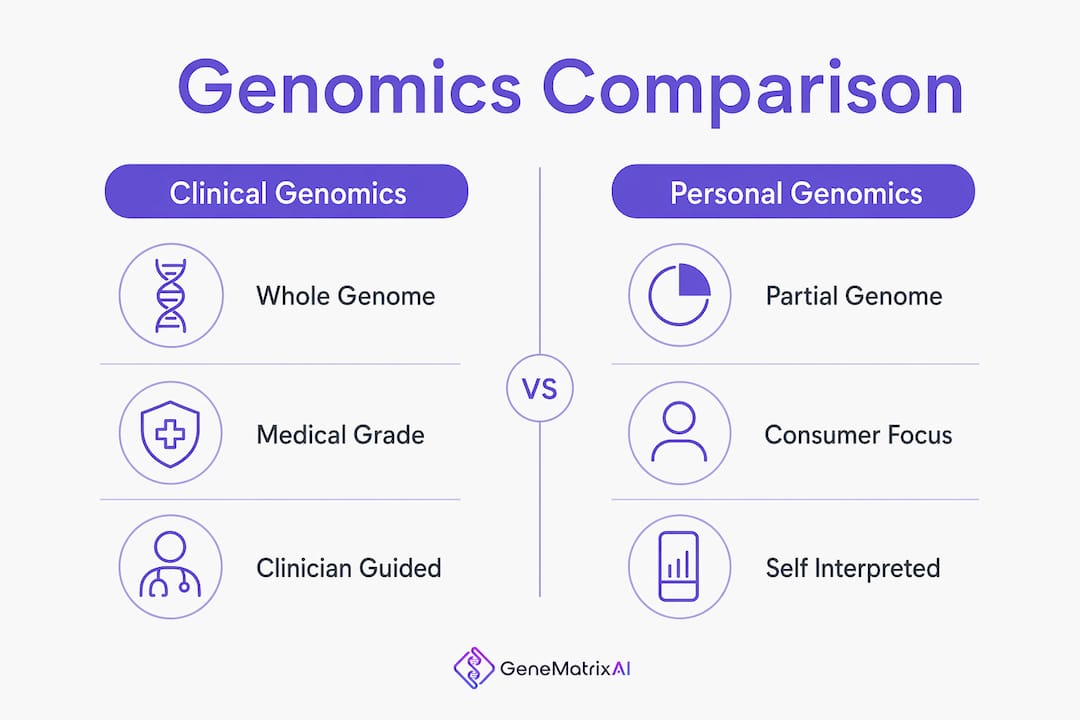
How does clinical genomics compare to personal genomics tests?
The distinction between clinical genomics and direct-to-consumer (DTC) personal genomics tests is not a matter of degree. It is a fundamental difference in purpose, methodology, and regulatory standing.
| Feature | Clinical genomics | Personal genomics (DTC) |
|---|---|---|
| Genome coverage | Nearly 100% via WGS or WES | Less than 0.1% via microarray |
| Lab certification | CLIA-certified, CAP-accredited | Not required for DTC |
| Result type | Diagnostic, clinically actionable | Probabilistic, exploratory |
| Interpretation | Medical geneticist and counselor | Algorithmic, no clinical review |
| Physician involvement | Required for clinical-grade tests | Not required |
| Legal diagnostic use | Yes | No |
Personal genomics tests like those offered by consumer platforms analyze a limited set of known markers and return probabilistic estimates of disease risk. They are useful for ancestry exploration and general wellness curiosity. They are not appropriate for making treatment decisions, confirming a diagnosis, or assessing hereditary cancer risk with clinical confidence.
A patient who receives a "low risk" result from a DTC test for BRCA1 mutations may still carry a pathogenic variant that the microarray simply did not interrogate. Clinical genomics sequences the entire BRCA1 and BRCA2 genes, including rare variants, with the diagnostic accuracy required to inform surgical or pharmacological decisions.
Pro Tip: If a family member has been diagnosed with a hereditary condition, do not rely on a DTC test to assess your own risk. Request a physician-ordered clinical genomics test from a certified genomics provider that sequences the relevant genes at diagnostic depth.
What are the ethical considerations in clinical genomics?
Clinical genomics generates information that extends beyond the individual patient, and that reality creates ethical obligations that the field takes seriously.
-
Informed consent. The National Model of Consent standardizes how patients are educated before genomic testing. Consent protocols cover what the test can and cannot detect, the possibility of incidental findings, and the implications for biological relatives. Documented consent is required before any clinical genomics test proceeds.
-
Incidental and secondary findings. Whole-genome sequencing sometimes reveals variants unrelated to the original clinical question. The American College of Medical Genetics and Genomics (ACMG) maintains a list of genes for which secondary findings should be reported, because the clinical benefit of knowing outweighs the psychological burden of unexpected information.
-
Family implications. A pathogenic variant in BRCA2 or a Lynch syndrome gene affects not just the patient but potentially every first-degree relative. Clinical genomics teams include genetic counselors specifically to help patients navigate these conversations and decide how and whether to share findings with family members.
-
Data privacy. Genomic data is the most personally identifying biological information that exists. Clinical genomics providers operating under HIPAA and CLIA regulations are bound by strict data governance standards. Patients should ask providers directly how their genomic data is stored, who can access it, and whether it is used for research.
-
Evolving results. Genomic results can change as science advances. A variant classified as "uncertain significance" today may be reclassified as pathogenic within two years. Dynamic platforms that update patient profiles as new evidence emerges provide meaningfully better care than static PDF reports that never change.
Key takeaways
Clinical genomics delivers medically definitive, whole-genome insights that consumer tests cannot replicate, and its value compounds over a patient's lifetime as science advances and new variants are classified.
| Point | Details |
|---|---|
| Clinical genomics definition | Analyzes the complete genome for diagnosis, treatment, and prevention in a certified clinical setting. |
| Testing standards matter | Only CLIA-certified, CAP-accredited labs produce results legally usable for clinical decisions. |
| DTC tests are not equivalent | Consumer tests cover less than 0.1% of the genome and cannot confirm or rule out diagnoses. |
| Ethics and consent are built in | Standardized consent models and genetic counseling protect patients before and after testing. |
| Results evolve over time | Dynamic genomic platforms update variant classifications as new research emerges, unlike static reports. |
Why clinical genomics is the baseline I'd want for every patient I advise
I've spent years watching patients arrive at specialist appointments carrying DTC test printouts, convinced they've already "done the genetic testing." The gap between what those reports contain and what a clinical genomics workup reveals is genuinely striking. A consumer microarray is a photograph taken from orbit. Whole-genome sequencing is a street-level map.
What I find most underappreciated is the longitudinal value. A genomic baseline taken today becomes more informative every year as variant databases grow and AI models trained on larger populations refine their predictions. Platforms like Genematrix's GeneMatrixAI, which continuously integrate new evidence into existing patient profiles, are not just delivering a one-time report. They are building a living clinical document.
The multidisciplinary model also matters more than most patients realize. The genetic counselor in a clinical genomics workflow is not a formality. That person translates probabilistic variant data into language a patient can act on, helps families decide how to share findings, and provides psychological support that a PDF report simply cannot offer. Choosing a provider that includes counseling in the workflow is not optional. It is the difference between data and care.
— Tarek
Discover Genematrix's clinical genomics solutions

Genematrix brings clinical-grade genomics to hospitals, physicians, and health systems across the United States. The GeneMatrixAI platform delivers results within 72 hours from a CLIA-certified lab, with AI analysis trained on 500,000-plus genetic profiles. Whether you need hereditary cancer screening through GeneCancer, pharmacogenomics guidance through GenePGx, or a comprehensive precision medicine baseline, Genematrix provides the clinical depth and expert interpretation that patient care demands. Explore Genematrix's testing science and certifications to understand exactly how each result is produced and validated before it reaches a clinician's hands.
FAQ
What is the clinical genomics definition in simple terms?
Clinical genomics is the use of a person's complete DNA sequence to make medical decisions about diagnosis, treatment, and disease prevention. It differs from traditional genetics by analyzing the entire genome rather than individual genes.
What is clinical grade genomics and why does it matter?
Clinical grade genomics refers to whole-genome sequencing performed in a CLIA-certified, CAP-accredited laboratory with results interpreted by medical geneticists. This certification level is required for results to be used in diagnosis or treatment decisions.
How long does a clinical genomics test take?
Turnaround time varies by provider and test type. Platforms like Genematrix's GeneMatrixAI deliver results within 72 hours, while some traditional lab workflows take two to four weeks.
Can clinical genomics results change over time?
Yes. As scientific databases grow and new variants are classified, a result previously labeled "uncertain significance" may be reclassified as pathogenic or benign. Dynamic platforms update patient profiles automatically, while static PDF reports do not.
Is clinical genomics covered by insurance?
Coverage depends on the clinical indication, the payer, and the specific test ordered. Physician-ordered tests for hereditary cancer risk or rare disease diagnosis are more likely to receive coverage than general wellness genomics. Patients should verify benefits before testing.