

TL;DR:
- Genomic insights provide a comprehensive view of how our DNA influences health risks, drug responses, and disease susceptibility before symptoms appear.
- They extend beyond single genes, capturing complex interactions and environmental factors, informing personalized diagnostics, treatment, and prevention strategies.
Most people assume genomic insights are only relevant when something has already gone wrong. They picture rare diseases, genetic disorders, or a cancer diagnosis. The reality is far broader. Genomic insights explained properly reveal a complete picture of how your DNA shapes cancer susceptibility, drug metabolism, and long-term health risks before symptoms appear. Genomic medicine examines your entire genome to inform personalized diagnostics, treatment, and prevention. For individuals and families thinking seriously about health, this is where modern medicine is heading.
Table of Contents
- Key takeaways
- Genomic insights explained: what your DNA actually reveals
- How genome sequencing works
- From raw data to real health information
- Practical applications for individuals and families
- Limitations, ethics, and what comes next
- My honest take on genomic medicine right now
- See how Genematrix puts genomic insights to work
- FAQ
Key takeaways
| Point | Details |
|---|---|
| Genomics goes beyond single genes | Your full genome, not one mutation, shapes disease risk, drug response, and long-term health. |
| Sequencing once unlocks lifetime value | Raw genomic data stored correctly can be reanalyzed as science advances, without repeat testing. |
| Pharmacogenomics reduces guesswork | Knowing how your body processes drugs helps physicians prescribe safely the first time. |
| Cancer risk screening is proactive | Hereditary cancer gene panels identify risk years before any diagnosis, allowing early intervention. |
| Ethical considerations matter | Data privacy, consent, and equitable access are real challenges that patients should understand upfront. |
Genomic insights explained: what your DNA actually reveals
The word "genomics" gets used interchangeably with "genetics," but they describe different scopes of inquiry. Genetics traditionally focuses on individual genes and specific inherited traits, like a single mutation causing cystic fibrosis. Genomics examines the entire genome, all three billion base pairs, and how they interact with each other, with environmental factors, and with your lifestyle over time.
A genomic insight is a clinically meaningful finding drawn from that full-genome analysis. It might tell you that you carry a BRCA2 variant linked to elevated breast cancer risk. It might reveal that your liver metabolizes a common antidepressant too quickly for a standard dose to work. It might identify a polygenic risk pattern suggesting you are at higher-than-average risk for early-onset cardiovascular disease. None of these findings come from a single gene. All of them require looking at the broader genomic picture.
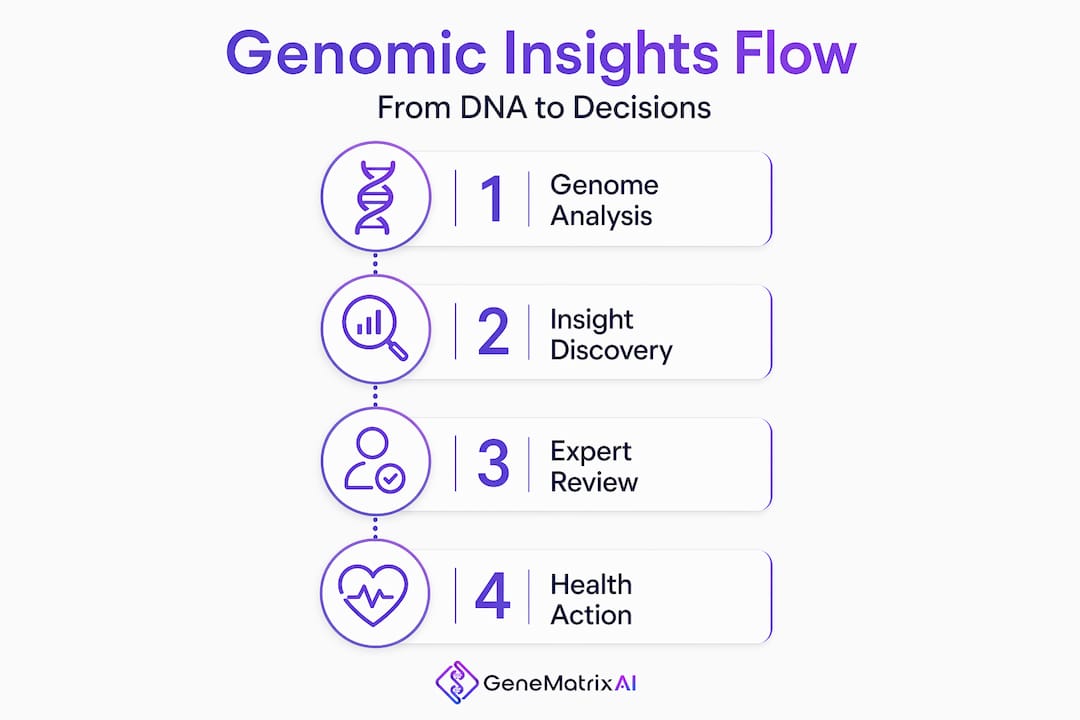
This distinction matters for families making real decisions. Understanding genomic insights at this level shifts the conversation from "do I have a disease gene?" to "how does my entire genetic makeup shape my health trajectory?" That is a fundamentally different and far more useful question.
How genome sequencing works
Generating genomic data starts with a biological sample, typically a saliva swab or blood draw. That sample goes through sequencing technology that reads your DNA base by base and identifies variations across your genome.
The most common variations analyzed include:
- Single nucleotide polymorphisms (SNPs): Single-letter changes in the DNA code that influence disease risk and drug response
- Structural variants: Larger rearrangements, deletions, or duplications that can disrupt gene function significantly
- Copy number variants: Repeated or missing segments of DNA that alter gene dosage
Next-generation sequencing has made comprehensive genome analysis affordable enough to use routinely in clinical settings. Standard short-read sequencing covers the genome efficiently and accurately for most clinical applications. When the focus shifts to rare hereditary conditions, long-read sequencing adds an important layer by detecting complex structural variants that short-read methods miss entirely.
There is also an important distinction between whole genome sequencing, gene panels, and genotyping arrays. Panels test a defined set of disease-relevant genes, making them practical and cost-effective for targeted cancer risk screening. Whole genome sequencing captures everything. Polygenic risk scoring uses hundreds of common variants to calculate risk across a spectrum rather than a binary positive or negative result.
Pro Tip: Ask your provider whether your raw genomic data will be stored for future reanalysis. The "Sequence Once, Query Often" model means your sequencing results stay valuable as science improves, without you paying for repeat tests.
From raw data to real health information
Generating sequencing data is the beginning, not the end. Raw genomic files contain billions of data points, and turning that into a report your physician can act on requires significant expertise and infrastructure.

Bioinformatics pipelines filter and align raw sequence reads against a reference genome. They flag variants and compare them to databases of known pathogenic mutations. Then AI and machine learning take on the task of identifying pathogenic variants, predicting drug response patterns, and detecting polygenic risk at a scale no human analyst could manage alone. This is where platforms like Genematrix's GeneMatrixAI make a meaningful difference, applying models trained on hundreds of thousands of genetic profiles to generate reports within 72 hours.
But the technology alone does not complete the picture. Gene-environment interactions add another layer of complexity. A genetic variant may only increase disease risk significantly when combined with specific lifestyle or environmental exposures. A variant linked to drug toxicity might not matter clinically if the patient never needs that drug class.
Genomic insights must be integrated by primary care providers in a team-based model involving genetic counselors and bioinformatics specialists to have real clinical impact.
This is why multidisciplinary interpretation teams are not a luxury. They are a requirement for responsible genomic medicine. A physician reading a variant report without a genetic counselor risks misinterpreting a variant of uncertain significance as a definitive finding, or worse, dismissing a meaningful result as noise.
Pro Tip: Before ordering a genomic test, confirm that a genetic counselor is available to review your results. Pre-test and post-test counseling sessions change how patients understand and act on their findings.
Practical applications for individuals and families
Understanding genomic insights in the abstract is one thing. Seeing how they apply to your family's health decisions is another. Here are the four most consequential ways genomic data gets used in clinical practice today:
-
Hereditary cancer risk screening. Gene panels covering BRCA1, BRCA2, Lynch syndrome genes, and dozens of other hereditary cancer markers tell you whether your risk is elevated enough to warrant earlier or more frequent screening. Multi-gene panels increase diagnostic yield and identify at-risk relatives who can then be screened before any cancer appears.
-
Medication optimization through pharmacogenomics. Pharmacogenomics allows physicians to evaluate how your genetic profile affects drug metabolism, replacing trial-and-error prescribing with genetically informed decisions. If you are a poor metabolizer of a drug class, your provider knows to start at a lower dose or choose an alternative entirely. You can learn more about how this works in practice through resources on DNA-based medication outcomes.
-
Early detection of chronic disease risk. Polygenic risk scores now calculate your likelihood of developing conditions like type 2 diabetes, cardiovascular disease, or Alzheimer's years before symptoms emerge. This gives families a window to modify lifestyle, increase monitoring, and intervene early.
-
Family health planning. A genomic finding in one person has implications for siblings, parents, and children. Cascade testing, where family members get targeted testing after a pathogenic variant is found in a relative, is one of the highest-value applications of the genomic insights workflow. One test result can change the health trajectory of an entire family.
The advantages of genomic insights extend well beyond any single condition. They create a proactive, personalized framework for health that replaces the traditional "wait and see" model.
Limitations, ethics, and what comes next
Genomic medicine is genuinely powerful. It is also genuinely incomplete. Knowing the limitations helps you and your family make better decisions about what to test, when to test, and how much weight to give the results.
| Challenge | Current reality | Direction forward |
|---|---|---|
| Incomplete knowledge | Many variants are classified as "uncertain significance" | Databases expand as more populations are sequenced |
| Data privacy | Genomic data is uniquely identifiable and permanent | Stronger encryption and regulatory frameworks are developing |
| Health disparities | Most genomic databases overrepresent European ancestry | Population-tailored risk scores are improving accuracy across ethnic groups |
| Cost and access | Whole genome sequencing remains expensive for uninsured patients | Prices continue to fall as clinical adoption grows |
| Ethical consent | Patients often don't understand what they consented to share | Standardized pre-test counseling is gaining ground |
Ethical challenges around informed consent, genetic discrimination, and data security are not hypothetical. They affect real patients today. The Genetic Information Nondiscrimination Act (GINA) in the United States offers some protection against discrimination in employment and health insurance, but gaps remain, particularly in life and disability insurance.
Looking ahead, the field is moving toward multi-omics integration, combining genomic data with proteomics, metabolomics, and microbiome data to build far richer health models. AI will continue expanding what is detectable and interpretable. The top genomic insights tools in 2026 already incorporate these layers to varying degrees, and the gap between early adopters and standard care is closing faster than most people expect.
My honest take on genomic medicine right now
I've spent years watching how patients respond when they first receive genomic results. The single most consistent problem is not the science. It's the expectation gap.
People come in expecting a binary answer. Either they have the gene or they don't. Either they are safe or they are not. What they get instead is a probability landscape, a set of risks that shift their odds but don't write their fate. That nuance is hard to communicate in a 15-minute appointment, and it is where so much of the current system falls short.
What I've found works better is framing genomic insights the way a financial advisor frames risk tolerance. Your genome tells you where your exposures are concentrated. It does not tell you what will happen. It tells you where to pay attention, where to intervene early, and what conversations to have with your care team. That reframe changes everything about how patients engage with the information.
I've also seen how much value a well-structured genomic profiling process adds when the team around it is right. A platform delivering a report in 72 hours means nothing if the patient has no one to walk them through it. The technology is ready. The care model around it is still catching up in most clinical settings.
My advice to any family considering genomic testing: ask your provider not just what they will test, but how the results will be explained, who will explain them, and whether your data can be reanalyzed as knowledge improves. Those three questions separate a valuable genomic experience from an expensive piece of paper.
— Tarek
See how Genematrix puts genomic insights to work

If you are ready to move from understanding genomic insights to acting on them, Genematrix offers a clear path forward. Their hereditary cancer genetic testing and precision medicine services cover everything from BRCA1/BRCA2 and Lynch syndrome screening to full pharmacogenomics panels, with AI-powered reports delivered within 72 hours. The GeneMatrixAI platform is trained on over 500,000 genetic profiles, which means your results are interpreted with a depth that goes well beyond standard lab reporting.
For families who want ongoing access to their genetic health data, the GeneMatrix mobile app puts your reports, medication guidance, and wellness recommendations on your phone, available whenever a health decision needs to be made. Whether you are working with a physician, a genetic counselor, or navigating a new medication choice, Genematrix is built to give you the information you need to make confident decisions.
FAQ
What is a genomic insight?
A genomic insight is a clinically meaningful finding derived from analyzing your full genome. It goes beyond single-gene results to include cancer risk patterns, drug metabolism profiles, and polygenic risk scores that inform personalized health decisions.
How is genomic testing different from ancestry DNA testing?
Clinical genomic testing is designed to identify medically relevant variants linked to disease risk and drug response. Ancestry tests use a much smaller set of markers and are not designed or validated for health decision-making.
What is pharmacogenomics and why does it matter?
Pharmacogenomics examines how your genes affect your response to medications. It helps physicians choose drugs and doses that are more likely to work safely for your specific genetic profile, reducing adverse reactions and the trial-and-error cycle of prescribing.
Can genomic testing identify my cancer risk before I have symptoms?
Yes. Hereditary cancer gene panels can identify pathogenic variants in genes like BRCA1, BRCA2, and Lynch syndrome genes that significantly elevate cancer risk, allowing for earlier screening and risk-reducing interventions before any cancer develops.
Is my genomic data private and secure?
Reputable clinical testing providers use encryption and strict data governance protocols. In the United States, GINA provides some legal protection against genetic discrimination in employment and health insurance, though gaps remain in other insurance categories. Always review the data policy of any provider before testing.