

TL;DR:
- Genetic profiles are complex and require careful interpretation beyond a simple yes-no result.
- Modern sequencing and AI tools improve accuracy but understanding variant classification is critical for proper health decisions.
- Ongoing expert guidance and updates are essential for making the most of genetic testing insights.
Genetic test results are not a simple yes-or-no answer. Many people assume that getting a DNA test delivers a clear verdict, but the reality is far more nuanced. A genetic profile is a layered document of biological signals, each requiring careful interpretation before it can guide a real health decision. Whether you're evaluating hereditary cancer risk or figuring out why a medication isn't working the way it should, the quality of the analysis behind your results matters enormously. Germline genetic testing uses NGS multi-gene panels to uncover actionable genetic risks, and understanding how that process works puts you in control of your own healthcare.
Table of Contents
- The building blocks: What makes up a genetic profile?
- How advanced technology decodes your genes
- From sequence to action: Clinical interpretation and its impact
- Benefits and limitations: Making informed genetic decisions
- Why most people misunderstand what genetic analysis can (and can't) do
- Unlock next-level personalized healthcare with Gene Matrix
- Frequently asked questions
Key Takeaways
| Point | Details |
|---|---|
| Multi-gene panels guide health | Comprehensive panels uncover cancer risks and drug sensitivities for precise care. |
| Technology improves accuracy | Long-read sequencing and AI tools boost detection, especially in complex cases. |
| Clinical actions follow results | Findings inform tailored screening, medication adjustments, and ongoing prevention. |
| Limits require expert guidance | Uncertain or changing results stress the value of ongoing expert support. |
The building blocks: What makes up a genetic profile?
After introducing why genetic profiling matters, let's look at what a genetic profile actually contains and why each element shapes your health decisions.
A genetic profile is a structured map of the variations found in your DNA. It's generated by comparing your genetic sequence to a reference genome and flagging differences that may carry clinical significance. These differences come in several types, including single nucleotide variants (SNVs), small insertions or deletions called indels, and larger structural variants that rearrange or duplicate entire segments of a chromosome.
Not all variants are equal. Here's what a typical genetic profile captures:
- Germline variants: Inherited from your parents and present in every cell, these are the primary target for hereditary cancer screening
- Somatic variants: Acquired during your lifetime in specific tissues, more relevant for tumor profiling
- SNVs and indels: The most common types, detected with high reliability by modern sequencing
- Structural variants: Larger changes, often requiring specialized technology to detect accurately
The reason multi-gene panels assess dozens of genes for cancer risk, such as BRCA1 and BRCA2, is that cancer and drug metabolism involve interconnected pathways. Testing a single gene misses the bigger picture. Panels covering 30 to 80 genes give clinicians the context needed to form a complete picture of risk.
Every variant in your profile is assigned a pathogenicity classification, ranging from pathogenic (clearly disease-causing) to benign (no known risk). This classification drives the clinical actions your care team will recommend. A deeper look at genetic risk assessment shows how these classifications translate into real screening protocols.
"The difference between a variant that changes your life and one that doesn't lies almost entirely in how accurately it's classified, not just detected."
For anyone beginning this process, reading more about gene panel testing insights can help frame what to expect from your results.
How advanced technology decodes your genes
Now that we know the main components of your genetic profile, let's look at how cutting-edge technology makes sense of so much genetic data.
Not all sequencing is created equal. The two dominant approaches, short-read and long-read sequencing, each have real strengths depending on what you're trying to find.
Short-read sequencing chops DNA into small fragments (typically 150 to 300 base pairs), sequences them in parallel, and reassembles the results. It's fast, cost-effective, and highly accurate for SNVs and common indels. Long-read sequencing, by contrast, reads much longer DNA strands without fragmentation. This makes it significantly better at resolving complex genomic regions and structural variants. Long-read sequencing outperforms short-read approaches specifically in structural and complex regions where traditional methods struggle.
| Feature | Short-read | Long-read | AI-enhanced analysis |
|---|---|---|---|
| Read length | 150-300 bp | 10,000+ bp | Applied to both |
| SNV accuracy | Very high | High | Near-perfect |
| Structural variants | Limited | Excellent | Improved |
| Cost | Lower | Higher | Adds value to either |
| Best use case | Common cancer panels, PGx | Complex cancers, rare disease | All clinical decisions |
The game-changer in modern genomics is AI-powered variant calling. Tools like DeepVariant analyze sequencing data using deep learning models trained on millions of reads. AI callers significantly boost variant detection accuracy, particularly in regions that stump traditional algorithms. For a broader view of how this technology is changing medicine, the personalized medicine guide is a useful reference.

Pro Tip: If your test involves a known gene rearrangement, a fusion event, or a region with high repetitive sequence content, ask your provider specifically whether long-read or AI-enhanced analysis was used. These are the cases where the technology gap matters most.
Exploring AI benefits in genomics reveals just how far the field has moved beyond manual interpretation in the last few years.
From sequence to action: Clinical interpretation and its impact
With sequencing technology laying the groundwork, the next step is understanding what your results actually mean for your health and treatment.
Detecting a variant is only half the job. The critical work happens during clinical interpretation, where laboratory scientists and genetic counselors weigh the evidence behind each finding. Variants are classified using a five-tier system established by ACMG (American College of Medical Genetics):
- Pathogenic: Strong evidence of disease causation. Triggers immediate clinical action.
- Likely pathogenic: High confidence of harm. Usually acted on similarly to pathogenic.
- Variant of uncertain significance (VUS): Insufficient evidence. Monitored, not acted on directly.
- Likely benign: Probably harmless. No action typically taken.
- Benign: No known health impact. Reported for completeness.
The clinical cascade after a pathogenic finding is direct. For a BRCA1-positive result, panel findings trigger tailored MRI schedules and surveillance starting as early as age 30, plus risk-reduction conversations. For pharmacogenomics, a DPYD variant (which affects how the body breaks down certain chemotherapy drugs) can lead to dose reductions before a patient ever experiences a toxic reaction.
| Gene | Variant type | Clinical action |
|---|---|---|
| BRCA1/2 | Pathogenic germline | Annual breast MRI, surgical risk reduction options |
| DPYD | Poor metabolizer | Reduced 5-fluorouracil dose or alternate drug |
| Lynch syndrome genes | Pathogenic germline | Colonoscopy every 1-2 years from age 25 |
| CYP2C19 | Poor/rapid metabolizer | Antidepressant or antiplatelet drug adjustment |
Pro Tip: When you receive results, always ask your care team: "What specific recommendation does this finding generate?" A variant label alone is not enough. You want to know the precise action it should trigger. Learning about genetic testing for prevention helps you prepare for this conversation.
For families navigating multi-step care plans, reviewing precision medicine steps provides a practical roadmap.
Benefits and limitations: Making informed genetic decisions
Understanding both strengths and limitations ensures you aren't blindsided when discussing results with your healthcare team.
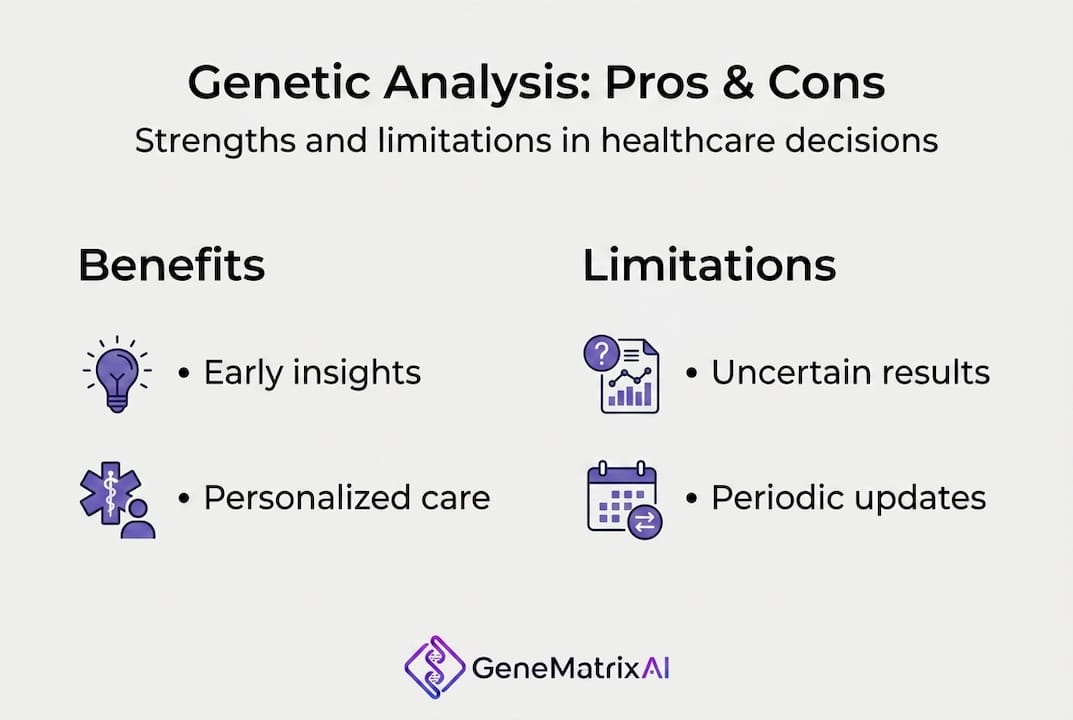
Genetic profiling offers real, measurable advantages for proactive health management. But being informed means knowing exactly where current technology excels and where it still has gaps.
Benefits you can count on:
- Early detection of hereditary cancer risk before symptoms appear
- Personalized screening schedules based on your actual biology, not population averages
- Precision drug dosing that reduces adverse reactions and increases effectiveness
- Ongoing support from AI tools that cross-reference your profile against the latest evidence
Limitations to understand:
- VUS findings create anxiety without clear guidance, and reclassification can take years
- Access and cost remain barriers, though coverage is expanding across insurance plans in 2026
- Recommendations evolve as science advances, meaning a finding classified today may be reinterpreted later
- Rare variants in underrepresented populations may have less supporting evidence in current databases
One practical decision many patients face is choosing between genotyping and full sequencing. Genotyping is faster and cheaper but only examines known sites, while full sequencing captures all variation. For standard hereditary cancer panels and pharmacogenomics, targeted testing is often the right starting point. Long-read sequencing becomes important when a complex structural variant or a rare cancer gene is suspected.
"Genotyping is quick and cost-effective for most clinical needs, but long-read sequencing is necessary for complex cancers and edge cases where precision can't be compromised."
For a step-by-step breakdown of how to choose and prepare for screening, the practical genetic screening guide is worth reviewing before your appointment.
Why most people misunderstand what genetic analysis can (and can't) do
Armed with an understanding of both strengths and limits, here's a deeper look at what really matters when you interpret your results.
Here's something the genetic testing industry doesn't say loudly enough: a pathogenic variant is not a diagnosis. It's a probability signal. BRCA1 carriers have a significantly elevated lifetime risk of breast cancer, but many will never develop it. The variant changes your odds. It does not write your future.
The second misunderstanding is treating your genetic profile as a one-time event. Genomic science is moving fast. Variants classified as uncertain today may be reclassified as pathogenic within two years. AI-powered genomics platforms that update interpretations as new data emerges are not a luxury. They're the standard of care you should expect.
The third and most costly mistake is buying a test without expert follow-up. Raw data without clinical context can mislead rather than guide. The most valuable part of genetic profiling isn't the sequencing. It's the expert interpretation that connects your specific variants to your specific health plan. Advocate for that partnership. Ask for updates. Make your profile a living document, not a one-time purchase.
Unlock next-level personalized healthcare with Gene Matrix
If you're ready to move from questions to concrete health actions, Gene Matrix was built for exactly this step.

Gene Matrix is a Chicago-based, CLIA-certified biotechnology company using an AI platform trained on 500,000 or more genetic profiles to deliver actionable genomic insights within 72 hours. Whether your focus is hereditary cancer testing for BRCA or Lynch syndrome, or drug-gene interaction analysis through GenePGx, the platform turns raw sequence data into personalized care recommendations. The GeneMatrix AI app keeps your profile current as new research emerges, and every report is backed by rigorous genetic testing science. Precision medicine starts with the right partner, not just the right test.
Frequently asked questions
What is the difference between targeted genotyping and whole-genome sequencing?
Targeted genotyping is faster and more affordable because it examines specific known genetic sites, while whole-genome sequencing captures all variation across your entire genome for broader clinical insight.
How accurate are modern genetic tests for cancer risk and drug response?
Long-read sequencing benchmarks show F1 scores above 99% for SNV detection in complex regions, and AI-powered variant callers further improve accuracy for drug-related variants that older tools often missed.
Can I change my health plan based on my genetic results?
Yes, your medical team can use your profile to personalize screening timelines or medication choices. Findings like BRCA1 positive prompt earlier MRI surveillance, while DPYD variants trigger chemotherapy dose adjustments before treatment begins.
What does a variant of uncertain significance mean?
A VUS means current evidence isn't strong enough to classify the variant as either harmful or harmless. Uncertain variants require future evidence to reclassify, so monitoring and periodic check-ins with your genetic counselor are important.
Is all genetic profiling data kept up to date with new science?
Leading providers update test interpretations as new research emerges, but you should ask your provider specifically how and when reclassifications are communicated. Interpretation updates are essential as the field advances, and staying proactive ensures you benefit from new findings.