

TL;DR:
- AI-powered personalized medicine uses machine learning and genomic data to tailor diagnosis and treatment to each individual’s unique biology. It integrates multimodal data such as genomics, imaging, and wearables to generate actionable clinical insights, accelerating drug discovery and optimizing real-time decision-making. This technology is transforming healthcare by shifting from population averages to precise, patient-specific interventions and diagnostics.
AI-powered personalized medicine is defined as the use of machine learning algorithms and genomic analysis to tailor diagnosis, drug selection, and treatment plans to each patient's unique biological profile. The industry standard term is precision medicine, and understanding how AI supports personalized medicine means understanding how it processes data no human clinician could analyze alone. AI now integrates genomic sequences, electronic health records (EHRs), imaging results, and real-time wearable data to generate treatment recommendations that population-level statistics simply cannot produce. Genematrix, operating from Chicago with a CLIA-certified lab and a platform trained on 500,000+ genetic profiles, represents exactly where this technology stands in 2026: deployable, clinically actionable, and measurably better for patients.
How AI supports personalized medicine through data integration
The role of AI in personalized medicine begins with a data problem that would be impossible to solve manually. A single patient generates genomic sequences, proteomic markers, imaging scans, prescription histories, and continuous wearable signals. No physician can synthesize all of that in a 20-minute appointment.
AI platforms address this through multimodal data fusion. Multimodal data integration enables systems-level insights for individualized treatment, meaning AI does not just read one biomarker in isolation. It identifies patterns across data types simultaneously, the way a conductor hears every instrument rather than one at a time.
The data types AI currently processes for personalized treatment plans include:
- Genomics and pharmacogenomics: Variants in genes like BRCA1, BRCA2, and CYP2D6 that affect cancer risk and drug metabolism
- Proteomics and metabolomics: Protein expression and metabolic signatures that reveal disease activity
- Electronic health records: Diagnosis history, lab trends, and medication responses over time
- Medical imaging: Radiology and pathology scans interpreted through computer vision models
- Wearables and digital biomarkers: Continuous glucose monitors, ECG patches, and sleep trackers feeding real-time physiological data
- Lifestyle and environmental inputs: Diet, activity levels, and geographic exposure data
The critical insight here is that systems-level biological insights matter far more than any single biomarker. A BRCA1 variant means something different in a patient with a specific inflammatory profile, a particular medication history, and a high-stress lifestyle. AI connects those dots. Without integration, you get a data point. With it, you get a clinical decision.
Pro Tip: When evaluating any AI-driven precision medicine platform, ask specifically whether it performs multimodal data fusion or simply analyzes one data type. The difference in clinical output is substantial.
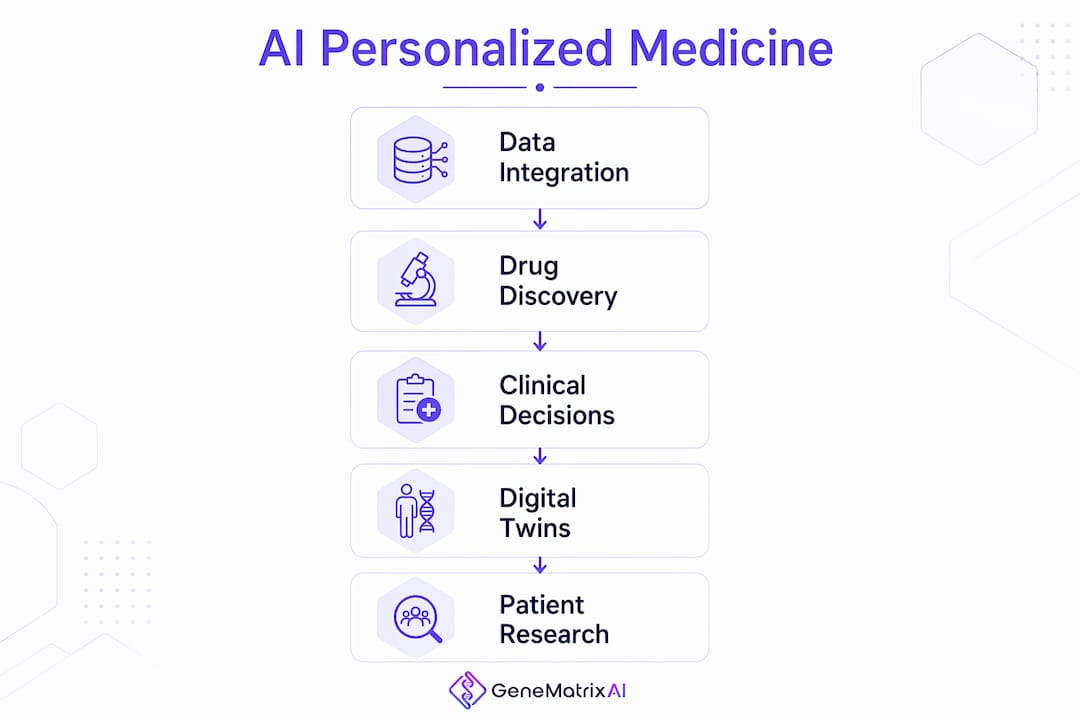
How does AI accelerate drug discovery and clinical trials?
Traditional drug development is a slow, expensive process. Drug development takes 10 years and costs $2.6 billion on average per approved therapy. That timeline means patients with rare diseases or aggressive cancers often run out of time before a treatment reaches them.

AI compresses this timeline by modeling molecular interactions computationally before any lab synthesis occurs. Machine learning for medicine allows researchers to screen millions of molecular candidates against a target protein in days rather than years. Compounds that would fail in phase II trials get flagged early, saving resources and redirecting effort toward candidates with genuine efficacy signals.
The impact on clinical trials is equally significant. AI enables instant patient-trial matching based on genetic profiles, which solves one of the most persistent bottlenecks in drug development: finding the right patients fast enough. Manual matching requires coordinators to review thousands of records. AI does it in seconds.
Here is how AI reshapes the drug development pipeline step by step:
- Target identification: AI scans genomic databases to find disease-driving proteins and pathways
- Compound screening: Generative models propose novel molecular structures optimized for the target
- Toxicity prediction: AI flags compounds likely to cause adverse reactions before animal studies begin
- Patient stratification: Genetic and biomarker profiles segment trial populations to identify who will respond
- Trial matching: Patients are matched to relevant global trials based on their molecular profile in real time
- Outcome prediction: AI models forecast trial endpoints, helping sponsors allocate resources efficiently
| Stage | Traditional approach | AI-assisted approach |
|---|---|---|
| Target identification | Years of literature review | Weeks using genomic AI models |
| Compound screening | Thousands of physical assays | Millions of virtual simulations |
| Patient matching | Manual record review | Automated genomic profile matching |
| Toxicity prediction | Late-stage animal studies | Early computational flagging |
| Trial duration | 6 to 10 years average | Projected reduction of 30 to 50% |
The AI healthcare diagnostics platform space has matured enough that these capabilities are no longer theoretical. They are being deployed in oncology, rare disease research, and cardiovascular medicine right now.
What AI-driven tools support real-time clinical decision-making?
The role of AI in personalized healthcare at the point of care is best understood as a co-pilot model. AI does not replace the physician's judgment. It surfaces information the physician would otherwise miss or take hours to retrieve.
Clinical decision support systems now operate in real time during patient encounters. AI flags genetic variants affecting drug metabolism, allowing immediate treatment adjustments before a prescription is written. This is genotype-guided dosing in practice: a patient with a CYP2C19 poor metabolizer variant receives a clopidogrel alternative automatically flagged in the EHR, preventing a therapeutic failure that would have gone undetected under standard prescribing.
Key clinical applications of AI-powered decision support include:
- Adverse drug reaction prevention: AI cross-references a patient's pharmacogenomic profile against a proposed medication before dispensing
- Oncology treatment selection: Tumor genomic sequencing feeds AI models that rank therapies by predicted response rate
- Chronic disease monitoring: Continuous glucose and cardiac monitors feed AI algorithms that detect deterioration before symptoms appear
- Psychiatric medication optimization: Genotyping for psychiatric drug metabolism guides antidepressant and antipsychotic selection, reducing trial-and-error prescribing
- Virtual triage: AI virtual triage systems reached 94% diagnostic accuracy in high-volume clinical settings in 2026, improving care efficiency at scale
An AI system analyzing pharmacogenomic data achieved 91.9% accuracy in extracting clinically relevant drug-gene interaction data across peer-reviewed literature. That level of accuracy means fewer medication errors and faster reporting for clinicians managing complex polypharmacy cases.
Pro Tip: For patients managing multiple chronic conditions, ask your physician whether their EHR system includes pharmacogenomic decision support. If it does not, a standalone drug-gene interaction test can provide the same safety layer independently.
How is AI enabling the future of precision medicine?
The most forward-looking applications of AI in precision medicine move beyond population-level data entirely. Two concepts define this frontier: medical digital twins and N-of-1 studies.
A medical digital twin is a virtual model of an individual patient, built from their genomic data, imaging results, physiological measurements, and health history. Virtual patient models guide therapy adjustments by simulating how a specific patient will respond to a treatment before it is administered. For a cancer patient considering two chemotherapy regimens, a digital twin can predict which will shrink the tumor more effectively and which will cause intolerable toxicity, based on that patient's unique biology rather than a clinical trial average.
N-of-1 studies take individualization even further. Generative AI now enables patients to run personal health experiments using high-frequency wearable data and federated AI models. A patient with treatment-resistant migraine can systematically test dietary, pharmacological, and behavioral interventions on themselves, with AI analyzing the results to identify what actually works for their specific physiology. This is citizen science at the clinical level.
| Concept | What it does | Best suited for |
|---|---|---|
| Medical digital twin | Simulates patient-specific treatment responses before intervention | Oncology, surgical planning, chronic disease |
| N-of-1 AI study | Runs personalized experiments using individual patient data | Rare diseases, treatment-resistant conditions |
| Population AI models | Identifies patterns across large cohorts to guide general protocols | Drug development, public health policy |
| Multimodal AI integration | Fuses genomic, imaging, and wearable data for a full patient profile | Preventive care, complex comorbidities |
The economic dimension matters here. Patients acting as citizen scientists shifts data ownership and generates insights that pharmaceutical companies and health systems cannot produce through conventional trials. This is not a distant possibility. It is happening now, and it will accelerate as wearable sensors become cheaper and AI models become more accessible.
Regulatory frameworks, however, have not kept pace. AI platforms face a regulatory gray zone as device and drug approval processes remain fragmented, complicating lifecycle oversight of AI tools. For patients and clinicians, this means evaluating platforms based on clinical validation evidence and lab certification rather than regulatory approval alone.
Key takeaways
AI supports personalized medicine by integrating genomic, clinical, and real-time patient data to generate treatment recommendations that are specific to each individual's biology, not population averages.
| Point | Details |
|---|---|
| Multimodal data integration | AI fuses genomics, EHRs, imaging, and wearables to build a complete patient profile. |
| Drug discovery acceleration | AI reduces a 10-year, $2.6 billion process by modeling molecular interactions and matching patients to trials instantly. |
| Real-time clinical decision support | Genotype-guided dosing and adverse reaction flagging prevent medication errors at the point of care. |
| Medical digital twins | Virtual patient models simulate treatment responses before any real intervention occurs. |
| N-of-1 patient science | Generative AI enables individuals to run personalized health experiments using their own continuous data. |
Why AI in precision medicine is more nuanced than the headlines suggest
I have spent years watching the precision medicine space generate enormous excitement and, periodically, enormous disappointment. The pattern is consistent: a breakthrough AI model performs brilliantly in a research setting, then struggles when deployed in a real hospital with messy EHR data, undertrained staff, and regulatory uncertainty.
The honest framing is this: AI augments clinical expertise rather than replacing it. The physicians I find most effective with AI tools are not the ones who trust the algorithm blindly. They are the ones who understand what the model was trained on, where its confidence intervals break down, and when to override it. That requires training that most health systems are not yet providing at scale.
Workforce training and real-world trials remain the unglamorous bottleneck between what AI can do in a lab and what it actually delivers in a clinic. The technology is ready. The infrastructure around it is catching up.
What I find genuinely exciting is the patient empowerment angle. The benefits of AI-powered genomics are no longer confined to academic medical centers. Platforms like Genematrix's GeneMatrixAI are putting pharmacogenomic and hereditary cancer insights in the hands of community physicians and their patients within 72 hours. That is the shift that matters most: moving precision medicine from a research privilege to a clinical standard.
The regulatory and data standardization challenges are real, and they will slow adoption in some markets. But the direction is irreversible. AI will not make medicine fully personalized overnight. It will do it one data point, one patient, one clinician at a time.
— Tarek
Genematrix brings AI-powered precision medicine to your practice

Genematrix delivers exactly what this article describes: AI-driven genomic analysis that integrates pharmacogenomics, hereditary cancer risk, and personalized wellness data into reports your clinical team can act on within 72 hours. The GeneMatrixAI platform is trained on 500,000+ genetic profiles and covers specialized modules including GeneCancer, GenePGx, GeneMind, GeneBaby, and GeneDiet. Whether you are a physician managing complex medication regimens or a patient seeking clarity on hereditary cancer risk, Genematrix translates raw genomic data into decisions. Explore hereditary cancer genetic testing and see how precision medicine works in practice, not just in theory.
FAQ
What is the role of AI in personalized medicine?
AI processes genomic, clinical, imaging, and wearable data simultaneously to generate individualized treatment recommendations. Its core function is identifying patterns across data types that no single clinician could synthesize manually.
How does AI improve diagnosis accuracy?
AI virtual triage systems have reached 94% diagnostic accuracy in high-volume clinical settings, and pharmacogenomic AI achieves 91.9% accuracy in extracting drug-gene interaction data. Both figures reflect AI's ability to reduce diagnostic error when integrated with clinical workflows.
What is a medical digital twin?
A medical digital twin is a virtual model of an individual patient built from their genomic, physiological, and clinical data. It simulates how that specific patient will respond to a treatment before any real intervention occurs, reducing trial-and-error in complex cases.
Can patients use AI for their own health research?
Yes. Generative AI now enables N-of-1 studies where patients run personalized health experiments using continuous wearable data and federated AI models. This approach is particularly valuable for rare diseases and treatment-resistant conditions where population-level data offers limited guidance.
How does AI support pharmacogenomics?
AI flags genetic variants that affect how a patient metabolizes specific drugs, enabling genotype-guided dosing at the point of care. Platforms like Genematrix's GenePGx module deliver these insights within 72 hours, helping clinicians avoid adverse reactions before a prescription is written.